What changed at the Allen Telescope Array?
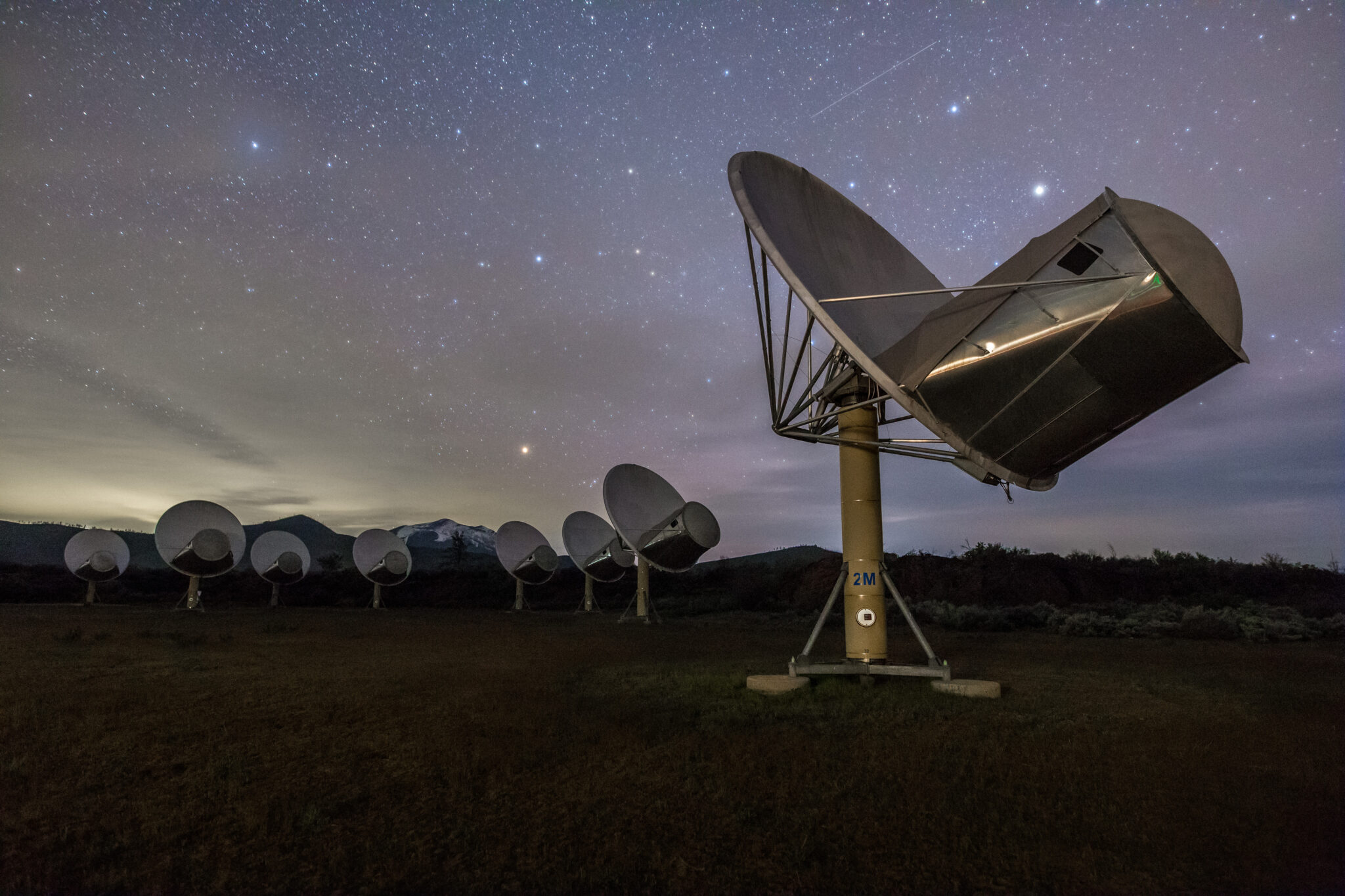
Nvidia published an account of new AI operations at the Allen Telescope Array on October 30. The SETI Institute and Breakthrough Listen have folded agentic software into daily work at the array. The instrument sits at the Hat Creek Radio Observatory in Northern California, about 300 miles north of San Francisco.
In Nvidia's description, a researcher types a request. Software then plans the observation, moves the antennas, corrects incoming data, and runs models against the signal stream. Nvidia calls the orchestrator Nexus. It is a web-based control layer that acts as a harness for AI agents.
According to the company, Nexus gives agents a single source of truth for instrument state, compute resources, and processing pipelines. Operators can watch packet loss, read live spectrograms, and rewrite signal-processing blocks by prompting in plain language.
Three pieces do the heavy lifting beneath Nexus. Holoscan, Nvidia's sensor-processing platform, moves data from the telescope into GPU memory. A Holoscan library called DAQIRI is built to pull terabits per second straight into the GPU. That lets the system process observations in flight instead of filling hard drives.
CyberEther, a signal-processing framework developed at the SETI Institute, handles the math using Nvidia's cuFFT and cuBLAS libraries. Inference runs on premises, next to the instrument, on RTX PRO 6000 Blackwell GPUs. Nvidia says the system can handle 2.4 terabits per second. That figure describes the pipeline's capacity, not everything the array currently collects.
The telescope itself is modest by modern standards. It has 42 dishes, each 6 meters wide, with a tuning range of 1 to 14 gigahertz. It can form three simultaneous beams and listen to 72 million one-hertz channels at once, according to the SETI Institute. Those numbers explain why the data problem is severe. A single observation can generate more raw data than a team can reasonably store.
Andrew Siemion, the Bernard M. Oliver chair for SETI at the SETI Institute and principal investigator of Breakthrough Listen, framed the shift in unusual terms. He said future observatories may find things with “much more in common with themselves than with the humans who created them.” He described that prospect as “a breakthrough in translation” rather than a threat.
How do AI agents run an observation?
The workflow Nvidia describes is broader than a single automated script. An agent can point the array and calibrate it for a clean signal. It can also catch and repair data errors, then plot the result. Each step used to require a different tool and a human who knew how to chain them together. Nexus is meant to collapse that chain into one request and one shared view of the system.
Latency is the reason the compute sits at the telescope. Data that travels to a distant cloud region and back adds delay. The agent cannot react while the observation is still running. Processing in flight also avoids the cost of storing raw voltages or spectra that may never be examined. The trade-off is that decisions about what to keep must be made immediately.
None of this makes the observatory fully autonomous. The Decoder reported on November 3 that researchers still type in their commands for now. Nvidia's account also describes monitoring and prompting rather than unattended operation. The agents are best understood as a control layer. They choose and sequence steps, but they do not replace the science team.
That distinction matters for how the result should be judged. A human still sets the goal and checks the output. The software handles the plumbing between those points. In practice, the agent is an interface to the instrument and its processing graph, not an independent investigator.
Why does SETI need AI to sift radio signals?
The case for AI at a radio telescope starts with volume and interference. The array's 72 million channels are designed to catch narrowband signals, the kind that technology might produce. Most of what those channels record comes from people: satellites, ground-based transmitters, and other human equipment. Separating a faint cosmic signal from that noise is the central technical problem in radio SETI.
Antenna arrays help. The SETI Institute notes that multibeam instruments can distinguish signals arriving from the sky from interference picked up locally or from orbit. Software still has to classify what remains, and the classes are not always obvious. A signal may drift in frequency, pulse at a steady rate, or appear in only one beam. It could be natural, human, or something else.
SETI has been chasing that distinction since Project Ozma in the spring of 1960. Frank Drake used an 85-foot telescope at the National Radio Astronomy Observatory in Green Bank, West Virginia. He listened around 21 centimeters toward Epsilon Eridani and Tau Ceti. He found no compelling evidence, though he briefly mistook terrestrial interference for a detection.
Modern programs are vastly more capable. Breakthrough Listen is a 10-year, $100 million effort. It surveys the million closest stars, the galactic center and plane, and the 100 closest galaxies, according to Breakthrough Initiatives. No technosignature has been confirmed in the decades since Project Ozma. That record is the context for any claim about AI improving the search. Better tools can widen the search or reduce false positives, but they do not change the underlying odds.
The Decoder made the point plainly. Researchers have been looking since 1960, and no one has found anything yet. An AI system that runs faster does not shorten that wait unless it also finds signals that older methods missed.
What did the Crab Nebula pulsar test actually prove?
The concrete result Nvidia cites is a pulsar in the Crab Nebula, detected in real time by the AI pipeline. Nvidia calls it the first real-time AI detection of a pulsar. A pulsar is a rapidly spinning neutron star that sweeps a beam of radiation across space. It produces regular pulses when the beam crosses Earth. The Crab pulsar is a well-known natural object, not a candidate signal from another civilization.
That makes it a useful test case rather than a discovery. A pulsar exercises the same chain an SETI search needs. The system must point the array, calibrate the band, and remove interference. It must also recognize a weak periodic signal while the observation is still underway. If the pipeline can do that in real time, it can plausibly help with other kinds of signal detection.
The Crab pulsar is bright and well studied. That makes it a fair first target and an easy one to verify. It is also a forgiving one. A pipeline that works on a strong, known source may still struggle with the faint, uncertain signals that SETI actually seeks.
The claim still needs scrutiny. Neither Nvidia's post nor the coverage reviewed for this article links to a peer-reviewed methods paper. There are no published detection rates, false-positive counts, or comparisons against the array's conventional pipeline. The Decoder attributes the result to the team, and Nvidia presents it in a product blog. That does not make the detection false, but readers should treat it as a vendor-reported result.
What would strengthen it? A published description of the model and its training data. A measured false-positive rate on known signals. A side-by-side test against the existing software chain. Those numbers would show whether the agent is faster because it is better. They would also reveal shortcuts that a human reviewer would catch.
What are the limits of Nvidia's claims?
The most important limitation is who is telling the story. Nvidia sells the GPUs, the Holoscan platform, and the inference stack involved. Its blog is a case study, not an independent evaluation. The line that agents compress work which would take humans weeks or years into hours has no stated baseline. Readers are not told which task, which previous workflow, or how success was measured. The Decoder repeats the claim but attributes it to the team.
The 2.4 terabits per second figure needs the same care. It is a throughput number for the processing pipeline, and throughput is not the same as scientific accuracy. A system can move data quickly while missing rare signals, especially signals that do not resemble anything in its training set. SETI's target is, by definition, unknown. A classifier trained to reject radio-frequency interference may also reject a genuine technosignature that looks unfamiliar.
Nvidia also does not name the model currently doing the orchestrating. The blog says the team is evaluating open models, including Nvidia's Nemotron, for cases where data locality and turnaround matter most. That suggests the production setup and the next setup may differ. Model choice matters for reproducibility. An agent that rewrites signal-processing blocks can change results in ways that are hard to audit unless every step is logged.
Then there is the lunar framing. Nvidia says open models are being considered for observatories that may someday run offline on the far side of the Moon. That is a reasonable long-term motivation for local inference. It is not a funded mission or a demonstrated capability. It should be read as a design goal, not a result.
Finally, autonomy cuts both ways. Letting software reconfigure a telescope is powerful, and it moves risk into software. An agent that misjudges calibration or filters out an unusual signal can waste observing time or lose data. The human-in-the-loop detail reported by The Decoder is therefore reassuring, but it also limits the speed advantage. The system is not yet a self-driving observatory in the sense the phrase implies.
What happens next for AI in radio astronomy?
The immediate next step is a broader test of open-weight models. Nvidia says Nemotron is being evaluated where data locality and fast turnaround matter. The Decoder reports that the team wants models which can run locally at the edge. The goal is to support future sensors on the far side of the Moon. If those tests are published, they will show whether the approach depends on Nvidia's proprietary stack or can travel to other instruments.
Radio astronomy is moving in a direction that favors this kind of computing. Arrays are becoming more data-intensive, and storage is expensive. Processing at the edge, close to the sensors, is becoming a standard design choice. The Allen Telescope Array deployment is an early example in a scientific setting. HPCwire treated it as a workflow worth describing to high-performance computing readers.
The scientific question is whether agentic control improves discovery rates. That will take time and comparison. A telescope that schedules itself more efficiently might simply observe more targets. A telescope that classifies signals more accurately might reduce the follow-up burden. Both are useful, but neither guarantees a detection. The field has learned to be patient about claims that a new instrument will finally find evidence.
Observers should also watch how the software handles failure. Radio telescopes operate in harsh, remote conditions, and instruments drift. An agent that can recover from a dropped packet is useful. An agent that silently compensates for a broken antenna could corrupt a whole campaign. Error handling, not raw throughput, may decide whether these systems earn trust.
Who is affected, and what should you watch?
The people most affected are the scientists and engineers who run observatories. They gain a control layer that can sequence complex tasks, but they also inherit the job of validating it. Funding agencies and taxpayers have an interest in whether expensive instruments are used efficiently. Software vendors have an interest in making their platforms the default for scientific edge computing.
For science, the standard is reproducibility. A result has to be checkable by people who were not in the room. If an AI agent chooses calibration steps and rewrites processing blocks, the observation record must capture those choices in enough detail. Nvidia's description of Nexus as a single source of truth is a promising start. It is not the same as an open audit trail.
The practical test is boring and essential. Can the team show a signal it found with the agent, then find it again with the conventional pipeline? Can it show a signal the conventional pipeline found that the agent missed? Those comparisons will matter more than throughput figures. They will also tell other observatories whether the approach is worth copying.
The bottom line is that this is a real engineering milestone with a narrow, vendor-reported evidence base. AI agents can now participate in the operation of a working radio telescope, and that is notable. It is not evidence of extraterrestrial intelligence. It is not yet proof that AI will make the search faster in any scientific sense. The next peer-reviewed result will be the one to watch.