What did AI super PACs spend in the 2026 midterms?
Leading the Future launched in August 2025 with more than $100 million in commitments and a blunt promise. It would back candidates who favored faster AI development and opposed a growing patchwork of state rules. Andreessen Horowitz, OpenAI president Greg Brockman and Perplexity co-founder Joe Lonsdale supplied early money (CNBC).
The network borrowed tactics from the crypto industry. Fairshake, the main pro-crypto super PAC, spent more than $130 million in the 2024 cycle and won 53 of 58 races (CNBC). Leading the Future was co-led by Josh Vlasto, who worked for Fairshake in the 2024 cycle (CNBC). It built separate Republican and Democratic arms.
The network is not a single committee. It is a group of federal and state super PACs plus nonprofit advocacy arms. American Mission handles Republican races, while Think Big handles Democratic ones (WIRED).
Super PACs can raise unlimited sums but cannot coordinate directly with campaigns. Their spending is reported as independent expenditures, separate from the candidate committees they support.
Federal filings show a large operation that slowed before Election Day. The super PAC registered as Leading the Future reported $76.0 million in receipts through October 14. It had spent $52.2 million and still held $23.8 million in cash (FEC).
The party-facing arms raised and spent comparable sums. American Mission reported $24.0 million in receipts, $19.1 million in disbursements and $4.8 million in cash. Think Big reported $25.0 million in receipts, $23.1 million in disbursements and $1.9 million in cash (FEC).
Most of that money went into primaries. WIRED reported about $26 million in primary independent expenditures and roughly $10 million in the general election. TechCrunch put primary spending at $27.38 million. The network still had just over $20 million left after the vote (WIRED).
The early record looked stronger. In March, three candidates backed by more than $500,000 each from American Mission won their Republican primaries. They were Jessica Steinmann and Chris Gober in Texas and Laurie Buckhout in North Carolina (CNBC). Those results supported the network's bet that primaries were the efficient place to spend.
General-election spending was far smaller than the primary push. CNBC counted about $8 million from pro-development groups and $6.9 million from pro-safety groups through October 20. The industry described the plan as a rerun of the crypto playbook (CNBC).
Which races did the AI industry lose?
The most expensive single bet was South Carolina's Senate race. American Mission put more than $2 million behind Darline Graham, the sister of the late senator Lindsey Graham (WIRED). TechCrunch counted a second PAC, Building the Future, and put the combined support at $4.8 million.
Graham lost to Democrat Annie Andrews with 46.5 percent of the vote (WIRED). Andrews had branded her “Data Center Darline” over her support for AI and data center expansion. South Carolina had not sent a Democrat to the Senate since 1998 (WIRED).
Andrews had called for a two-year moratorium on new data center projects (TIME). The race became a statewide test of whether open support for the industry could survive a general election.
Two House races followed the same pattern. American Mission spent more than $500,000 each on Aaron Flint in Montana and Laurie Buckhout in North Carolina (TechCrunch). Flint conceded to Democrat Sam Forstag, though the Associated Press had not called the race (WIRED). Buckhout won her Republican primary in March (CNBC) and lost the general election to Democrat Don Davis (WIRED).
New York's 12th District hosted the cycle's largest AI spending battle. Think Big spent $8.3 million trying to defeat assembly member Alex Bores, who wrote a state AI safety law (CNBC). A rival group spent about $15 million supporting him. Bores lost to Micah Lasher, 39 percent to 35 percent (CNBC).
WIRED and CNBC describe that pro-Bores spending differently. WIRED attributed the $15 million to Public First, an Anthropic-backed group. CNBC attributed the same figure to Jobs and Democracy PAC.
Florida's 25th District showed both machines at work. Think Big spent $310,000 supporting Democrat Jared Moskowitz (CNBC). Defending Our Values, a pro-safety PAC, spent almost $857,000 boosting Republican Scott Singer and another $740,000 against one of his primary rivals. Moskowitz still won the general election by about 13,000 votes (WIRED).
Pro-safety groups also claimed wins in Michigan, Colorado and Wisconsin (TIME). Their candidates included Abdul El-Sayed, Manny Rutinel and Rebecca Cooke.
The industry's wider political spending fared no better. Elon Musk was the cycle's biggest donor at $446 million, including $168 million tied to supporting Ken Paxton in Texas (TIME). Paxton lost to James Talarico.
Why did Leading the Future hold back in the general election?
Leading the Future told TechCrunch that primaries offer better returns. Early money can build name recognition and push a candidate toward an AI policy agenda. By November, many of its preferred candidates were running in safe seats.
WIRED reported that the donations went overwhelmingly to safe candidates. In the handful of competitive races the network entered, results were poor. A win rate measured across all races can therefore hide a weak record in the contests that mattered.
The retreat was visible in the filings. American Mission and Think Big together held under $7 million in cash on October 14, after spending most of what they raised (FEC).
Fundraising also became harder. The network reported zero donations in the second and third quarters of 2026 (WIRED). Brockman and investor Ron Conway backed away from previously promised donations as public skepticism grew (TIME).
Guardrails Alliance political director Charlie Blaettler offered a blunter explanation. He said the network did not want its money to become an issue in competitive races. “They don't want their money to become an issue in these elections,” he told TechCrunch.
The advertising strategies diverged. Blaettler said Leading the Future's ads rarely mentioned AI and instead focused on issues that polled well for each candidate. Guardrails Alliance built its message around who was taking AI money, turning a spending fight into a local trust issue (TechCrunch).
Polling helps explain the caution. One survey cited by TIME asked voters about AI super PAC money. Three-quarters of likely voters said they would be less likely to support a candidate who took it. That is not a result, but it is a signal about the cost of visible industry backing.
Who is spending against the AI industry?
The main counterweight came from Anthropic. The company contributed more than $40 million to Public First Action, an advocacy group focused on AI safeguards (TIME). CNBC reported two $20 million commitments, one in February and one in July.
Anthropic says the money is restricted to policy and public education and cannot fund candidate elections (CNBC). Super PACs allied with the group handle the campaign spending. Public First spent about $15 million supporting Bores (WIRED). It also contributed $3 million to a PAC supporting California state senator Scott Wiener (TechCrunch).
Guardrails Alliance took a more confrontational approach. The group spent more than $1 million each opposing California representative Jimmy Gomez and Montana's Aaron Flint (TechCrunch). It also spent $300,000 supporting Angela Gonzales-Torres, who defeated Gomez.
Both camps reject the idea that they oppose regulation outright. Bruce Freed of the Center for Political Accountability told CNBC that “everyone supports some form of regulation.” The argument, he said, is about how much. The spending, he added, is about being “in the driver's seat”.
Blaettler described his own strategy in one line. “Our goal is to make AI money politically toxic,” he told TechCrunch.
The pro-safety side did not sweep either. Public First backed several Republicans who lost, while its Democratic candidates fared better (TechCrunch). Its co-founder, Brad Carson, called the results “a crushing blow” to the industry's anti-regulatory effort (WIRED).
Why did voters punish data centers?
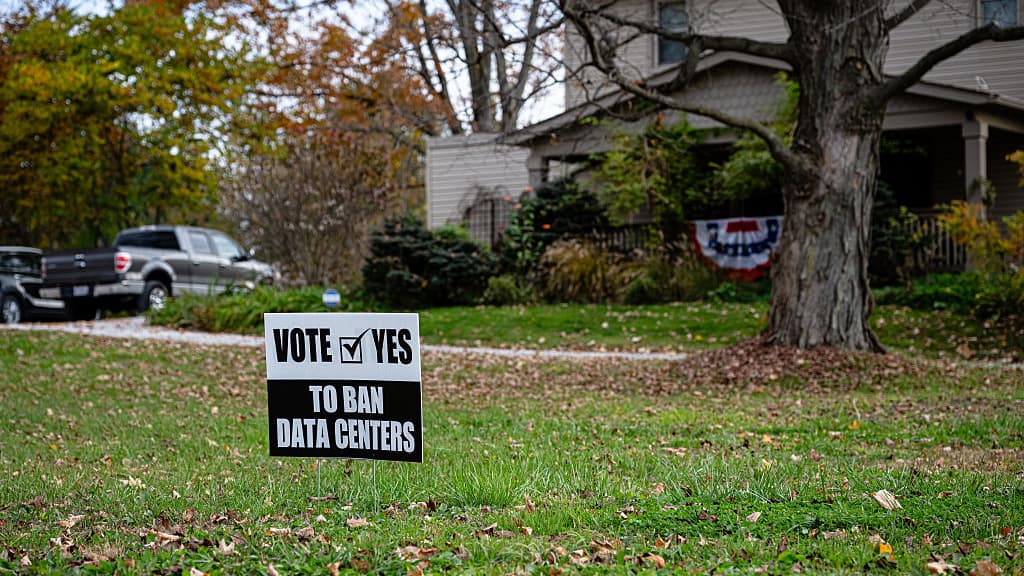
The common thread in the results was local opposition to data centers, not AI models. An NBC exit poll asked voters what shaped their congressional vote. Fifty-six percent called AI and data centers a crucial or major factor (TIME).
The backlash appeared on local ballots. Counties from Edgewater, Florida, to Bloomington, Illinois, passed data center bans or moratoriums (TIME). The mayors of Piqua, Ohio, and Yukon, Oklahoma, were recalled over their support for projects.
Data centers ranked below other unpopular neighbors in comparative polling. Blue Rose Research compared them with other unwanted local facilities. It found Americans would rather live near a prison, a methadone clinic or a nuclear power plant (TIME). Higher energy bills, noise and water use were more salient than abstract AI risk.
Other polling pointed the same way. An October Politico poll found nearly half of Americans saw Republicans as the party most eager to build data centers (TIME). Blue Rose Research found opinion had soured among voters of both parties.
The discontent was broader than AI. Energy bills, noise and land use drove local votes, and those concerns crossed party lines (TIME).
Democratic candidates leaned into the issue. The party spent more than $100 million on broadcast ads tying Republicans to Big Tech and data centers (TIME). Sherrod Brown won Ohio's Senate race by five points. He had called his opponent the face of data centers in the state (TIME).
The issue cut against both parties. In Wisconsin, Republican Tom Tiffany derisively called his opponent “Data Center David Crowley” (TIME). Crowley shifted toward tighter restrictions in October and won.
The Ohio race drew millions of dollars in ads on the issue (TIME). The National Republican Senatorial Committee acknowledged the problem in an August memo, calling data centers “the anchor hanging around Husted's neck.”
Deepfakes were a secondary concern. Maine's Troy Jackson won by more than seven points after fake videos circulated (TIME). Wisconsin's Derrick Van Orden posted deepfakes of his opponent and lost. Neither example supports a claim that synthetic media decided races.
What happens to AI regulation now?
The immediate fight is over federal preemption. The two camps disagree on whether Congress should pass a national AI framework that overrides state laws (TechCrunch). The industry wants uniform rules, while safety groups want states to keep their authority.
The midterms were partly a proxy fight over that question. State legislators face no presidential veto and can move faster than Congress.
A sweeping federal law remains unlikely. Democrats won both chambers, but they need Republican support to overcome a presidential veto (TIME). That math limits what can pass before 2028.
Oversight is a more immediate threat. Democrats have promised hearings with tech executives, and Senator Ron Wyden signaled the tone with a one-word post: “Subpoenas” (WIRED). Committees can compel testimony and documents even when legislation stalls.
The 2028 cycle is already on the calendar. Leading the Future told TechCrunch it plans to stay involved. Guardrails Alliance says it will keep opposing industry-backed candidates.
Both sides also have to explain what their money bought. The network ended with more than $20 million in the bank (WIRED). Its record in the races that drew national attention was mixed.
What are the limits of the evidence?
The results do not prove that spending backfired. 2026 was a Democratic wave, and most voters were responding to several issues at once. Analysts cannot isolate the effect of a single ad or donation.
Spending also does not equal votes. A group can claim victory when its candidate wins a safe seat it did not affect. The useful test is the competitive races, where both sides spent and the result was in doubt.
The spending figures are also incomplete. FEC totals run through October 14 and exclude nonprofit advocacy spending that never appears in campaign filings. Independent expenditures are reported on separate schedules, and the final pre-general reports will change the picture.
Newsrooms counted differently. WIRED attributed more than $2 million to American Mission's support for Graham, while TechCrunch attributed $4.8 million to two PACs. Primary totals ranged from about $26 million to $27.38 million.
Both figures may be accurate. One counts a single committee's contribution; the other counts two allied committees.
The $100 million figure is an announced pledge, not a single account balance. The main super PAC reported $76 million in receipts. Affiliated committees raise and transfer money separately, so the numbers should not be added together.
Some races were also still uncalled when the first analyses appeared. That includes the Montana House race, where Flint conceded but the AP had not declared a winner (WIRED).