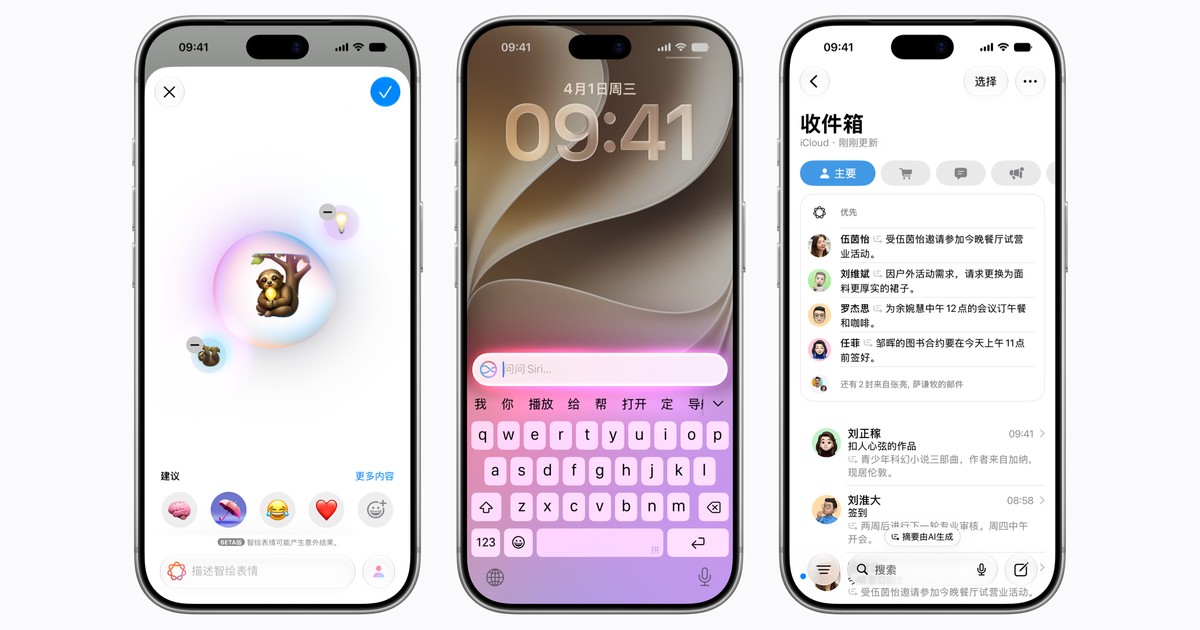
What did Apple announce for China?
Apple published the launch announcement on its Chinese newsroom on 31 October. The first batch of Apple Intelligence features will reach iPhone users in China. Apple presented the release as a first step rather than a complete rollout.
Developer testing starts on 4 November with the latest iOS developer beta. The public release follows in December with iOS 27.3.
The features cover everyday tasks. Real-time translation works in Messages, FaceTime and Phone, and face to face through supported AirPods. Writing Tools can rewrite, proofread and summarise text.
Visual Intelligence reads the world through the camera. Clean Up removes unwanted objects from photos while keeping the look of the original shot, according to Apple. Genmoji turns a text prompt into a custom emoji.
Photos gain natural-language search and memory movies. Email gains a priority inbox section, one-tap summaries and smart replies. Notifications gain summaries, priority alerts and a reduced-interruptions focus mode.
Notes can summarise audio transcripts, and the Phone app can summarise call transcripts. Siri gains Type to Siri, which accepts typed requests and keeps context across a conversation.
The rollout starts on the iPhone only. Apple says iPad, Mac and other platforms will follow after the necessary approvals.
Supported phones are the iPhone 15 Pro, iPhone 15 Pro Max, iPhone 16 and later, iPhone Air and iPhone Duo. Siri and the device language must both be set to English or Simplified Chinese.
Live translation through AirPods needs recent hardware and the latest firmware. Apple lists AirPods 5, AirPods 4 with active noise cancellation, AirPods Pro 2 or later, and AirPods Max 2.
The wording of the release matters. Apple calls these the first core features, which leaves room for more once further approvals arrive. The company has not said what the next batch will contain.
Which Apple Intelligence features are missing in China?
Apple’s Chinese release states that the update excludes Siri AI. It also leaves out the other next-generation Apple Intelligence features announced at WWDC 2026. MacRumors reported that Image Playground is also absent.
The omission matters because Siri AI is the centrepiece of Apple’s AI push elsewhere. Apple launched Siri AI in September as “an entirely new version of Siri”, with personal context, on-screen awareness and app actions.
Siri AI is not a minor upgrade. It began in English and expanded to French, Japanese, Korean, Portuguese and Spanish with iOS 27.2 in late October. Apple says it can draft an email, edit and share photos, and find information in a user’s messages. It can also answer questions about what is on the screen.
Four more languages, including Traditional Chinese, are due by the end of the year, according to 9to5Mac. Siri AI still will not be available in mainland China.
Chinese users instead get the earlier generation. The Verge described the release as covering “several of its earlier Apple Intelligence features”. Those include notification summaries, real-time translation, rewriting, visual intelligence and object removal.
The gap is not cosmetic. Siri AI can recall earlier conversations and act across apps, according to Apple and MacRumors. The China version keeps a more limited assistant with typed input and handoffs to Qwen.
Apple has given no date for Siri AI in China and no explanation beyond the release note. It has also not said whether the feature would need a separate model filing. The release frames the gap as a property of this update, which leaves open the possibility of a later release.
Image Playground is the other clear gap. Apple’s September release described an “all-new Image Playground” that can create photorealistic imagery. That feature is not part of the China launch.
Apple says some features may be limited to certain languages or regions. The final December build could therefore differ from the beta that arrives next week.
How does Alibaba's Qwen fit into Apple Intelligence?
Alibaba’s Qwen model is the local partner in the launch. Apple’s release confirms a partnership with Alibaba and says Qwen will support some Apple Intelligence experiences.
Qwen appears in three places. Siri can hand certain requests to Qwen. The model is also available inside Writing Tools and Visual Intelligence, including text and image understanding.
Users can ask questions about photos and documents, including PDFs and presentations. A creation tool lets Qwen write original content from scratch inside the system-wide Writing Tools.
Access requires signing in to a Qwen account or using Sign in with Apple. Qwen is Alibaba’s international name for the Tongyi Qianwen model family, which appears in the Chinese filing for Apple’s iPhone licence.
Apple is careful to separate the layers. Its release says Apple Intelligence runs on generative models built by Apple. That makes Qwen an add-on for specific tasks rather than the base model.
The structure resembles Apple’s ChatGPT integration in other markets, where users can pass a request to a third-party model. In China, that model is Alibaba’s. The sign-in is the visible link between the two companies.
Reuters reported in August that Apple had trained its own model for China with Alibaba’s support. The report described a “dual-track strategy”. MacRumors, summarising the report, said Apple was the first foreign company approved to offer a proprietary AI model in the country.
MacRumors also summarised the report as a break from Apple’s earlier plan to rely on an existing Chinese model. Apple’s Chinese release now describes both layers: its own models for core features, and Qwen for selected requests.
For Alibaba, the arrangement puts its model inside the default assistant on Apple’s phones. That also ties part of the iPhone experience to Alibaba’s account system.
Apple has kept the partnership low-key. In August it briefly published a support page for Mac users in China. The page explained how to connect Qwen to Siri and Writing Tools, and Apple removed it within a day, MacRumors reported.
How did Apple get approval to launch AI in China?
Two Chinese processes sit behind the launch. One is model filing with the Cyberspace Administration of China. The other is the Ministry of Industry and Information Technology’s network access licence for phones sold in China.
The Paper reported that the CAC published a list of seven filed on-device generative AI services in July. Apple’s model, filed by Apple Technology Development (Shanghai), was registered on 8 July 2026 for use on Apple phones.
A filing covers a named model and a defined use. The registration lists the model and says it is intended for Apple phones. That helps explain why the launch starts with the iPhone rather than every Apple product.
The licence adds model filing numbers to device approvals. The Paper reported that the iPhone Duo, model A3721, completed a licence renewal on 29 September with three filing numbers.
Those numbers cover Apple’s model, Alibaba’s Tongyi Wanxiang and Alibaba’s Tongyi Qianwen. The iPhone 18 Pro series, iPhone 17 Pro series and iPhone Air gained filing numbers on the same day.
The two steps are linked. The filing numbers appear in the device’s network access paperwork, so the software approval travels with the hardware approval.
Tim Cook confirmed the approval in Shanghai on 15 October. The Paper, which interviewed him, reported that he said the first core features had been cleared. He said a test version would arrive later in October, and that Siri AI was not included.
That October target slipped. Apple now says testing starts on 4 November, and 9to5Mac noted that iOS 27.3 had not appeared by the end of October.
Cook’s visit came before iPhone Duo pre-orders. Apple’s first foldable phone launched on 23 October, with the AI filings already attached to its licence.
The filings are the visible part of China’s approval regime. They link a named model and a named company to a device that can be sold. That is why the licence numbers matter as much as the feature list.
Who is affected by the China launch?
Chinese iPhone buyers are the most direct audience. They need an iPhone 15 Pro or newer. Both Siri and the device language must be set to English or Simplified Chinese. The feature set is also smaller than the one available in the United States and other markets.
Travellers and cross-border workers may notice the translation features first. Real-time translation works in calls and messages, and through AirPods in face-to-face conversations.
Developers are the second group. Siri and Writing Tools are system surfaces that many apps rely on, and the Qwen handoff changes what those surfaces can do. Apple’s release does not mention a separate developer API for the China launch.
Alibaba gains a distribution channel on Apple’s flagship devices. Qwen appears inside Siri, Writing Tools and Visual Intelligence, and users sign in with a Qwen account or Sign in with Apple. That ties part of the experience to Alibaba’s account system.
Apple gains a local AI story for the market carrying its iPhone 18 Pro sales. It also keeps the flagship assistant out of a market where regulators vet each model. That limits the risk of a launch that could be pulled.
Competing phone makers are affected too. Counterpoint said higher prices for competing Android flagships helped Apple in China. Local brands now have a clearer comparison point for their own AI assistants.
Regulators in other markets will watch the arrangement. Apple has built a two-model system for one country. Its own models handle core tasks, and a local partner handles extra requests.
Why does China matter so much for Apple right now?
China is the strongest market for Apple’s latest iPhone launch. Counterpoint Research measured combined global sales of the iPhone 18 Pro and Pro Max in their first three weeks. Sales rose 3.1% compared with last year’s launch period.
China sales rose 29%. US sales fell 4%, and Japan fell 27%, according to Counterpoint.
Counterpoint attributed China’s growth to better initial supply and higher prices for competing Android flagships. In the US, it said buyers saw too few changes, despite additions such as the variable aperture camera.
Apple raised US starting prices by $100, to $1,199 for the Pro and $1,299 for the Pro Max. Exchange rates compounded the increase in Japan, Counterpoint said. The Pro Max share of sales slipped from 57% to 56%.
The split matters for the AI launch. China has been carrying the iPhone 18 Pro, yet Apple Intelligence had been unavailable there until this launch. The new features give Apple a local AI story to sell alongside the hardware.
The timing also lines up with the foldable. The iPhone Duo arrived on 23 October, and the AI filings were attached to its licence before launch. Apple is selling its first foldable in the same market where its AI rollout has been delayed.
Counterpoint’s tracking period ended before the iPhone Duo launch, so the early sales figures cover the Pro models only. The firm said it is watching whether the foldable adds buyers or takes sales from the Pro Max.
The risk for Apple is that the China version feels behind. The reward is that the company can sell AI features in the market doing the most work for iPhone 18 Pro sales.
What are the limitations, and what happens next?
4 November is the start of testing, not a public release. 9to5Mac noted that Apple confirmed the date for Apple Intelligence testing in China. That is not necessarily the release date of the first iOS 27.3 beta.
Hardware and language limits apply. Users need a supported iPhone with Siri and the device language set to English or Simplified Chinese. AirPods translation needs recent AirPods and the latest firmware.
Apple has not published accuracy data for the China features. No independent test results are available yet. The company says some features may be limited to certain languages or regions.
Data handling is another open question. Apple’s release explains how users sign in to Qwen. It does not describe how Qwen processes the text, images or documents that users send.
The main unknown is Siri AI. Apple has given no date, and the feature remains the biggest difference between Apple Intelligence in China and elsewhere. Whether it needs a separate filing, a new partner or a different design is unresolved in public.
Watch the iPad and Mac next. Apple says those platforms will follow after the necessary approvals, so the same filing process will set the pace.
Watch Alibaba too. Tongyi Wanxiang, Alibaba’s image model, already has a filing number attached to Apple’s phone licence. Image Playground is still not part of this launch.
Beta software often changes before release, and Apple has not published a final feature list for the December build. The beta is the first chance to test what actually ships in Chinese.
For developers, the open question is whether Qwen handoffs will be consistent enough to build around. Apple has not said whether developers will get a way to call Qwen directly.
December is the date to watch. If iOS 27.3 ships on schedule, Apple will have a working AI stack in the market carrying its iPhone 18 Pro sales. That stack mixes Apple’s own models with a partner’s, and other regulated markets will watch the arrangement closely.