What is Apple's keyboard blocklist?
Apple ships a hidden list inside iOS that tells the keyboard which word sequences it should not suggest. The list is not a ban on writing. It is a filter on autocomplete, predictive text and, for many entries, swipe typing.
Independent researcher Derik Kauffman decoded the English list and published it at swipeblocked.com on 6 November 2026. His site counts 4,513 English phrases, ranging from slurs and drug terms to political slogans and public figures.
Reuters reported the finding the same day and described an undisclosed multilingual gray list of tens of thousands of words and phrases. The Guardian and The Verge published their own accounts within hours. All three trace the underlying research to Kauffman.
Apple stores the data as a table of fingerprints rather than readable text. That design keeps the phrases out of sight for anyone browsing the operating system. It also made the list hard to read without reconstructing it.
The practical effect is narrow but constant. A phrase on the list will not appear as a suggestion, even when it is the obvious next word. Swipe typing may substitute a different word, sometimes an implausible one.
The keyboard reaches hundreds of millions of iPhone users, according to Reuters. A filter that rarely announces itself can therefore shape wording at a scale no single editor could match. That is the core of the concern raised by the researcher and civil liberties groups.
Apple's predictive text is not a simple dictionary lookup. The Guardian noted that Apple introduced a transformer-based autocorrect in 2025, a design closer to a language model. The blocklist sits alongside that system as a fixed rule set, separate from the statistical guessing.
How did Derik Kauffman find the list?
Kauffman is the founder of Blacklight, a startup that uses software to find errors in scientific papers. He told Reuters that he found the list in September 2026 after noticing odd behaviour while typing on his iPhone.
Swipe typing stalled on some phrases but not on nearby alternatives. A user glides a finger across the keyboard for swipe typing, also known as QuickPath, instead of tapping each letter. The inconsistency gave him a thread to pull.
He then used OpenAI's Codex and Anthropic's Claude Code to search the iOS files. The coding agents helped him locate a compact data structure stored deep inside the operating system. Kauffman described the location to Reuters as deep in the bowels of iOS.
Apple's table holds 32-bit fingerprints, not words. To recover the phrases, Kauffman enumerated candidates and checked each one against Apple's table. His methodology page sets out the file format, the runtime lookup and the search in enough detail for others to reproduce.
The English keyboard uses two bundles. One holds 4,525 entries for predictions and completions. The other holds 2,794 entries for swipe typing, a strict subset of the first. The published list contains 4,513 phrases, and Swipeblocked says its lists are incomplete where entries could not be decoded.
Not every language ships the same way. English, Chinese and Cantonese are built into the system image. Most other languages arrive as downloads from Apple's asset servers. Older catalogues remain online back to 2015, which let Kauffman reconstruct how the list changed over time.
The technical design is efficient. Apple uses a minimal perfect hash function, which maps each known phrase to a unique slot without storing the phrase itself. The English table fits in under 30 kilobytes and costs two to three bits per key.
Matt Suiche, an engineer at the security company Tolmo, told Reuters that he recovered the same list independently. He said he cross-referenced it against Apple's internal data and got a near-perfect match. Reuters also reported that a Norwegian systems administrator found some of the same entries days earlier.
Which words and phrases are blocked?
Most entries are unsurprising. The list covers slurs, insults, sexual terms, drug references and violent phrases. Apple's keyboard also refuses to complete the mundane sentence iMessage isn't working.
Political and historical phrases form a smaller but conspicuous group. English entries include dictator Trump, sleepy Joe, illegal immigrant, right wing conspiracy, Kashmir dispute and Tibetan independence. The Guardian also noted restrictions on phrases such as question your sexuality and on MDMA.
Some entries look inconsistent. Swipeblocked's comparison table shows bad girl blocked while bad boy is not. White man is blocked while black man is not, although the site says white woman and black woman are both blocked.
The list reaches well beyond English. Apple keeps similar tables for 27 other languages and scripts, and the site says many are as long as the English one. A few entries show how local politics and history carry into the keyboard.
In Chinese, the list includes 六四, a term for the 1989 Tiananmen crackdown, and 台独, meaning Taiwan independence. Chinese works differently. The words still appear as candidates when typed in pinyin. Once a user picks one, the keyboard stops suggesting what comes next.
In Arabic, the list includes حركة حماس, the Hamas movement, and العدوان الإسرائيلي, Israeli aggression. In Hebrew it includes השטחים הכבושים, the occupied territories. Swipeblocked says the entire Hebrew list has six entries.
European lists carry their own flashpoints. German includes Heil Hitler and Deutschland über alles. French includes immigration trop élevée, or immigration too high. Spanish includes Gibraltar español, and Italian includes Crimea è russa.
Other languages show the same pattern of local flashpoints. Hindi entries include मंदिर वहीं बनेगा, the Ayodhya temple slogan, and पप्पू है राहुल, a jibe at Rahul Gandhi. Punjabi includes ਖਾਲਿਸਤਾਨ ਜਿੰਦਾਬਾਦ, or Long live Khalistan. Turkish includes Ermeni soykırım, Armenian genocide.
The rules match exact sequences. A blocked phrase can pass with slightly different wording, and some entries are blocked only in suggestions while swipe typing still works. Swipeblocked marks those cases separately, including illegal immigrant and make America great again.
Can you still type a blocked phrase on an iPhone?
Yes. Nothing on the list prevents a user from typing a phrase one letter at a time. The restriction applies to predictions, completions and, for some entries, swipe typing. Apple said as much in its response to Reuters.
Swipe typing often produces a different word instead. Reuters tested a small set of phrases on an iPhone and reported results that matched Kauffman's description. The tests were limited, but they showed the substitutions are repeatable.
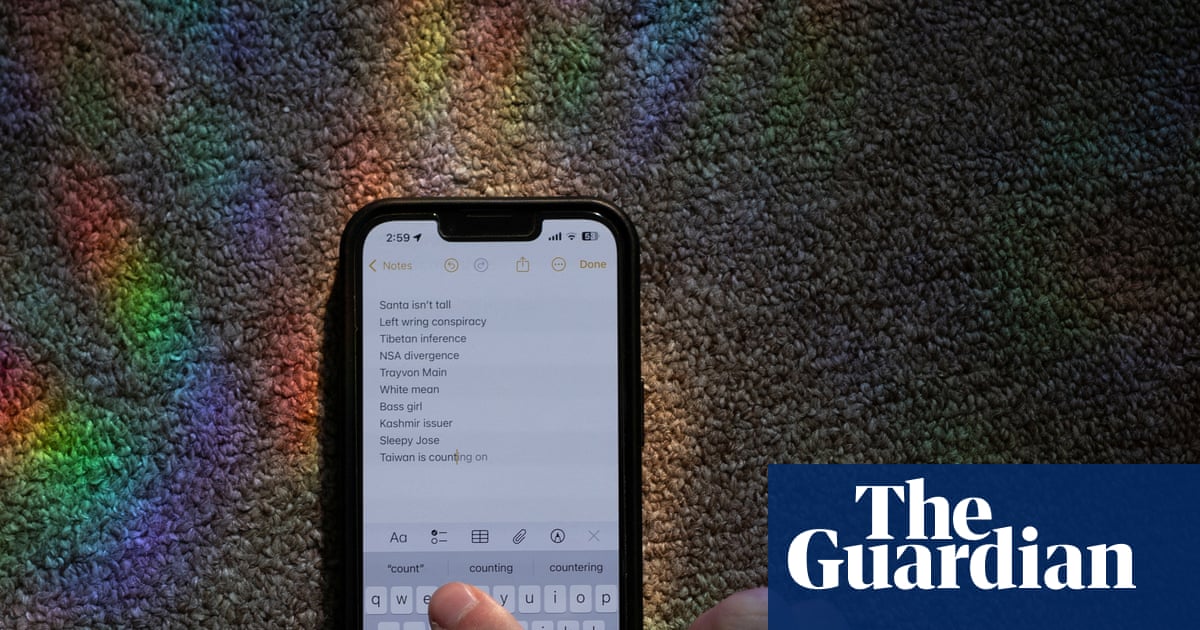
United Ireland often became United Iceland. Tibetan independence became Tibetan independences. Sleepy Joe became Sleepy hope. The keyboard was not blocking the idea so much as failing to reproduce the exact sequence.
Dictator Trump could be swiped, but the word trump appeared in lowercase and the phrase was not offered in autocomplete. The keyboard suggested dictator trumps instead. The difference is small on screen and meaningful in a message.
Read gay smut became Read gay Smit, while read smut swiped without trouble. White man became white mean, though red man and blue man worked. The Verge reported a similar pattern with left wing conspiracy, which became left wrong conspiracy.
Apple told Reuters that users can always type specific words or phrases and can override predictive suggestions. That statement is accurate. It does not address how often users accept the substitute the keyboard offers instead of retyping the sentence.
The friction matters most for people who rely on swipe typing or predictive text. Users with motor impairments, or anyone typing quickly on a phone, may have fewer practical alternatives. The list changes the path of least resistance, not the legal limit of speech.
Why does Apple keep a blocklist?
Apple says its keyboard is designed to avoid suggestions that might be inappropriate or offensive. The company did not comment directly on the size or composition of the list. It also did not explain why it flags specific political terms.
That rationale covers obvious cases, such as slurs and sexual content. It does not explain why historical events, independence movements and nicknames for politicians sit in the same table. Apple has not offered a public taxonomy.
Kauffman described the mechanism as a light-touch form of censorship. "But at the scale that Apple is operating, it only takes a light touch to have a big impact," he told Reuters. His site is careful to note that a phrase's presence says nothing about why Apple added it.
David Greene, senior counsel at the Electronic Frontier Foundation, told Reuters that part of him found the list creepy. He also saw an argument for curbing unwanted or inflammatory suggestions. His main concern was that the list is secret.
Greene said users should be aware of the list and have some ability to customise it. He added that this is something that should not be secret. Apple has not announced a user-facing setting for viewing or editing the list.
The list also changes over time. Swipeblocked records about 1,700 English phrases in iOS 14.0 in 2020, rising to 4,513 in iOS 27.0. President Trump and President Bush were removed in iOS 26.3 after being blocked since a 2022 update.
Other entries arrived at specific moments. Dictator Trump appeared in iOS 16.1, sleepy Joe in iOS 16.2 and make America great again in a June 2022 update. Zionist propaganda is listed as an iOS 27.0 addition.
Apple has faced similar scrutiny before. The Guardian noted a 2025 dictation glitch that briefly flashed the name Trump when a user said racist. Apple called it an error and fixed it. Reuters noted that Google's autocomplete has drawn criticism and litigation over its suggestions.
Apple also tags individual words, not only phrases. Swipeblocked found three labels in the English dictionary: vulgar, offensive and sensitive. A vulgar word is not suggested until the user has typed it three times. An offensive word is never suggested, and a sensitive word is never offered as a prediction or completion.
What are the limits of the research?
The list is a filter, not a complete account of Apple's intent. Swipeblocked states plainly that a phrase's presence says nothing about why Apple added it. The sequence may reflect a legal review, a safety policy, a regional rule or an engineering shortcut.
Counting is also imprecise. Apple's English bundle holds 4,525 entries, and 4,513 were decoded. The larger figure of about 100,000 includes other languages and word forms. Reuters described that number as a conservative estimate that excludes Chinese characters.
The data comes from iOS 27.0 and language downloads served in October 2026. Apple can change the tables with software updates or background asset downloads, so any published list is a snapshot. The next iOS release may add, remove or rename entries.
Chinese, Korean and Japanese use different formats, which limits direct comparison across languages. Some entries could not be decoded at all. The published lists are therefore incomplete in ways the site acknowledges.
Most of the reporting rests on one researcher's reconstruction. Suiche's independent recovery strengthens the finding, but the results have not been peer-reviewed. Apple has not confirmed the size, the selection criteria or the individual political entries.
Reuters had the exclusive interview and the on-device tests. The Guardian and The Verge largely summarised that reporting, adding context and links. Readers who want the underlying evidence should start with the Swipeblocked site and its GitHub repository, then read the Reuters interview.
The absence of an Apple explanation is itself a limitation. Without it, any claim about motive remains inference. The verifiable facts are the entries, their behaviour on a device and the way the tables change between releases.
What should iPhone users watch next?
The immediate question is transparency. Apple has not published the list or explained how phrases are chosen. An EFF lawyer has called for disclosure and user control, and Kauffman's site now provides a reference point for anyone testing the keyboard.
The next test is whether the list keeps growing. It expanded from about 1,700 English phrases to 4,513 in six years. Background downloads can change it between iOS releases. The version on a phone may not match the version in a published report.
Users can check their own keyboard behaviour. If a phrase will not swipe or autocomplete, typing it letter by letter remains the workaround. Overriding a suggestion is also possible, though it takes more effort than accepting one.
The larger issue is scale. Predictive text shapes the sentence a user is about to send, and small frictions can steer wording without an explicit rule. A blocklist is one visible part of a system that otherwise stays invisible.
Apple has not said it will change course. Until it does, the list remains visible mainly through independent reconstruction. The gap between what the keyboard knows and what its owner can see is the story that is likely to persist.
A public list would let researchers and users check changes without reverse-engineering each release. It would not settle the underlying argument over which phrases deserve filtering. That dispute involves safety, politics and language, and Apple has so far kept it internal.