What did Boston Dynamics do to Atlas?
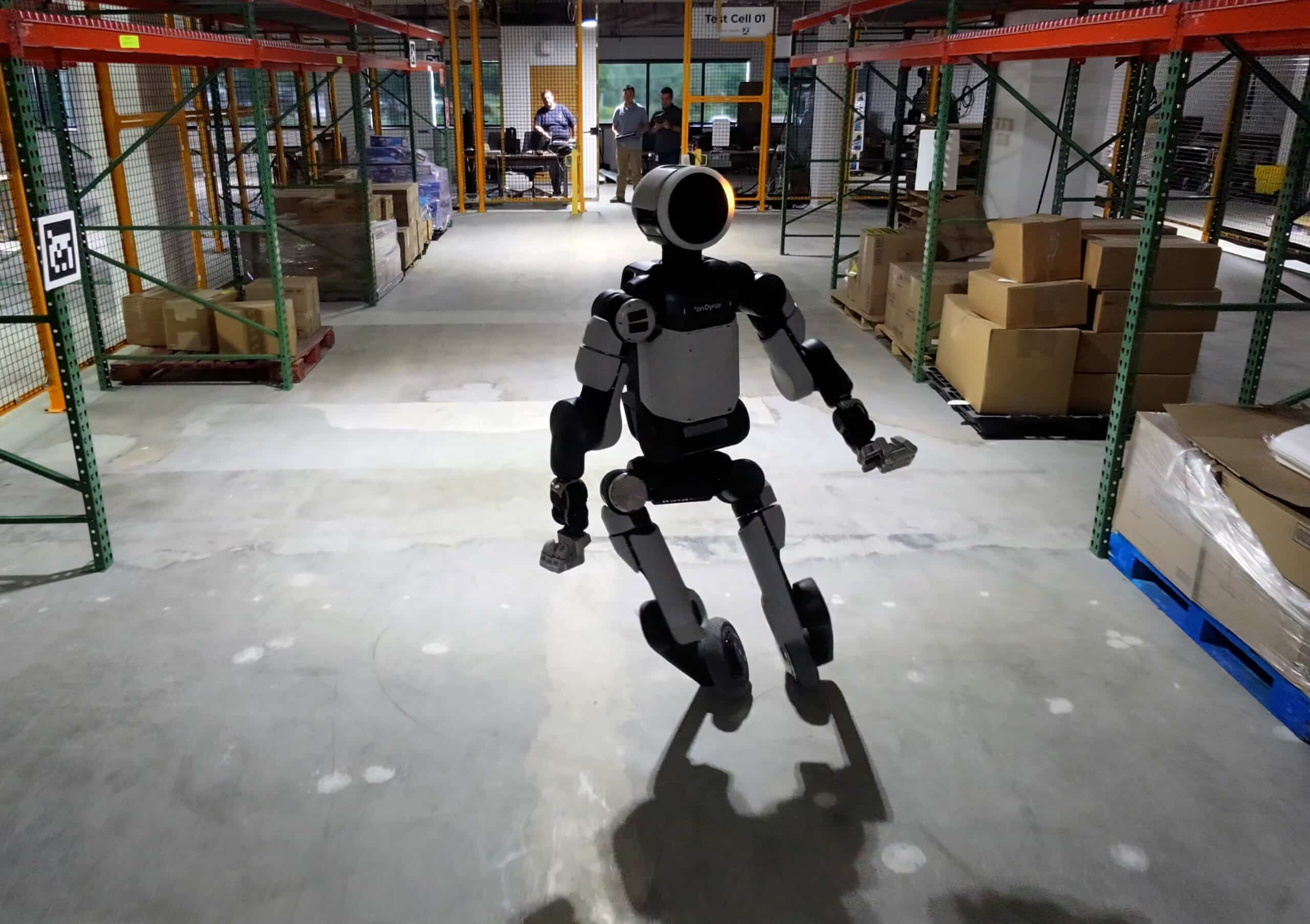
On Nov. 9, 2026, Boston Dynamics published a blog post and a video showing its Atlas humanoid rolling on wheels instead of feet. The company mounted an off-the-shelf scooter rim on each ankle actuator. A single custom adapter connected each wheel to the leg.
Boston Dynamics was founded in 1992 as an MIT spin-off. It is best known for the Spot quadruped, the Stretch warehouse robot and the Atlas humanoid. The company has a long history of publishing videos of its machines, including clips of Atlas dancing.
Controls engineer Xiaoyu Wu wrote the post. He said the adapter was the only new part in the whole build. Technicians Mark Loughlin and Peter Jardin bolted the wheels on, and Josh Geating designed the adapter.
Wu described the conversion as "wonderfully simple." He compared the retrofit to swapping a wheel on a bicycle. Atlas was designed for high-volume production and easy service, which made the change practical.
The video shows Atlas rolling, drifting and sliding through a warehouse test space. It also performs a 360-degree jump and quick side dashes. The robot balances on two points of contact, more like a skater than a walker.
Boston Dynamics was direct about the status of the machine. "A wheeled Atlas isn't a product. It's a research testbed," Wu wrote. That line frames the entire project and separates it from a product announcement.
Atlas is the company's flagship humanoid. Hyundai Motor Group, its majority owner, showed a production version at CES 2026. The robot is designed for material handling in factories, not for internet demonstrations.
The wheel experiment sits between those two roles. It uses the same actuators, the same controller stack and the same robot model. Only the feet changed, and only for the test.
Why put wheels on a humanoid robot?
The goal was not faster locomotion. Wu wanted a workload that pushed Atlas's motors to their limits for long stretches. Wheels provided that workload in a simple, repeatable form.
On wheels, every launch, turn and stop drives the leg motors across their full torque-speed range. The motors must deliver high torque and high speed continuously. They also carry the robot's weight the entire time.
Walking loads the actuators in short bursts. Rolling keeps the load applied. That difference makes wheels a useful stress test for motor models and control tuning, not just a novelty.
Wu put it plainly: "The wheels weren't really the point of this. The point was pushing the actuation to its limits." He added that he could have run a normal behavior on a robot with feet.
The Robot Report describes the work as a blend of classical model-based motor control and whole-body reinforcement learning. That combination matters because each approach covers the other's weaknesses. Model-based control provides predictable behavior, while learned policies adapt to disturbances that models miss.
Boston Dynamics says field data from Spot and Stretch shows that real sites produce conditions labs cannot fully recreate. The company wants Atlas to stay reliable at the edges of its performance envelope.
The robot under test is substantial. Boston Dynamics lists the following specifications for Atlas.
Those numbers explain the load on each ankle motor during the experiment. A 90 kg robot that stops, turns and lands repeatedly puts repeated peak demand on hardware designed for walking.
The experiment also tests the models used to predict motor behavior. If a simulated motor is too ideal, a learned policy can produce moves the real hardware cannot safely execute. Better motor models make learned behavior more trustworthy.
- •Atlas stands 1.9 m tall and weighs 90 kg.
- •It has 56 degrees of freedom and a 2.3 m reach.
- •It can lift 50 kg instantly and 30 kg continuously.
- •Its battery lasts about four hours and can swap itself.
- •It carries an IP67 rating and works from -20°C to 40°C.
How did the learned controller adapt to wheels?
The software change was as small as the hardware change. Each wheel is modeled as an ankle joint that can spin without limit. Wu took the standard Atlas model and replaced the feet.
Atlas uses a whole-body reinforcement learning policy for balance and movement. The team trained the policy in simulation, then transferred it to hardware. That transfer is the hard part, known as the sim2real gap.
Wu changed three things: reward weights, the range of commands used in training, and posture targets. Rolling then emerged without being scripted. The robot stayed stable and easy to steer.
The work was not only about the policy. Wu checked that low-level control parameters matched across software setups. He also tuned the simulated motor model to match measurements from the real robot.
Training happened across millions of simulated runs before the hardware test. The team used MuJoCo, an open-source physics engine, and worked on matching simulated motor behavior to measured behavior.
The policy also consumes proprioceptive feedback and velocity commands in real time. It adjusts pose and force to handle unmodeled disturbances and imperfect contact, according to The Robot Report.
Some moves came from Boston Dynamics' library of human motion capture. Wu chose clips with heavy foot sliding, where wheels would change the solution. In a side dash, the policy steered the wheels instead of sliding feet.
The 360-degree jump also started as a motion capture recording. A trajectory-tracking policy followed the human jump, and it worked on the first hardware attempt. During the windup, the lower body rolled into position before pushing upward.
Wu said the simulation policy transferred "basically perfectly" to the physical robot. He credited the RL stack to Robin Deits, Shane Rozen-Levy and Roberto Shu. The team also thanked Google DeepMind's MuJoCo group for the physics engine.
That result is the interesting engineering claim. A controller trained for wheels learned to use traction in ways the team did not explicitly program. The behavior came from optimization rather than choreography.
Is the wheeled Atlas a product?
No. Boston Dynamics says it has no plans to sell a wheeled Atlas. The company describes the robot as a testbed for actuator and control research.
The lessons are already flowing back to the standard robot. Wu wrote that insights from the project are being adapted to the legged configuration. The goal is better policy robustness and a wider capability envelope.
His next project is actuator failure. He wants the policy to respond when a motor fails, and to find behaviors that keep the robot useful. That work matters for machines expected to operate for years in factories.
Atlas is also getting new hands. The Robot Report notes a four-fingered gripper in development, alongside the wheel research.
The testbed approach fits Boston Dynamics' design philosophy. Atlas was built for volume and serviceability, so a bolt-on experiment is cheap. Engineers can repeat stress tests without rebuilding the robot.
Serviceability is part of the commercial case. Hyundai's plan depends on fleets that can be maintained at scale, and a robot built for quick repairs is easier to keep running. The wheel adapter is a small demonstration of that design choice.
A wheeled product would be a different bet. It would trade stairs and rough terrain for speed on flat floors. Boston Dynamics is not making that bet yet, and it has not published a business case for one.
When will Atlas work in Hyundai factories?
Hyundai Motor Group owns 80% of Boston Dynamics. Engadget reported in July 2026, citing Bloomberg, that Hyundai was preparing to buy SoftBank's remaining 9.9% stake. That would give Hyundai full ownership.
Deployment is staged. Hyundai says Atlas will enter HMGMA, its Georgia metaplant, in 2028 for parts sequencing. Component assembly is targeted for 2030.
Boston Dynamics opened the Robotics Metaplant Application Center at HMGMA on Sept. 21, 2026. Atlas robots are training there on logistics and sequencing tasks in a real production environment.
The scale is large. Boston Dynamics says the group plans to begin with 25,000 Atlas units across Hyundai and Kia plants. A new U.S. facility is planned to produce 30,000 robots a year.
Hyundai Mobis is also involved. The group says its components arm will develop high-performance actuators and standardize parts for the robotics platform, which could lower production costs.
The center will move into a building about ten times larger in 2027. Boston Dynamics also plans to explore use cases outside automotive, including aerospace, semiconductors and logistics.
Those plans explain why reliability testing matters. A factory robot must work through long shifts with minimal supervision. Actuator failures and thermal limits become operational problems, not demo problems.
Atlas is specified for four hours of battery life and self-swapping packs. Both features point to continuous operation, where uptime and service cost matter more than any single stunt.
Is the wheels-versus-legs debate settled?
No. The experiment adds a data point to a long-running argument in robotics. Wheeled humanoids are not new, either. Handle, Boston Dynamics' own robot from nearly a decade ago, balanced on two wheels, as The Verge notes. The difference now is that Atlas is a commercial platform.
The core tradeoff has not changed. Wheeled platforms are efficient on flat floors, while legs handle stairs, curbs and clutter.
The Robot Report says many companies are developing wheeled humanoids. Others remain committed to legs because factories and homes are built around human geometry.
Agility Robotics is exploring wheeled configurations. Co-founder Jonathan Hurst said Digit likely will not get wheels, but the company is studying other wheeled designs.
Hexagon designed its AEON humanoid around wheel-based locomotion from the start. Humanoids Daily reports that AEON is deploying with BMW at Plant Leipzig and has a 1,000-unit commitment from Schaeffler.
Unitree showed a G1 humanoid with wheels in April 2026. It also sells wheeled quadrupeds, including the AS2-W, which Unitree says carries 16 kg and drives more than 30 km unloaded.
Unitree's scale is another signal. Humanoids Daily reports that the Chinese company had produced roughly 18,000 bipedal robots by July 2026 and listed on Shanghai's STAR Market in August. Price and volume are becoming part of the competition.
Atlas sits differently. It is a legged robot that briefly borrowed wheels to test its motors. The company did not change its product direction, and it did not publish a performance comparison against the legged version.
For Hyundai's factories, flat floors make wheels plausible. For a general-purpose humanoid, stairs and obstacles keep legs necessary. Atlas is being positioned as the second kind of machine.
What are the limits of the demonstration?
The video is a demonstration, not a benchmark. Boston Dynamics published no top speed, torque, energy use or durability figures for the wheeled configuration. There is no independent measurement of the sim2real claim.
The test space is controlled. A warehouse floor is easier than a cluttered site, and the clip shows selected maneuvers rather than a full shift. Repetition over weeks would say more about reliability.
Wheels also remove capability. A wheeled Atlas cannot climb stairs or step over debris in the same way. The Robot Report describes the value as switching between rolling on flat ground and legged motion over obstacles.
Safety is another open question. Atlas weighs 90 kg, and a fast-moving robot of that mass needs clear separation from people. Boston Dynamics has not described how a wheeled version would handle crowded spaces.
The video shows successful runs. Boston Dynamics has not released footage of failures or actuator damage from the experiment. That is normal for a company demo, but it limits what viewers can conclude about durability.
Independent replication would help. A university lab or a competitor could run a similar test and publish motor data, but no such comparison exists yet.
The simulation claim also depends on internal data. Wu reports that the policy transferred well, but outside researchers cannot inspect the motor models or the training setup. That limits how far the result can be generalized.
The strongest evidence will come from the standard Atlas. If actuator models improve and failures become rarer in Hyundai's trials, the wheel experiment will have paid off. If not, it stays a clever engineering demo.
For now, the correct description is narrow. Boston Dynamics attached wheels to a research robot to study motors, control and simulation. It did not announce a wheeled product, a new Atlas variant or a change in its factory roadmap.