What did Canada agree to buy?
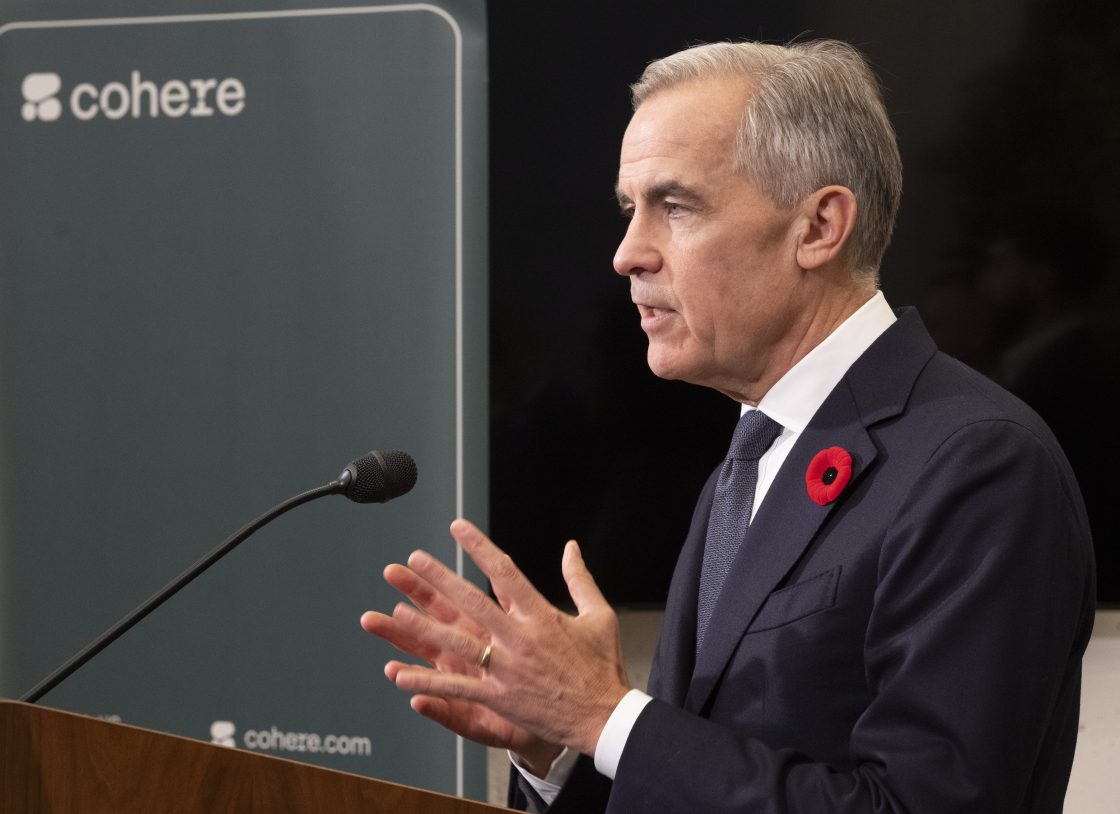
Canada will buy up to C$1.6 billion of equity in Cohere, the Toronto artificial intelligence company, Prime Minister Mark Carney announced on October 29, 2026. The commitment is an investment rather than a grant, and it will be paid in stages alongside private investors.
The money sits inside Cohere's Series E, a late-stage funding round that the company says is targeting up to C$7 billion, or about US$5.13 billion. Germany's Schwarz Group, which owns the Lidl and Kaufland retail chains, led the round, according to Cohere and Dealroom.
Cohere lists NVIDIA, Bell Ventures, Inovia Capital, Bullhound Capital, Prosperity7 Ventures and the Government of Canada as participants. BetaKit reported that the state's shares are being bought through the Canada Development Investment Corporation, a federal Crown corporation.
BetaKit put the post-money valuation at nearly C$36 billion, while Dealroom gives US$26.2 billion. The two figures sit close together once converted, at roughly 1.37 Canadian dollars to the US dollar. A post-money valuation counts the new money as already invested, so it runs above the price placed on the business before the round.
On that basis, the federal commitment is worth about US$1.16 billion. At a C$36 billion post-money valuation, the full C$1.6 billion would correspond to roughly 4% to 5% of Cohere. If the round reaches its C$7 billion ceiling, existing holders would be diluted by close to a fifth.
Dealroom described the financing as the largest private round ever raised by a Canadian technology company. That makes the federal cheque a minority position in the biggest private financing the country has seen, rather than a controlling stake.
The release frames the goal as secure, sovereign AI, a phrase that now runs through government technology policy in several countries. In practice, it means systems that a government or company can run and audit without depending on a foreign provider's cloud.
Why is Ottawa buying equity instead of giving a grant?
The purchase fits Canada's national AI plan, branded AI for All and launched earlier in 2026. The strategy commits C$50 million to expand the Canadian AI Safety Institute and C$500 million to a technology growth fund, according to Innovation, Science and Economic Development Canada.
It also sets targets of 250,000 new AI-related jobs and C$200 billion in added economic growth over five years. The plan says Canada will use its purchasing power, including a Buy Canadian policy, to support domestic suppliers.
Equity changes the politics of the money. A grant is a cost on the books, while a stake is an asset that can rise or fall with the company. Carney framed the purchase as a strategic position rather than a subsidy.
Canada's investment in Cohere is an investment in choice, in security, and in our ability to live our lives as we choose, the Prime Minister's release quoted him as saying.
Ottawa had already backed Cohere with a different instrument. The company received up to C$240 million in 2024 under the Sovereign AI Compute Strategy, BetaKit reported. That money went toward computing capacity, while the new commitment buys ownership.
The distinction matters for accountability. Compute funding is spent and audited as a program, while an equity stake sits on the federal balance sheet and moves with the company's fortunes. It also gives the government a standing reason to defend the investment in public.
How big is Cohere, and is a C$36 billion valuation justified?
Cohere was founded in 2019 by Aidan Gomez, Nick Frosst and Ivan Zhang, according to the company. It employs more than 800 people and sells AI systems to organisations that want control over where their data is stored and processed.
The Prime Minister's release describes the business as building secure AI that gives organisations control over how their data is stored, used and accessed. That pitch targets banks, hospitals and governments that cannot send sensitive records to a consumer chatbot.
In September the company signed a definitive agreement to combine with Aleph Alpha, a German AI company. Cohere said the merged business would employ more than 1,000 people and keep headquarters in Toronto and Berlin.
Analysts are not unanimous on what the combination is worth. Futurum Group's Nick Patience called it a consequential deal in non-US AI, while warning that the pair still trails OpenAI and Anthropic on model quality and deployment trust.
The C$36 billion figure is a private mark agreed by investors, not an audited market price. Cohere does not publish revenue, so outsiders cannot calculate a sales multiple or test the valuation against earnings.
Early reports of the merger put the combined company near US$20 billion, according to Futurum. The Series E values the business well above that mark, which is either a sign of demand or a sign of how thin the comparables are.
Enterprise AI contracts are also slow to win. Sales run through procurement and security reviews, so revenue lags the capacity investors are paying for. The valuation is a bet that a pipeline of regulated-industry deals converts into recurring contracts.
Cohere's differentiator is deployment rather than scale. It sells models that customers can run in their own environments, the segment where governments and regulated industries pay a premium for control.
What conditions did Canada attach?
The Prime Minister's release lists several strings attached to the money. Cohere must keep its legal home and head office in Canada, fund research and student opportunities, and work with the Canadian AI Safety Institute.
That institute is the body AI for All is expanding with C$50 million to track emerging AI risks and conduct technical research. Tying Cohere to it creates a formal channel between a commercial lab and the government's safety work.
Cohere separately committed to spend C$1.7 billion on new Canadian computing infrastructure by 2030, BetaKit reported. That is more than the federal equity cheque, and it is the part of the deal most likely to show up in construction and electricity demand.
Payments are staged against milestones that include jobs and revenue targets, BetaKit reported. Evan Solomon said the staging is tied to those measures, which gives Ottawa a way to slow the money if Cohere falls behind.
That structure matters for how the deal should be read. The headline C$1.6 billion is a ceiling rather than a completed transfer, and the final total depends on performance that has not yet happened.
Cohere's chief executive framed the raise as a choice about where the company grows. We are choosing to grow Canada's technology future instead of someone else's, Aidan Gomez said, according to BetaKit.
Joëlle Pineau, a leading Canadian AI researcher, pointed to the constraint behind the capital. To get compute, you need capital, she said. It's a fuel that we need in order to build high-quality models.
Cohere's lead Canadian investor made the case in blunter terms. Chris Arsenault described the company as the most important private Canadian technology company by valuation, fundraising, talent and global partnerships, BetaKit reported.
- •Keep Canadian incorporation and headquarters.
- •Invest in Canadian research and student opportunities.
- •Partner with the Canadian AI Safety Institute.
- •Create at least 1,000 high-paying technical jobs by 2030.
- •Spend C$1.7 billion on Canadian computing infrastructure by 2030.
What could go wrong?
The first risk is disclosure. Public documents released on October 29 do not state how many shares Canada receives, what class they are, or whether the government gets a board seat. Without those terms, the stake is hard to value independently.
Currency adds a second layer. The round is described in both Canadian and US dollars, and the C$1.6 billion commitment converts to roughly US$1.16 billion at the rate implied by the two valuations. A swing in the exchange rate changes the dollar value of the government's holding even if the business does nothing.
Execution carries its own risk. Data centres take years to plan, connect to power and fill with chips, and Cohere has not named the sites for its C$1.7 billion build. A 2030 deadline leaves little slack if permitting or equipment orders slip.
Milestone staging cuts both ways. If Cohere slows hiring or misses revenue targets, the state's stake shrinks in practice, and the jobs headline becomes an aspiration rather than a commitment.
Later rounds can also dilute the position. A stake bought at a C$36 billion valuation falls to a smaller share of the company if Cohere raises again at a higher price, which is the normal path for a growing lab.
Concentration is another risk. Ottawa is backing one company in a market where large customers can choose among OpenAI, Anthropic, Google and Microsoft. Futurum notes that Cohere still trails those firms on the measures that decide enterprise contracts.
There are commercial entanglements to watch as well. NVIDIA is both an investor in the round and a supplier of the chips that Cohere needs. Prosperity7 Ventures, another participant, is the venture arm of Saudi Aramco, according to BetaKit, which raises questions about which governments end up with access to Canadian data.
The size of the equity bet is striking next to the strategy's safety spending. The C$1.6 billion commitment is more than thirty times the C$50 million that AI for All allocates to the AI Safety Institute.
Job pledges are also gross rather than net. A target of 1,000 technical roles by 2030 does not say how many of those positions would have existed without federal money, which makes attribution difficult to audit.
Who is affected by the Cohere deal?
Cohere's own staff and customers come first. The company says the round will pay for frontier model development, secure platforms and cyber defences built outside the United States and China.
Canadian enterprises in banking, health care and government are the intended buyers of sovereign AI. If Cohere grows as planned, they gain a domestic supplier that keeps data handling inside Canadian jurisdiction, which is easier to justify to regulators and boards.
Rival Canadian startups face a changed baseline. Ottawa has now shown it will take equity in a single company, and AI for All favours Canadian suppliers in public procurement. Firms outside that circle will compete for contracts against a part-owned rival.
Data-centre developers, utilities and construction firms have a direct interest in the compute pledge. C$1.7 billion of new infrastructure by 2030 implies land, power and equipment contracts, though Cohere has not said where the facilities will sit.
Universities and students are parties to the deal too. Cohere must fund research and student opportunities under the terms, which could route money and placements into Canadian AI programs. The release does not say how much.
Taxpayers hold both the upside and the downside. If Cohere's valuation rises, the stake can be sold at a profit. If it falls, the loss lands on the federal balance sheet, and the government will have to explain a markdown.
In Europe, Aleph Alpha's staff and customers are affected by the combination and by the new capital. Schwarz Group's role as lead investor ties a German retailer to a Canadian AI supplier, and the two firms plan dual headquarters in Toronto and Berlin.
What should we watch next?
First, the terms. Watch for disclosure of the stake size, the share class and any board representation, since those details determine what Canada actually owns and how much influence it carries.
Second, the milestones. Jobs and revenue targets trigger each tranche, so federal disclosures and Cohere's own updates should show whether the company is on pace for 1,000 technical roles by 2030.
Third, the compute. Cohere has promised C$1.7 billion for Canadian infrastructure by 2030. Where those data centres are built, and who supplies the chips, will shape the industrial impact of the deal far more than the equity line.
Fourth, the merger. The Aleph Alpha combination signed on September 16 would create a dual-headquartered company with more than 1,000 staff. Completing that integration is the next test of whether Canada's bet produces a genuine transatlantic supplier.
Fifth, procurement. AI for All says Canada will use buying power and a Buy Canadian policy to support domestic firms. Whether Cohere wins federal work under those rules will show if the strategy extends beyond one cheque.
Another marker will be the next valuation. Private marks move only when a company raises, so a future round, a tender offer or a listing would show whether the C$36 billion figure holds.
Sixth, the precedent. Whether other governments respond with equity stakes of their own is an open question, and Canada's result will be the first real evidence either way.
For now, the deal gives Canada a financial position in a frontier lab for the first time. It also gives the government a direct interest in one company's commercial success, which is a different posture from funding research and letting the market decide.