What did CesiumAstro announce?
CesiumAstro closed a $730 million Series D round at a valuation above $4.5 billion, the Austin, Texas company said on 5 November 2026. Janus Henderson led the equity, with Insight Partners, Sands Capital, Sumitomo Corporation of Americas, Toyota's Woven Capital, Incharge Capital, Magnetar, AV and NewSpace Capital participating.
The structure was not pure equity. Payload Space reports that the round combined $630 million of equity with a $100 million debt facility from the Export-Import Bank of the United States and JPMorgan. CesiumAstro says it has now announced more than $1.2 billion of capital in 2026.
That total includes a $470 million growth round in February 2026. The company described that round as $270 million of equity plus non-dilutive EXIM financing, and said it would fund manufacturing and the Element satellite line. Bloomberg, as cited by The Next Web, puts CesiumAstro's total capital raised to date at $1.4 billion.
Alongside the funding, CesiumAstro unveiled Synchronicity, a planned 737-satellite constellation for commercial, sovereign and defense missions. The company says the network will use Ku-, Ka- and V-band links, carry onboard compute and apply AI to network management.
The strategic shift matters more than the headline number. CesiumAstro built its business selling phased-array antennas, payloads, terminals, custom silicon and complete spacecraft to other operators. Synchronicity would make it an operator too, selling connectivity rather than only hardware.
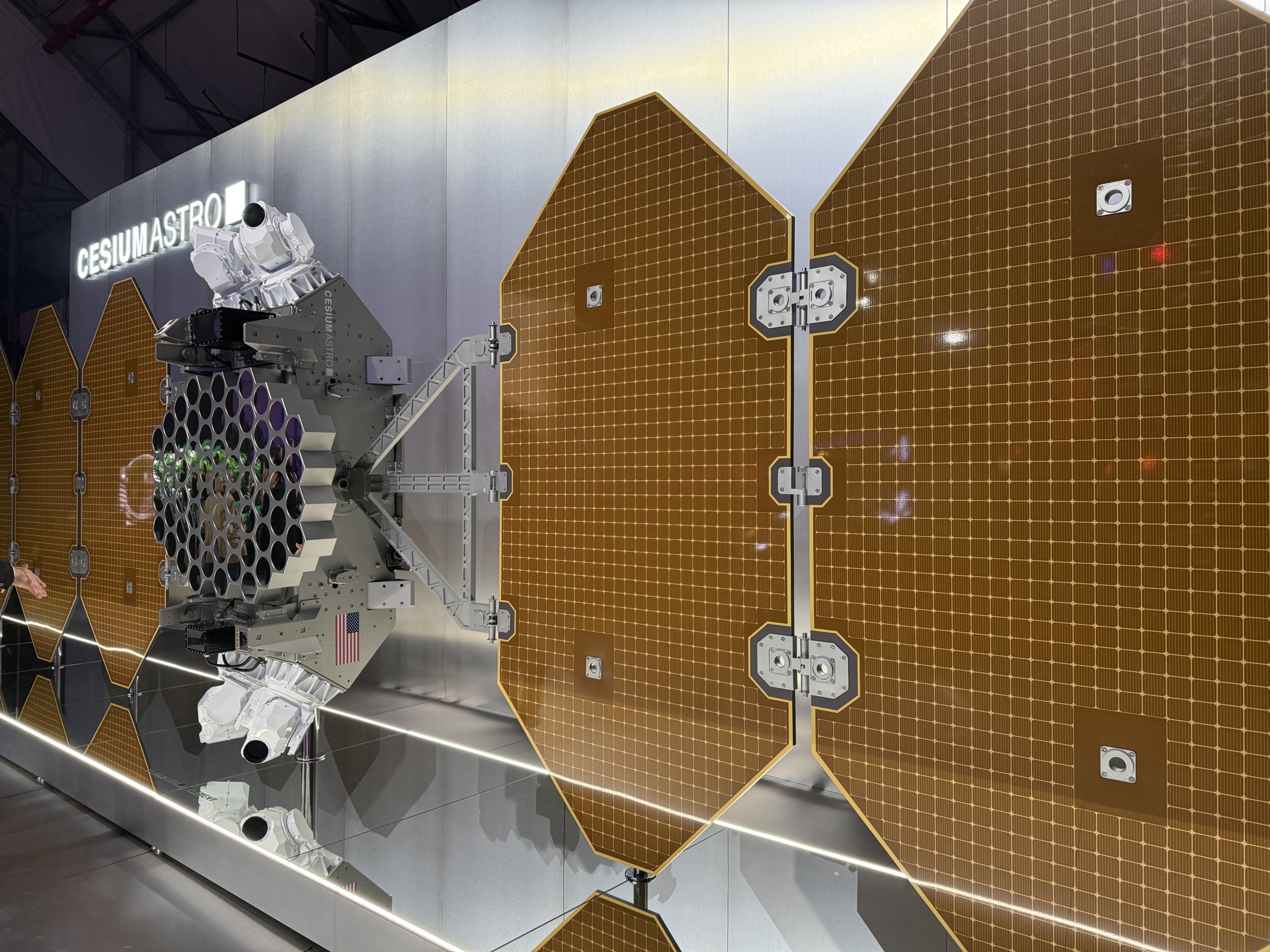
The company has one satellite in orbit. Element-1 launched on 1 October 2026 on SpaceX's Transporter-18 rideshare, according to SpaceX, and CesiumAstro says it has begun operations. It is the first of eight planned Element spacecraft.
What is Synchronicity and where would it orbit?
The clearest picture comes from CesiumAstro's license application, not its press release. The company filed with the US Federal Communications Commission on 6 July 2026 for a non-geostationary, fixed-satellite service system of 737 satellites. The FCC accepted the application for filing on 2 October 2026.
The satellites would fly in 58 orbital planes at two altitudes. A lower shell of 672 satellites would sit at 1,100 km, divided between 24 planes of one satellite and 24 planes of 27. A second shell of 65 satellites would sit at 1,200 km in ten planes.
The lower shell is inclined at 67 degrees, which covers mid-latitude regions well. The upper shell is inclined at 100.3 degrees, slightly past polar and therefore retrograde. The filing allows tolerances of 30 km in altitude and two degrees in inclination.
Two shells give the operator two coverage geometries and more paths over a given ground area. The trade-off is coordination, because every additional plane and altitude adds spectrum-sharing and collision-avoidance work.
Fixed-satellite service means links to fixed ground stations, not direct connections to ordinary phones. That distinguishes Synchronicity from direct-to-device systems. Its customers would be organizations that need capacity between sites, vehicles, ships or deployed forces.
The application lists frequencies from 10.7 GHz to 52.4 GHz, covering Ku-, Ka- and V-band in both directions. Higher bands allow wider channels and narrower beams, but they are more sensitive to rain and atmospheric loss than lower frequencies.
CesiumAstro's release describes "multi-orbit operations." The FCC filing, however, describes two low-Earth-orbit altitudes rather than a mix of low, medium and geostationary orbits. The company has not published capacity, latency, throughput or cost-per-bit targets.
- •1,100 km shell: 672 satellites in 48 planes, 67-degree inclination (FCC)
- •1,200 km shell: 65 satellites in 10 planes, 100.3-degree inclination (FCC)
- •Service type: non-geostationary fixed-satellite service in Ku-, Ka- and V-band (FCC)
What would AI actually do in the network?
CesiumAstro describes AI as part of the architecture rather than an add-on. The company says it would optimize the network, allocate communications resources dynamically and adapt to changing mission requirements and operating conditions.
The more concrete piece is edge processing. Onboard compute would handle data closer to where it is generated, which can reduce how much raw data has to travel to a ground station. That matters for sensing and surveillance payloads that produce more data than a downlink can carry in real time.
Vidrovr, one of three companies CesiumAstro acquired in the past year, specializes in real-time multimodal signal analysis. The company says the deal supports intelligent radio-frequency optimization, autonomous satellite operations and reconfigurable edge compute.
Those functions are plausible, but they are not yet demonstrated at constellation scale. CesiumAstro has not published benchmark results, simulated capacity gains or latency figures for the AI features. Element-1 is a single spacecraft, not a test of network-level automation.
Space is also a difficult place to run heavy computation. Processors face limits on power, heat rejection and radiation tolerance, and flight-qualified chips usually trail the latest ground hardware by years. That constrains how much AI can run on each satellite.
The idea is not unique. The same FCC notice that lists CesiumAstro's application also records Blue Origin amending its Project Sunrise constellation of orbital data centers. Several companies are testing whether compute in orbit can serve customers on the ground.
For AI watchers, Synchronicity is less a new model than a distribution question. It asks whether inference and signal processing can be pushed to the edge of a network whose nodes are moving at orbital speed. The answer will depend on power budgets, not just algorithms.
Why would a hardware supplier become an operator?
The logic is vertical integration. CesiumAstro designs custom silicon, active phased arrays, software-defined payloads, processors, spacecraft, ground terminals and mission software in house. It argues that owning every layer lets it tune the whole system instead of integrating parts from different vendors.
Sabripour put it directly: "We designed the silicon, the active phased array, the payload, processors, the spacecraft, ground terminals, and the network as one system." That claim is the company's main differentiator against primes that assemble suppliers.
Three acquisitions in the past year fill specific gaps. Jariet Technologies brought millimeter-wave radio chips and digital beamforming. 1Aardvark brought mission software for defense programs. Vidrovr brought AI for signal analysis. Payload reports that CesiumAstro is still looking for more deals.
The demand story is sovereignty. Sabripour told Bloomberg that governments want "sovereignty over their own constellation" instead of depending on a proprietary system such as Starlink. The Next Web reported that governments from Canada to Europe are backing their own networks.
He also said such buyers are "not necessarily competing with Starlink, but they don't want to be part of a proprietary system." CesiumAstro says it has access to radio frequencies beyond those regulators approved for SpaceX and Amazon, which would let it offer capacity on different terms.
Sovereign sales are slow and demanding. Buyers typically want domestic manufacturing, security clearances, control of encryption and a say over coverage. Those requirements favor a supplier that can build and run the entire stack, but they also stretch procurement timelines.
The company is spending to match that ambition. It plans $500 million over five years on its Austin headquarters, including 270,000 square feet of manufacturing space, and expects to add 550 jobs, taking the local workforce past 1,000 by 2030.
It also lists facilities in Colorado, California, Alabama, Florida and the Washington area, plus operations in Britain, Germany, Switzerland, Taiwan, Singapore and Japan.
How does Synchronicity compare with Starlink and Amazon Leo?
Scale separates the projects. The Next Web, citing Bloomberg, reports that SpaceX has more than 11,000 Starlink satellites in orbit and that Amazon's Leo network is planned to exceed 3,000. Synchronicity's 737 satellites would be a fraction of either.
That gap does not make it a copy. Consumer broadband rewards scale, cheap terminals and high-volume manufacturing. Government and defense buyers pay for resilience, control, bespoke coverage and the ability to operate through interference.
The business model follows that difference. Starlink and Leo sell retail subscriptions and wholesale capacity. CesiumAstro would sell capacity and services to institutions, potentially including dedicated payloads or priority access during crises.
Spectrum is another distinction. Synchronicity's V-band allocation sits above the Ku- and Ka-band links used by many broadband constellations. V-band offers more bandwidth, but rain fade is severe, so it suits high-capacity fixed links more than mobile consumer service.
The satellite count is also not the whole story. CesiumAstro plans onboard processing, which can make each spacecraft more useful for sensing and analysis. A smaller fleet with compute and flexible beams can serve niches that a consumer broadband network handles poorly.
Cost remains opaque. Neither the company nor its investors disclosed a price per satellite or a total budget for Synchronicity. The $730 million round is large for a hardware supplier, but it has not been presented as the full cost of 737 spacecraft, their launches and ground segment.
The competitive risk is that incumbents move downmarket. Starlink already sells government capacity, and Amazon is building a defense-facing business. A sovereign buyer may prefer a local operator, but it may also prefer a proven network with thousands of satellites already flying.
What are the biggest risks?
Launch capacity is the first. Payload reports that CesiumAstro has secured launches for the seven remaining Element satellites between 2028 and 2029, but it has not announced contracts for the 737-satellite constellation. The company is still working out which partnerships it needs.
The schedule is the second. Sabripour has set a goal of 350 Synchronicity satellites in orbit by 2032, according to Payload. From a standing start, that requires a manufacturing and launch cadence far beyond anything CesiumAstro has demonstrated so far.
Capital is the third. LEO constellations have a long record of cost overruns and restructurings; Iridium's original network is the usual cautionary tale. A $730 million round can fund development, a first batch and infrastructure, but it is not obviously enough to build and launch 737 satellites.
Regulation is the fourth. The FCC has accepted the application for filing, which is not the same as a grant. CesiumAstro has asked for waivers of several rules, and its Ku-, Ka- and V-band request joins processing rounds opened in June 2026 alongside other operators.
Technical execution is the fifth. The AI features are described in general terms, with no published benchmarks or simulated results. Onboard processing adds power, thermal and radiation challenges, and a failure in orbit is far harder to fix than a software bug on the ground.
Demand is the sixth. Governments say they want sovereign capacity, but budgets move slowly and incumbents are already selling to the same agencies. CesiumAstro has not named an anchor customer or disclosed a backlog for Synchronicity.
History offers a warning about vertical integration, too. Owning the supply chain can cut costs and speed development, but it also concentrates risk. If one link in the chain slips, the whole constellation schedule slips with it.
There is also a credibility gap between hardware and software claims. CesiumAstro has flight heritage in payloads and one satellite in orbit; it does not yet have a track record operating a network. Running a constellation is a different business from building one.
What should we watch next?
The first checkpoint is the FCC. A grant would come with deployment milestones, and conditions on spectrum sharing could reshape the plan. A long review, or a challenge from another operator, would push the schedule to the right.
The second is launch procurement. Watch for contracts covering batches of Synchronicity satellites and for the mix of rideshares and dedicated missions. The seven Element launches in 2028 and 2029 will show how quickly the company can move from one spacecraft to a line.
The third is customer disclosure. No anchor tenant has been named for Synchronicity. A sovereign or defense contract with published requirements would say more about the network's real capabilities than any artist's impression.
The fourth is technical evidence. Capacity tests, latency measurements and results from Element-1's onboard processing would let outsiders judge the AI claims. So far, the company has published architecture descriptions rather than performance data.
The fifth is the capital path. Janus Henderson said the deal came through its Ascent platform, which it describes as private capital for companies moving toward public markets. That is not an IPO commitment, but it hints at the exit route the lead investor expects.
The company's own language offers a clue about timing. Its release says the new capital will support "development and production of next-generation spacecraft" and "Synchronicity deployment," without dates. Investors should treat the constellation as a multi-year program, not a 2027 product.
What happens to Element matters just as much. The program is meant to prove the manufacturing model and the onboard compute that Synchronicity would rely on. A successful eight-satellite run would be the strongest evidence yet that the bigger plan is credible.
For now, the verifiable facts are narrow. CesiumAstro has raised $730 million, filed for 737 satellites at two altitudes, flown one demonstration spacecraft and set a 2032 target of 350 satellites. The rest is a plan that depends on launch capacity, spectrum approval and paying customers.