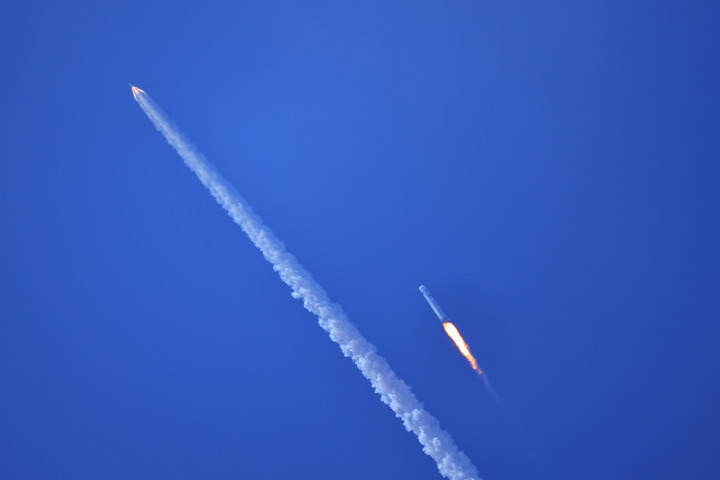
What China announced in Beijing this weekend
China has set out, in public detail, how it intends to return humans to the Moon. Wang Xiang, deputy chief designer of China's manned space program and chief designer of its lunar exploration program, presented the plan at the 7th Manned Space Symposium in Beijing on Saturday, October 31, 2026. Xinhua published the account on November 1, and Global Times reporters covered the same briefing.
The core of the announcement is an architecture rather than a new deadline. China will use what officials call a "two launches, lunar orbit rendezvous" profile for the first crewed lunar mission, which remains officially targeted for before 2030. Reporting on Wang's presentation slides by the specialist newsletter China in Space indicates the team is working toward a landing no later than October 2029.
The crew plan is now explicit as well. Global Times learned at the symposium that the first mission will carry three taikonauts, two of whom are expected to set foot on the lunar surface. Chinese space coverage summarizes the design as "two launches, one lunar landing".
Specialist observers have known the hardware names for years. SpacePolicyOnline.com notes that development of the Long March 10 rocket, the Mengzhou crew spacecraft and the Lanyue lunar lander has been underway for some time, but the step-by-step execution plan was only shared this weekend. That makes the symposium the fullest public accounting yet of how China expects to execute the landing, and Global Times adds that research, development and construction work for the lunar landing phase is progressing steadily.
The symposium itself was an industry gathering rather than a press event. China in Space reports it was held to keep partners in industry and academia informed, with officials from the China Manned Space Agency presenting the current status of the human spaceflight program and debating concepts for missions beyond the first landing. That mix of confirmed plan and open-ended studies explains why some figures reported from Beijing are firm and others are explicitly provisional.
How would a two-launch, lunar-orbit-rendezvous mission work?
The profile follows the approach NASA used for Apollo in 1969. According to Xinhua, one Long March 10 rocket will send the Lanyue lander into Earth-moon transfer orbit on its own. A second rocket will follow with Mengzhou and its crew, and the two spacecraft will rendezvous and dock in orbit around the Moon.
Global Times describes what happens next: "Two taikonauts will then enter the lander", which separates from the orbiting spacecraft and descends to the surface to carry out scientific work. When the surface tasks end, the lander's ascent stage carries the pair back up for a second rendezvous and docking. The full crew of three then returns to Earth inside Mengzhou.
Wang defended the design on practical grounds. Xinhua reports he said the approach matches China's existing technical capabilities and infrastructure, and that developing the spacecraft and lander separately can standardize production. That, he argued, supports building what he called a "long-term family of vehicles" for repeat missions rather than a one-off lander.
China in Space adds fresh hardware figures from the symposium. Mengzhou's lunar variant is to carry four engines and full-sized propellant tanks, while a low-Earth-orbit variant with two engines and smaller tanks will serve the Tiangong space station, with both sharing the same service-module form factor. The Long March 10 itself is rated to send up to 27,000 kilograms on a trans-lunar trajectory, and the family also includes a single-core Long March 10A rated for about 18,000 kilograms to low Earth orbit and a two-stage variant rated for up to 70,000 kilograms.
Lunar orbit rendezvous is ultimately a mass-saving decision. Landing a full spacecraft on the Moon and lifting it home again would demand a far more powerful rocket, so the orbiting mothership stays in place and only the lander makes the round trip. Apollo used the same split in 1969, and China's lander design is meant to stretch beyond crews: concepts shown at the symposium include cargo and reusable Lanyue variants, with one study replacing the crew cabin with an autonomously roving pressurized laboratory.
What test flights come before the first crewed landing?
The uncrewed ladder is the clearest new detail. A slide from Wang's presentation, described by SpacePolicyOnline.com, shows three flights ahead of the crewed mission: a Mengzhou test flight to Earth orbit in 2027, a Lanyue test that lands on the Moon in 2028, and a full dress rehearsal in 2029. The 2029 exercise would use two rocket launches and a complete lunar landing and ascent, with no crew aboard.
China in Space's account is broadly consistent, though it reports that officials did not state a total number of test flights. It adds that Lanyue will fly proving missions carrying cargo, while Mengzhou is expected to visit the Tiangong space station at least twice before lunar duties. Those station visits would double as operational experience for a spacecraft that, per Xinhua's list of completed milestones, has so far flown only in uncrewed abort and escape tests. Every one of those flights would use rockets from the Long March 10 series.
The striking choice is what is missing: a crewed rehearsal. SpacePolicyOnline.com observes that China apparently is not planning an equivalent of Apollo 10, which flew astronauts to just above the lunar surface in 1969. Apollo worked through a longer crewed ladder, with Apollo 7 testing the capsule in Earth orbit, Apollo 8 orbiting the Moon, Apollo 9 rehearsing docking in Earth orbit and Apollo 10 dress-rehearsing the landing in lunar orbit. China's ladder, by contrast, appears to be entirely robotic until the landing itself.
The first landing is expected to be modest in scale. China in Space reports that officials described a surface stay of about three days, with two taikonauts going outside for a spacewalk each day while a crewmate remains in lunar orbit. Later missions would stretch toward roughly fourteen Earth days, the practical limit set by the Moon's day-night cycle.
How much of the hardware has already been tested?
Xinhua's report lists the major milestones already in the log. They include Mengzhou's zero-height abort test and maximum dynamic pressure escape test, a landing and takeoff test of the Lanyue lander, and a low-altitude demonstration flight of the Long March 10 rocket. A Xinhua photo accompanying the story shows the Long March 10 low-altitude test and a Mengzhou abort test at the Wenchang Spacecraft Launch Site in Hainan on February 11, 2026.
The rocket family has also begun operational flying. A Global Times photo caption from the symposium dates the maiden flight of a Long March 10B variant to July 10, 2026, when it lifted a satellite into its designated orbit from the Hainan commercial space launch site. SpaceNews reported in October 2025 that the first Long March 10 launch and a lunar-capable crew spacecraft flight were being targeted for 2026, so the schedule appears to have held. China in Space separately reports that the first flight-ready Mengzhou may have recently arrived at Wenchang, while cautioning that this is not yet confirmed.
Lanyue received its first official numbers at the symposium. According to China in Space, officials said the lander weighs about 26,000 kilograms in total, with the landing module itself between 9,000 and 10,000 kilograms. Its engines, proven across a range of settings at the Tongchuan Test Center, are inherited from designs flown on the robotic Chang'e missions.
Suits and surface equipment are moving forward alongside the vehicles. China in Space reports that the Wangyu lunar spacesuit and the Tansuo unpressurized rover are making steady progress. Neither is flight hardware yet, but both would be needed for the mission profile officials described, in which crews walk on the surface daily and ride across it during scientific traverses.
The choice of Wenchang as the test site fits the landing plan. The south China coastal spaceport handles China's heaviest rockets and is also where the robotic Chang'e lunar missions launch, so one site is maturing both halves of the program.
How does the plan compare with NASA's Artemis timeline?
The United States is converging on the same window, with a different test sequence. SpacePolicyOnline.com notes that NASA's Artemis II already sent four astronauts around the Moon in April 2026. Artemis III is being restructured as an Earth-orbit test of rendezvous and docking between Orion and the hired landers, similar to Apollo 9, and is currently set for 2027.
NASA Administrator Jared Isaacman wants crews on the Moon via landers from two companies in 2028. SpaceX's Starship would dock with Orion in Earth orbit before traveling onward, while Blue Origin's Blue Moon MK2 would launch on New Glenn and make its way to lunar orbit under its own power, a profile closer to China's. SpacePolicyOnline.com notes NASA contracted with SpaceX in 2021 and Blue Origin in 2023, and that in both American profiles two astronauts would ride the lander down and return in Orion, just as in the Chinese plan.
Isaacman has framed the pace as a warning. At an October 23, 2026 news conference on accelerating Artemis, he blamed "the weight of institutional inertia and misplaced priorities and decades of decisions" for holding the American program back. SpacePolicyOnline.com reports he is intent on both companies landing astronauts in 2028 after repeated slips to earlier official timelines.
The symposium materials did not mention NASA, but the comparison is unavoidable. Several countries, including China, have landed robots on the Moon, while only the United States has landed people there, last with Apollo 17 in December 1972. If China's schedule holds, it would become the second nation to put crews on the lunar surface, and the two programs could arrive within months of each other.
Each side also carries a different kind of schedule risk. NASA's 2028 goal rests on two commercial landers, from SpaceX and Blue Origin, that are still in development, while Mengzhou has yet to carry a crew, based on the completed-test list in Xinhua's report. Artemis II has already proved the American transport stack with people aboard; China's new-generation spacecraft has not yet flown with anyone at all.
Why the target date matters — and what could push it
Officially, China has committed only to a landing before 2030, a pledge it first made in 2023, as SpacePolicyOnline.com notes. The October 2029 working target comes from reporting on symposium slides rather than a formal government statement. Readers should treat the month as informed reporting, not an announced date.
The schedule leaves little slack. The 2029 dress rehearsal involves two launches, a lunar landing and an ascent, which is nearly the entire crewed mission flown without people. Any slip in the 2027 Mengzhou flight or the 2028 Lanyue landing test would cascade directly into that window, and the skip-crewed-test design means there is no intermediate human flight left to absorb delays.
Wang acknowledged the difficulty in his remarks. Xinhua reports he said the plan presents considerable challenges, and that "the new system for mobilizing resources nationwide is the fundamental advantage for addressing them". He said the program now runs under unified system plans, technical standards and quality requirements in a single development framework, with an integrated design process that emphasizes interface verification between subsystems.
He also framed the program's ambitions in careful terms. Future lunar work should follow what he called "building knowledge and capability before moving into resource utilization", with a prolonged survey phase before any use of lunar materials. Xinhua adds that the crewed program shares key technologies, infrastructure and personnel with the robotic Chang'e efforts, so each mission is meant to feed the next.
The longer-term destination is the China-led International Lunar Research Station. China in Space reports that module-style Lanyue variants under study would serve the station, with eight surface module types listed covering power, habitation, command and control, science and other functions, including a nuclear power module assigned to Russia. Officials stressed, per the same account, that every crewed mission must build confidence step by step before any long-term presence is attempted.
What to watch next
The near-term marker is robotic, not crewed. The Chinese government says Chang'e-7 is scheduled to launch in the second half of 2026 to survey environmental and resource conditions around the lunar south pole. Its findings are expected to shape where future landers target.
After that, the hardware checkpoints arrive in quick succession. Based on the symposium disclosures and reporting on them, the sequence officials have laid out is as follows.
On the American side, watch Artemis III's Earth-orbit docking test planned for 2027 and progress on the SpaceX and Blue Origin landers against the 2028 goal. Each program's next slip or success will show whether 2028 or 2029 is realistic. Within roughly two years of test results, the question of who lands first should largely answer itself.
Further out, the concepts presented in Beijing hint at the shape of a sustained program. Beyond the laboratory rover, China in Space lists night-capable, cargo, reusable and surface-module Lanyue variants under consideration, plus a heavy cargo lander of roughly 15,000 kilograms that would need the larger Long March 9 rocket. None of that is approved hardware, but it shows the first landing is being designed as the opening move rather than the finish line.
- •2026: Chang'e-7 robotic mission to the lunar south pole, scheduled for the second half of the year.
- •2027: first Mengzhou test flight to Earth orbit on a Long March 10 rocket.
- •2028: uncrewed Lanyue test that lands on and lifts off from the Moon.
- •2029: end-to-end dress rehearsal with two launches, a lunar landing and an ascent, with no crew.
- •Before 2030: first crewed landing, with symposium reporting pointing toward October 2029.