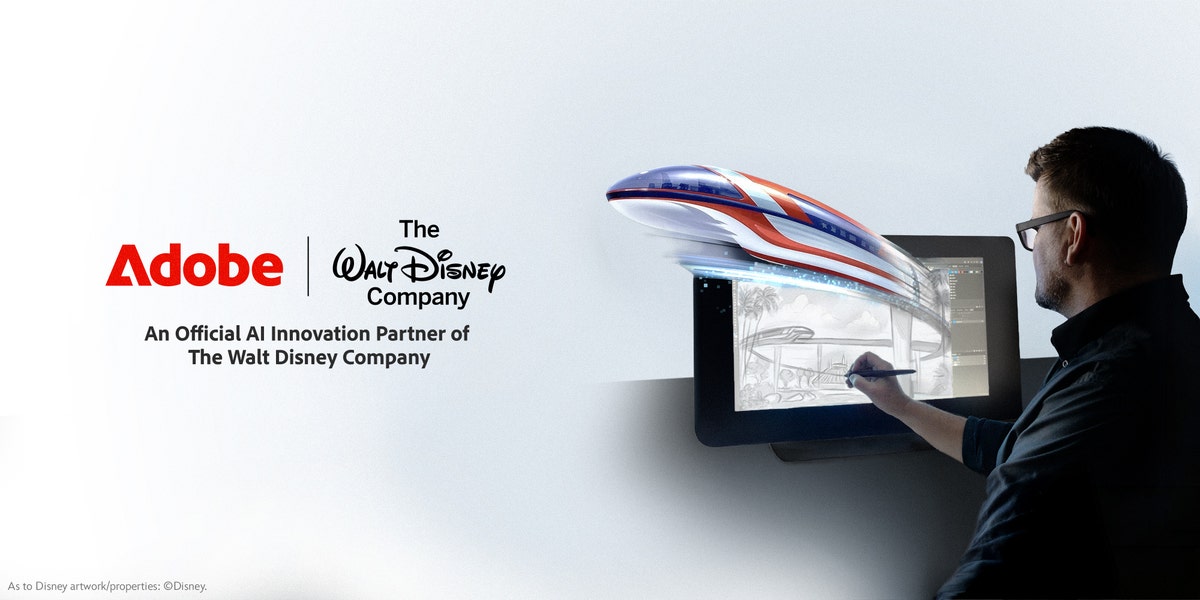
What Disney and Adobe announced
Adobe and The Walt Disney Company announced a multi-year strategic alliance on Nov. 9, 2026, at Adobe MAX in Miami Beach. Under the deal, Adobe becomes the Official AI Innovation Partner of The Walt Disney Company. Neither company disclosed the contract's value or a specific end date.
The agreement has two layers. One is technical: Adobe will give Disney early access to Firefly, Firefly Foundry, Premiere and Photoshop, plus dedicated engineering and research resources. The other is promotional: Adobe will appear across Disney platforms and events, including Walt Disney World, Disneyland, Disney Cruise Line, ESPN Edge and StudioLAB.
Adobe says its tools will support concept work in Disney's innovation labs and in park and cruise development. The release is careful not to promise finished film or television production. It describes “responsibly developed AI” supporting Disney's creative teams, a phrase that leaves the scope open.
Hannah Elsakr, an Adobe vice president, said the alliance would “build a new creative foundation that thoughtfully deploys AI as an accelerant for artistic vision, creativity and guest engagement.” Becca Vodnoy, a Disney senior vice president, said the partnership could “give our creative teams new ways to explore and develop their ideas.”
The announcement is not a product launch. No new model, price or public tool was introduced. The core of the deal is private model development, wrapped in a sponsorship-style partnership that puts Adobe's brand alongside Disney's parks, sports and studio properties.
Adobe joins StudioLAB, the Walt Disney Studios innovation program, as an Innovation Partner. At ESPN Edge, the two companies will study how AI can change fan engagement and bring ESPN's archive into new formats. Adobe said co-innovation projects at both groups are already underway.
The companies are not new partners. Adobe says the relationship spans decades and that Disney already uses its creative tools across content production and marketing. Firefly Foundry extends that existing stack rather than replacing it, which reduces integration work on both sides.
Why is Disney building private AI models instead of using general tools?
The short answer is control. General-purpose image and video models are trained on broad internet data. Disney's characters, visual styles and unreleased designs are among the most valuable intellectual property in entertainment. A model that can reproduce Mickey Mouse or Elsa without permission is a legal and brand risk, not just a creative tool.
Adobe's pitch addresses that risk directly. Firefly Foundry lets a company build models on its own catalog. Adobe says the Disney models will be tuned to character attributes, environments and visual styles. In June, Adobe argued that models trained on scraped data offer “no guarantees around IP fidelity, brand consistency or the provenance” of their output. That is a vendor claim, but it explains why Disney chose a private system.
Disney's recent history makes the logic clearer. In 2025, the company signed a three-year licensing deal with OpenAI that would have let Sora generate videos using more than 200 Disney, Marvel, Pixar and Star Wars characters. Disney also planned to take a $1 billion stake in OpenAI. When OpenAI shut down the Sora app and API on March 24, 2026, Disney ended the partnership and dropped the investment.
Disney said it would keep working with AI platforms “while responsibly embracing new technologies that respect IP and the rights of creators.” The Adobe deal follows that script. It keeps generation inside licensed, Disney-specific models rather than a public app where users type prompts.
Disney has also enforced its rights in court. Variety reported in June 2026 that the company was still pursuing copyright cases against Midjourney and MiniMax. The contrast is deliberate: Disney is suing over unlicensed use of its characters while licensing those characters into tools it controls.
Private models do not remove every risk. They still depend on training data, human review and legal agreements that the public cannot inspect. Adobe's description of the Disney models as “commercially safe” is a company assertion. No outside audit or benchmark accompanied the announcement.
For Disney, the appeal is also workflow. Its artists already use Photoshop and Premiere. Adding custom models inside those applications avoids a separate tool, a new vendor review and a second rights negotiation for every project.
What does Firefly Foundry actually do inside Disney?
Firefly Foundry is Adobe's custom-model service, announced on Oct. 28, 2025. Adobe builds models on a customer's own content and makes them available inside Creative Cloud, GenStudio, the Firefly app and Express. The service supports image, video, audio, vector and 3D output. Adobe told TechCrunch that Foundry is priced by usage rather than by seat.
Imagineering is already a customer. Disney's park design unit uses Foundry for three named workflows. A sketch-to-image model turns hand-drawn concepts into rendered 2D concept art. A custom image model produces franchise-accurate assets for properties including Mickey & Friends, Frozen, Moana, Lilo & Stitch and Cars. A 3D capability converts 2D designs into prototypes that teams can use to plan builds and estimate materials.
The models were built on more than 70 years of Imagineering work, from concept art to technical drawings. Kyle Laughlin, a senior vice president at Walt Disney Imagineering, said the tools let teams move faster. “What's most exciting is that it allows months of work to be compressed into days and weeks,” he said.
That speed claim deserves context. Concept art is an early, iterative stage. A faster sketch-to-image loop can help designers explore more options before committing to expensive construction drawings. It does not prove the same system can produce final film footage, ride safety documentation or engineering-grade CAD without review.
Adobe also says Foundry outputs are commercially safe and production-ready. Those words carry legal weight, but the public release does not explain how the system handles artist consent, style attribution or disputed characters. The 3D workflow, in particular, sits close to engineering decisions where errors are costly.
Foundry is not a single model. Adobe fine-tunes base Firefly models with a customer's assets, then adds workflows for the formats that customer needs. For Disney, that means a model that knows a character's proportions, colors and costume details, not just its name. The approach is closer to a private studio archive than to a public chatbot.
Adobe's broader Foundry business gives the Disney work a template. The service is aimed at brands that want campaign assets in many formats without losing visual consistency. Disney's use case is more complex because its characters are protected by copyright and have established canon.
The ESPN piece is less defined. Adobe says the companies will look for ways AI can enhance fan engagement and bring ESPN's archive to life. No product, launch date or metric has been announced.
Will the Adobe deal replace Disney artists?
Both companies frame the technology as an aid. Adobe calls the models “human-centered and artist-led.” Disney's Laughlin has said the company wants a collaborator that respects its creator-driven culture. The release says the tools will help teams “explore and develop their ideas,” not eliminate the people who have them.
The public record does not settle the employment question. No document released with the deal describes artist consultation, compensation, credit rules or job guarantees. Disney has not said how many roles, if any, the Adobe tools will change. Those details may exist in private contracts, but they are not available for scrutiny.
History suggests the effect will vary by task. Tools that speed concept iteration tend to change how many options a team can explore, not whether a team is needed. Production scheduling, review cycles and union agreements usually determine staffing. A model that drafts 40 variations still needs artists to choose, correct and finish them.
The cost backdrop makes the question sharper. CNBC reported on Nov. 3 that Disney plans to cut several thousand jobs and has asked some managers to find up to 20% in savings. The company cut as many as 1,000 roles in April and about 300 in September. Disney had about 231,000 employees at the end of fiscal 2025.
None of those reports link the layoffs to Adobe. Disney executives have described the cuts as a broad effort to free money for growth. Still, a multi-year AI deal announced six days after a layoff report will be read by employees through that lens, whatever the companies intend.
Union contracts will also matter. They can set rules for how new tools are introduced, who operates them and how work is credited. No such terms were included in the public announcement.
The economics point in both directions. Faster concept work can reduce overtime and outside vendor spending, which appeals to a company targeting 20% savings. It can also raise output expectations, so the same team is asked to deliver more in the same time.
The strongest evidence will be practical. If Disney publishes case studies with named artists, clear credits and time savings, the augmentation story gains credibility. If the first visible results are staff reductions, the framing will not hold.
Why the timing matters after a collapsed OpenAI deal
The Adobe alliance lands during a difficult stretch for Disney. CEO Josh D'Amaro took over earlier this year and has been reshaping the company. The Verge described the reported cuts as what would be Disney's fourth round of layoffs in 2026. Disney reports fiscal fourth-quarter results on Nov. 17, when investors will press for details on costs and park attendance.
AI is one of the few areas where Disney is adding partners rather than removing them. That fits a common corporate pattern: cut overhead, then invest in automation that promises to do more with fewer people. Disney has not framed the Adobe deal that way in public. Its release talks about creativity and storytelling, not efficiency.
The deal also gives Adobe something beyond model revenue. Adobe will appear across Disney's parks, cruise line, sports properties and conferences. That is valuable marketing for a company selling AI tools to other studios and brands. The alliance is as much a distribution agreement as a research partnership.
Disney's alternatives were narrowing. Its highest-profile AI partnership, with OpenAI, ended when Sora closed. A private, licensed model from a vendor it already uses is a lower-risk path. It keeps Disney's assets inside a controlled system and gives its teams a familiar interface.
The catch is dependence. Custom models tie a studio to one vendor's format, pricing and roadmap. If Adobe changes Foundry's terms or priorities, Disney's workflow changes with them. The release does not describe an exit plan or a requirement that models be portable.
For Adobe, the timing is also useful. MAX runs Nov. 10–12, and a flagship entertainment customer gives the Foundry pitch a concrete case study. Adobe has sold Firefly as a commercially safe alternative to models trained on scraped data. Disney is the most visible proof point it could ask for.
Disney's own statement leaves room for other vendors. A company representative said Disney “will continue to engage with AI platforms,” not that Adobe is its only partner. That wording matters for any studio weighing a similar deal.
What is still unknown, and what to watch next
Several basic questions remain unanswered. The companies did not disclose the deal's value, its exact duration, whether Adobe has exclusivity, or when Disney teams outside Imagineering will get access. They also did not say whether the custom models will touch theatrical films or Disney+ originals.
The next public milestones are close. Adobe's main MAX program runs Nov. 10–12, where executives may show Foundry examples. Disney reports earnings on Nov. 17. Analysts are likely to ask about the cost-cutting plan, park results and any AI spending.
A healthy dose of skepticism is warranted. Corporate AI announcements often describe capabilities that take years to reach daily production. The Disney-Adobe release mixes real, running workflows at Imagineering with broad language about “emerging technology” at ESPN and StudioLAB. Readers should separate the two.
For now, the deal confirms a strategic choice. Disney is not trying to win the consumer AI video market. It is buying private, licensed tools that fit its existing pipeline. That is a quieter bet than the Sora partnership, but it may prove more durable.
The clearest test is not the keynote. It is whether Disney's creative teams use these models on projects that reach guests, and whether the artists involved say the tools helped. That evidence will take months, not days, to appear.
- •Whether Disney publishes named artist case studies or only polished demo reels.
- •Whether the ESPN Edge work produces a consumer feature or stays internal.
- •Whether Disney's unions negotiate AI rules in their next contracts.
- •Whether Adobe discloses Foundry pricing for deals of this size.
- •Whether Disney extends private models to film and television production.