What did Fujifilm announce?
Fujifilm said on October 29 that it will invest about 10 billion yen in its Kanagawa Factory at Odawara, Japan. The money will expand manufacturing facilities and add personnel for data-storage tape. The company plans to raise production capacity about five times by fiscal 2028, measured against fiscal 2025 shipments.
Ars Technica and Tom's Hardware both put the investment at roughly $63 million. Fujifilm calls it “the largest investment Fujifilm has made to date in dedicated LTO tape facilities.” The work will run from fiscal 2026 through fiscal 2028.
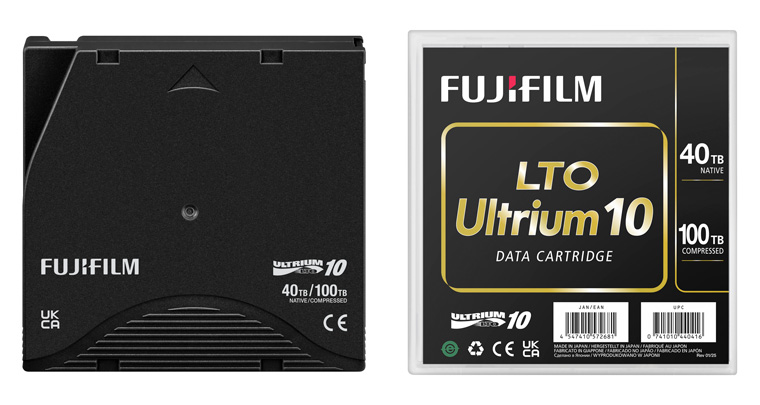
The expansion focuses on the current generation, FUJIFILM LTO Ultrium 10. Fujifilm says the plant will mainly make that tape, rather than a new format. The company also says it holds the top global share of the magnetic tape market.
This is a supply decision, not a product launch. Fujifilm is betting that customers will buy far more cartridges than they did in fiscal 2025. The company ties that bet to generative AI and cloud services. It says those workloads are causing “exponential growth” in worldwide data.
The announcement fits a wider storage squeeze. AI buildouts have increased demand for memory, disk and flash, and suppliers have shifted capacity toward enterprise buyers. Tape is the cheap, slow tier in that hierarchy, and Fujifilm expects it to absorb part of the overflow.
Fujifilm's tape business is old by technology standards. The company began research into magnetic tape in the 1950s and launched its first LTO Ultrium cartridge in 2000. It commercialized barium ferrite particles in 2011 and introduced fine hybrid particles with LTO-10 in 2025.
The format itself is run by a consortium. HPE, IBM and Quantum develop and license LTO Ultrium, while Fujifilm and other media makers produce cartridges. That split matters: Fujifilm can expand media output, but customers also need drives and libraries from the hardware vendors.
Why does AI need magnetic tape?
Most AI training does not run from tape. Models train from fast storage, often flash or disk, and tape is far too slow for that job. The tape market is growing for a different reason: retention.
Training runs produce datasets, checkpoints, logs and evaluation records. Companies also keep source data for compliance, audits and future model versions. That material is large, rarely read and expensive to keep on premium storage. Tape is built for that profile.
Fujifilm says “major cloud service and data center operators” have been expanding their use of tape. Ars Technica reports that cloud giants rely on tape to back up large troves of data. The format stores data at low cost and can sit offline.
Offline storage matters for security. A cartridge in a vault or on a shelf cannot be reached over a network. Fujifilm says tape is drawing “increasing attention as a means of protecting data from threats such as ransomware.” The LTO Program also cites hardware encryption and write-once media for regulated records.
StorageReview describes tape as a cold tier that offsets costly flash and disk arrays. Cloud providers can move cold objects to tape behind the scenes. The economics favor that approach when data must be kept for years but read rarely.
Not every byte deserves a cartridge, so companies must decide what to retain, for how long and at what cost. That decision is becoming harder as AI systems generate more logs, outputs and intermediate artifacts.
The volume is not only text. AI systems generate images, audio, video and synthetic datasets, and teams often keep the inputs that produced them. A single training corpus can dwarf the model it trains. Archives absorb the copies that no longer need fast access.
Retention policies vary by industry. A bank may keep transaction records for years. A hospital may keep images for a patient's lifetime. A studio may keep raw footage indefinitely. Tape gives those organizations a place to put the long tail.
How much data fits on one LTO-10 tape?
LTO-10 arrived in two steps. Fujifilm launched a 30 TB cartridge in June 2025 with up to 75 TB of compressed capacity. That was 1.67 times the uncompressed capacity of LTO-9. LTO-9 holds 18 TB native and up to 45 TB compressed.
In December 2025, Fujifilm announced a 40 TB version. It began shipping in January 2026 and holds up to 100 TB compressed. The company used a thinner aramid film to fit 30 percent more tape in the same cartridge. It works in the same LTO-10 drives.
That capacity is large by any storage standard. One cartridge can hold more than many desktop SSDs, and a robotic library can hold thousands of cartridges. The catch is access: tape is a sequential medium, so reading one file can mean winding past others.
The LTO Program lists LTO-10 drive throughput at up to 1,200 MB/s through a 32 Gb interface. That equals about 3.6 TB per hour per drive, assuming 2.5:1 compression. Restoring a full 100 TB cartridge therefore takes many hours on one drive.
Fujifilm also widened the recommended operating range for the 40 TB media. The temperature range moved from 15–25°C to 15–35°C. Humidity tolerance reaches 80 percent at the lower end. Those changes matter in real data centers, not just laboratories.
The format has come a long way: LTO-1 offered 100 GB per cartridge when the standard arrived about 25 years ago. LTO-10 now offers 40 TB native, roughly 400 times the original capacity in the same form factor.
Native and compressed figures are not interchangeable. Vendors quote compression ratios around 2.5:1, but real data often compresses less. A 40 TB cartridge may hold 100 TB of compressible text and far less of already-compressed video or encrypted data.
Why is tape still cheaper than disks and SSDs?
The main argument is cost per terabyte. Tom's Hardware reports that tape storage can cost as little as one-quarter of hard disk storage. The gap is wider against SSDs. The advantage grows when data sits idle for years.
Tape cartridges draw no power when they are not mounted. StorageReview notes zero idle power per cartridge, a useful property when data centers face power limits. Disks and flash consume power even when idle, though at different rates.
Media cost is only part of the total. Customers also pay for drives, robotic libraries, software, floor space, staff and periodic migration. Tape wins when capacity is large and access is rare. It loses when applications need random reads or short response times.
Fujifilm cites an estimate that worldwide data would reach 175 zettabytes in 2025. Not all of that data is worth keeping. The storage industry's problem is separating data that must be retained from data that can be deleted.
Regulation pushes some of that retention. Financial, medical and public-sector rules require records to survive for years. The LTO Program notes that WORM cartridges can support those obligations. AI adds another category: training data and model outputs that teams want to revisit.
Durability helps the case. The LTO Program says tape can protect data for up to 30 years. It also cites an uncorrectable error rate of 1 in 10^19. Those figures describe controlled conditions, not a guarantee for every cartridge.
Total cost of ownership can flip the comparison. A small archive may spend more on drives, robots and software than it saves on media. Tape makes sense when a library runs for years and utilization stays high.
Energy use is part of the calculation. Tom's Hardware notes that research has found tape less polluting than hard disks and SSDs. The comparison depends on workload, lifetime and how often data is read, so it is not a universal rule.
Is tape demand actually growing?
The shipment data is mixed, which makes Fujifilm's fivefold bet worth scrutiny. LTO media shipments reached a record 176.5 exabytes in 2024, up 15.4 percent. They fell 9 percent to 160.3 exabytes in 2025, according to LTO Program figures reported by StorageReview and Tom's Hardware.
That 2025 total was still higher than any year before 2024. The first quarter of 2026 then rose 57 percent year over year. StorageReview links the rebound to LTO-9 adoption, early LTO-10 uptake and AI-related archive demand.
Year-to-year swings can reflect inventory, drive transitions and customer budgets. A single quarter does not prove a long trend. Fujifilm's expansion will not be fully online until fiscal 2028, so the company is forecasting demand years ahead.
The LTO Program attributes the recent growth to several forces. It lists AI data growth, traditional archives, cyber-resilient backups and the LTO-10 transition. Quantum CEO Hugues Meyrath said the industry faces “unprecedented data growth” alongside cost, energy and cyber resilience pressures.
The timing is also a bet on AI infrastructure spending. If model training continues to expand, the volume of retained data should rise. If spending slows, tape suppliers could face the same overcapacity that hits other hardware markets.
Tape has one advantage that does not depend on AI enthusiasm. An offline copy is a simple defense against ransomware, and many security teams already keep one. That demand existed before the AI boom and should outlast it.
The wider storage market is tight. Tom's Hardware reports that Toshiba plans to double hard disk production capacity amid shortages. NAND makers are also pushing higher-capacity enterprise drives. Tape benefits when disk and flash capacity is scarce or expensive.
Hyperscaler spending is the biggest variable. Cloud providers buy storage in bulk and can delay projects when demand forecasts weaken. Fujifilm's fivefold plan assumes those buyers keep expanding archive tiers.
What are the limits of tape storage?
Tape is not a drop-in replacement for disk or flash: access is sequential, so random reads are slow. Applications that need millisecond responses cannot run from a cartridge in a library.
Restores take time: a single LTO-10 drive moves about 3.6 TB per hour at the rated compression. A full 100 TB cartridge would take roughly 28 hours to read on one drive. Large restores need multiple drives and careful scheduling.
Compatibility is another cost. The LTO Program says LTO-10 drives can only read and write LTO-10 media. They accept both the 30 TB and 40 TB versions, but older cartridges need older drives. Customers must plan migrations rather than assume every generation reads the last.
Air gaps only work when the tape is actually offline. A cartridge sitting in a connected library is not isolated. Operators must remove media, manage vaults and test restores. Those processes cost money and attention.
Capacity gains also slow over time. The LTO roadmap calls for 365 TB per cartridge at LTO-14, several years away. Fujifilm's 5x plan increases supply of current media, not the capacity of each cartridge.
LTFS helps with file access by keeping an index on the tape. It does not turn tape into a random-access disk. The format remains best suited to large files, bulk archives and scheduled restores.
The ecosystem is open but not simple. LTO is an open format, and the LTO Program tests products for interoperability. Customers still depend on drive vendors, library software and migration tools. A change in any of those can strand media.
Security features do not remove operational risk. Encryption protects data if a cartridge is lost, but keys must be managed. WORM media prevents overwrites, yet it cannot stop deletion or media decay. Tape is durable, not indestructible.
What happens next?
Fujifilm's investment is a supply-chain signal. The company expects AI-era archives to grow faster than its current factories can serve. The Odawara expansion is the response. Shipments from fiscal 2026 to fiscal 2028 will show whether it was right.
Watch three numbers. First, LTO Program shipment reports, which show whether the 2026 rebound lasts. Second, LTO-10 drive and library upgrades, which determine whether customers can use the new media. Third, cloud archive prices, which show how much demand reaches tape.
The people most affected are not consumers buying laptops. They are cloud providers, banks, insurers, hospitals, media companies and research institutions that keep data for years. Consumers feel the effects through storage prices and cloud backup tiers.
Fujifilm's fivefold target is ambitious. It assumes that AI data retention keeps rising and that tape remains the cheapest place to park cold copies. Both assumptions are plausible. Neither is guaranteed, and the shipment data will show which one holds.
A few developments would weaken the case. A sharp pullback in AI capital spending would reduce data growth. Faster progress in disk or flash economics could make cold storage cheaper elsewhere. A delay in LTO-11 would stretch the current generation.
A few would strengthen it. Longer regulatory retention periods, more AI-generated media and continued ransomware attacks all favor offline copies. Fujifilm is not forecasting any single outcome. It is adding capacity for a range of them.