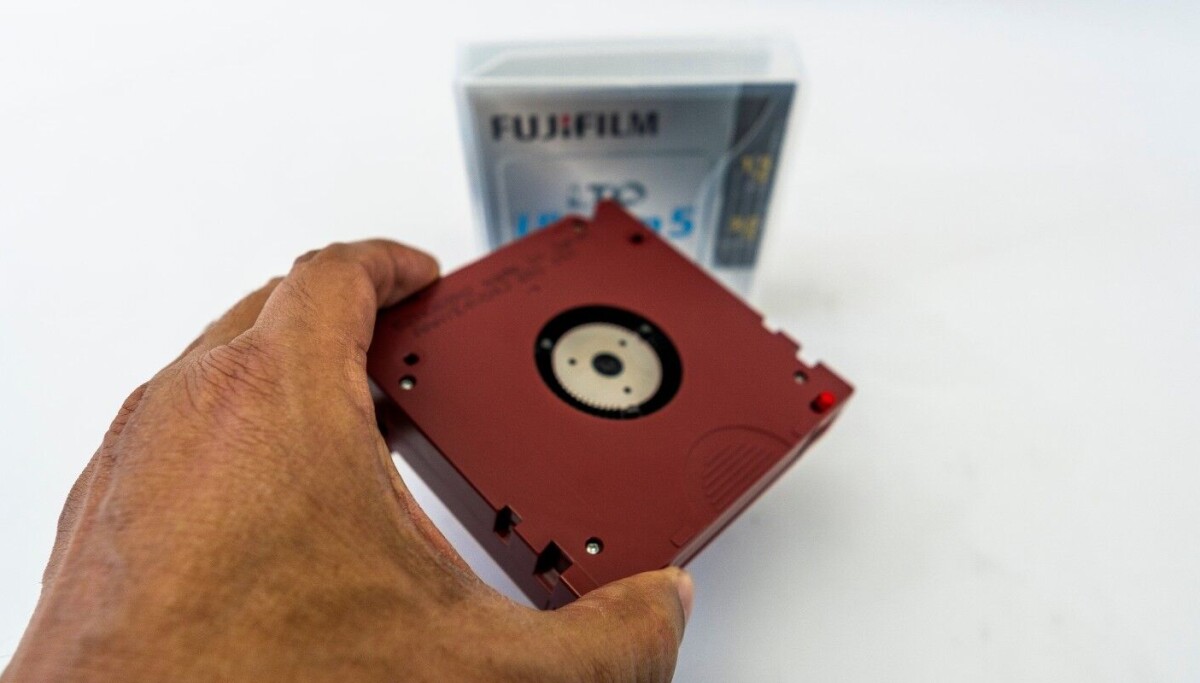
What did Fujifilm actually announce?
Fujifilm will spend about ¥10 billion to raise its output of data-storage magnetic tape by roughly five times. The company announced the plan on 29 October 2026. The work will take place at its Kanagawa factory in Odawara, south-west of Tokyo.
The investment runs from fiscal 2026 through fiscal 2028. Fujifilm says the money will expand manufacturing facilities and add personnel. The fivefold target compares shipment capacity with fiscal 2025 levels.
Fujifilm described the sum as the largest it has ever spent on facilities dedicated to LTO tape. LTO means Linear Tape-Open, the open tape format maintained by HPE, IBM and Quantum. Those three companies set the format's roadmap and publish its shipment data.
Most of the new capacity will make FUJIFILM LTO Ultrium10 media, the current generation. Fujifilm launched the 30TB LTO-10 cartridge in June 2025. It announced a 40TB version on 22 December 2025, and that cartridge began shipping in January 2026.
The 40TB cartridge packs about 30% more tape into the same shell. Fujifilm achieves this with a thinner aramid base film and its fine hybrid magnetic particles. The cartridge works in the same LTO-10 drives as the 30TB version.
Fujifilm is not a newcomer to the format. It launched LTO Ultrium1 in 2000 and was first to commercialise barium ferrite particles for tape in 2011. It says it holds the top share of the magnetic tape market, a figure it attributes to its own producer data.
The announcement was a supply update, not a product launch. No new tape generation was introduced, and no prices were disclosed. The news was about factory capacity, lead times and the ability to keep customers supplied.
The investment also carries weight because the media market is narrow. Fujifilm and Sony are the main LTO cartridge manufacturers, while HPE, IBM and Quantum drive the format. A capacity decision by one of two media suppliers therefore signals the whole supply chain.
Why does AI need magnetic tape at all?
AI workloads create data faster than they consume it. Training pipelines ingest large datasets and then produce checkpoints, logs and evaluation outputs. Inference adds request logs and derived data every day.
Flash and disk hold the data that models read constantly. Tape holds the copies that must be kept but rarely opened. That split is why storage analysts describe tape as a cold tier rather than a replacement for primary storage.
Fujifilm's release points to "exponential growth in the volume of data generated worldwide". It says the data comes from AI training and inference, plus the digitisation of business processes. The company argues that storing and using that data securely is now a foundation of the digital economy.
Tape has three practical advantages for that job. It is cheap per terabyte, it needs no power while a cartridge sits on a shelf, and it can be taken offline. Each advantage matters more as data volumes rise.
The offline property matters for ransomware. A cartridge that is not mounted cannot be encrypted by malware running on a server. Fujifilm explicitly cites physical isolation from networks as a reason data centres buy tape.
StorageReview makes a related point about power. Data centres face limits on electricity, and tape libraries draw nothing per stored cartridge when idle. That makes tape a way to keep more data without adding always-on load.
Cost is the other driver. Tom's Hardware estimates tape can cost as little as one-quarter of hard-disk storage per terabyte. The gap widens against flash. For petabytes of training data that must be retained, the difference is large.
The trade-off is speed. Tape is sequential, and restoring a single file can take minutes. Nobody runs a live model from tape. The archive is where data goes after the working copy is no longer needed.
AI archives are not only training data. Regulated industries keep records for years, and those records are growing as more work moves online. Banks, insurers, hospitals and public agencies all need copies that survive hardware failures and staff turnover.
Most large organisations also keep several copies of important data. One sits on primary storage, one on a second system, and one is kept offline. Tape often fills the offline role because a cartridge can leave the library and be stored somewhere else.
That makes tape an insurance policy as much as a cost-saving tool. The archive is rarely read, but it must remain readable. The value shows up on the day a primary system fails or a ransomware attack succeeds.
How much data does one LTO-10 tape hold?
Capacity figures for tape need care, because vendors quote both native and compressed numbers. LTO-10 comes in two native sizes. The standard cartridge holds 30TB, and the extended cartridge holds 40TB.
At the format's standard 2.5:1 compression ratio, those become 75TB and 100TB. The LTO Program lists 40TB native and 100TB compressed for LTO-10 drives. Fujifilm's own launch release uses the same numbers.
The compression figure assumes the data compresses. Video, encrypted archives and many AI datasets are already compressed, so a planner should use the native number. That is 40TB, not 100TB.
The roadmap shows why Fujifilm is expanding now. LTO-11 is expected around 2029 with 70TB native capacity, roughly 175TB compressed. LTO-12, LTO-13 and LTO-14 follow at 120TB, 210TB and 365TB.
Compatibility has become less generous. LTO-10 drives can read only LTO-10 cartridges, according to The Register. Earlier generations could read the previous version. Archives that skip generations now face a migration project.
The 40TB cartridge may explain part of the demand surge. It arrived in early 2026 and gave existing LTO-10 drive owners a density upgrade without new hardware. StorageReview links the first-quarter shipment jump partly to that ramp.
The scale is hard to picture. One exabyte equals one billion gigabytes. The 160.3 exabytes shipped in 2025 therefore represent roughly 160 billion gigabytes of compressed capacity. At current cartridge sizes, that implies millions of physical tapes.
- •Standard LTO-10: 30TB native, 75TB compressed at 2.5:1.
- •Extended LTO-10: 40TB native, up to 100TB compressed, shipping since January 2026.
- •Transfer rate: up to 400 MB/s native.
- •Working range: 15-35°C and up to 80% humidity at 15-25°C for the extended cartridge.
- •Roadmap: LTO-11 at 70TB around 2029, then 120TB, 210TB and 365TB.
Tape shipments fell in 2025, so why expand now?
The tape market is not growing in a straight line. LTO cartridge shipments reached a record 176.5 exabytes in 2024, up 15.4% on 2023. In 2025 they fell 9% to 160.3 exabytes.
The LTO Program blamed difficult macroeconomic conditions. It noted that sales picked up strongly in the second half of 2025 and predicted a record year in 2026. The 2025 total was still the second-highest ever recorded.
Early 2026 supported that view. LTO capacity shipments rose 57% year on year in the first quarter, according to the LTO Program. StorageReview and Blocks & Files both attribute the jump to LTO-10 adoption and archive demand.
Those exabyte figures measure compressed capacity, not the number of cartridges. A shift to higher-capacity media can lift exabytes while unit volumes stay flat. That distinction matters when reading headlines about tape's revival.
Fujifilm's fivefold plan is therefore a multi-year bet, not a reaction to one quarter. A factory expansion takes years to commission. The company is sizing for demand in fiscal 2028, when LTO-10 should be mature and LTO-11 may be close.
Other storage suppliers are making similar bets. Toshiba plans to double hard-disk production capacity, Tom's Hardware reports. Seagate and Western Digital are pushing higher-capacity drives, while Kioxia and SanDisk have detailed 332-layer NAND.
The wider context is a storage shortage. AI data centres are absorbing enterprise drives, and manufacturers are prioritising profitable enterprise orders over consumer products. Tape is the cheapest way to add capacity during that squeeze, which helps explain Fujifilm's confidence.
A record year is also often followed by a pause. Buyers that refreshed tape libraries in 2024 had less reason to order in 2025. The LTO Program pointed to macroeconomic conditions, not a structural loss of interest, when it explained the decline.
What are the limits of tape for AI data?
Tape will not replace the disks and flash that serve AI models. Training jobs read data continuously and need random access. Tape reads sequentially and is designed for archives, backups and long-term retention.
Restore time is the main operational risk. A tape library can take minutes to mount a cartridge and locate a file. Restoring a large dataset can take hours. Organisations plan around this by keeping recent copies on disk.
The fivefold figure is relative, not absolute. Fujifilm is multiplying its own fiscal 2025 shipment capacity. The plan says little about its market share or Sony's output. Blocks & Files notes that Sony is the other LTO media manufacturer.
The investment is also small by semiconductor standards. About $63 million buys production lines and staff, not a new material science breakthrough. The gain comes from volume, not a sudden change in areal density.
Rival archive technologies are emerging but not ready. Blocks & Files says holography and DNA storage remain early-stage, with DNA archival storage roughly five to ten years away. It also names ceramic-on-glass storage from Cerabyte as a possible rival by the late 2020s.
Tape's air gap is a security advantage, but it is not automatic. Libraries are online devices, and cartridges are mounted for reads and writes. Write-once media and offline vaulting help, but they depend on process discipline. Fujifilm's release stresses physical isolation, not immutability.
Environmental tolerance has improved but remains a constraint. The 40TB cartridge widened its recommended range from 15-25°C to 15-35°C. Humidity limits still apply. Tape is robust, but it is not a fit-and-forget medium.
Tape's cost advantage also depends on scale. A small business needs a drive, a library, management software and somewhere safe to store cartridges. Those fixed costs are hard to justify below a few hundred terabytes. Large archives spread them across petabytes.
Who is affected, and what should you watch next?
The immediate buyers are cloud providers and large data centre operators. Fujifilm says tape use is expanding among major cloud service providers and data centre operators. Media companies, banks, hospitals and research institutions also keep long archives.
The LTO ecosystem shares the benefit. HPE, IBM and Quantum own the format and sell drives and libraries. Quantum and Spectra Logic build tape libraries. More media supply helps them ship systems without long lead times.
Hard-disk makers face a different calculation. Tape competes at the cold tier, where hard drives are the default alternative. Cheaper, more available tape could slow some nearline disk purchases, though most archives use both.
Customers should watch three dates. The first is Fujifilm's fiscal 2028, when the new lines should run at five times the fiscal 2025 level. The second is the LTO Program's annual shipment report, which will show whether 2026 set a record. The third is LTO-11, expected around 2029 at 70TB native.
Pricing is the practical question. A fivefold supply increase could shorten lead times for LTO-10 media. It could also be absorbed by AI-driven demand, leaving prices firm. Fujifilm has not published prices for the new capacity.
Cloud customers may feel the effect indirectly. Fujifilm says major cloud service providers are already among its tape buyers. Any benefit is more likely to appear in restore times and archive pricing than in a headline rate cut.
For IT teams, the lesson is to treat tape as a tier with its own rules. Budget for native capacity, not compressed capacity. Keep drives matched to media generations. Test restores, because an archive that cannot be read is not a backup.
The practical effect for buyers will be slower than the headline suggests. New factory lines will not change prices or lead times this quarter. Companies planning archives for 2027 should assume current LTO-10 supply until Fujifilm confirms more.
The bigger picture is that AI has changed the economics of forgetting. Companies now keep training data, model outputs and audit trails that they once deleted. Tape is the cheapest place to put data that must exist but is rarely touched. Fujifilm is betting that pile keeps growing.
The bet is plausible, but not guaranteed. A single weak year in 2025 showed how quickly enterprise buying can pause. The expansion will look wise if AI archives keep growing through 2028, and premature if they do not.