What did the Google study actually find?
On 5 November 2026, the journal Nature published a peer-reviewed study of an AI system called AI-PPG-ACC-HTN. The work comes from Google Research, with collaborators at Beth Israel Deaconess Medical Center and Harvard Medical School. Its central claim is narrow but notable: a consumer smartwatch can flag a likely hypertensive state without a cuff and without calibration.
The study enrolled 196 adults at five US sites. Participants had no known cardiovascular disease and were not taking blood pressure medication. Each person wore the watch for seven days while also completing 24-hour ambulatory blood pressure monitoring, the reference standard clinicians use to confirm hypertension.
For initial screening, the smartwatch system reached 65.8% sensitivity and 90.0% specificity against that reference. Its positive predictive value was 80.6%. An initial office blood pressure reading, judged in the same framework, reached 55.3% sensitivity, 90.0% specificity and 77.8% positive predictive value.
In a confirmatory subset of 48 people who had elevated office readings, the watch reached 78.4% sensitivity, 90.9% specificity and 96.7% positive predictive value. Multi-day home monitoring in the same comparison reached 89.2% sensitivity, 81.8% specificity and 94.3% positive predictive value.
A clinic reading is a snapshot. Ambulatory monitoring samples pressure across a full day and night, including sleep, so it captures patterns a brief visit misses. The researchers used that fuller picture as the reference, which makes the comparison more demanding than a single cuff check.
The two scenarios mirror how diagnosis usually works. A clinic reading is the first filter, and guidelines then ask for out-of-office confirmation before treatment starts. The study therefore tests the watch twice: once as a substitute for the initial filter, and once as a confirmation tool for people whose office reading was already high.
Nature is distributing the paper as an accepted manuscript, which the journal says is peer reviewed, citable and subject to later edits. The abstract describes the hardware only as a "widely available consumer smartwatch" and does not name the model. That omission matters when readers try to map the result onto a specific product.
How does it detect hypertension without a cuff?
The system does not try to output systolic and diastolic numbers. Google's researchers argue that point-in-time estimates are too sensitive to transient noise such as sudden movement or temperature changes. Instead, the model estimates whether a person has a persistent hypertensive state across several days.
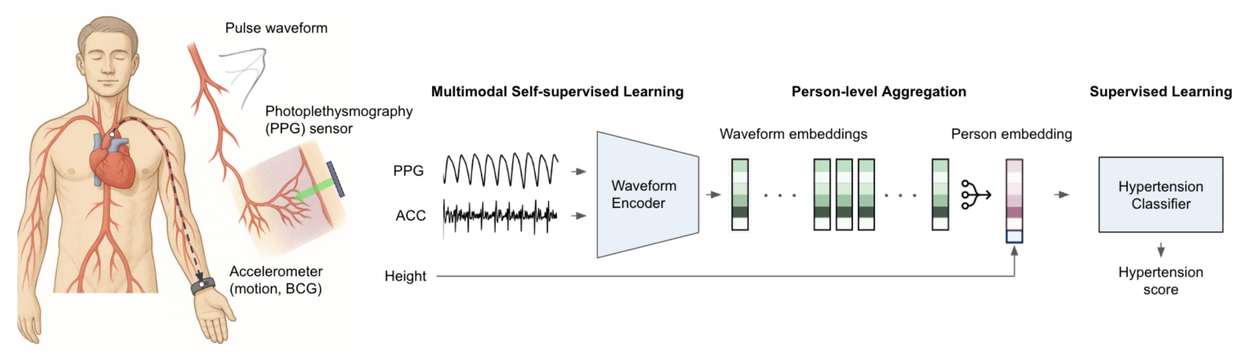
It uses two sensors that already ship on most smartwatches. Photoplethysmography captures pulse wave contours from reflected light at the wrist. Accelerometry captures periods of stillness and the ballistocardiogram, the small wrist vibration produced when the heart ejects blood into the aorta.
The pipeline has two stages. First, a one-dimensional convolutional network was pretrained on 492,347 hours of unlabeled sensor data from 2,109 participants. It learned to place overlapping 15-second pulse and motion windows from the same person close together in a latent space.
That pretraining set carried no hypertension labels. The encoder learned general waveform structure first, then a much smaller labelled study supplied the clinical outcome. Unlabeled wearable data is abundant, so this split lets the team use far more recording hours than a clinic trial could collect.
Second, those embeddings are averaged across days, combined with the user's height as a proxy for arterial path length, and passed to a regularized logistic regression classifier. The output is a continuous probability score, not a reading in millimetres of mercury.
The researchers also examined what the model responded to. Higher-risk waveforms showed narrower pulse width, a slower systolic upstroke and a lower ratio between the forward pulse wave and the reflected wave. The accelerometer picked up deeper K waves and wider IJK complexes. These are plausible vascular and mechanical signals, but they are associations rather than a diagnostic mechanism.
That design choice explains why the result is interesting. Existing cuffless watches usually need periodic calibration with an arm cuff. They then track relative change from that baseline. Google's claim is different: an absolute probability of hypertension, learned from raw waveforms collected during ordinary wear.
Is this available on a Pixel Watch or Fitbit today?
Google already sells something adjacent. Its Blood Pressure Trends feature, part of the Health Guardian suite, uses pulse and motion data to estimate blood pressure trends. Google Health lists the feature for Pixel Watch 3, Pixel Watch 4, Pixel Watch 5 and Fitbit Air, and says it is arriving "this fall."
Health Guardian is broader than blood pressure. Google bundles insulin resistance trends, sleep breathing quality and an emergency breathing alert alongside the blood pressure feature. The suite is central to how Google is positioning Pixel Watch and Fitbit as health devices, not just fitness trackers.
In September 2026, heise online reported that the feature needed at least five consecutive days of data in a week to produce a trend. It appears in a monthly summary rather than as a daily reading. The report said the trend features are free on Pixel Watch 3 to 5, while Fitbit Air owners need Google Health Premium.
The product's own wording is cautious. Google Health says the feature is for general wellness and is "not a prescreener for hypertension." It also says the data is not for medical use, not a replacement for a blood pressure monitor and not for people who are pregnant.
Google's research post adds a further qualification. It says the findings helped inform the Blood Pressure Trends feature, then states that the methods are exploratory and "not indicative of any existing or upcoming commercial product feature or device capability." Both statements can be true, but they point in different directions. One describes a shipped wellness feature. The other describes a research system with no product claim attached.
There is no announced FDA clearance for a Google hypertension screening feature. That is the gap between this paper and a diagnostic claim. The study validates an algorithm in a controlled research setting. It does not certify a consumer product, a label or a clinical workflow.
How does it compare with Apple's hypertension notifications?
Apple took the regulated route. Its Hypertension Notification Feature received FDA 510(k) clearance on 11 September 2025. The clearance covers a Class II software device for over-the-counter use by adults aged 22 and over who have not been diagnosed with hypertension.
The FDA indication is explicit about limits. The feature is not intended to replace diagnosis, monitor treatment or serve as blood pressure surveillance. It is not for use during pregnancy. The agency also states that "the absence of a notification does not indicate the absence of hypertension."
Apple's algorithm reviews 30-day periods of optical heart sensor data and notifies users who show consistent signs. Apple lists the feature for Apple Watch Series 9 and later and Ultra 2 and later, with availability in more than 150 countries and regions. Its pivotal study enrolled 2,229 people and analyzed 1,863 who provided at least 15 days of usable data. Against a home blood pressure monitor, it reported 41.2% sensitivity, 92.3% specificity and 70.9% positive predictive value at 31.4% prevalence.
Those figures are not directly comparable with Google's. The reference devices differ, the populations differ and the endpoints differ. Apple's study is far larger and its feature has been reviewed by a regulator. Google's study is much smaller, but it reports higher sensitivity and used ambulatory monitoring, which captures nighttime and daily-life readings rather than clinic or home cuff snapshots.
The shared design is a prompt, not a measurement. Both systems push a person toward a cuff and a clinician. Neither claims to replace the cuff, and both set a low bar for what an alert means. An alert says the pattern deserves confirmation, not that hypertension has been diagnosed.
Apple makes the follow-up explicit. It says the feature was developed with training data from multiple studies totalling more than 100,000 participants. After a notification, Apple recommends logging blood pressure for seven days with a third-party cuff and sharing the results with a clinician. Google's paper ends at the same place: the alert is a reason to measure, not an answer.
What are the study's limitations?
The first limitation is size. A group of 196 participants is small for a screening claim, and the confirmatory analysis rests on 48 people. The confidence interval for initial screening runs from 54.0% to 76.3% sensitivity, which is wide.
The second is selection. Participants had no known cardiovascular disease and took no blood pressure medication. That excludes many people who are already monitored, and it says little about performance in treated patients, pregnancy or younger age groups.
The third is the device. The paper does not name the watch, so the result cannot be assumed for every wrist sensor. The model depends on motion-free periods, and different hardware may capture those periods differently.
The fourth is the metric. A sensitivity of 65.8% means the system missed roughly one in three people who had hypertension in this study. Positive predictive value also depends on how common the condition is in the group being screened. In a younger, lower-risk population, the same model would produce more false alarms.
The fifth is the evidence standard. A commentary in Hypertension Research, published online in November 2025, reviewed cuffless devices and concluded that "there is no convincing evidence that any cuffless BP technology has adequate accuracy as required for clinical use." The authors added that scientific societies do not recommend them for that purpose.
Google's own post calls the work "early feasibility research." That phrase should temper headlines describing a finished screening tool. The paper shows that a signal exists in everyday wrist data. It does not show that the signal is reliable enough to act on without a cuff.
Definitions also vary. WHO describes hypertension as 140/90 mmHg or higher. The FDA summary for Apple's feature describes it as an average of 130/80 or higher under American Heart Association guidance. A lower threshold catches more people and shifts the arithmetic of sensitivity and specificity, so comparisons across studies need care.
Finally, the study measured agreement with a diagnostic reference. It did not test whether screening prevented heart attacks, strokes or deaths. That question would need a much larger trial with years of follow-up, which this study was not designed to answer.
Why does hypertension screening matter at this scale?
Hypertension is the leading modifiable risk factor for heart attack, stroke and kidney disease. WHO estimates that 1.4 billion adults aged 30 to 79 had the condition in 2024, about one-third of that age group. It also estimates that 600 million of them, or 44%, did not know they had it.
Two-thirds of affected adults live in low- and middle-income countries. Only about 320 million, or 23%, have the condition under control. Those numbers are what make opportunistic screening attractive. A device already on the wrist could prompt people who rarely see a doctor, without adding a clinic visit or a new cuff.
WHO also estimates that 630 million adults with hypertension are diagnosed and treated. Finding more cases helps only if treatment follows. The gap between diagnosis and control is where most of the health benefit is won or lost.
The hurdle is what happens after the prompt. A screening signal only helps if confirmatory measurement and treatment are available. False positives create anxiety and consume clinic time. False negatives can create false reassurance, especially when a user treats a watch score as a clean bill of health.
Cost and access also shape the impact. Pixel Watch and Fitbit hardware are consumer products, and some trend features sit behind a subscription. A tool aimed at undiagnosed hypertension will reach mostly people who can already afford a smartwatch, at least in its first years.
The equity question is therefore not only technical. A cheap, passive screen could widen access if it runs on hardware people already own. It could also deepen gaps if the alerts arrive mainly among affluent users who already get annual check-ups.
What should we watch next?
The next milestone is regulatory. Google has not announced an FDA-cleared hypertension feature, and its research post explicitly avoids a product claim. A cleared label would require a larger validation set, a defined intended-use population and post-market controls.
Apple's clearance shows what that path involves. It included a predetermined change control plan, an FDA mechanism that lets a company update an algorithm within agreed bounds without filing a fresh submission each time. Any Google product would likely need a similar arrangement, plus monitoring of real-world performance after launch.
Independent replication matters too. A second group should test the approach on different hardware and in more diverse cohorts. It should also report performance in people with diabetes, kidney disease and existing heart conditions, who are common in primary care.
Data governance is another open question. Continuous pulse and motion data can reveal sleep, activity and heart rhythm patterns. Google says the research used consenting participants. Any product would need clear limits on secondary use, retention and sharing.
For readers, the practical advice is unchanged. A watch alert is a reason to measure blood pressure properly, ideally with a validated upper-arm cuff and, where indicated, ambulatory monitoring. It is not a diagnosis, and a missing alert is not proof of health.
Google's study is a credible step for cuffless screening research. It adds peer-reviewed evidence to a field that has struggled to produce it. It is not the end of the cuff, and Google's own wording says as much.