What did Google announce on 9 November 2026?
Google added two systems to its eighth-generation TPU family on 9 November 2026. TPU 8tx handles confidential inference, while TPU 8i Max targets very large context windows. Both are built on silicon Google already sells inside TPU 8t and TPU 8i.
The company describes the pair as systems, not chips. A chip takes years to design and fabricate, while a system can be assembled in months. Engineers change packaging, memory, networking and security around existing silicon.
TPU 8tx runs on the same silicon as TPU 8t, the training chip Google introduced in April 2026. It pairs that silicon with 5th Generation AMD EPYC CPU hosts and Google's low-latency Boardfly network.
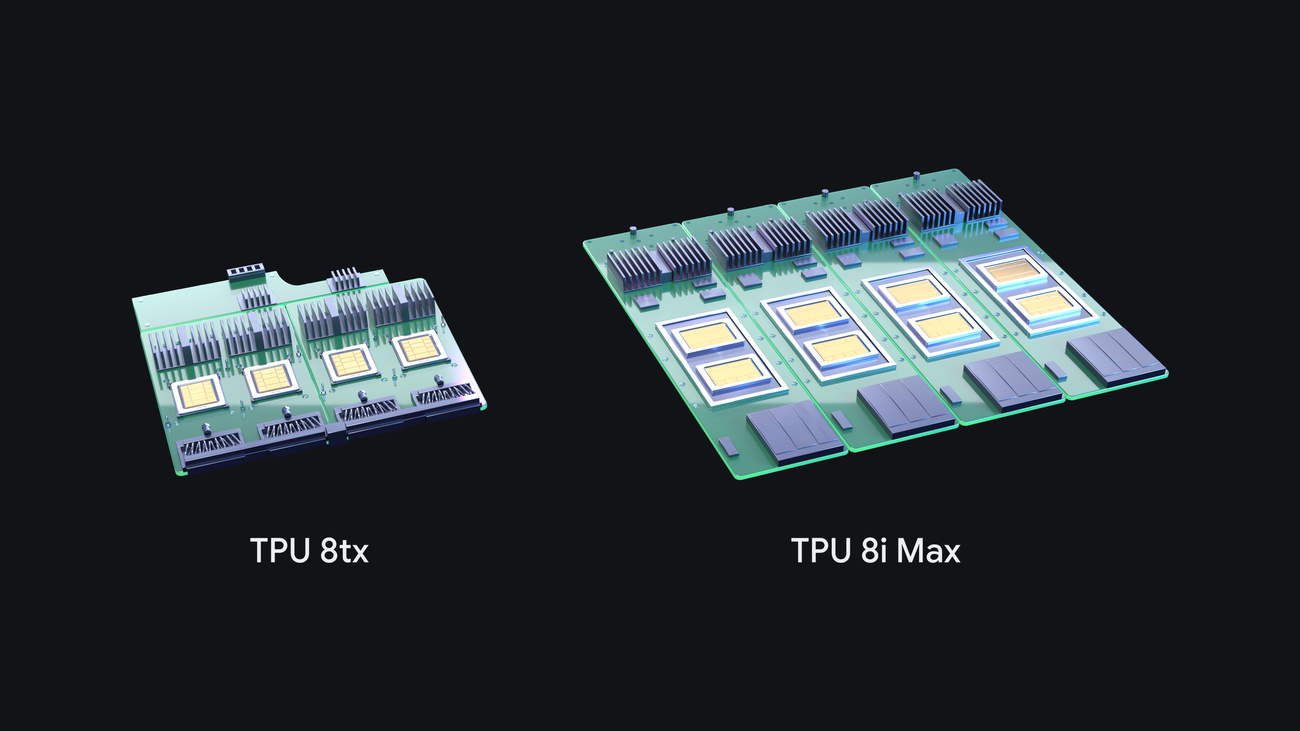
TPU 8i Max takes a different route: it places two TPU 8i inference chips on a single package. Compute, SRAM and memory bandwidth all double as a result.
The launch is Google's fourth TPU system of 2026. TPU 8t and TPU 8i arrived at Google Cloud Next in April. Google says this is the first time it has introduced four TPU systems in one year.
The eighth generation succeeded Ironwood, which SemiAnalysis refers to as TPU v7. Google says TPU 8t and TPU 8i deliver up to twice the performance per watt of that earlier hardware.
TPUs are not a side business for Google. The company uses them to train and serve its own Gemini models, as well as to host customer workloads in Google Cloud.
Amin Vahdat is Google's senior vice president and chief technologist for AI and infrastructure. He framed the additions around agent workloads. He described "two urgent new challenges: hardware-level data security and million-token context scale".
Google illustrated the announcement with an image of the four systems. Data Center Dynamics and The Decoder both label that image as AI-generated.
The company also scheduled a launch broadcast on YouTube under the title The Future of AI Infrastructure. The post pointed readers to the broadcast, scheduled for 9 a.m. PT.
- •TPU 8t: large-scale training, with superpods scaling to 9,600 chips and 121 exaflops.
- •TPU 8i: low-latency reasoning, with 288 GB of HBM and 384 MB of on-chip SRAM.
- •TPU 8tx: confidential inference and small-scale training on TPU 8t silicon.
- •TPU 8i Max: two TPU 8i chips per package for long-context agent workloads.
What is TPU 8tx for?
TPU 8tx is aimed at organizations that cannot let sensitive data sit unprotected in memory. Normal encryption protects data at rest and in transit. Data is decrypted while a processor works on it, which creates a window of exposure.
Google says the new system keeps data and model weights "protected and isolated even while in active use". The protection is built into the hardware layer rather than added by software.
That design suits governments, banks, health providers and other regulated buyers. They want proprietary models and agents next to sensitive records.
The practical benefit is consolidation. A team can fine-tune, distill and run reinforcement learning on the same confidential system that serves the model. Sensitive data does not need to move between clusters.
The host processor also changes. TPU 8t and TPU 8i run on Google's Axion Arm-based CPUs. TPU 8tx pairs its accelerators with 5th Generation AMD EPYC hosts instead, which Google does not explain in the post.
Memory encryption normally carries a cost. Data must be encrypted and decrypted as it moves between processor and memory. Google says the penalty is near zero, but has published no measurements.
Google claims up to 2x lower latency than TPU 8t, with a near-zero performance penalty. The figure is a vendor claim and has not been independently tested.
Confidential computing is not unique to Google. The Decoder notes that Nvidia already offers a comparable feature for GPUs through its confidential computing architecture.
Government interest is easy to explain. AI agents that read contracts, patient records or defense data create a new audit problem. Hardware isolation gives buyers a technical control they can point to.
The harder question is attestation, since buyers will want proof that the encrypted environment is genuine and correctly configured. Google's announcement did not describe those details.
What does TPU 8i Max change for long-context AI?
TPU 8i Max attacks the memory wall. Agents now work across whole codebases, long video files and multi-hour transcripts. Every extra token adds to the key-value cache that must stay close to the processor.
Google's answer is to double the silicon per package. Two TPU 8i chips share one package, so compute, SRAM and HBM bandwidth all grow together.
TechTarget reports that the resulting system carries 768 MB of on-chip SRAM and 17.2 TB/s of HBM bandwidth. Those figures are double the 384 MB of SRAM on a single TPU 8i. Google specified that capacity in April.
Density matters as much as capacity. Google says the package fits twice the silicon into the existing rack footprint. Data centers can therefore add compute per square foot and per watt.
Google argues the design "scales compute and memory in lockstep". In practice, that means large workloads should stall less often while waiting for data.
Long context is the commercial target. A single agent session can now span hundreds of thousands of tokens. Groups of agents multiply the pressure on memory bandwidth.
The key-value cache explains the pressure. A model stores attention state for every token it has read, and that state grows with the conversation. At very long contexts, one chip cannot hold it alone.
Google also claims the highest compute density per rack for this system. Density claims are difficult to compare across vendors, because rack power, cooling and networking all change the result.
Google has not disclosed the HBM capacity of TPU 8i Max, and bandwidth and capacity are different constraints. Buyers will need both numbers before they can size deployments.
The capacity question matters for model sizing. Context windows and batch size both consume HBM, and a faster link does not create more room. Until Google publishes capacity, the 8i Max remains a bandwidth story.
The memory claim also depends on software. Memory tiering, KV-cache offload and disaggregated serving decide how much bandwidth a workload can use.
Why is Google shipping systems instead of chips?
Google's core argument is that system design now matters more than a single die. The company says new chips are bound by physics and multi-year manufacturing schedules.
Systems are different. Packaging, high-speed memory, optical networking and security can be rearranged around proven silicon. Google says that lets it ship specialized supercomputers in months rather than years.
The 8tx shows the pattern. It borrows TPU 8t silicon but adds the Boardfly network designed for low-latency reasoning. That combination supports multi-step agents on encrypted data.
Software is part of the same pitch: Google made Cloud Pathways generally available on Google Kubernetes Engine. The service runs large TPU jobs from a single controller.
GKE dynamic slicing also reached general availability. Google says it cuts job startup time by up to 5x. Fault recovery improves by up to 4.5x through optical circuit switching.
Mark Lohmeyer is Google Cloud's vice president and general manager for AI and computing infrastructure. He made the point during a press briefing. "You can't optimize that infrastructure just by focusing on the chip," he said.
This approach has a cost for buyers, because comparisons become harder. A vendor can improve a system without changing the chip, so peak specifications tell only part of the story.
For operators, the software changes may matter more than the silicon. Faster slice assembly and recovery reduce idle time across fleets that cost millions to run.
It also explains the pace. Google can answer a request for more memory or stricter isolation without waiting for a new manufacturing node.
Google is now using AI in that design loop. It says AlphaChip and Gemini help produce chip layouts in hours rather than weeks. Google calls this a unique differentiator.
Is Google's TPU business really a challenge to Nvidia?
Google says TPUs now serve nearly 100 customers. They include frontier labs, trading firms, retailers and universities. TechTarget reports the figure is above 100 and names Caltech among users.
Anthropic is the largest public example. The company said in April 2026 that it had signed for multiple gigawatts of next-generation TPU capacity. Delivery is expected to start in 2027.
That commitment matters because Anthropic also runs on AWS Trainium and Nvidia GPUs. It treats TPUs as one option in a multi-platform strategy rather than a single dependency.
Demand is shifting toward inference. Patrick Moorhead of Moor Insights & Strategy told TechTarget that "roughly two-thirds of AI compute" now goes to inference. Inference rewards cost per token and latency, not peak training throughput.
Google has spent a year removing software barriers. It open-sourced TorchTPU so PyTorch code and Hugging Face models run on TPUs without rewrites. Backends for vLLM and SGLang are available.
The sales model is broadening too. Google says customers can now deploy TPUs directly into their own data centers, not only rent them through Google Cloud. SemiAnalysis notes that Ironwood can be bought outright as well as rented.
Anthropic's agreement names Broadcom alongside Google, which puts two suppliers behind a single capacity plan. That concentration carries execution risk for a company adding capacity at that scale.
A preview TPU agent suite plugs into Claude Code, Cursor and Google Antigravity. Google says it can diagnose bottlenecks and autotune kernels in plain language.
Independent evidence is starting to appear. SemiAnalysis published third-party InferenceX results in September 2026. It measured Ironwood, the previous TPU generation. Ironwood delivered up to 50% better performance per dollar than Nvidia B200 and B300 systems.
That result covers TPU v7, not the systems announced today. It supports Google's cost argument without proving anything about 8tx or 8i Max.
Nvidia is not standing still. The Decoder notes that Nvidia strengthened its inference position through a licensing and acquihire deal with Groq. Groq confirmed a non-exclusive inference technology license in December 2025.
Google's weakest point remains software depth. CUDA has two decades of tooling and a large developer base. TorchTPU is months old.
What is still unconfirmed about TPU 8tx and 8i Max?
Google did not publish prices or availability dates for TPU 8tx and TPU 8i Max. TechTarget confirmed the omission after the briefing.
The earlier systems are still rolling out. TPU 8t and TPU 8i are due online by the end of 2026, according to TechTarget. Google's April post said they would be available later this year.
Performance figures come from Google: the latency gain, doubled density and near-zero encryption penalty are vendor claims. No independent lab has tested the new systems yet.
Benchmark framing adds another caveat. Google cites InferenceX and AgentX results for its software stack. Those tests cover realistic agentic coding and long-context work, but the configurations matter.
Confidential computing claims are especially hard to audit. Buyers need details on attestation, memory encryption keys and side-channel defences. None of that was in the announcement.
Software maturity is also unresolved. SemiAnalysis lists speculative decoding, disaggregated prefill, KV-cache offloading and multi-turn agent workloads. It describes that work as still needed for external TPU stacks.
The economics are incomplete too. Doubling memory bandwidth per package raises the value of each rack. It also raises the memory content, and Google has not discussed cost per token.
The absence of a launch date is normal at this stage, but it limits what buyers can plan for multi-year regulated workloads.
What should buyers and developers watch next?
Three disclosures would settle most open questions. The first is pricing, including cloud rental rates and purchase options. The second is general availability for each system.
The third is independent benchmarking. Watch for InferenceX and AgentX results produced outside Google, on identical models and serving configurations.
Customer names will matter too. A regulated bank or government agency running production agents on TPU 8tx would be stronger evidence than a pilot.
Anthropic's 2027 build-out is the most visible scheduled test. Multiple gigawatts of TPU capacity must be delivered, powered and operated. Execution risk sits with Google, Broadcom and Anthropic.
Nvidia's response will shape the comparison. Its next inference products and the Groq license will determine whether TPU price-performance gains hold.
Power is the quieter constraint, and Google markets density per watt along with density per square foot. Data center operators will test both claims under real workloads.
For developers, the practical change is access, because PyTorch, vLLM and SGLang support lower the cost of trying a TPU. The decision then turns on price, availability and support.
For Google, the strategic bet is clear: it wants TPUs treated as a platform, not an internal advantage. Shipping four systems in a year is the opening move.