What did Meta acquire, and what does Conductor actually do?
Meta has acquired Conductor, a startup whose Mac app lets engineers run several coding agents at once. Axios reported the deal on 4 November 2026, citing sources familiar with the transaction. Neither company disclosed a price.
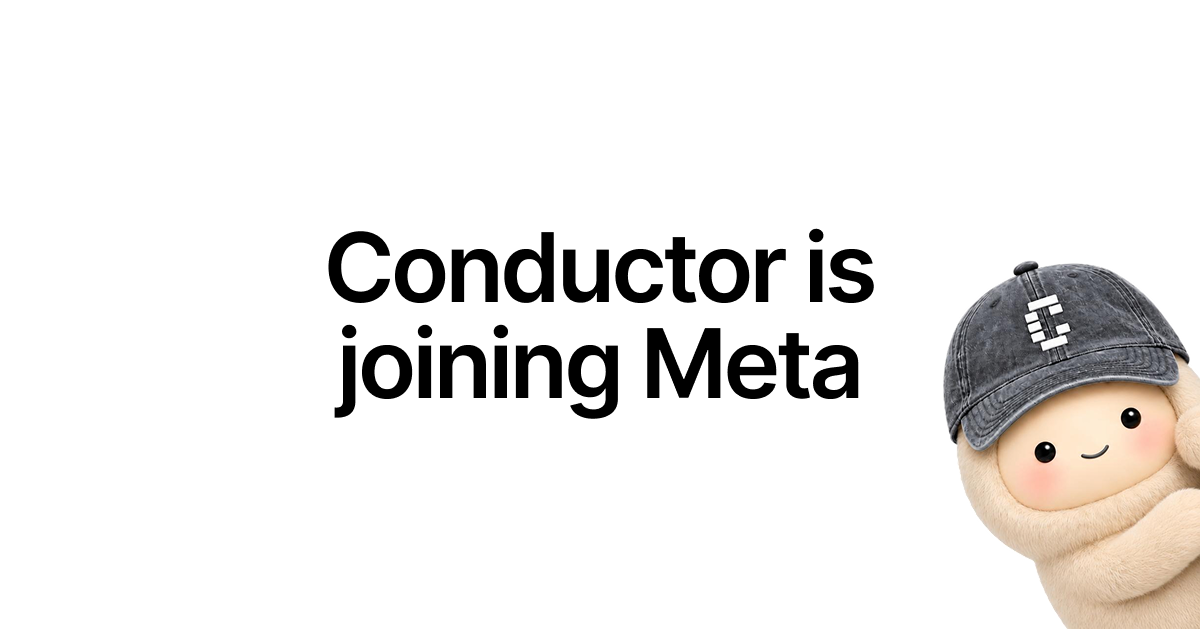
The confirmation came from Conductor itself. The company replaced its changelog with an announcement titled "Conductor is joining Meta" and now signs its site "Conductor from Meta". The message is signed by co-founder and chief executive Charlie Holtz.
Conductor was founded in 2024 and launched its product in July 2025, according to the company. The app is not a model. Instead, it wraps first-party agents such as Claude Code, Codex, Cursor and OpenCode in a shared workspace.
Each workspace gets its own branch, files, terminal, diff and review path. Users bring their own model subscriptions or API keys, then send tasks to agents in parallel. Conductor's homepage says the product is trusted by more than 100,000 builders, a company figure rather than an audited metric.
The product sits above the model. It is a desktop control surface for terminal agents, not an editor with autocomplete bolted on. That distinction shaped both its appeal and its fate.
Conductor's March funding post described the original goal plainly. The team wanted to create isolated copies of a codebase, run agents in each one, and review and merge their work. The bet was that most software would soon be built by AI teams.
Conductor said its users included engineers at Meta, Google, Amazon, Spotify, Datadog and Ramp. Meta was already a customer before it became the owner.
Why is Meta buying a coding-agent orchestrator now?
Coding has become a crucial route to enterprise AI spending. Axios frames the deal as part of a race among model companies to own the tools developers use. Meta wants its models and ecosystem in front of those users.
Meta already sells a model for agent work. TechCrunch reported in September that Muse Spark is intended for operating coding and other agents. Meta priced a contributor tier at about 95% below standard rates for customers willing to share prompts and outputs.
A model alone does not create a daily habit. Conductor supplies the console: dispatch, isolation, review, merge and team visibility. That is the layer where preferences and usage habits form.
The timing is not isolated. On the same day, OpenAI told Axios it would acquire Pierre Computer, a developer-tools startup whose technology is already inside Codex. OpenAI also announced plans in June to buy Ona, which works on cloud coding environments and agent orchestration.
Conductor already had a foothold inside its buyer. Its March funding post said Meta was among the companies with dozens of engineers using the product, alongside Google, Amazon, Spotify and others. Meta now owns the tool those engineers were using.
Owning Conductor gives Meta control of a workflow that already sat inside large engineering teams, including its own. It also gives the company a product team that has shipped orchestration features at a rapid pace.
Conductor also shipped features that reach beyond a single developer. It added multiplayer workspace links and an API for starting sessions. Those features turn a local utility into shared infrastructure, which is the kind of product a platform owner can absorb.
The company has not said how Conductor will be integrated. Its announcement promises a new interface, not a roadmap. "We have some big, crazy plans for the next interface," Holtz wrote.
What happens to Conductor users before the shutdown?
The wind-down starts immediately. New sign-ups and downloads closed on 4 November. Existing free users cannot upgrade, while paying subscribers keep pro features without charge.
Conductor Cloud becomes read-only on 13 November. Customers can read old chats and export data but cannot send new messages. Active subscribers will receive refunds.
The cloud service shuts down on 20 November, and the company says it will begin deleting cloud user data then. Teams that rely on shared workspaces, presence and reassignment need to move before that date.
The local Mac app has a longer runway. It will receive new models and critical bug fixes until early 2027, when it starts winding down. Conductor says it will delete all user data when the app shuts down.
The gap between those dates is the practical story. A cloud workspace holds chats, diffs, Git state and environment configuration. Moving it is not the same as downloading a folder of files.
Conductor says it built a transfer path. The company also says it has never sold or trained on user data. Both claims are worth recording, because the data will be deleted on a fixed schedule.
Refunds apply to active subscribers, according to the announcement. Pro users keep pro features for free, but nobody can create a new account or download the app.
- •Right-click a cloud workspace and choose Transfer to local to copy it, with its chats, to a Mac.
- •Use Settings, then Account, then Export data to download an archive of everything.
- •Export before 20 November, because cloud deletion begins that day.
- •Check .worktreeinclude patterns and setup scripts so restored workspaces can install dependencies.
How does running agents in parallel actually work?
Conductor's isolation model rests on Git worktrees. A worktree is a second working tree attached to the same repository, so each workspace can check out a different branch without cloning the project again.
The app creates workspaces under ~/conductor/workspaces in the user's home folder. Agents edit files, run terminals and execute tests inside that directory. Git history, refs and remotes remain shared, so commits and pull requests work normally.
Git permits a branch to be checked out in only one worktree at a time. Conductor's docs use that rule to keep each branch tied to one workspace. The rule prevents two agents from checking out the same branch, but it also forces teams to name and track branches carefully.
The docs are candid about the boundary. Workspace isolation is "development isolation, not a security boundary". Local agents run with the same file and terminal permissions as the user, and macOS may prompt for access to protected folders.
Cloud workspaces move execution to isolated Linux sandboxes that Conductor's documentation says are hosted by Vercel. The homepage describes Firecracker microVMs, preinstalled repositories and sandboxes that start in seconds. Agents keep running after a laptop closes, until the sandbox sleeps, and teammates can open the same workspace.
The workflow supports two patterns. Separate workspaces suit independent features, bug fixes and experiments that may be discarded. A single workspace with several agents suits review, test repair and changes that must land on one branch.
That distinction matters because parallel agents are not free parallelism. Each stream needs review, tests and a merge decision. The tool organises the work; it does not decide whether the work is correct.
A worktree is cheap to create because it shares the repository's object database. It is not a copy of the whole project, and it is not a container. Files, running processes and installed dependencies still live on the host.
Conductor starts a new worktree from tracked files, so untracked and gitignored files are not copied automatically. Files such as .env.local, local certificates and generated configuration need a .worktreeinclude pattern or a setup script. Miss that step and an agent starts with a broken environment.
Cloud workspaces add their own controls. Each starts from a Cloud Computer build that holds repositories, environment variables, secrets and installed software. New workspaces inherit the latest successful build; existing ones keep the environment they started with.
The API extends the same model to other clients. Conductor's homepage shows session creation through an API, and the docs describe an interface for starting sessions programmatically. That matters for teams that wanted orchestration inside their own internal tools.
What are the limits and risks of agent orchestration?
The first risk is security. A coding agent with local permissions can read environment files, run shell commands and touch anything the user can reach. Conductor's approval prompts help, but teams should assume secrets need scoping before agents run.
The second is cost. Conductor runs agents from providers under the user's own subscriptions or keys. Ten parallel agents can mean ten times the token spend, even if wall-clock time falls. Finance teams should meter this before declaring a productivity gain.
The third is review load. Parallel branches can conflict, duplicate work or drift from the intended design. Without tests and a clear merge owner, the output becomes a queue of plausible diffs rather than shipped software.
The fourth is vendor risk. Conductor raised a $22 million Series A in March and is now winding down its cloud service within weeks. That is a short window for teams that built shared workflows around it.
Some details remain unclear. Meta did not disclose terms, and Conductor has not described the new product beyond a teaser for early 2027. The announcement also gives two data-deletion markers: cloud deletion begins on 20 November, while all data is deleted when the app shuts down in early 2027.
Conductor's usage figures are company-reported. The 100,000-builder figure, the customer list and the growth claim come from Conductor, not from audited disclosures.
Support is another constraint. Closing a cloud service while helping customers migrate is a support burden. The announcement invites users to email for help, but does not promise individual migration assistance.
Compliance teams should also check where data goes. Local sessions send model requests directly from the Mac to the provider. Cloud sessions run in Conductor-managed infrastructure, with requests going to configured providers, MCP servers and integrations.
What does this mean for the AI coding tools market?
The deal shows that orchestration is becoming strategic. Model quality still matters, but the interface that routes work, holds context and reviews changes is where switching costs build.
It also shows consolidation. OpenAI is buying developer-tools companies, and Meta is buying a workflow layer. Smaller orchestration startups now compete with buyers that can bundle the tool into a model subscription.
For developers, portability is the practical lesson. Git branches, plain prompt files and exported chat histories survive a vendor change. A proprietary workspace that lives only in one cloud does not.
Meta's contributor pricing adds a second signal. The company is willing to trade margin for usage data, which suggests the value it sees is not only subscription revenue. How Conductor's data policy fits that strategy is an open question.
The acquisition does not settle which agent wins. Claude Code, Codex, Cursor and OpenCode remain separate products with separate pricing and controls, and Conductor's docs list them as supported harnesses.
OpenAI's Pierre deal points in the same direction. Axios reported that Pierre's technology is already embedded in Codex and framed the purchase as a challenge to GitHub. The battle is not only over models but over where code lives and how it is reviewed.
Procurement teams are also consolidating. Each agent harness brings its own subscription, permissions and audit trail. A single orchestration layer promises one place to review that spend, which is attractive to buyers even when the underlying models change.
Enterprise buyers will ask different questions after this week. They will want exit terms, export formats and a second orchestration option before standardising on any single vendor's agent console.
What should Conductor users and developers watch next?
The first test is execution. Teams should confirm refunds, export archives and test a local transfer this week, not on 19 November. A dry run exposes missing environment files while support is still staffed.
The second is the product Meta builds. Conductor promises "something new" early next year, but has not said whether it will be a Meta-branded app, an internal platform or a feature inside existing Meta tools.
The third is the talent. Holtz and co-founder Jackson de Campos are the public faces of the product. Seeking Alpha reported that both are expected to join Meta; retention and scope will determine whether the orchestration expertise survives the acquisition.
The fourth is the market. If Meta bundles agent orchestration into its developer offering, independent tools will need clearer advantages in review, governance or support for multiple model providers.
A practical migration plan is short. List every cloud workspace, identify the ones with active chats, transfer them to a Mac, run the setup script, and confirm tests pass before deleting the cloud copy.
Two signals will show whether the transition is orderly. One is whether refunds and data exports arrive without support escalations. The other is whether the shutdown dates slip, which would suggest the cloud service is harder to unwind than the announcement implies.
The strategic question is less short. Meta is buying a team that built a product for managing many agents, not a model that writes better code. If that interface becomes part of Meta's developer platform, the acquisition will matter beyond the shutdown.
For now, the concrete facts are narrow. A popular Mac app is closing its cloud service, its team is expected to join Meta, and users have until 20 November to secure cloud data. The larger contest is over who runs the control room for software agents.