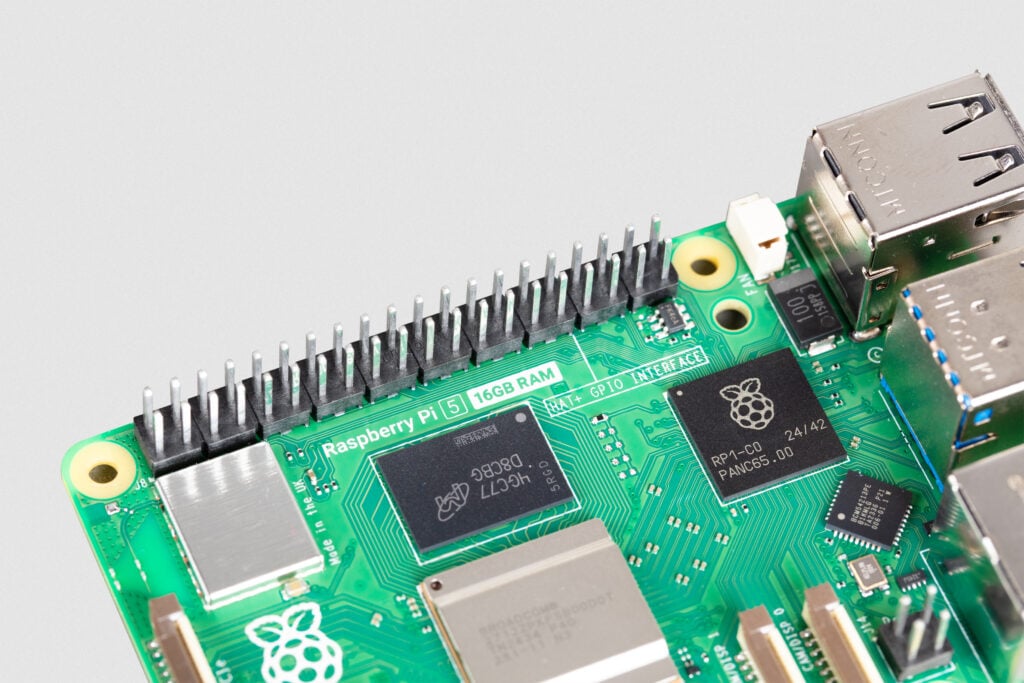
How much does the 16GB Raspberry Pi 5 cost now?
Raspberry Pi raised the price of its 16GB Raspberry Pi 5 by $80 on 2 November 2026. The board now lists at $385, up from $305. The change took effect that day, according to a post by chief executive Eben Upton.
The 16GB model arrived on 9 January 2025 at $120. The first Pi 5 boards, with 4GB and 8GB, were announced in September 2023 at $60 and $80. At $385, the top model costs more than three times its own launch price and nearly five times the 8GB launch price.
Notebookcheck calculates the latest step as a 26 percent increase. That follows several smaller rises across the Pi range over the past two years.
One product escaped the change. Raspberry Pi held the price of the Raspberry Pi 500+, its all-in-one desktop built into a mechanical keyboard. Tom's Hardware lists the 16GB 500+ at $485, unchanged for now. Raspberry Pi said it has avoided blanket increases across the product line.
Upton described the increases as “unavoidable” and said the company knows they are “unwelcome news” for customers. He did not give a date for reversing them.
The list price is not always what shoppers pay. Notebookcheck notes that some retailers still sold the 16GB board below $385 at the time of its report.
Why did Raspberry Pi raise the price of the 16GB model?
Raspberry Pi blames memory. Upton wrote that the company has made selective price increases over the past two years. The rises target products affected by “the steep rises in the cost of memory.”
The specific problem this time is density. Raspberry Pi cited a “lack of alternative supply for 16GB DRAM.” It added that other component shortages are compounding the problem. Qualifying second sources has helped elsewhere, but not for this part.
The 16GB board is not a standard memory configuration. At launch, Raspberry Pi said the model used one package holding eight 16Gbit LPDDR4X dies supplied by Micron. Fewer suppliers make that part, and substitutes are harder to qualify.
The wider market is tight. TrendForce expects DRAM contract prices to rise about 20 percent quarter on quarter in the fourth quarter of 2026. That is slower than earlier gains, but it follows a year of steep increases.
The same research links the pressure to AI demand and limited new supply of mature memory. Older memory types compete for factory capacity with newer, more profitable products.
Samsung expects the squeeze to last. Memory executive Jaejune Kim said on the company's October earnings call that tight conditions would continue in 2028, according to The Verge. Samsung also said its 2027 HBM supply is already sold out.
Samsung reported record quarterly revenue of 195.3 trillion Korean won, about $146.3 billion, in the same call. Memory is currently a seller's market, and the largest suppliers can choose where capacity goes.
HBM matters to cheaper parts because memory makers allocate wafers and packaging capacity to the most profitable products. HBM is built by stacking memory dies next to a processor. That approach uses more silicon and packaging capacity per gigabyte than ordinary memory. When AI accelerators absorb that capacity, ordinary DRAM gets less room to expand.
That gives memory makers a reason to prioritize HBM and newer memory types over the LPDDR4X used on a Raspberry Pi. The Pi is a small customer buying an older part, so it has little leverage when supply tightens.
That is the chain behind a $385 hobby board. AI data centers pull memory capacity upward, contract prices climb, and small buyers pay more for the same part.
Which Raspberry Pi models went up, and which did not?
The 16GB Raspberry Pi 5 is the headline change. It moved from $305 to $385, an increase of $80. This is the most expensive configuration of the board, not the standard one.
The 16GB Compute Module 5 variants moved by $40. The Verge reported that the 16GB modules now range from $375 to $415, depending on configuration. Buyers should confirm the figure for their exact variant.
The 500+ did not move. Raspberry Pi held its price even though the top model has 16GB. Tom's Hardware puts that model at $485.
This is not the first increase. On 1 October, Raspberry Pi raised the 2GB Pi 4 and 2GB Pi 5 by $12.50 each, to $67.50 and $77.50. Tom's Hardware called that round the third price increase of 2026.
The 2GB Pi 5 launched at $50, and its price has risen 55 percent over its lifetime. It now costs just $2.50 less than the 8GB Pi 5 did at launch in 2023.
The 1GB variants and the 2GB Compute Module 4 and 5 stayed unchanged in that round, Raspberry Pi said. Boards with 1GB have not seen recent increases, Tom's reported.
- •Raspberry Pi 5, 16GB: $120 at launch, $305 before 2 November, $385 now.
- •Compute Module 5, 16GB: up $40; the total depends on the variant.
- •Raspberry Pi 500+, 16GB: $485, held on 2 November.
- •Raspberry Pi 5, 2GB: $77.50 after an early October rise.
- •Raspberry Pi 4, 2GB: $67.50 after the same round.
What does a $385 Raspberry Pi mean for makers?
The Pi built its reputation on price. Tom's Hardware notes that generations of the board stuck to a $25 to $35 target for years. A $385 flagship sits far outside that promise.
Buyers are paying more for the same board. Raspberry Pi did not announce a new processor, more storage or a different design alongside the price change. The Pi 5 remains a 2.4GHz quad-core Cortex-A76 board with up to 16GB of memory.
The people most exposed are not casual buyers. Raspberry Pi says the 16GB model suits large language models and computational fluid dynamics. Those uses benefit from more memory per core.
Those workloads need memory capacity, not just a faster chip. A board with 4GB or 8GB can run the same software, but larger models and simulations may not fit. Raspberry Pi also says heavier Linux desktops, such as Ubuntu, benefit from the extra memory.
The 16GB version exists because local models need memory. A smaller board can run a compressed model, but capacity limits the model size and the context it can hold.
Hobbyists are already adapting. Tom's Hardware reports that makers are moving to Raspberry Pi Pico and ESP32 boards for small projects. Others are turning to mini PCs or x86 single-board computers for more performance.
That shift has a cost for Raspberry Pi. The company makes less from a microcontroller board than from a $385 board. That is true even when the cheaper device is enough for the job.
Industrial customers face a different problem. They design products around a specific board, certify it, and buy in volume. Switching to another supplier can take months and require new testing.
The 16GB Compute Module 5 also rose, so industrial buyers cannot simply move to the module version to escape the increase. Lower-density modules remain an option, but they may not meet the memory requirement.
Education buyers are squeezed too. Schools that equipped labs with 16GB boards now face a higher replacement cost, while cheaper models remain available for simpler lessons.
The price is also close to a laptop. The Verge notes that the MacBook Neo now starts at $649 for students with 8GB of memory. A Pi usually needs a case, storage, power supply and display.
For buyers, the Pi is no longer the obvious cheap option at the top of the range. It remains inexpensive at the bottom, where memory density is lower.
Is the memory crunch only hitting Raspberry Pi?
No. The same shortage has reached finished computers. The Verge reported on 28 October that Apple raised the MacBook Neo's education price to $649. That is $150 more than its $499 starting point.
The Neo's regular starting price is now $699, and the $649 education configuration includes 8GB of memory and 256GB of storage. Apple raised the Neo's prices in June, then added another $50 shortly before the October report.
Apple's desktops have not escaped either. Tom's Hardware reported in August that the M6 Mac mini starts at $899 with 16GB of memory and 256GB of storage. The M4 Mac mini started at $599 in October 2024.
If Apple is raising prices on its budget laptop and desktop, smaller buyers have little chance of holding the line.
The Pi is also no longer far from the price of a small desktop. The Verge described the $385 board as “nearing the price of a desktop mini PC”. A mini PC usually includes a case, storage and an x86 processor.
The Pi still has advantages. It offers dual 4Kp60 HDMI outputs, Gigabit Ethernet with power-over-Ethernet support in a separate HAT, and a standard 40-pin GPIO header. It also has two USB 3.0 ports and a PCIe 2.0 x1 lane. Raspberry Pi says the board idles at 2 to 3 watts and draws under 10 watts under full load.
It also offers camera and display connectors that industrial add-ons rely on. Those features can matter more to buyers than raw benchmark scores.
A mini PC offers more CPU and GPU performance, more storage, and compatibility with standard Windows and Linux software. For a desktop replacement, that often matters more.
The right choice depends on the job. A home server, sensor gateway or robot controller may not need x86 power. A workstation running a local model or compiling large projects may.
Buyers should compare total cost. A Pi needs a microSD card or SSD, a power supply, a case and cooling. Those extras add to the sticker price and narrow the gap with a mini PC.
The comparison is also about availability. Retailer discounts vary, and Notebookcheck found the 16GB Pi below list price on announcement day.
When will Raspberry Pi prices come down?
Raspberry Pi says prices will come down. Upton wrote that the memory landscape is “difficult but ultimately temporary”. He said the company looks forward to rolling back increases when memory costs fall.
He gave no timetable. The company has not announced any rollback yet, and the direction of travel since January 2025 has been upward.
The pattern is established. Raspberry Pi raised prices in April and October, then again in November. Another selective rise is plausible if memory costs keep climbing.
Industry forecasts are not encouraging. Samsung expects tight supply in 2028, driven by AI demand. TrendForce sees DRAM contract prices rising again in the fourth quarter of 2026, though at a slower pace.
New capacity takes time. Fabs and packaging lines are planned years ahead, and memory makers prefer high-margin products when capacity is scarce.
There are limits to this story. Raspberry Pi is a small buyer, and its list prices are not a forecast for laptop or phone prices. The company also chose to protect the 500+ and leave 1GB boards alone.
The 16GB board is a niche product. Buyers who need less memory can still choose a cheaper model, and Raspberry Pi is encouraging them to do so.
What to watch next: DRAM contract prices in the first quarter of 2027 and Samsung's HBM capacity plans. Raspberry Pi's next move on prices is the other signal.
What should buyers do now?
Buy only the memory you need. That is Raspberry Pi's own advice. Upton asked customers to “make sure you're not paying for more memory than you need.”
Check the exact configuration before ordering. A 16GB board and an 8GB board can run the same project, but only one fits a large model in memory.
Consider an older board. Raspberry Pi's October post pointed to older models as lower-cost options. It named the Pi 3B, 3A+ and 3B+ for projects that do not need Pi 5 performance.
Buy from an Approved Reseller. Raspberry Pi warned that some sellers are charging inflated prices or advertising boards with more memory than they contain.
For industrial buyers, talk to Raspberry Pi directly. The company offers advice on memory optimisation for business customers.
Watch the reseller price, not just the list price. On 2 November, some retailers still sold the 16GB board below $385.
List prices exclude local taxes, and shipping can add more. Check the delivered cost before comparing a Pi with a mini PC or laptop.
Expect more selective increases if memory stays tight. The pattern so far is targeted rises on high-density products, not across-the-board changes.
The underlying question is simple. If AI demand keeps absorbing memory capacity, the cheapest computers will keep getting more expensive.