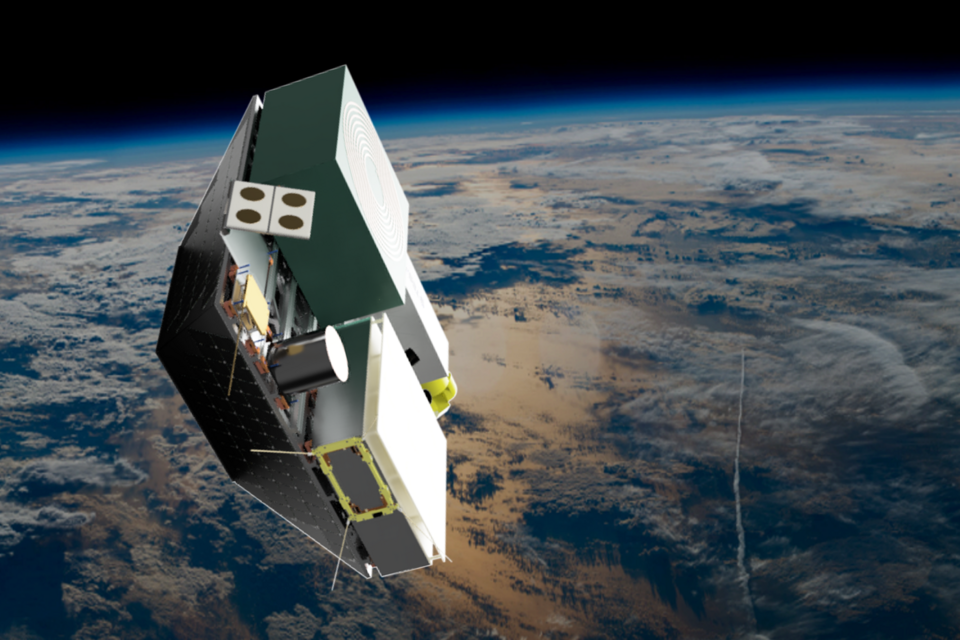
What is the Titania satellite?
The Ministry of Defence announced on 7 November that Titania, a British-built military satellite, is in orbit and will be operated by UK Space Command. The spacecraft is the second in a planned constellation of intelligence, surveillance and reconnaissance satellites. It joins Tyche, launched in 2024, and will be followed by Juno and Oberon.
The launch itself happened earlier. Titania reached orbit on 1 October 2026 aboard a SpaceX Falcon 9 rideshare, the Transporter-18 mission, from Vandenberg Space Force Base in California. The MOD says the launch was completed "last month"; it did not explain the five-week gap between the launch and the public announcement.
Titania is small. The MOD puts its mass at around 100kg and compares its size to a washing machine. It circles Earth every 90 minutes at roughly 27,000 km/h. The Gunter's Space Page database lists a slightly lower mass of about 80kg and identifies the spacecraft as a Faraday bus built by In-Space Missions, which BAE Systems later acquired.
The MOD says Titania was designed and built in Hampshire by the Defence Science and Technology Laboratory and BAE Systems under a £9.5 million contract. That is a modest sum for a satellite. The larger ISTARI programme, which owns the constellation, is valued at £968 million in earlier government documents.
Titania follows Tyche, the first satellite in the constellation, which launched in 2024. The MOD has not said when Juno or Oberon will fly. When all four are in orbit, the UK will have a small but sovereign chain of sensors, ground systems and tasking.
What will Titania actually do in orbit?
The MOD's description of Titania focuses on Earth observation. It says the satellite will improve the Armed Forces' ability to observe military activity on Earth from space and help troops coordinate operations. Air Chief Marshal Sir Harv Smyth says observing Earth from space is "critical to both national resilience and military advantage."
Launch records add a second purpose. Gunter's Space Page says Titania is intended to demonstrate high-rate space-to-ground optical communications for MINERVA, a programme that underpins ISTARI. It says optical links can provide several gigabits per second and improve the resilience and capacity of military satellite communications. The MOD's own release does not mention a laser or optical payload.
That omission leaves two readings. Titania may be an observation satellite that also carries a communications demonstrator. Or it may be a technology testbed whose data links support the wider ISR constellation. The public record does not settle the question, and the MOD has not published a payload manifest.
Optical links use narrow, tightly pointed beams rather than wide radio broadcasts. That can offer higher data rates and a smaller interception footprint, but it demands precise pointing and a clear path to a ground station. For a small satellite sending imagery to analysts, the downlink can matter as much as the camera.
MINERVA was set up as an operational concept demonstrator. A 2022 government release said it would show the UK's ability to "autonomously collect, process and disseminate data" from UK and allied space assets. It received £127 million over four years and was meant to underpin the larger ISTARI programme.
Titania is not a weapon. The MOD describes it as an observation satellite, and neither the official release nor the launch database lists a weapon payload. Its role is to gather and move information, not to attack other spacecraft.
Why is the UK building its own military satellites?
Britain's military space ambitions are not new, but they are accelerating. UK Space Command was established in July 2021 to lead defence space operations. Tyche, the first satellite in the constellation, launched in 2024. Titania is the second, and two more are planned.
Two more satellites are in development. Juno is being built with SSTL and Oberon with Airbus Defence and Space. The MOD has not published launch dates for either. The aim is a sovereign chain: UK-operated satellites, UK ground systems and UK tasking, rather than dependence on allied or commercial imagery.
The industrial argument is part of the case. Titania was built in Hampshire. BAE Systems says the programme highlights "the strength of the UK's sovereign space capability." Dstl says it was involved from the original concept through to launch. The supply chain also includes In-Space Missions, SSTL and Airbus.
The strategic argument is simpler. Space underpins weather forecasts, financial transactions, navigation and mobile connections, as Defence Secretary Wes Streeting noted. Military operations rely on the same services. A country that cannot see what happens in orbit, or move data from its own sensors, depends on others for basic situational awareness.
Sovereign satellites give London its own tasking queue and a stronger position in allied planning. Countries that contribute sensors tend to get more say over what those sensors collect. That is part of the logic behind ISTARI, even if the UK constellation remains far smaller than those of the United States or China.
The MOD also frames the programme as an economic one. Streeting says Titania and Inaros are "British-built and British-designed" and support highly skilled jobs. BAE and Dstl make similar points. Those claims are hard to test without contract-level data, but the work is clearly distributed across UK sites and suppliers.
What is Project Inaros and how does it watch for threats?
Project Inaros is the other half of the 7 November announcement. The MOD is trialling three ground-based sensors designed to monitor activity in space. The sites are in the UK, Australia and British facilities on Cyprus.
The sensors were developed by Optera, a British-Australian company backed by the National Security Strategic Investment Fund. The MOD describes them as neuromorphic: they mimic biological processes by detecting changes in light. Optera says its event-based sensors and AI analytics work "more like the human eye than a traditional camera", capturing only changes in a scene.
That design has practical benefits. It reduces the data and power needed to track fast-moving objects, especially in difficult lighting. Optera says the technology already has several years of on-orbit heritage. The company raised £3 million to scale its UK headquarters and engineering team.
The trial is meant to feed UK Space Command's space-warning units. The MOD names No. 1 Space Operations Squadron, No. 2 Space Warning Squadron and the new No. 3 Space Effects Squadron. The sensors could eventually become an early-warning system for unusual or threatening activity near UK satellites.
Ground sensors are a sensible first step. They are cheaper than dedicated surveillance satellites, can be upgraded, and can cover orbits that are hard to see from a single site. But three fixed sites cannot see everything. Weather, geography and the limited number of sensors will shape what Inaros can detect. The MOD calls it a trial, not an operational system.
Space domain awareness is also a collision-avoidance problem. Operators need to know where objects are, where they are going and whether a manoeuvre is deliberate. The MOD's release frames Inaros around threats, but the same data can support safety and traffic management.
How much is the UK spending on military space?
The money is spread across several lines. The MOD says more than £3 billion will be spent on space capabilities over the next four years. That sits inside a Defence Investment Plan worth £298 billion over the same period. ISTARI accounts for £968 million, and MINERVA for £127 million over four years.
Titania's £9.5 million contract is a small fraction of that. The satellite is a pathfinder, not the main event. The expensive parts are the ground segment, the follow-on satellites, the data processing and the people who turn imagery into intelligence.
Budget figures are commitments, not receipts. The £3 billion is a four-year envelope, and the £298 billion plan covers the whole defence programme. Spending can slip between years, and the MOD has not published a year-by-year breakdown for Titania or Inaros.
Even so, the direction is clear. The Strategic Defence Review identified space as increasingly vital to national security and daily life, according to the MOD. The 7 November release ties Titania and Inaros to that judgment. Space is no longer a niche domain in British defence planning.
The spending also buys alliance credibility. Australia hosts an Inaros sensor, and Cyprus hosts another at a British facility. Those sites give the UK data from three countries and make the programme easier to integrate with allied networks. They also create dependencies that the MOD will need to manage.
What are the limitations and risks?
The first limitation is coverage. A satellite in low Earth orbit completes a circuit every 90 minutes, but it does not stare at the same spot. A single spacecraft cannot provide persistent surveillance of a crisis. Constellations solve that problem by adding satellites and timing their orbits. The UK is building toward four.
The second is transparency. The MOD has released a mass figure, an orbit period and a speed, but not imagery resolution, swath width or tasking details. The mass figures do not even agree: the MOD says about 100kg, while Gunter's lists about 80kg. That is normal for military space programmes, but it limits independent assessment.
The third is launch dependence. Titania reached orbit on a SpaceX Falcon 9 rideshare from California, rather than a UK launcher. Rideshare is cheap and reliable, but it ties launch timing and orbit to the provider's schedule.
The fourth is the ground chain. A satellite is only useful if its data reaches analysts and decision-makers in time. The UK is building ground systems and squadrons, but Inaros is still a trial. The MOD has not said when the sensors will become operational or how their data will be fused with other sources.
The fifth is the threat environment. The MOD's rationale for Inaros is that satellites face unusual or threatening activity. NSSIF describes space as "increasingly congested and contested." Jamming, dazzling, cyber operations and debris can all degrade a constellation. A small satellite has less redundancy than a larger platform.
None of this makes Titania pointless. It makes it a first step. The value of a pathfinder is to prove the bus, the payload, the launch integration and the ground chain before the UK commits to a larger constellation. The risk is that the pathfinder becomes the endpoint if budgets tighten.
What happens next?
The next milestones are Juno and Oberon. Juno is being developed with SSTL and Oberon with Airbus Defence and Space. The MOD has not announced launch dates. Both will matter more than Titania for coverage, because a constellation needs multiple satellites in complementary orbits.
Project Inaros has its own test programme. Three sensors in the UK, Australia and Cyprus will generate data on how well event-based sensing works for space domain awareness. The results will shape whether the MOD buys more sensors or moves to a different architecture. No timetable has been published.
UK Space Command is also standing up No. 3 Space Effects Squadron. The MOD names the unit among those that will use Inaros data. It has not published the squadron's full role, so its mission should be treated cautiously.
The wider question is whether the money buys a real capability. Four small satellites and three ground sensors will not replicate the scale of US or Chinese constellations. They can give the UK a sovereign core, a seat at allied tables and a testbed for technologies such as optical links and neuromorphic sensing.
For now, the public evidence is a satellite in orbit, a £9.5 million contract and a trial of three sensors. The claims about strategic effect will need to be tested against imagery, tasking records and trial results that the MOD has not yet released.
The near-term signal to watch is disclosure. If the MOD publishes Titania's first imagery, confirms its optical payload and sets out how Inaros data will be used, the programme will be easier to assess. If it does not, the UK's military space build-out will remain a promise measured mostly by press releases.