What did Trump's robotics proclamation actually do?
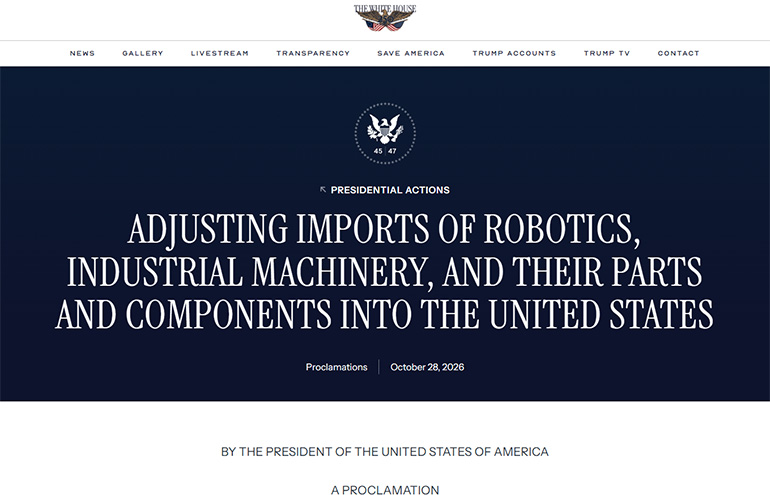
On October 28, 2026, President Donald Trump signed a proclamation under Section 232 of the Trade Expansion Act of 1962 covering robotics, industrial machinery and their parts and components. The document accepts the Commerce Department's finding that those imports threaten to impair US national security. It does not impose a single new duty.
Instead, it directs the commerce secretary and the US trade representative to negotiate agreements with trading partners. The two officials must report progress within 180 days of signing. That puts the first formal checkpoint around April 26, 2027.
The proclamation is explicit that tariffs stay on the table. It describes negotiations as the opening step of a plan of action that can also include tariffs, duties, quotas and fees. It adds that the president may take further steps if an agreement is not reached, not carried out or ineffective within those 180 days.
The White House fact sheet presented the move as an effort to strengthen American industry. It placed the robotics action alongside earlier Section 232 measures on steel, aluminum, copper, automobiles, trucks, timber and lumber, semiconductors, pharmaceuticals, polysilicon and drones. Those earlier cases generally ended in duties. This one has not.
Two omissions matter. The proclamation contains no product list, no tariff schedule and no effective date. It also does not include the Commerce Department report behind the finding. The specific tariff lines officials might eventually adopt therefore remain unpublished.
The file has been open for a while. Commerce began the investigation on September 2, 2025, and published its request for public comments on September 26, 2025. The comment window closed on October 17, 2025, and the docket recorded 277 submissions. The proclamation says the secretary sent his report to the president within the past 90 days.
The immediate effect is procedural rather than financial. Importers face no new cost today, but they now operate inside a defined window in which the terms of access to the US market can change.
One clause deserves attention. Section 232 permits a plan of action with adjustments over time, and the proclamation invokes that structure. It also supersedes earlier proclamations and executive orders to the extent they conflict. That language keeps the option of a phased schedule rather than a single rate.
Why does Washington treat imported robots as a security risk?
The rationale rests on three claims: economic scale, defense dependence and cybersecurity. Each is stated in the proclamation itself, which draws on the commerce secretary's investigation.
On scale, the document says robotics and industrial machinery support roughly $7.1 trillion in shipments of manufactured goods in 2024. It puts the value of equipment produced that year at about $86 billion.
On defense, it argues that nearly all modern defense systems and critical infrastructure sectors need robots or industrial machinery to function. Industrial robots and machines produce parts used across all 16 US critical infrastructure sectors, according to the finding.
The text names advanced robots directly. It lists autonomous robots, humanoid and quadruped robots, and autonomous ground vehicles as systems that support US troops. The tasks cited include intelligence, surveillance and reconnaissance, casualty extraction, and mine detection and clearing.
The defense industrial base argument goes further. The proclamation says missiles, aircraft and ships are built with automated machinery, that repetitive tasks can run with minimal error, and that the ability to surge production during conflict depends on industrial robotics.
On security, it warns that machinery sourced from foreign entities routinely processes and stores sensitive data. That creates cyber vulnerabilities with severe consequences, the finding says.
The most consequential admission concerns capacity. The United States produces less robotics and industrial equipment than it consumes, the proclamation states. It relies on imports for most types of robots, machinery and their components, and it underuses the capacity it has.
The document adds that the value of these imports has risen over the last decade and is projected to keep rising. That projection is what turns a trade statistic into a security argument.
Industry executives make a similar point from the factory floor. Robert Little, a former chief of robotics strategy at Novanta, said the country still has limited industrial robot manufacturing. He expects more investment announcements and argues the weakest link is the component supply base.
Which robots and companies are affected?
The category is broad and loosely bounded. The phrase used throughout is robotics, industrial machinery, and their parts and components. The proclamation does not define which machine types fall inside it, and it names no company or country.
Industrial machinery is illustrated rather than listed. The examples given include construction equipment, electronics, medical devices, metal fabrication, motor vehicles and aircraft.
The supply side is concentrated abroad. The Robot Report notes that most major industrial automation providers are based overseas. It names FANUC, Teradyne Robotics and Yaskawa as companies that have already announced investments aimed at expanding US robot manufacturing.
EqualOcean points out what the document does not do. The proclamation creates no company-specific sanctions, procurement bans or investment restrictions. For Chinese robotics exporters, the near-term change is uncertainty over future market access rather than an announced duty.
Components may matter more than finished machines. Little told The Robot Report that the biggest gaps sit in the domestic supply of sensors, actuators, precision gears and encoders. He described that component base as the area needing the most help.
Humanoid and quadruped machines appear in the security reasoning but not in any specific measure. They are named as defense-relevant systems, which puts them inside the policy conversation without giving them a defined tariff category.
The scope question is not academic. A dutiable list has to be written in tariff codes, and the phrase parts and components can reach gearboxes, servo drives and controllers as easily as complete arms. EqualOcean lists product coverage, country treatment and implementation dates as the milestones ahead.
That leaves suppliers and buyers with a planning problem rather than a price change. Contracts signed now do not know which side of a future list their equipment will land on.
How large is the US robot market, and who supplies it?
The International Federation of Robotics published its World Robotics 2026 report on September 24, 2026. It counted 5 million industrial robots operating in factories worldwide in 2025, up 9%. Annual installations rose 11% to more than 600,000 units.
China installed 354,000 units in 2025, up 20% year on year, for 59% of global deployments. Chinese manufacturers also outsold foreign suppliers at home, with 195,000 installations and a 55% domestic market share, down from 57% a year earlier.
The United States passed Japan to become the second-largest market. US installations reached almost 38,500 units, up 12% and the third-highest total in the history of the statistics.
Japan installed 36,219 units, a drop of 19%, and slipped from second to third worldwide. South Korea held fourth place with 30,000 units, down 1%, a level it has roughly maintained since 2019.
Europe was weaker. Germany, the largest European market and the source of 41% of EU installations, fell 8% to fewer than 25,000 units. Italy dropped 11%, France 8% and Spain 15%.
Elsewhere the picture is mixed. India installed almost 10,500 units, up 15%, to rank sixth behind Germany. Mexico fell 7% to fewer than 5,200 units, while Canada rose 5% to almost 4,000 and Brazil jumped 38% to almost 4,300.
Robot density tells a different story. IFR's preliminary US figures put the country at 307 industrial robots per 10,000 manufacturing employees, eighth worldwide and up two places. South Korea stood at 1,220, Germany at 449, Japan at 446 and China at 166.
IFR expects global installations to reach 655,000 units in 2026 and 806,000 in 2029. It reports that the strongest growth is taking place in Asia, followed by the Americas.
Read together, the figures explain the attention. The United States is one of the two largest buyers of industrial robots, produces far less than it uses, and competes with a country that installs roughly ten times as many units each year.
What happens if no deal is reached in 180 days?
The proclamation sets a single hard date. The commerce secretary and trade representative owe the president an update 180 days after October 28, 2026, which falls in late April 2027.
If talks stall, the available remedies are broad. The operative section says the president may consider imposing or modifying tariffs, duties, quotas and fees. It also raises the possibility of a program to incentivize new investment in US production of robots, machinery and parts.
A later paragraph points to 19 U.S.C. 1862(c)(3)(A). According to the proclamation, that provision allows further action when an agreement is missing, unimplemented or ineffective.
Analysts caution against reading the document as an immediate tariff. Ash Sharma, vice president of research at Interact Analysis, said the investigation should not be read as a new robotics tariff. He called it a clear indication of the direction of travel.
Sharma added that tariffs, quotas or other measures could affect supplier competitiveness, pricing and manufacturing localization. Those effects would reach the components that go into robots, not only finished machines.
The proclamation does not name the trading partners. It leaves that choice to the commerce secretary and the trade representative, who may approach any partner they consider appropriate. That keeps Japan, the European Union, South Korea and China inside the same undetermined process.
The Robot Report's reading is that experts expect negotiations before any tariffs. That sequencing differs from the earlier actions the fact sheet describes, which imposed or strengthened duties on the goods named.
For buyers, the practical exposure is timing. Factory automation is planned years ahead, and a duty that takes effect after a plant has ordered its line changes the cost of a project already in motion.
How does this fit the wider Section 232 agenda?
Robotics is the latest entry in a long list. The fact sheet says the administration has used Section 232 to impose and strengthen tariffs on steel, aluminum, copper, automobiles, trucks, timber and lumber, semiconductors, pharmaceuticals, polysilicon and drones.
The White House's own related-actions list shows the pace. A Section 232 proclamation on wind turbines and their parts was issued on October 22, 2026, six days before the robotics document. Fact sheets covering commercial aircraft and jet engines, timber, and automobiles sit in the same list, dated July 2026, December 2025 and March 2025.
The robotics case differs in one respect. According to the fact sheet, the earlier actions imposed or strengthened duties on the goods named. This proclamation stops at negotiation, which is why importers describe it as a warning rather than a new cost.
The White House also presents the approach as an investment tool. The fact sheet says negotiations and tariffs have secured trillions in private and foreign investment while diversifying supply chains. Those totals are not broken down in the document.
For robotics, the investment evidence is narrower and comes from companies rather than the government. FANUC, Teradyne Robotics and Yaskawa have announced US expansions, according to The Robot Report, and Little expects more announcements to follow. None of those commitments is quantified in the reporting available.
The sequencing carries its own risk. A negotiated outcome would produce country-specific agreements with named terms. A failure would produce a tariff schedule written later, after the review, with less notice for the factories that depend on imported equipment.
What is the robotics industry watching next?
Executives welcomed the signal while noting that nothing is settled. The next phase is negotiation, and the outcome depends on deals that have not started.
Brendan Schulman, vice president of policy and government relations at Boston Dynamics, described the sequence on LinkedIn. He said the federal government would negotiate over the next six months, then consider other trade measures. He also noted that the Special Competitive Studies Project's robotics commission reached similar conclusions.
Little focused on the supply chain rather than the tariff question. He said the United States still has limited industrial robot manufacturing and expects more investment announcements. His concern is the component layer, where domestic capacity is thinnest.
The policy backdrop stretches beyond one proclamation. The Robot Report links the investigation to concerns about China and to recent FCC restrictions on robotics equipment, which sit outside trade law.
Industry groups have their own proposals. A3, the North American automation association, published a Vision for a National Robotics Strategy. According to IFR, it calls for a federal robotics office, a national commission, tax incentives, workforce retraining, updated safety standards and a federal mandate to buy domestic robotics.
Four signals will show where this goes. Watch whether the two agencies name specific partners in the coming months. Watch whether the FANUC, Yaskawa and Teradyne investments move from announcements to production. Watch whether humanoid imports receive separate treatment. And watch the April 2027 update, the first point at which duties, quotas or fees could become concrete.