Reported by ScienceDaily
Mars may not be as geologically inactive as it appears. New evidence from mysterious gas emissions near an enormous Martian volcano suggests that heat and volcanic processes could still be present deep beneath the planet's surface.
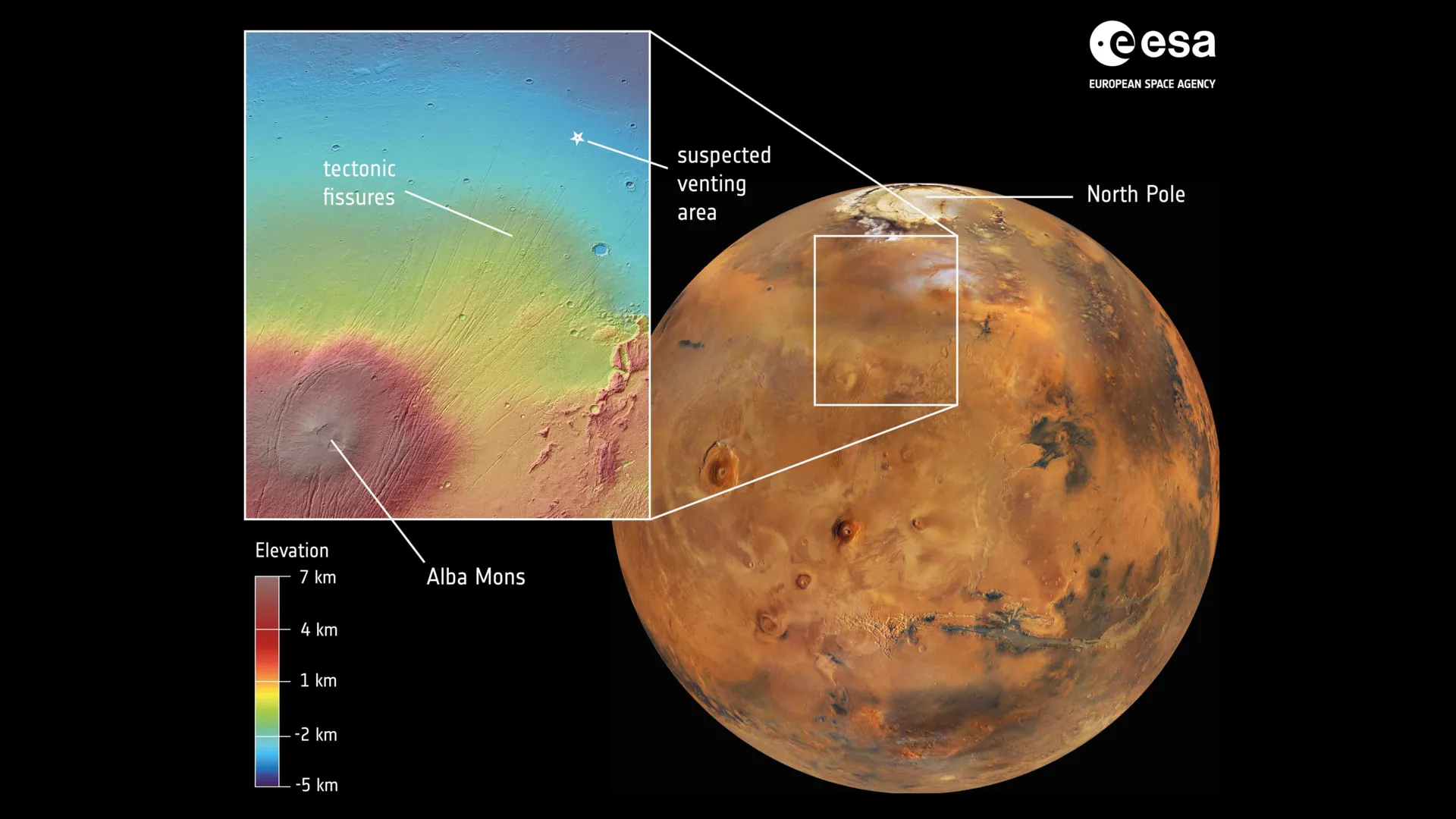
Researchers have identified unusual concentrations of hydrogen chloride gas above fractures in the Alba Mons volcanic region. The findings suggest that gases from the planet's interior may be escaping through cracks in the surface, potentially revealing volcanic activity that has remained hidden until now.
An international team led by Alexander Trokhimovskiy believes the gas could originate from hot magma underground. If confirmed, this would indicate that Mars still has dormant volcanic systems capable of releasing gases to the surface.
More from the original report
The European Space Agency's ExoMars Trace Gas Orbiter (TGO) first detected hydrogen chloride in the Martian atmosphere in findings reported in 2021. On Earth, hydrogen chloride is frequently released through openings connected to magma, raising the possibility that similar processes could be occurring on Mars.
"Our findings suggest that Mars has retained enough internal heat to support volcanic activity until recently, and possibly still does," says Daniel Mège, Professor at the Space Research Centre of the Polish Academy of Sciences and co-lead author of the study published in Science Advances .
The researchers noticed something unusual during early summer in the Martian northern hemisphere. Hydrogen chloride concentrations were unexpectedly elevated in a particular region, even though the gas normally becomes scarce at that time of year.
Hydrogen chloride levels on Mars generally follow a seasonal cycle. They typically peak during northern winter before declining to very low levels in summer. Scientists believe much of this behavior is associated with the planet's dust and water cycles.
However, the observations revealed a striking exception. Elevated hydrogen chloride repeatedly appeared in early summer over volcanic fractures on the slopes of Alba Mons. The unusual timing and consistent location suggested that something beyond ordinary atmospheric chemistry might be responsible.
Mars is home to the largest volcanoes in the Solar System, but scientists still do not know whether volcanic processes remain active beneath their surfaces.
Images taken from orbit indicate…