Reported by ScienceDaily
NASA's Juno spacecraft has uncovered remarkable new details about how Jupiter withstands the constant stream of high-energy particles flowing from the Sun. The findings reveal that the solar system's largest planet relies on a much more complex system of plasma waves and shock regions than Earth does.
Led by scientists at the University of Iowa, the research provides the most detailed observations yet of Jupiter's bow shock, an invisible boundary where particles from the Sun encounter the planet's magnetic environment. The discovery reveals important differences in how Jupiter and Earth respond to these incoming particles.
Beyond Jupiter, the results could also help scientists understand some of the most powerful events in the universe, including the extreme shock waves associated with exploding stars.
More from the original report
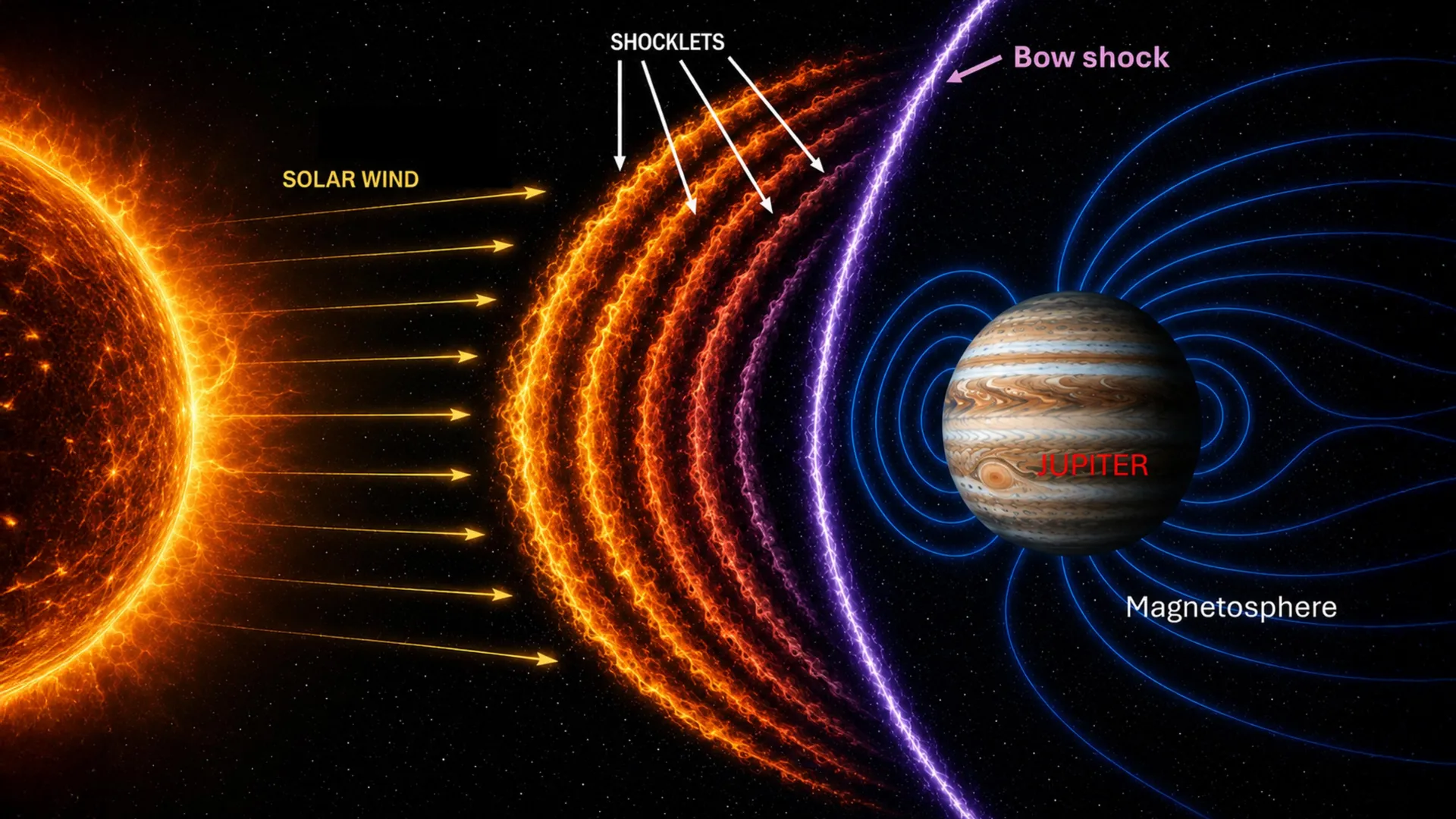
The Sun continuously releases a stream of electrically charged particles called the solar wind. These particles travel through space at tremendous speeds, often faster than the speed at which sound waves move through the surrounding plasma. When the solar wind approaches a planet with a magnetic field, it encounters a boundary known as the bow shock.
At Earth, this boundary plays an important protective role. It slows and heats the incoming particles, helping redirect much of the solar wind around the planet. Without this process, more harmful particles could reach Earth's atmosphere, potentially making conditions less favorable for life.
Jupiter also has a bow shock, but its enormous size, powerful magnetic field, and gaseous composition make it a particularly interesting place to study how these boundaries behave. Scientists have long wanted to understand whether Jupiter handles the solar wind differently from Earth and what those differences might reveal about other objects throughout the universe.
Using measurements from Juno, researchers discovered that Jupiter relies on plasma waves with multiple frequencies to slow and heat incoming solar particles. These different frequencies, known as "harmonics," create a more elaborate wave pattern than the one typically observed at Earth.
The process can be compared to music. Just as several notes played together produce a richer sound than a single note, plasma waves containing multiple frequencies can interact with incoming particles in more…