Reported by ScienceDaily
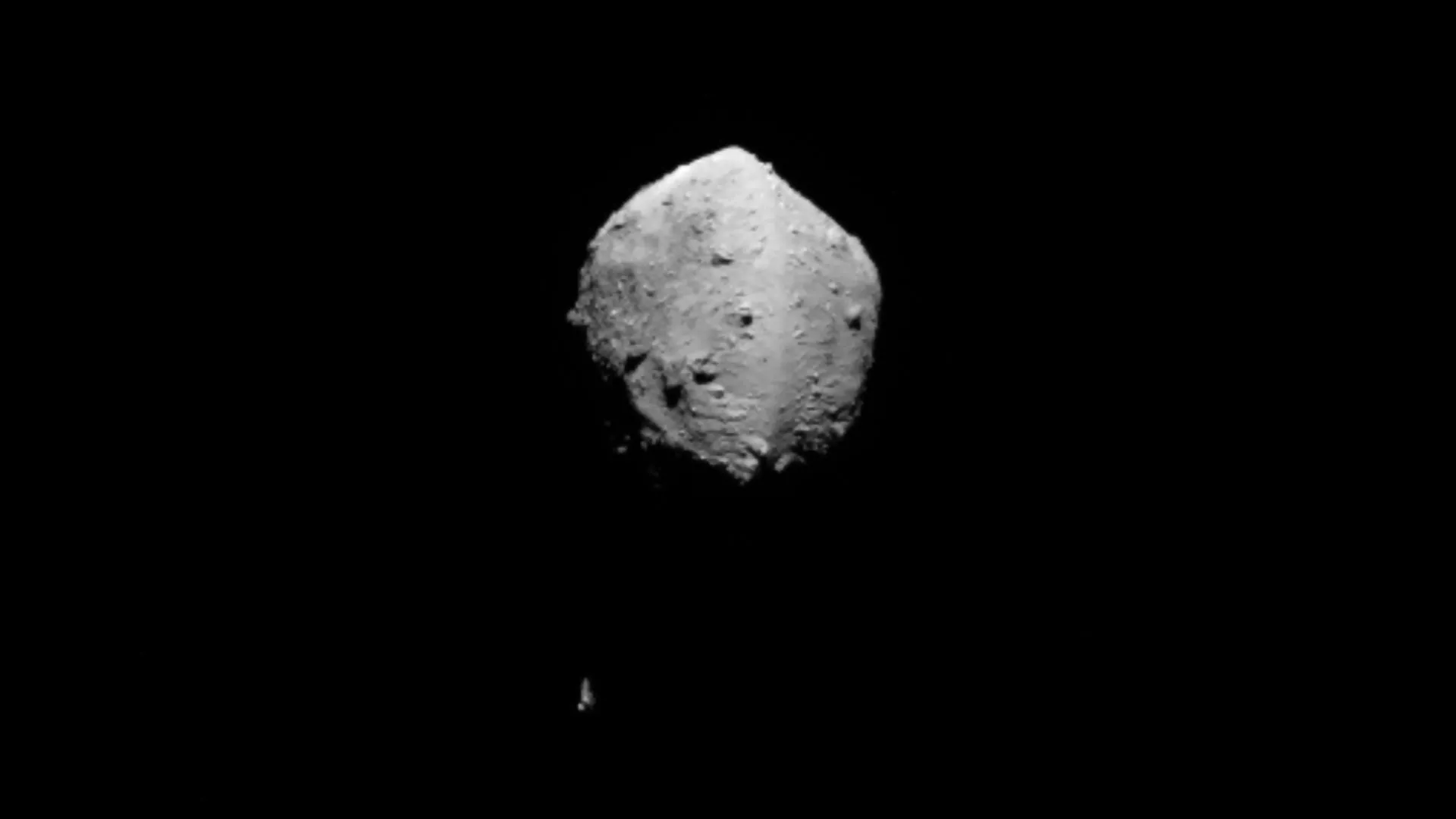
The European Space Agency's (ESA) Hera spacecraft has captured its first close-up image of the Didymos asteroid system, offering scientists a surprising new perspective on the site of NASA's historic asteroid deflection experiment.
On September 26, 2022, NASA's DART spacecraft deliberately crashed into Dimorphos, the smaller of the two asteroids in the system. Hera's latest image provides a look at its larger companion, Didymos, from a side that scientists had not previously seen in such detail.
The image was taken from a distance of 60 km using Hera's monochromatic Asteroid Framing Camera, which captures images in black and white. Although most of Dimorphos, which measures 151 m across, is concealed in shadow, the much larger Didymos, with a diameter of 780 m, is clearly visible.
More from the original report
"The first thing we said was wow!" observes Hera Principal Investigator Patrick Michel, Director of Research at CNRS / Observatoire de la Côte d'Azur. "This is the other side of Didymos from the one that DART's camera showed us shortly before impact, so this feels like looking at a whole new world.
"This side of Didymos has the same central ridge along its equator that we saw before, but otherwise appears very different, with multiple boulders and craters and what look like patterns of grooves or ridges."
The newly revealed terrain raises intriguing questions about how the asteroid's surface developed and whether NASA's collision with Dimorphos may have left traces on its larger neighbor.
When DART struck Dimorphos, the impact sent material flying into space. Scientists believe some of that debris may have traveled across the roughly 1 km separating the two asteroids and reached Didymos. Determining whether this material contributed to the features now visible on its surface will be an important part of Hera's investigation.
ESA's Hera mission scientist Michael Kueppers adds: "Since we expect a lot of impact-ejected material to have made it across the approximately 1 km of space from Dimorphos to Didymos, it may be that some of these characteristics originate from this transport of material, and we have exciting work ahead of us to sort it out. We look…