Reported by ScienceDaily
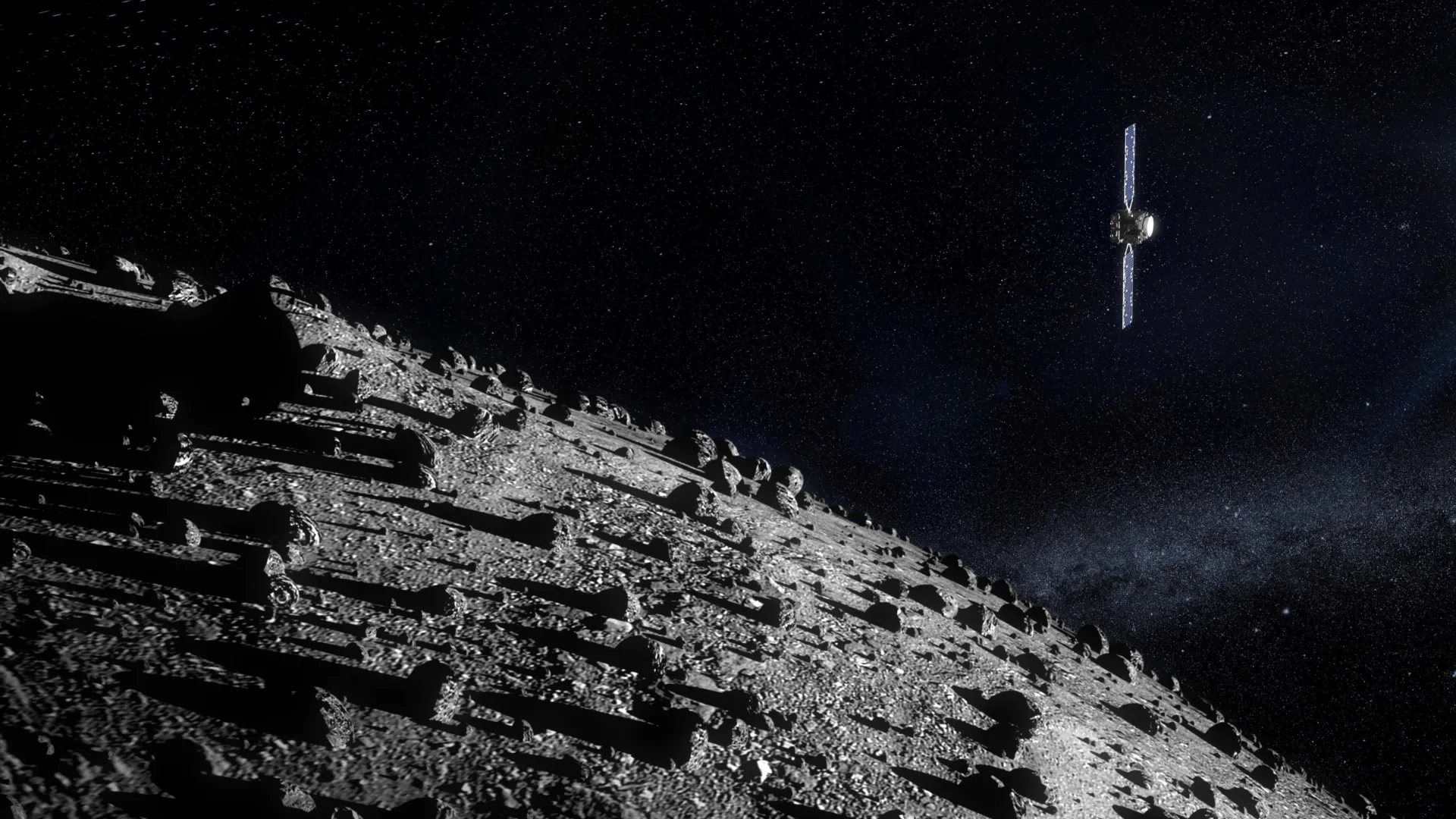
The European Space Agency's Hera spacecraft has reached an important milestone in its mission to investigate a historic asteroid collision. For the first time, its onboard camera has captured the two asteroids Didymos and Dimorphos as separate objects rather than a single point of light.
The asteroid pair is currently about 197 million kilometers from Earth. Hera obtained the new image on the evening of October 18 using its black-and-white Asteroid Framing Camera, while the spacecraft was approximately 1,280 kilometers from its targets.
"With this image, the smaller Dimorphos asteroid becomes visible for the first time," explains Michael Kueppers. "Before this acquisition, the spacecraft was still resolving the Didymos system as a single dot. But now, even though Dimorphos is made up of only around one pixel in this initial image, it is clearly well separated from its parent body."
More from the original report
The breakthrough image follows a successful series of maneuvers designed to slow Hera as it approaches the asteroid system. Earlier in October, the spacecraft fired its thrusters twice, with one week between the maneuvers. These adjustments reduced its speed relative to the asteroids to just 20 meters per second, allowing mission controllers to carefully manage the remaining approach.
Although the two asteroids appear tiny in the initial image, they are substantial objects. Dimorphos measures about 151 meters across, making it roughly comparable in size to the Great Pyramid of Giza. Its larger companion, Didymos, is approximately 780 meters in diameter, slightly smaller than the height of Dubai's Burj Khalifa, the world's tallest building.
Dimorphos travels around Didymos at an average separation of just 1.15 kilometers, moving at a speed of approximately 18 centimeters per second.
"For the very first time we are seeing through Hera's own eyes the very double asteroid system that the mission was designed and built for," adds mission manager Ian Carnelli.
"Our views will grow much sharper as Hera comes closer. We will unveil the first detailed images of Dimorphos -- the first object in the Solar System to have had its orbit measurably shifted by human action -- on 25 November."
Uncovering the Aftermath of…