Reported by NPR Health
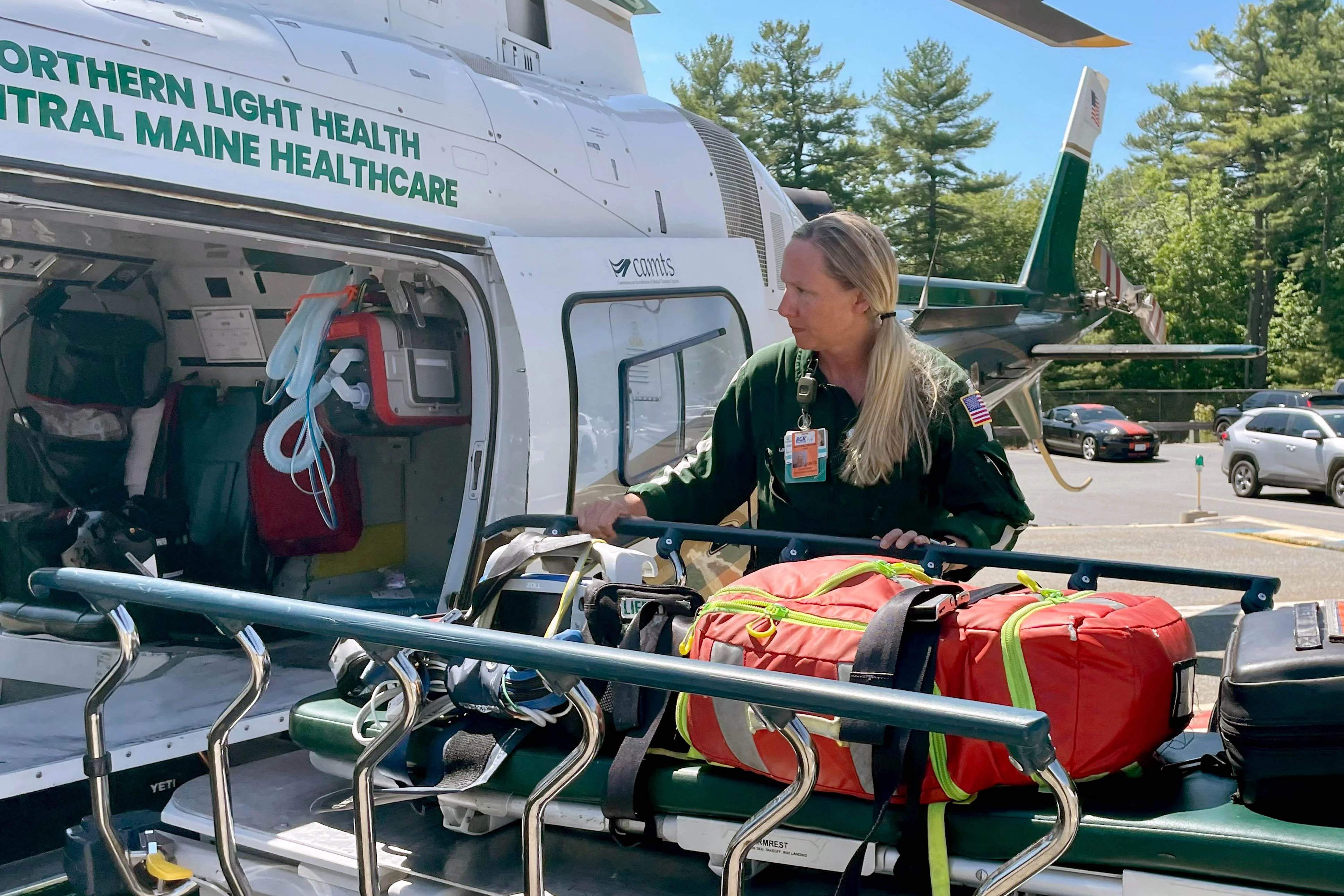
Flight nurse Denise Saucier begins loading a stretcher and equipment into a helicopter on the tarmac at LifeFlight of Maine's Bangor headquarters. It takes only a few minutes for the crew to prepare for takeoff. Elaine Appleton Grant for NPR hide caption
Clipboard in hand, pilot Will Bradbury stands near a helicopter at LifeFlight of Maine's Bangor headquarters. He's running down emergency landing tips with his crew.
"If we need to get out quickly because of smoke or fire, just watch the terrain so that you're not walking uphill into the rotors," he reminds flight nurse Denise Saucier and paramedic Brian Merklin.
More from the original report
The team is getting ready to take off on a medical transport flight. Saucier folds herself into the compact helicopter. She's worked for the air ambulance service for seven years and still calls it a dream job.
Dream job or not, the life of a flight clinician is hard and, given the headwinds slamming rural healthcare, getting harder.
Pilot Will Bradbury runs down emergency landing tips with his crew ahead of a flight from LifeFlight of Maine's Bangor headquarters. Henry Frank/LifeFlight hide caption
Since 2015, demand for medical flights in Maine has doubled. In 2025, LifeFlight crews flew 3,031 flights, more than one every three hours. This year, demand is up another 10%.
Nationwide, air medical services are filling the gaps left behind as rural hospitals close , convert to outpatient-only rural emergency hospitals, or stop offering unprofitable services like labor and delivery.
And, as Medicaid cuts estimated by the Congressional Budget Office at $911 billion over ten years take effect, it's going to get worse . Hundreds more rural hospitals or maternity departments are at immediate risk of closing . With every closure, medical care gets further away.
And, increasingly, ground ambulance stations, many of which are also struggling to keep their doors open, can't meet the need. That leaves flight clinicians like Saucier and Merklin seeing more patients every day.
"We're seeing this across the board. The need for air medical services is increasing year over year," says Nicholas George. He runs the ETHOS Database ,…