Reported by ScienceDaily
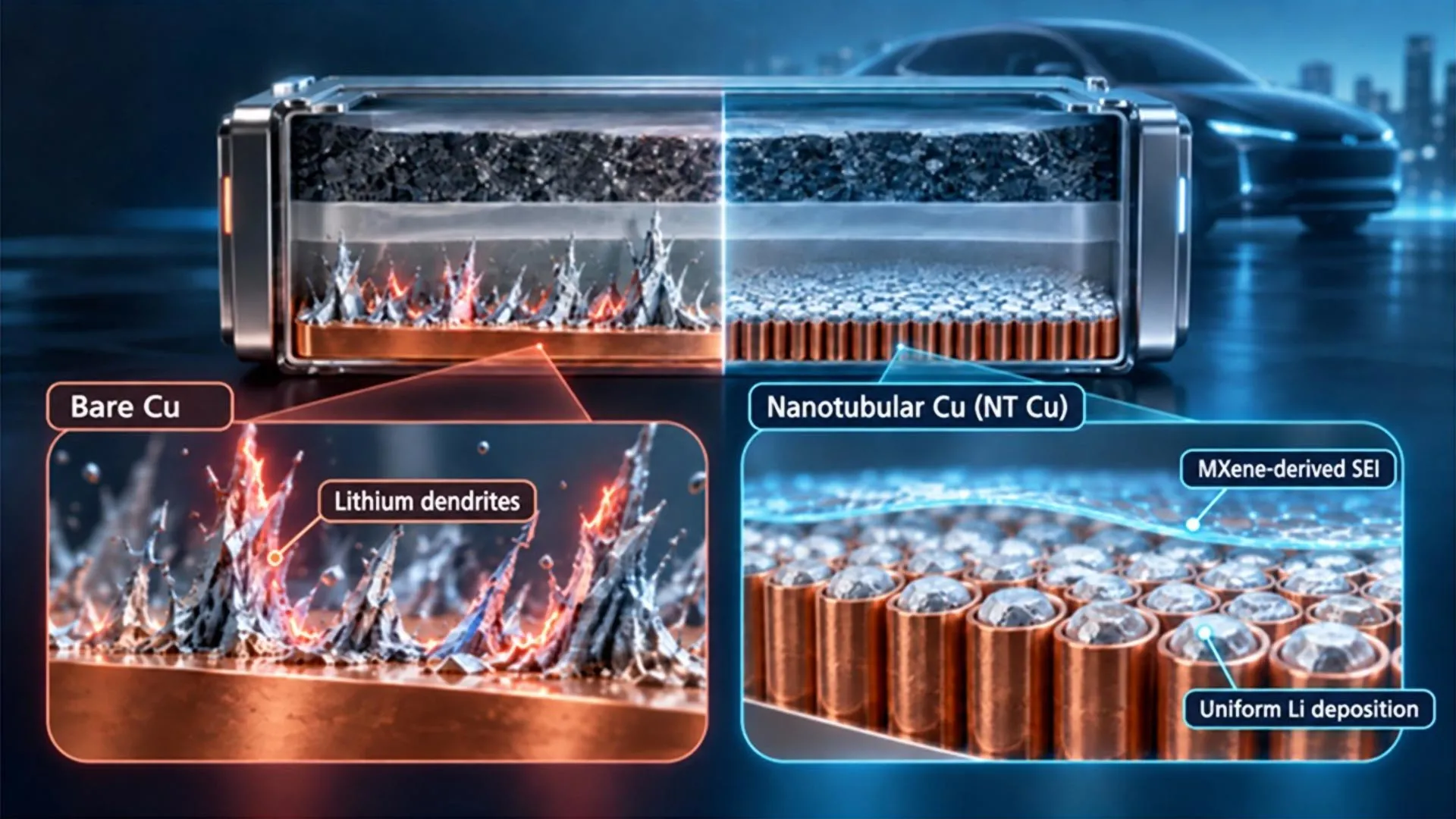
Researchers in South Korea have developed a new technology that could lead to smaller, lighter electric vehicle (EV) batteries capable of delivering longer driving ranges on a single charge. Scientists at KAIST have found a way to address a major weakness of anode-free batteries, which eliminate conventional materials such as graphite to reduce battery size and weight. Although these batteries can store more energy in less space, their lifespan is often limited by the formation of sharp lithium structures during charging. The researchers tackled this problem by adapting precision manufacturing techniques from the semiconductor industry, allowing lithium to accumulate more evenly while encouraging the development of a durable protective layer.
On September 22, KAIST (President Choongsik Bae) announced the breakthrough by a collaborative team led by Professors Jinwoo Lee and Hee-Tae Jung of its Department of Chemical and Biomolecular Engineering. The project also involved scientists from Kyungpook National University (President Heo Young-woo) and the National NanoFab Center (President Park Heung Soo). By applying extremely precise fabrication methods traditionally used to manufacture semiconductor devices, the researchers developed an approach that extends the operating life of anode-free batteries without significantly increasing their size or weight.
In conventional lithium-ion batteries, lithium is stored in an anode made from materials such as graphite when the battery charges. Anode-free batteries operate differently. Instead of relying on a separate anode material, they allow lithium to accumulate directly on a thin sheet of copper foil.
More from the original report
Removing the conventional anode eliminates material that would otherwise contribute to the battery's overall weight and thickness. This makes it possible to store more energy within the same amount of space, potentially allowing electric vehicles to travel farther without requiring larger or heavier battery packs.
However, this promising design comes with a serious drawback. As the battery repeatedly charges and discharges, lithium does not always spread evenly across the copper surface. Instead, it can accumulate in branching or needle-like formations called dendrites.
These structures interfere with battery performance, while the protective layer surrounding the lithium can also become unstable. Together, these problems cause the battery to deteriorate more quickly, making limited lifespan…