
Reported by BBC Science
Nepal became the first country approved to receive money from a fund for damages linked to climate change after flash floods in August 2026
In Paris in 2015, almost 200 countries signed a landmark agreement designed to limit global warming to 1.5C and avoid its worst impacts.
But despite some progress in areas like renewable energy, the world has continued to warm at a rapid pace.
More from the original report
A recent UN report said the target was likely to be breached in the next few years and that "urgent and stringent" action would be needed to return the world to 1.5C.
The Paris Agreement is at the heart of the international commitment to tackle rising global temperatures.
It came into force on 4 November 2016 and saw almost all the nations of the world agree to cut the greenhouse gas emissions which cause global warming.
However, the United States - the world's second biggest greenhouse gas emitter - withdrew from the deal in January 2026 under President Donald Trump.
The US also withdrew during Trump's first presidency, but it rejoined in 2021 under his successor President Joe Biden.
The only other UN member states outside the Paris agreement are Iran, Libya and Yemen.
to "pursue efforts" to limit global temperature rises to 1.5C, and to keep them "well below" 2.0C above those recorded in pre-industrial times, generally considered to mean the late 19th Century
to achieve a balance - known as net zero - between the greenhouse gases that humans put into the atmosphere and the gases that they actively remove, in the second half of this century
each country to set its own emission-reduction targets, reviewed every five years to raise ambitions
richer countries to help poorer nations by providing funding, known as climate finance, to adapt to climate change and switch to renewable energy
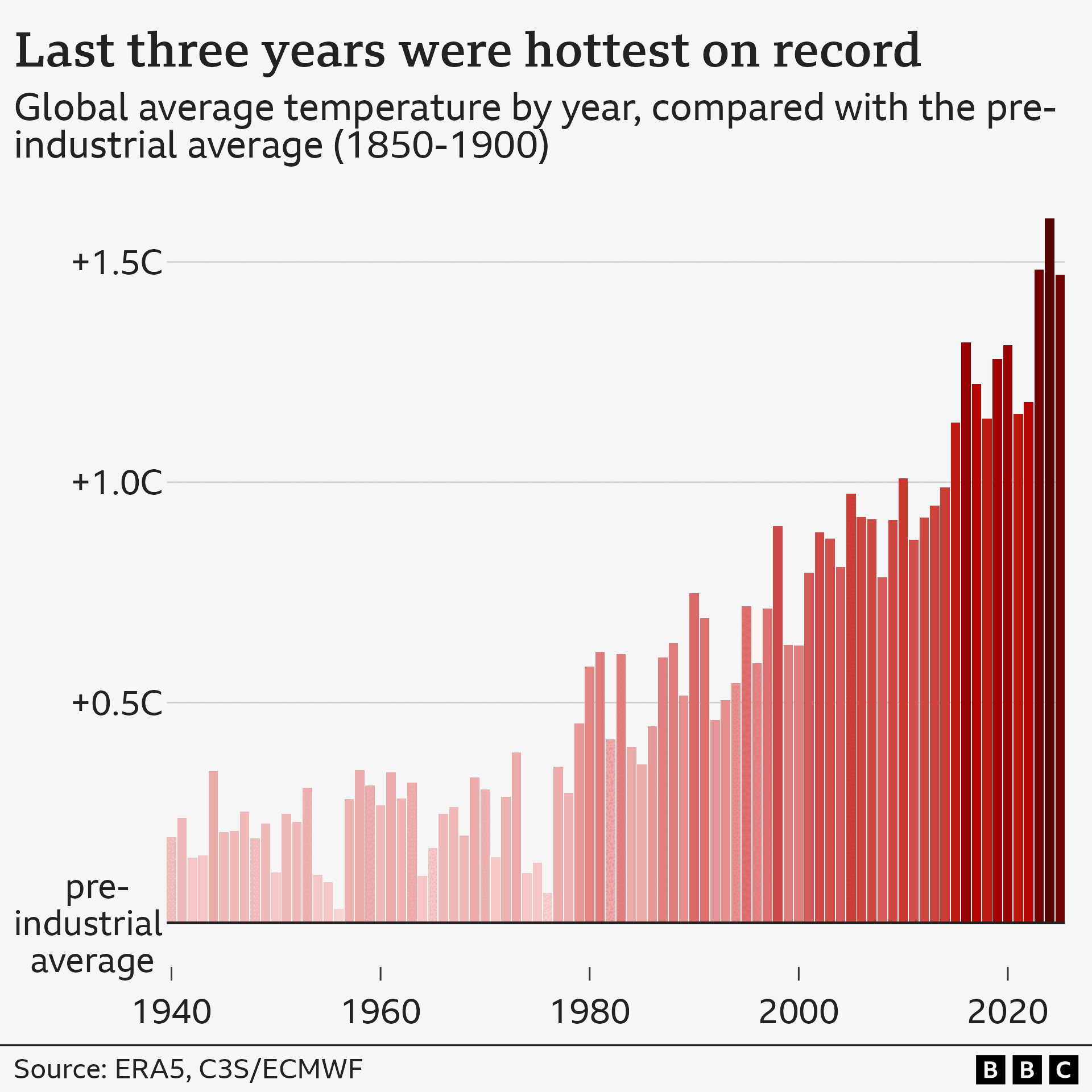
The 1.5C target is generally accepted to refer to a 20-year average rather than a single year.
So, while 2024 was more than 1.5C warmer than pre-industrial times , it did not mean the Paris Agreement threshold has been breached
Every 0.1C of warming brings with it…