Qdrant
Open-source vector search engine written in Rust for large-scale AI
🎬 Product Demos & Video Guides
2 VideosWatch these curated walkthroughs to master Qdrant from beginner setup to advanced features:
1. Qdrant: Perfect Vector Store For RAG in Python (NeuralNine)
2. What is Qdrant & Why It’s Used | Beginner Guide to Vector Database (JG universe)
Qdrant (qdrant.tech) Review
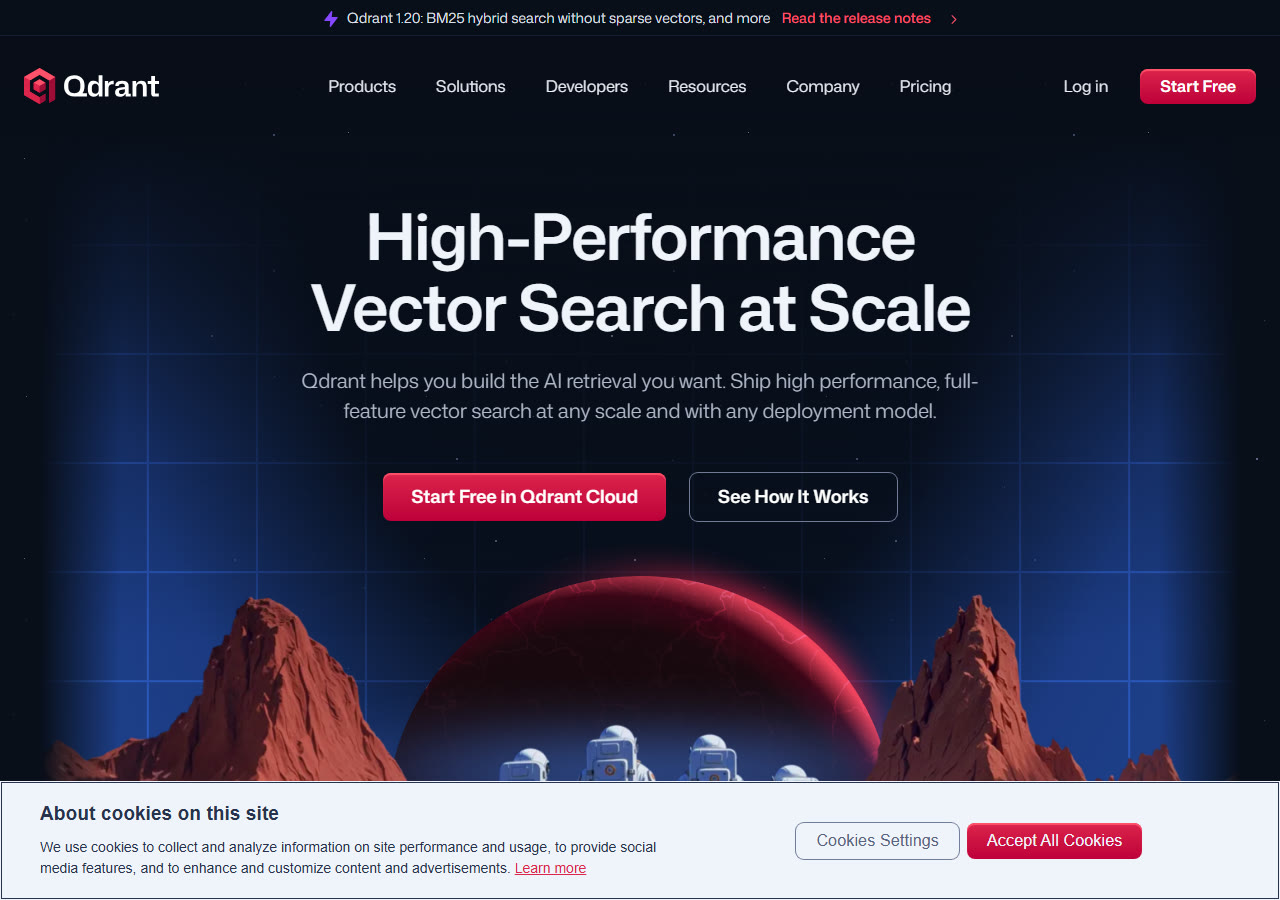
Qdrant is an open-source vector search engine written in Rust. It combines dense and sparse vectors with keyword search, applies filters during HNSW traversal, and supports quantization to reduce memory use. It deploys on Qdrant Cloud, hybrid, private, or edge environments.
🏆 Feature this Award on Your Website
Official 2026 BadgeAre you part of the Qdrant team? Embed your verified benchmark badge on your landing page or press kit:

<a href="https://www.topai-tools.org/tools/qdrant" target="_blank" rel="noopener">
  <img src="https://www.topai-tools.org/badges/verified-2026.svg" alt="Featured on Top AI Tools 2026 Directory" width="220" height="54" />
</a>
Key Capabilities & Features
- •Native hybrid search combining dense and sparse vectors
- •Filtering applied during HNSW traversal
- •Scalar, binary and asymmetric quantization
- •REST, gRPC and official client libraries
- •Deploy cloud, hybrid, private or edge
- •Written in Rust
Pricing, Access & Specs
✓ Strengths & Highlights
- Vector Databases
✕ Potential Drawbacks
- Plan limits change; confirm current terms on the official pricing page.
Community Reviews
No community reviews submitted yet. Be the first to evaluate this tool.
Post a Verified Review
Share your hands-on benchmarks, workflow impressions, and latency notes.