Tavily
Real-time search API for AI agents, with web search and extraction
🎬 Product Demos & Video Guides
2 VideosWatch these curated walkthroughs to master Tavily from beginner setup to advanced features:
1. Getting Started with the Tavily Search API (Tavily)
2. What is Tavily? The Real-Time Web Search Engine Powering Smarter AI Agents! #tavily (Neuro_Nerds)
Tavily (tavily.com) Review
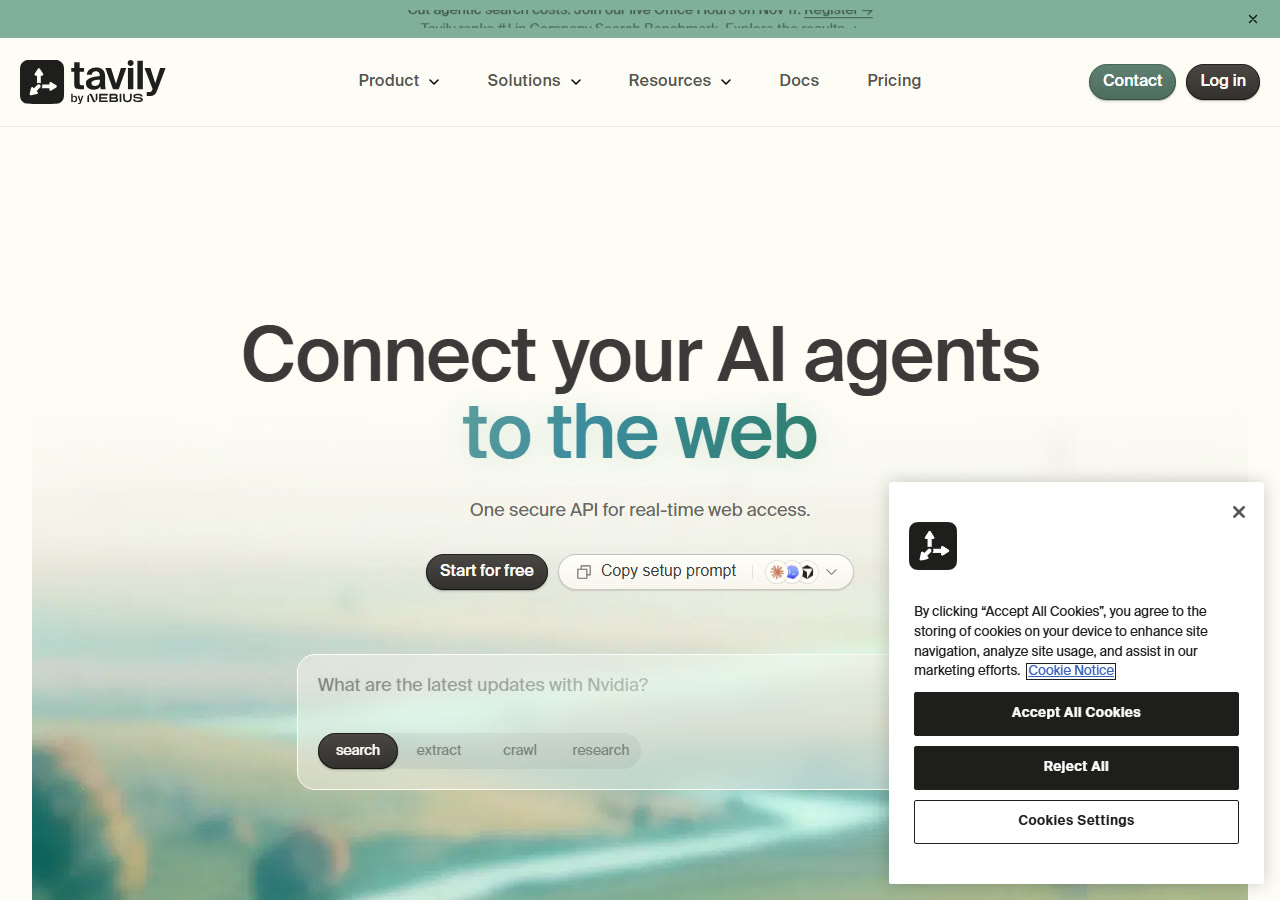
Tavily provides a real-time search API for AI agents and RAG pipelines, returning ranked results and extracted page content. It offers search, extract, crawl, and map endpoints with filters for domains, dates, and search depth. A free Researcher plan includes 1,000 API credits per month.
In-depth review: what Tavily actually does
Checked 29 Oct 2026Tavily is a search API built for AI agents and RAG pipelines. Instead of returning a list of blue links, it returns ranked results and extracted page content that a model can read.
The API covers search, extraction, crawling and site mapping. Credits are shared across those endpoints. The free Researcher plan includes 1,000 API credits per month.
Paid usage starts at $0.008 per credit. Tavily publishes the full ladder on its pricing page, and team plans add higher rate limits.
Features worth knowing
Results are ranked for machine consumption. Each result carries a title, URL and content snippet. Agents can answer from that payload without a second fetch.
Give Tavily a list of URLs and it returns clean page text. That removes navigation, ads and boilerplate. It is the usual second step after a search returns candidate pages.
Crawl follows links from a starting page and collects content. Map lists the URLs on a site without downloading every page. Documentation teams use both to build a retrievable corpus.
Queries accept domain filters, date ranges and a search depth setting. Depth trades latency for coverage. You can keep a chat agent fast or give a research job more material.
Official Python and JavaScript SDKs wrap the REST API. One credit pool covers search, extract, crawl and map. That makes cost forecasting simpler than per-endpoint billing.
How a Tavily request works
You send a query with optional filters. Tavily returns ranked results with content. Your model reads the payload and writes an answer.
For a deeper job, take the top URLs and call the extract endpoint. You get full page text, trimmed to the parts you asked for. A crawler can collect a whole site when one page is not enough.
Every call returns structured JSON. That keeps the integration small. Most teams wrap search in a single function and add extraction only when the snippet is too short.
Pricing and free tier
The Researcher plan is free and includes 1,000 credits per month. Paid plans start at $0.008 per credit. Larger plans lower the unit price and raise rate limits.
Credits are shared. A search costs credits, and extraction or crawling costs more. Check the credit table before you estimate a monthly bill.
There is no per-seat charge on the entry plans. That suits small teams shipping one agent. High-volume production should model the credit burn at peak traffic.
Where it fits best
It suits agents that must answer with current facts. Support bots, research assistants and news monitors all need fresh pages, not a static index.
RAG teams use it to fill gaps in their own corpus. A private knowledge base covers internal facts, and Tavily covers the public web.
It is not a general web browser for humans. There is no visual interface for browsing. The product is an API, and the docs are the main surface.
What to check before committing
Measure credits per answer on your own traffic. Search depth and extraction both change the number.
Check the rate limit for your plan. A burst of users can hit it before the monthly credit cap.
Test result quality on your domain. Niche topics may need domain filters or a custom query rewrite.
Limitations to weigh first
- –Credits are shared across search, extract, crawl and map, so heavy extraction drains the pool faster.
- –Rate limits differ by plan and can bind before the monthly allowance.
- –Returned content still needs validation before it reaches a customer.
- –There is no human-facing search interface; it is an API product.
Common questions
What is Tavily used for?
Tavily gives AI agents and RAG systems real-time web search plus clean page extraction. It returns ranked results and content that a model can read directly.
Does Tavily have a free plan?
Yes. The Researcher plan includes 1,000 API credits per month at no cost. Paid plans start at $0.008 per credit.
Which endpoints does Tavily offer?
Search, extract, crawl and map. All four draw on the same credit pool and are documented in the API reference.
Does Tavily replace a vector database?
No. Tavily fetches public web content. A vector database stores and searches your own embeddings. Most RAG stacks use both.
Details checked against: Tavily homepage · Tavily pricing
🏆 Feature this Award on Your Website
Official 2026 BadgeAre you part of the Tavily team? Embed your verified benchmark badge on your landing page or press kit:

<a href="https://www.topai-tools.org/tools/tavily" target="_blank" rel="noopener">
  <img src="https://www.topai-tools.org/badges/verified-2026.svg" alt="Featured on Top AI Tools 2026 Directory" width="220" height="54" />
</a>
Key Capabilities & Features
- •Search API tuned for LLM and agent workflows
- •Extract clean content from known URLs
- •Crawl sites and map their link structure
- •Filters for domains, dates and search depth
- •Python and JavaScript SDKs
- •Credit-based usage shared across endpoints
Pricing, Access & Specs
✓ Strengths & Highlights
- Search
✕ Potential Drawbacks
- Credits are shared across search, extract, crawl and map, so heavy extraction drains the pool faster.
- Rate limits differ by plan and can bind before the monthly allowance.
Community Reviews
No community reviews submitted yet. Be the first to evaluate this tool.
Post a Verified Review
Share your hands-on benchmarks, workflow impressions, and latency notes.