What happened on November 5, 2026?
Agility Robotics is due to begin trading on the Nasdaq Stock Market today, November 5, under the ticker AGLT. Its warrants will trade as AGLTW. The Salem, Oregon company closed its merger with Churchill Capital Corp XI, a blank-check company, on November 4.
This was not a traditional initial public offering. Agility went public by combining with a special purpose acquisition company, or SPAC. The transaction raised about $465 million in gross capital before expenses and valued Agility at $2.5 billion before the new money.
Agility calls itself the first US-listed pure-play humanoid robotics company with active commercial deployments. Ars Technica describes it as the first dedicated humanoid developer to become publicly traded in the United States. No opening share price was available when this article was published.
More than $300 million of Digit 5 orders helped make the listing possible. CEO Peggy Johnson told TechCrunch that the order book was one of the driving factors behind the decision. The company has not disclosed the customers behind those orders.
The milestone matters because humanoid robots have spent years in demonstrations and promotional videos. Agility's pitch is narrower and more practical. It sells robots that do repetitive lifting in warehouses and factories, and it already has a small paying customer base.
Why is Agility the first US pure-play humanoid stock?
Agility was founded in 2015 by Jonathan Hurst, Damion Shelton and Mikhail Jones. The company spun out of Oregon State University's Dynamic Robotics Laboratory. Researchers there worked on machines that could walk on two legs without falling.
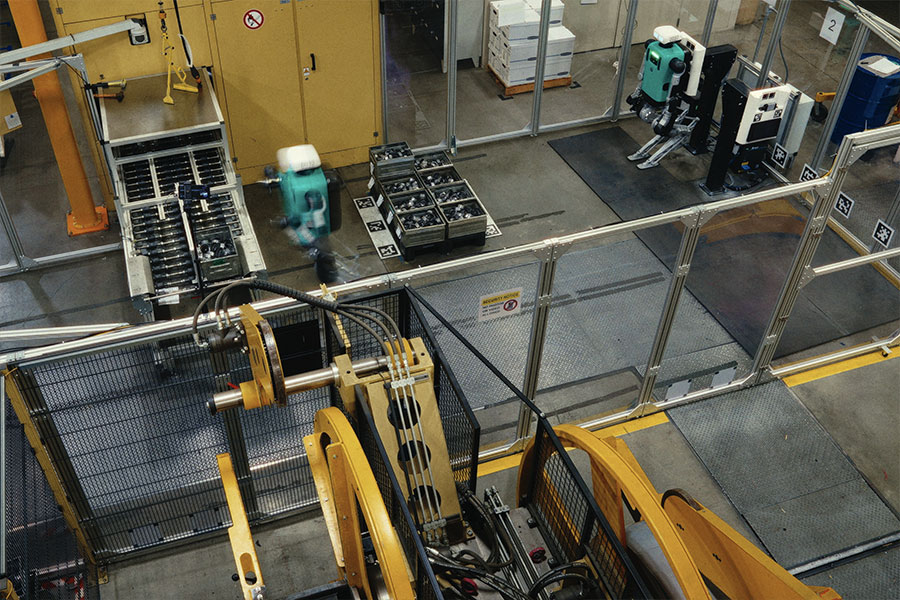
Its robot, Digit, is a two-legged machine built to move totes and other loads in spaces designed for people. Agility says Digit has worked at nine customer facilities and logged more than 65,000 hours of operation. Customers include GXO, Schaeffler, Toyota Motor Manufacturing Canada and Mercado Libre. At one GXO site in Georgia, Digit has moved more than 100,000 totes.
Jonathan Hurst, Agility's co-founder and chief robot officer, told Ars Technica that renting robots lowers risk for customers. He said the rate is comparable to a human labor rate, which makes the economics straightforward. Agility also argues that its robots fill chronic physical labor shortages in manufacturing and logistics.
Pure-play is the key word in the listing. Figure, Tesla and Boston Dynamics all build humanoid robots, but none is a US-listed pure-play. Buying Agility stock is a direct bet on the humanoid thesis, without a larger business to cushion the result.
Agility is not first globally. Unitree, a Chinese robot maker, listed on Shanghai's STAR Market in August 2026. It raised about $904 million and surged 460% in its debut, Bloomberg reported. Agility is first in the US market, not the world.
The company also arrives with a safety story rather than a spectacle. Its robots have mostly worked inside fenced cells, separated from people. That limitation shapes the next product and the investment case. Cooperation with human workers is the promised unlock, not a finished feature.
How much money does Agility Robotics actually make?
Agility's revenue is tiny relative to its new valuation. The company reported $1.78 million in net sales for 2025. Its net loss was $143.9 million, according to its SEC registration statement. The Robot Report put the 2025 operating loss at $140 million, with about $100 million of cash burned during the year.
In the first six months of 2026, net sales were $175,000, the same filing shows. Divide the $2.5 billion equity value by 2025 revenue and the result is roughly 1,400 times sales. The Robot Report made the same calculation. It noted that a SPAC lets a company list on future expectations rather than a long record of public results.
The bull case rests on a different revenue model. Agility plans to rent Digit through robots-as-a-service at about $8,500 a month, or roughly $102,000 a year, plus a $25,000 deployment fee. The Robot Report, citing the filing, estimates that produces about $535,000 of revenue per robot over five years.
Customers can also buy a robot outright. The filing describes a price of about $200,000, plus a $20,000 deployment fee and roughly $36,000 a year for software and maintenance. Over five years, that works out to about $400,000 per robot.
The company has more than $300 million in multi-year Digit 5 orders. Those orders are subject to contractual milestones, product features and specifications, so they are not the same as booked revenue. Agility also says it has an active pipeline of more than 30 prospective customers across manufacturing, logistics, aerospace, consumer products and defense.
The filing's internal projections are ambitious. They imagine about 800 Digit 5 units deployed in 2027, 7,000 by 2030 and 25,000 by 2035. At 25,000 units and the illustrative rental rate, subscription revenue would approach $2.55 billion a year. Those are management projections, not signed contracts.
Agility's model depends on utilization. A robot that sits idle still consumes maintenance and software costs. The filing warns that actual contracts, deployment timing and pricing may differ from the company's assumptions.
The company also points to a US market opportunity of about $1 trillion across manufacturing, distribution and logistics. That is a management estimate, not a forecast from an independent analyst, and it does not describe revenue Agility expects to capture.
The gap between $1.78 million of actual 2025 sales and a $2.5 billion valuation is the central question for public investors. The company must grow revenue roughly 57-fold to match the annual subscription revenue from 1,000 rented robots. That is The Robot Report's arithmetic.
Why did the SPAC raise $465 million instead of $620 million?
The original announcement promised more cash. In June, the companies said the deal would deliver more than $620 million in gross proceeds. That assumed no redemptions from Churchill's $420 million trust. The figure included a PIPE of about $200 million led by Foxconn.
The closing numbers were smaller. The final structure raised about $465 million. It combined three sources. The trust contributed $164 million. A Foxconn-led PIPE contributed $201 million at $10 a share, and $100 million of equity funding had arrived earlier. Those figures come from the November 2 filing.
The difference points to redemptions. Churchill XI had 41.4 million public shares, and its trust held about $420 million if nobody cashed out. Only about $164 million remained at closing. That implies roughly $256 million, or about 60% of the trust, was redeemed.
Shareholders still approved the deal by a wide margin. More than 84% of votes cast backed the combination, Churchill said. The vote and the redemptions tell different stories. Approval was easy, but many public holders chose cash over shares in the combined company.
Agility therefore started public life with a smaller cheque than planned. The $465 million is still substantial for a company that burned about $100 million in 2025. It is not the $620 million that the June announcement advertised. The shortfall is a signal about how SPAC investors judged the price.
The structure also left existing Agility shareholders rolling 100% of their equity into the new company. They are locked up for 180 days, which will keep the tradable supply of shares thin at first.
The S-4 described a minimum cash condition for closing. The final structure cleared it. The PIPE price of $10 a share also set a reference point for the deal's economics. The $201 million PIPE was committed at that price. That gives those investors a fixed entry point whatever the first trade later implies.
What is Digit 5, and when will it reach customers?
Digit 5 is the product the listing is meant to fund. Agility unveiled it in September 2026 and calls it the first cooperatively safe humanoid. The design is meant to work near people without a fence between them.
The hardware changes target industrial work. Agility says the robot uses cycloidal actuators built for repeated lifts of up to 50 pounds. It also has interchangeable end effectors for different tasks. The company plans to standardize onboard compute on Nvidia's IGX Thor platform and expand its use of Nvidia Halos safety software.
Agility also works with FORT Robotics on safety systems and Nyobolt on fast charging. Nyobolt's battery technology is designed to recharge Digit 5 in nine minutes. Agility says that supports more than 20 hours of productive work in a 24-hour day. Those are partner claims, not independent test results.
Customers will not get the robot immediately. Agility expects early customer access in the first half of 2027 and general availability at the end of 2027. TechCrunch reported that the company has not yet shown working prototypes publicly, even though it has announced the product.
Today's Digit can place heavy loads with 98% accuracy, TechCrunch reported, but it cannot handle complex manipulation. Prospective customers pay $500,000 for an on-site proof of concept before a full deployment. Agility had four such customers signed up as of May 2026.
Manufacturing capacity is not the immediate constraint. Agility's RoboFab plant in Salem covers 70,000 square feet and is designed for up to 10,000 robots a year. The harder problem is proving that Digit 5 can hit throughput, uptime and placement targets in real facilities.
Cooperative safety matters commercially because fenced cells limit where a robot can work. A machine that can share a floor with people can take on more tasks and fit into existing workflows. It also raises harder questions about liability, insurance and supervision. Digit 5 is not yet in customers' hands, so its safety record will be built in the field.
The commercial calendar offers early tests. GXO plans to add Digit at two more US logistics facilities in early 2027. AGCO has signed a commercial agreement for a pilot expected in 2027. Three other manufacturing customers are in paid programs, though Agility has not named them.
What are the biggest risks for AGLT investors?
The filing's own risk factors are blunt. Humanoid robots remain unproven at scale, Ars Technica noted, especially compared with industrial robots that have decades of commercial use. Agility has a short operating history and a long record of losses.
Order quality is another question. The $300 million of Digit 5 orders depends on milestones and on shipping features that do not exist in customers' hands yet. A missed specification or a delay in general availability could push revenue out or shrink the order.
Customer concentration is hard to judge because Agility has not named most of the buyers behind its order book. That makes it difficult for outside investors to tell whether demand is broad or depends on a few large accounts.
Cash is a live issue. CEO Peggy Johnson told TechCrunch that the SPAC proceeds meet current needs but would not say they make the company self-sustaining. At the 2025 burn rate, $465 million covers several years, but costs will rise as production and deployments scale.
Competition is intense. Figure, Tesla, 1X and Boston Dynamics are all chasing factory and warehouse work. Unitree has public-market capital in China after a 460% debut. Agility's advantage is deployment experience, not a proven cost advantage.
Public ownership adds pressure. The company must report quarterly results, which will expose the gap between orders and revenue. Its forecasts will be compared with delivery, and its share price will react to both.
Finally, the $2.5 billion figure is a negotiated deal value, not a market price tested by trading. The first weeks of trading will show what public investors think the company is worth. That number can differ sharply from the price insiders accepted in private negotiations.
What should investors watch next?
Three numbers matter in the short term. They are the first trade price, the cash balance in the first public earnings report and the pace of Digit 5 milestones. Each will test the story told during the SPAC campaign.
Agility has promised a public demonstration of Digit 5 at CES 2027. GXO plans to add the robot at two more US logistics sites in early 2027. AGCO has a pilot scheduled for the same year. Those deployments will show whether the order book converts into revenue.
The first public results will show how much cash remains after transaction expenses, a figure the company has not yet broken out. They will also set the baseline against which later quarters are judged.
The lockup is the other date to circle. The 180-day restriction on existing shareholders ends around early May 2027, which could change the supply of shares and the stock's liquidity.
Beyond Agility, the listing gives the humanoid sector its first US public benchmark. A strong AGLT would encourage rivals to test the public markets. A weak one would make the SPAC route look less attractive for capital-intensive robot builders.
For now, Agility has money, customers and a ticker. It does not yet have revenue that justifies the valuation. The next year of deployments, disclosures and trading will decide whether the public market agrees with the private one.