What did Aramco and PIF agree?
On Sunday, 1 November 2026, Saudi Aramco closed its purchase of a 49% stake in HUMAIN through a wholly owned subsidiary.
PIF, the kingdom's sovereign wealth fund, keeps 51% and majority control of its AI company, which launched in May 2025.
The consideration has two parts, and only one of them is disclosed in cash terms.
Aramco is contributing about SAR 9.9 billion, or $2.6 billion, in cash during 2026.
It is also transferring AI, compute and digital assets into HUMAIN, and those assets carry no disclosed value.
The closing follows a non-binding term sheet signed in October 2025.
PIF described that step as a plan to pool both organizations' AI programs under one company.
The term sheet was subject to definitive agreements and regulatory approvals.
Neither announcement values the transferred assets or names Aramco's board seats or the business units that will move.
Nor does either statement set out a payment schedule beyond 2026.
So the $2.6 billion is not a valuation of HUMAIN.
It is the cash half of the price, while the asset half remains unpriced by outsiders.
HUMAIN launched in May 2025 as a PIF vehicle for data centers, cloud capacity, Arabic AI models and industry software.
Its chief executive is Tareq Amin, and its statements describe a full-stack AI company with global ambitions.
The release lists four core areas, from data centers and cloud to models and industry solutions.
Those models include ALLaM, which the release calls one of the world's most powerful multimodal Arabic LLMs.
The ownership change turns a PIF company into an oil-and-sovereign-wealth joint venture, with the fund still in control.
Reuters reported that the cash was invested this year.
The wire service said the deal lets HUMAIN monetize Aramco's existing AI and digital assets.
That framing matters because Aramco is partly paying with things it already built, rather than with new money alone.
Aramco had been planning a significant minority stake for at least a year, according to Daily Sabah.
Closing it now gives HUMAIN a second large shareholder before its next construction phase.
For PIF, the deal moves AI spending closer to industrial demand while keeping control.
The fund also gains a partner with power, land and engineering capacity.
Aramco gets a stake in the whole stack, not just a supplier contract.
Why is an oil company buying into AI compute?
Aramco is not buying a passive financial position, and the release makes its industrial motive explicit.
It says Aramco will use HUMAIN's infrastructure to turn AI into industrial applications.
It also expects to earn revenue from AI and digital assets it already owns.
The company has spent years deploying software across its operations.
Amin Nasser is Aramco's president and chief executive.
He said the company had booked $11.3 billion in what it calls Technology Realized Value since 2023.
"Since 2023, Aramco has achieved $11.3 billion in Technology Realized Value," Nasser said.
The statement says a significant portion of that value came from AI solutions.
That number is company-reported and not audited in the release, but it is still a useful signal.
Aramco has industrial data, power, land and a large internal customer for AI tools.
The industrial angle is central to the case for the deal.
Oil and gas operations generate sensor data, maintenance records and logistics problems that AI systems can address.
Aramco can test those systems on its own assets before selling them to other industrial buyers.
Aramco Digital was already part of the Nvidia plan announced in May 2025.
Nvidia said the unit would develop AI computing infrastructure and an engineering and robotics center of excellence.
For PIF, the transaction consolidates separate AI programs under one company.
SCAI, a PIF-owned AI company, was transferred into HUMAIN before closing.
Aramco's AI work now sits in the same vehicle, which reduces duplication between two state-linked entities.
It also concentrates risk, because a delayed buildout hurts both the fund and the oil company.
That is different from a hyperscaler spreading a portfolio across many sites and customers.
The structure fits a Gulf pattern in which governments fund AI through sovereign vehicles.
Those vehicles then recruit industrial partners to anchor demand, and HUMAIN now plays both roles.
Aramco says the stake should support margins and monetization, but those are forward-looking claims.
The closing statement reports no HUMAIN revenue, profit or contracted capacity figures.
Nasser also framed the deal as industrial policy.
He said it would help localize the AI industry and speed deployment of AI systems across the kingdom.
That goal runs through Saudi Vision 2030, the diversification plan cited in Nvidia's Saudi announcements.
The transaction therefore serves three purposes at once.
It funds HUMAIN, gives Aramco a financial stake and aligns the kingdom's AI assets under one majority state-owned group.
The release also ties the deal to PIF's 2026-2030 strategy.
That plan calls for deeper integration across economic ecosystems and more private-sector participation.
How big is HUMAIN's data center buildout?
HUMAIN's target is 3 gigawatts of AI data center capacity by 2030, and capacity here means power.
That is the standard shorthand for how much compute a site can host.
The figure is a plan rather than an operating number.
HUMAIN has announced partners and sites, but it has not published a single total for capacity that is energized today.
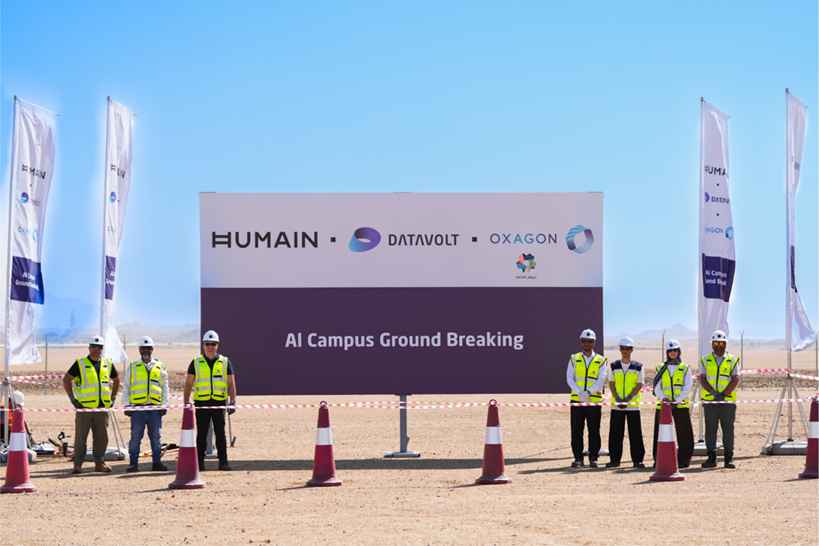
The clearest construction project is at Oxagon, inside NEOM, where HUMAIN and DataVolt are building an AI campus.
The site offers subsea cable links to Europe and Africa, and the design calls for renewable energy and advanced cooling.
DataVolt's wider Oxagon campus is planned at 1.5 gigawatts, with the first 360-megawatt phase under construction.
Power is the binding constraint for projects at this scale.
A 3-gigawatt target needs generation, transmission and cooling at a level few private developers can finance alone.
That explains the partner list, which spans chips, construction, state finance and cloud services.
A typical AI-focused data center uses as much electricity as 100,000 households, according to the agency.
The largest facilities under construction use about 20 times that amount.
The agency estimates all data centers used about 415 terawatt-hours in 2024.
That was roughly 1.5% of global electricity, and it projects about 945 terawatt-hours by 2030.
Run flat out for a year, 3 gigawatts would consume about 26 terawatt-hours.
That is under 3% of the IEA's 2030 projection, from one company in one country.
One company's target would be small against global demand but enormous for one grid and one supply chain.
Public statements rarely say how much capacity is live today.
They describe frameworks, phases and target dates instead, which makes independent verification difficult.
Each project behind the headline number has its own timeline, financing and counterparties.
- •Nvidia: AI factories of up to 500MW over five years, with an 18,000-GPU GB300 first phase.
- •xAI: a 500MW data center in the kingdom, announced in November 2025.
- •DataVolt: 100MW of a 360MW first phase at Oxagon, with the first 100MW expected in 2028.
- •Infra: up to $1.2 billion of non-binding financing for up to 250MW.
- •Nebius: a 50MW framework at Oxagon, reported by Reuters in November 2026.
- •Al Moammar Information Systems: a contract to expand a data center from 50MW to 250MW.
Where do the chips come from, and on what terms?
The chips are American, so the buildout depends on U.S. export licenses.
In November 2025, the Commerce Department authorized HUMAIN and G42 to buy up to 35,000 Nvidia chips.
CNBC valued the approval at about $1 billion.
The decision reversed earlier restrictions on direct sales to state-backed Gulf AI firms.
It came with conditions that CNBC called "rigorous security and reporting requirements" for the firms.
What those conditions require in practice is not public in detail.
Hasan Alhasan of the International Institute for Strategic Studies spoke to CNBC about the terms.
"The safeguards to which Saudi Arabia has agreed are still unknown," he said.
Washington's concern is diversion to China.
The earlier rules existed to stop advanced American chips reaching Chinese firms through Gulf intermediaries.
The UAE moved further to address that concern, according to CNBC.
G42 replaced its Chinese-developed AI stack, let go of Chinese personnel and divested Chinese tech holdings.
Alhasan described those steps as "far-reaching measures to assuage U.S. concerns" taken by the UAE.
Volume is the other constraint on the plan.
Nvidia's 2025 announcement described several hundred thousand GPUs for HUMAIN.
The approved tranche is far smaller, and any volume beyond it needs further approval.
That makes export policy a schedule risk for a project already years from completion.
A licensing delay can idle a data center that is otherwise built.
The same approval covered a UAE rival, so both Gulf AI champions face similar hardware limits.
Nvidia's release also tied the plan to national infrastructure.
It described 5,000 Blackwell GPUs for a Saudi sovereign AI factory run with SDAIA.
It also gave Aramco Digital a role in AI computing and robotics.
Those commitments predate the stake and show how deep the relationship already was.
The approvals also sit inside a wider bargain.
CNBC reported that Saudi Arabia raised its stated U.S. investment pledge to $1 trillion during the crown prince's visit.
The chip license and the investment pledge were part of the same diplomatic push.
What are the risks and limitations?
Execution is the first risk, because three gigawatts by 2030 is a target rather than a contract.
The first 100 megawatts at Oxagon are not expected until 2028.
Financing is the second risk, since the $1.2 billion Infra framework is non-binding.
HUMAIN needs binding debt, equity and paying customers before capacity earns a return.
Disclosure is the third, because the closing statement gives no asset valuation and no governance detail.
Outside investors cannot judge how much operating control Aramco bought.
Demand is the fourth, and HUMAIN must sell compute to government entities, Saudi firms and export customers.
The release cites regional and global demand but no signed volumes.
Energy is the fifth, because three gigawatts is a large load for any grid.
Saudi Arabia has gas and renewable plans, but power and grid connections now set the pace of AI projects.
The transaction also creates a related-party relationship that invites scrutiny.
Aramco is both a shareholder and a customer of HUMAIN, so the pricing between them matters.
The release says the partnership should offer attractive margins without explaining how they will be earned.
For PIF, the risk is dependence on state-linked demand rather than competitive wins.
For Aramco, the risk is that a non-core asset absorbs management attention.
The disclosure gap extends to the asset transfer itself.
The release does not say whether the contribution includes data centers, software platforms, or only staff and contracts.
It also says nothing about dividends, transfer pricing or the accounting treatment of the in-kind contribution.
None of these risks makes the deal unusual, because capital-intensive infrastructure always carries them.
A sovereign fund and an oil company are carrying a bet that hyperscalers usually carry.
Who is affected by the transaction?
Aramco's shareholders gain exposure to AI infrastructure through an owned stake.
They also take on the risk of a business still under construction.
Saudi industrial firms may gain a local supplier of compute and Arabic models, with Aramco as an anchor customer.
Hardware suppliers are the clearest early beneficiaries.
Nvidia, AMD, Qualcomm, Cisco and others signed HUMAIN partnerships around its launch and later forums, according to CNBC.
Rivals include G42 in the UAE and global cloud providers.
G42 received the same U.S. approval tranche, so neither Gulf company starts with a clear hardware edge.
Workers and local suppliers are affected too, because the projects need engineers, crews and grid connections.
Saudi taxpayers are exposed indirectly through two state-linked owners.
PIF and Aramco are state-linked, and HUMAIN's growth is presented as national economic strategy.
The upside and the losses both land partly in public hands.
Lenders and infrastructure funds have a role as well.
Infra's framework, and the investment platform it explores with HUMAIN, would bring institutional capital into the buildout.
Localization may also shape who wins contracts, since the release stresses building a domestic AI industry.
What should readers watch next?
Watch for disclosure first, because a definitive asset list, valuation and board composition would show what Aramco bought.
Watch construction second, since energized capacity at Oxagon would be the first hard test of the 3-gigawatt plan.
Watch export policy third, because new U.S. approvals or tighter conditions will set the ceiling on deployment.
Watch customers fourth, since named contracts with paying buyers would show demand beyond government intent.
Watch the financing too, because a binding Infra agreement would show that outside capital is willing to fund the plan.
Until those appear, the deal is best read as a financing and consolidation step.
It strengthens HUMAIN's balance sheet, but it does not prove that the capacity exists.