What did the FAA switch on at Bartow and Kenai?
On 6 November 2026, the Federal Aviation Administration said its first digital control towers were operational at Bartow Executive Airport in Florida and Kenai Municipal Airport in Alaska. The agency described the systems as a better way for controllers to watch runways, taxiways and nearby airspace. Both fields are small by airline standards, and that is the point.
Kenai was chosen earlier this year as a demonstration site for Alaska. Airport commission documents cited by the Peninsula Clarion say the field offered scheduled passenger flights, paved and gravel runways and floatplane facilities. That mix gave engineers several operating environments to evaluate in one place.
Kenai also had a working control tower. Under the FAA's initial plan, the conventional facility kept running while the camera system was installed nearby. Controllers could use the old tower as a backup and compare the two views during the trial.
Bartow arrived by a different route. Frequentis, the supplier, says the Florida airport has one of the oldest control towers in the country and hosts a Florida Center of Excellence for digital tower work and training. AVweb reports that Bartow began operating its system in September, before this month's national announcement.
The FAA says the technology followed years of testing at the William J. Hughes Technical Center in Atlantic City, New Jersey, and at other locations. That work produced the standards the agency now uses to judge whether a design is safe enough to deploy.
The word first needs a caveat. Camera-based towers have operated in the United States before, including at Leesburg Executive in Virginia, but those projects never reached an FAA system design approval. The agency now presents Bartow and Kenai as its first operational digital towers.
How does a digital tower actually work?
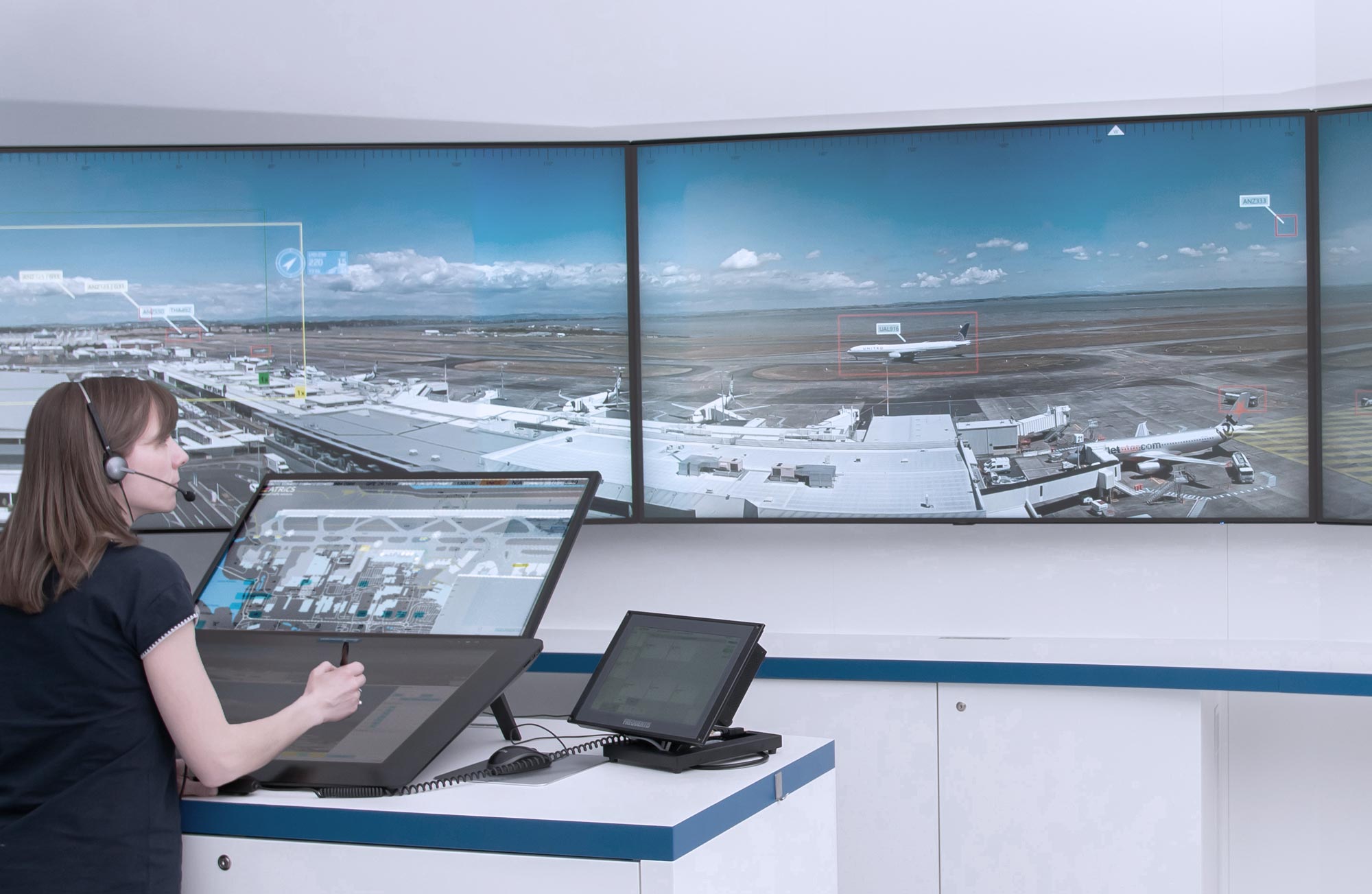
A digital tower swaps the glass cab for sensors and screens. FAA program documents say a system can include day and night cameras, infrared or thermal cameras, and displays that reproduce what a controller would otherwise see outside. The agency now prefers the term digital tower over the older label, remote tower.
The aim is a continuous 360-degree view of runways, taxiways and surrounding airspace. Because nobody needs a window over the airfield, the screens and control equipment can sit away from the airport, or in another town entirely.
Off-airport siting is the commercial heart of the idea. If screens can sit anywhere, one control room can serve several fields, and a small airport can share controllers with its neighbours instead of staffing its own cab around the clock.
AVweb adds more detail. The systems can carry infrared cameras, aircraft identification tags and microphones that pipe airfield sound into the control room. Frequentis, which supplied the American installation, says its software stitches several camera streams into one panoramic view.
The vendor's public material describes high dynamic range panoramic cameras and pan-tilt-zoom cameras with light-gun functions that meet ICAO requirements. Labels and surveillance data are overlaid on the image, and controllers can follow an aircraft using touch, a mouse or a virtual joystick.
Kenai shows the physical form. The Clarion describes a rapidly deployable camera mast linked to a modular control room, where monitors reproduce the view of the field. No new tower building was required, which is central to the cost argument.
A window is not only an image, though. Controllers also read depth, peripheral movement, light changes and engine noise without thinking about it. A digital system has to reproduce enough of that to be useful, and Frequentis markets overlays and tracking as the substitute.
Which airports are next, and who pays?
Five more airports are queued: Winter Haven Regional and Venice Municipal in Florida, Montgomery County Airpark in Maryland, Johnston Regional in North Carolina, and Durango-La Plata County in Colorado. The FAA describes all five as non-towered airports.
That description carries the real change. A non-towered field has no control tower, so pilots coordinate on a shared radio frequency and rely on see-and-avoid. If the new systems deliver the same service as at Bartow and Kenai, those airports would gain a controlled tower service for the first time.
For pilots, the difference is practical. At a non-towered field they announce position and intentions, and separation depends on everyone listening and looking. A tower adds sequencing, clearances and a controller who can stop a runway conflict before it develops.
The FAA says the installations are funded through the Working Families Tax Cut Act. AVweb puts that allocation at $50 million and reports that the agency sees camera systems as a cheaper way to extend tower services to small fields than building conventional towers.
The digital towers sit beside a much larger modernization bill. The Guardian reports that Congress approved $12.5 billion over five years in June 2025 for air traffic control reform, and that the administration is seeking another $30 billion. AVweb notes that the digital tower program is not formally part of the Brand New Air Traffic Control System effort.
Grants are moving too. A tracker run by the Digital Tower Technology Coalition says the FAA's contract tower grant program lists certified digital towers as eligible, with up to $100 million available this year and applications closing on 19 October 2026. For a small airport, a grant can decide whether a camera system happens at all.
Why did the US take until 2026 to approve a digital tower?
Other countries moved earlier. AVweb reports that London City became the first major international airport fully controlled by a remote digital tower in 2021, with controllers working from Swanwick, roughly a two-hour drive away. Sweden's transport regulator formally approved remote towers in 2015, according to Saab.
The American delay was partly procedural. The FAA evaluates tower designs at its technical center in Atlantic City before granting a System Design Approval, the certificate that lets a design move forward. Vendors cannot skip that step and expect to operate in the national airspace.
That path had already failed once. A camera-based remote tower opened at Leesburg Executive Airport in Virginia in 2018, and the FAA judged it operationally viable in 2021. The agency ended the program in June 2023 after the developer, Saab, withdrew from the approval process.
A second project at Northern Colorado Regional Airport never won full certification, AVweb reports, and the FAA relied on a temporary mobile tower there instead. Both cases left the agency with little operational evidence to build on.
Critics blamed the process as much as the hardware. AVweb cites a Reason Foundation analysis from May 2025 noting that the FAA still required vendors to test in Atlantic City rather than at the airports themselves, and that late technical requirements delayed the Frequentis installation.
Congress pushed for clearer rules. AVweb notes that the 2024 FAA Reauthorization Act directed the agency to define standards for digital and remote towers. The first approval came on 2 September 2026, when the FAA granted Frequentis USA a System Design Approval with conditions, according to FAA funding guidance summarized by the coalition tracker.
The conditions themselves were not published in the documents reviewed for this article. The same guidance says a design approval is not operational approval, and that the airport sponsor must own, operate and maintain the system.
Demand may outlast the demonstrations. The coalition's tracker records an FAA request for proposals reported in April 2026 for remote tower systems, with a potential 50 units over five years.
Do digital towers replace air traffic controllers?
The FAA says no, at least not in the way that phrase suggests. Controllers still separate aircraft and issue instructions. The cameras change what they can see, not who is responsible for the traffic.
Many small American fields are already served by contract towers, staffed by private companies working for the FAA rather than by agency employees. The coalition tracker draws that distinction, and it matters when a camera system changes who sits where.
"Digital towers provide controllers with greater visibility of airport activity and more information to make critical decisions," Administrator Bryan Bedford said in the announcement. Whether better visibility translates into fewer staff is a separate question, and the agency has not answered it in public.
At Kenai, the old tower stayed available as a backup during the trial, according to the Clarion. That is not a permanent promise. The FAA's rationale for the program is cost: a camera mast and a control room are cheaper than a tower building at a small field.
Cost pressure meets a staffing problem. The Guardian reports that tower staffing has been under close scrutiny since a 2025 midair collision near Washington killed 67 people. It also reports criticism of the agency's response to a controller shortage after last year's government shutdown.
Multi-airport centers are the model that changes the job most. AVweb notes that Avinor's remote tower center in Norway helps controllers oversee up to 15 airports at once, and that Sweden's Sundsvall center manages several. One controller covering more fields is a different working life, even if total headcount holds.
What are the safety concerns?
The clearest critique comes from a European controllers' group. The Luxembourg association GLCCA published an analysis in January 2026 arguing that camera feeds give up peripheral vision, depth perception, natural light and sound cues that a tower cab provides for free.
The group also points to latency. Camera systems can introduce delays ranging from milliseconds to more than a second, it says, which matters most during runway incursions, emergencies or unexpected aircraft movements.
GLCCA does not claim the technology fails everywhere. It argues that remote towers may suit small, low-complexity airports but are not yet proven for busy fields with mixed traffic. Bartow and Kenai are small fields, which helps explain why the FAA started there.
The FAA has its own safety framework. Its program page describes operational visual requirements, an operational safety assessment that maps hazards to risk, and minimum technical requirements derived from that work. Vendors are judged against those documents rather than against a demo.
Independent verification is thinner. The conditions attached to the Frequentis approval were not public in the sources reviewed, and operating statistics from the first weeks at either airport did not appear in those sources. The system is approved, but the evidence base is still mostly the agency's own testing.
Night and poor weather are the obvious stress cases. The FAA lists infrared and thermal cameras among the sensor options, and Frequentis markets high dynamic range imagery for low light. Neither the agency page nor the vendor material reviewed here gives recognition distances or failure rates.
What should pilots and passengers watch next?
Bedford is due before the House transportation and infrastructure committee next week, where the Guardian says he will face questions on the modernization program's progress and costs. The digital towers will be one item on a long list that also includes radars, radios and older communications gear.
The five airports are the real test. Watch whether Winter Haven, Venice, Montgomery County, Johnston Regional and Durango-La Plata get their camera arrays on schedule. Watch too whether they keep tower-style service at night and in low weather, which is where camera systems earn or lose trust.
Alaska is the other test. The Clarion reports that the FAA presented Kenai as a potential model for other communities in the state, where new tower buildings are expensive and distances are long. A working model in Alaska would be a stronger signal than a Florida showcase.
Watch the approval scope as well. AVweb says the September approval initially covered single-runway airports in Class D airspace, a narrow slice of the system. It is not clear from the sources reviewed how Kenai's paved and gravel runways fit that scope. A wider certificate would show that digital towers can handle busier fields with more complex runway layouts.
The cost case will face scrutiny too. A camera mast needs power, network links, maintenance and spare parts, and those recurring costs do not appear in the FAA's announcement. Frequentis says its remote tower technology is deployed by 12 customers at 16 airports, AVweb reports, so the American sites join a modest global base.
For travellers, nothing changes at the gate yet. The practical question is whether a camera-based tower can extend controlled service to airports that never had it, without adding risk that nobody measures in public.
The next milestone is operational approval at scale. Each new site needs clearance to run live traffic, not just equipment on a mast, and the FAA has not said publicly how long that step will take at the five fields now waiting.