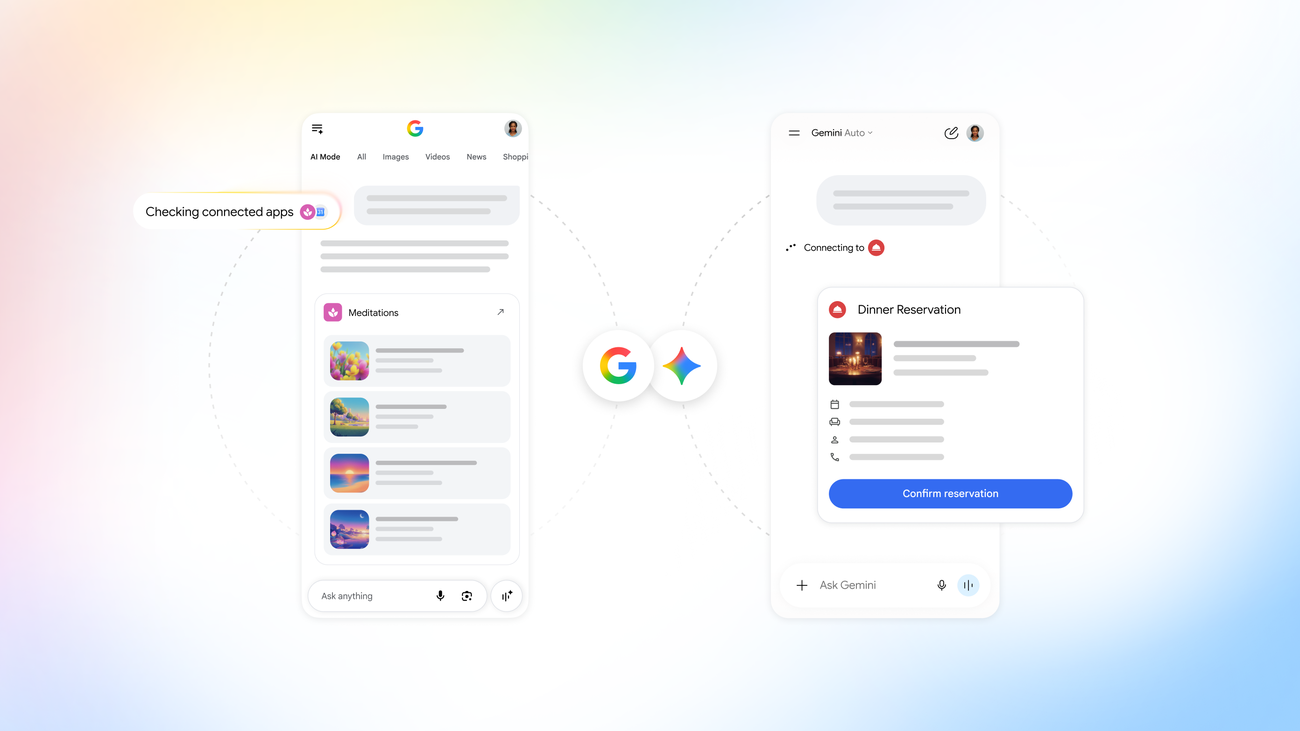
What did Google announce on 28 October 2026?
Google opened a preview of its Connected Apps Platform on 28 October 2026. The platform gives developers one place to build and manage apps for Google Search and the Gemini app. Chips Mistry is a group product manager for Search, and Mai Lowe holds the same title for Gemini. They announced it on Google’s blog.
The launch is narrower than the headline suggests. Access is limited to developers in the United States who join a waitlist. Google says it will add more developers, markets and products in phases over the coming months. TechCrunch reported that Google did not say when broader access would arrive.
Connected Apps are not new. Google introduced them in Gemini earlier in 2026 and brought a small set to AI Mode in Search in July. Until now, building one required working closely with Google, according to 9to5Google. The new platform replaces that hand-held process with self-service tools, app review and analytics.
What is new is the distribution layer: Google is trying to turn a set of partner integrations into a repeatable developer programme. More than 50 Connected Apps have launched across Search and Gemini, according to Google. Adobe, Experian, Localiza, Peloton and Calm are among the partners named this week.
Google calls it a “unified way for more app developers to bring their capabilities directly into Gemini and Search.” The wording matters. This is not a new chatbot feature. It is an attempt to make third-party software a standard part of Google’s AI surfaces.
Why is Google doing this now? Search is being rebuilt around AI Mode, which answers questions in a conversational format. Connected Apps extend that format from answers to actions. They also give Google a way to keep shopping, booking and planning inside its own surfaces.
The word “preview” carries weight. Google has not published a general-availability date. It says access will expand to more markets over the coming months. Developers are being asked to build against a platform whose rules and reach are still taking shape.
How does the Connected Apps Platform work?
Developers have two integration paths: a cloud-hosted MCP server, or Android MCP with the AppFunctions APIs. MCP stands for Model Context Protocol, an open standard for connecting AI systems to external tools and data.
The user experience is meant to be simple. A person links an app once, then can use its data and actions inside a conversation. Google’s developer documentation calls this “enable once and run Google-wide.” OAuth 2.1 handles authorisation through a standard consent flow.
Developers register, test and submit their app through the Google Connected Console. Before review, they choose whether the app will appear in Search, Gemini, or both. After launch, the console reports traffic, latency and error rates. It also manages brand identity, including verified logos and authenticated accounts.
Review is the gate that matters most. Google says apps go through review before launch, but it has not described the criteria or typical timelines. For developers, that adds uncertainty to planning, and a rejected or delayed app can miss a season or launch.
Google’s documentation also points to MCP Apps for richer, interactive interfaces. That suggests Connected Apps need not be text-only, and a partner could present such interfaces inside the conversation.
Google describes the promise as the ability to “build once and reach high-intent users” across both surfaces. That phrase is the commercial heart of the offer, because search queries often carry clear intent. Google wants partners to complete tasks at that moment rather than send users to another app.
The technical burden is real. A developer must run an MCP server or Android integration, implement OAuth, pass review and keep latency low. For Android apps, the local path can execute tools on the device. Google says that approach suits apps that want execution to stay on the phone.
Google keeps control of the gateway. It runs the review, sets the rules for each surface, and presents the results. The company has not published detailed rules for how apps are ranked or selected inside AI answers.
Which apps can you use in Gemini and Search?
Google says it has launched more than 50 Connected Apps across Search and Gemini. The catalogue spans productivity, event ticketing, health and fitness. It includes both Google’s own services and third-party tools.
In Gemini, Adobe, Experian, Localiza and Peloton are live. Existing integrations also include Dropbox, Instacart, OpenTable and Ticketmaster, according to 9to5Google. Google’s first-party apps, such as Workspace, Photos and YouTube, sit alongside them.
Partners have clear incentives to join. Google’s surfaces reach users at the moment they are deciding what to buy, watch or book. For Adobe or Peloton, an integration is a new front door. For smaller developers, it is a chance to appear beside much larger brands.
Google’s own apps set the benchmark, with Workspace, Photos and YouTube already inside Gemini. Third parties therefore compete for attention alongside Google’s products, not just against other startups.
Search has a smaller set: TechCrunch named Instacart, Canva, YouTube Music and Yahoo Fantasy Football as examples. Google began rolling out these Search integrations in the United States in July 2026, starting with Instacart, Canva and YouTube Music.
Google plans to close the gap in the coming weeks. It will bring Adobe, Experian, Localiza and Peloton from Gemini into Search. Calm will launch across both surfaces, though Google did not give exact dates.
The 50-plus figure sounds large, but it is small next to a mobile app store. The publicly named apps lean toward shopping, productivity and fitness. The full list may be broader, but Google has not published it in its announcement.
Why does the platform matter for the web and for SEO?
For most of its history, Search has sent people to websites. Connected Apps point to a different model: a user asks for a task, and Google’s AI calls a service to complete it. The website can become a backend rather than a destination.
The examples are deliberately ordinary: a shopper can add ingredients to an Instacart cart without leaving AI Mode. A designer can ask Canva for template options inside the conversation. A listener can build a YouTube Music playlist and start playing it inside the conversation.
TechCrunch compared the shift to SEO, which helped sites compete for rankings. A Connected App has to compete for selection inside an AI answer. The skills are different, and the rules are less visible.
Marie Haynes, an SEO consultant, called the change significant. “For 25 years, Search was a place where people connected with websites for information,” she said. “In this new era, it’s functionality that matters.” Search Engine Roundtable quoted her comments.
John Mueller, a Google Search Advocate, also welcomed the move. He called connected apps “a search platform” and described the effort as still extremely early. He noted that he does not work on connected apps. He was giving a personal view.
The commercial logic is straightforward. If users complete tasks inside Gemini or Search, Google captures the moment of intent. Partners get distribution without building a separate audience, and users get fewer app switches and passwords.
The risk is disintermediation. A brand that becomes a backend may lose the customer relationship, the upsell and the data. A content site that relied on clicks may find that the answer never leaves Google. The platform therefore matters well beyond developers.
Measurement changes too. Websites watch sessions, page views and conversion funnels. Connected App developers watch requests, latency and error rates. Those metrics describe reliability, not audience loyalty. A service can be used heavily and still build no direct relationship with the person using it.
App installs are the older funnel. A user discovers an app in a store, downloads it and creates an account. Connected Apps collapse those steps into a conversation. That is convenient for the user, but it can weaken the app’s own brand and notification channel.
What are the limits and risks for developers and users?
The first limit is geography: the preview is for US developers, and access is phased. Businesses in Europe, Asia and elsewhere cannot yet plan around it. Even in the United States, a waitlist does not guarantee entry.
The second limit is discoverability. Publishing an app does not mean people will see it. Users must connect apps in their personalised Search settings, according to Search Engine Roundtable. The site warned that “just because you make an app, it doesn’t mean searchers will see it” without a user connection.
The third limit is opacity: Google has not explained how it ranks or selects Connected Apps. Developers can see traffic, latency and errors, but not the criteria that decide whether their service appears. That uncertainty makes the channel hard to forecast.
Privacy is the fourth issue. Google’s documentation says apps can access “personal live account context” and take “real-world actions.” OAuth limits access to approved scopes. Users can manage connections, but each link expands the set of parties that can act on an account.
Security depends on the developer. A hosted MCP server is another internet-facing service to patch and monitor. Google’s review may catch obvious problems, but it cannot guarantee that every tool behaves safely. Users should treat each connection like a new app permission.
The business model is also unclear, because Google has not published pricing for the platform. Its announcement and the coverage reviewed here do not mention fees. Developers should assume the commercial terms may change as access expands.
Support costs may rise. A connected app may have to work across Search, Gemini and Android. Developers may need monitoring and on-call cover for a channel that can send unpredictable traffic.
Small teams may struggle, because the platform requires an MCP server, OAuth flows and a review process. That is a heavier lift than publishing a website or a simple API. The self-service label lowers the barrier, but it does not remove it.
There is a dependency risk. Google controls review, presentation and distribution across two of its most important surfaces. A policy change or a ranking adjustment could reshape a partner’s reach overnight. That is a familiar trade-off for anyone who has built on a platform before.
One question remains unanswered. If a connected app books the wrong table or orders the wrong item, who is responsible? Google’s announcement does not address liability. The answer will matter as soon as these tools handle money, travel or health tasks.
How does this compare with ChatGPT and Meta?
Google is not alone in building an app layer for AI. TechCrunch noted that ChatGPT and Meta’s Muse have taken different approaches to connected services. The common idea is that users may stop opening individual apps and work through an AI assistant instead.
Each platform wants to become the front door. Google’s advantage is Search, which already handles searches at global scale and is the default on many Android devices. Its weakness is that Gemini arrived later to the assistant habit than ChatGPT did.
MCP gives Google a shared technical standard. The same protocol can connect a service to multiple AI platforms, which lowers the cost of building integrations. But Google still runs its own review, console and distribution rules.
The competitive effect is defensive as much as offensive. By opening Search to third-party actions, Google keeps those transactions inside its surfaces. It also gives Gemini more reasons to be used for daily tasks. The app store metaphor is becoming literal, with AI assistants as the new storefronts.
What should businesses and users watch next?
The next visible milestone is the Search rollout. Adobe, Experian, Localiza and Peloton are due to arrive in Search in the coming weeks. Calm will follow on both Search and Gemini. Those launches will show whether the Search experience matches the Gemini one.
Watch for Google’s rules on discovery: if the company publishes ranking guidance, developers can optimise for it. If it stays silent, the channel will favour partners with existing relationships. That would weaken the promise of self-service access.
Watch user adoption too. Connected Apps only work when people link them. Google has not shared usage numbers in its announcement. Without adoption, the catalogue remains a list of options rather than a new distribution channel.
Analytics will be the early scoreboard. Google highlights traffic, latency and error data rather than conversion or revenue. Partners must combine those numbers with their own systems to judge whether the channel pays.
Watch whether Google adds ads or paid placement, which it has not announced. If that changes, the economics of the channel would shift again.
For businesses, the practical test is task fit. Services that complete a clear action, such as booking, ordering or tracking, are natural candidates. Publishers and content sites should treat the platform as a complement to search visibility, not a replacement.
For users, the main task is permission hygiene. Review which apps are connected, what data they can reach and whether the convenience is worth it. The platform makes linking easier, so the cost of an unwanted connection also falls.
Google calls this a preview, and that label is accurate. The direction is clear, but the scale is not. The coming months will show whether Connected Apps become a real layer of the web or remain a useful feature inside Gemini.