What did the judge decide in the xAI Clean Air Act case?
A federal judge in Mississippi has refused to dismiss the NAACP's Clean Air Act lawsuit against xAI. SpaceX now owns the AI company. The ruling, issued on 30 October, lets the case move forward. At issue is whether the gas plant powering the Colossus 2 data center needed air permits.
Judge Debra M. Brown of the U.S. District Court for the Northern District of Mississippi denied the motion to dismiss. Her 28-page opinion addresses three defenses: lack of standing, an exemption for the turbines, and the constitutionality of citizen suits.
The decision is procedural: it does not establish that xAI broke the law. It means the plaintiffs' claims are strong enough to continue. At this stage, the court accepts the complaint's factual allegations as true.
The plaintiffs are the NAACP and its Mississippi State Conference. The Southern Environmental Law Center and Earthjustice represent them. The defendants are X.AI Corp. and MZX Tech LLC, a wholly owned xAI subsidiary that owns the plant site.
The complaint was filed on 14 April 2026. It makes three claims. First, the plant was built and run without a state permit. Second, it lacks a federal Prevention of Significant Deterioration permit and best available control technology. Third, it is a major source of hazardous air pollutants without the required national emission standards.
xAI moved to dismiss on 15 June; the plaintiffs responded on 10 July, and the company replied on 24 July. The order resolves that motion only.
SpaceX did not immediately respond to CNBC's request for comment. The company can still contest the allegations as the case develops. It may argue fair notice and dispute the facts about the turbines.
Why did xAI say its turbines were exempt from air permits?
The plant sits at 2875 Stanton Road South in Southaven, DeSoto County, Mississippi. It supplies power to the Colossus 2 data center in Whitehaven, Memphis, Tennessee, according to the order.
In July 2025, xAI's vice president of operations, Brent Mayo, emailed Mississippi's environmental regulator. He described plans to use combustion turbines at the site. The Mississippi Department of Environmental Quality replied on 29 July.
MDEQ said it understood the turbines would be mobile. Each would stay on a flatbed trailer and remain on site for less than 12 months, the agency said. On that basis, it said the units were exempt under Rule 2.13.D of the state plan. It wrote that "the referenced turbines are exempt from permitting requirements."
xAI relied on that letter. Its motion argued that Mississippi's state implementation plan categorically excludes mobile sources from construction and operating permits.
The judge disagreed: Mississippi's plan does not define mobile source. The court therefore followed the federal definition that the plan incorporates. That definition covers a motor vehicle, a nonroad engine or a nonroad vehicle.
The turbines are not vehicles. They could qualify only as nonroad engines, and that route failed. Federal rules define a stationary combustion turbine as one that is not self-propelled. The same definition adds that it "may, however, be mounted on a vehicle for portability."
The definition arrives through a chain of cross-references. Mississippi's Rule 5.2 adopts federal air quality rules at 40 C.F.R. 52.21. That section uses the term mobile source without defining it. 40 C.F.R. 52.01 then sends undefined terms to Part 51, where Section 51.50 supplies the definition.
xAI argued that the definition should not travel that far. Rule 2.13, the exemption, does not itself incorporate the federal rules. The court rejected the point. Rule 2.1 imports the Chapter 5 definitions into Chapter 2, so the same meaning applies.
Each turbine has a heat input above 10 million British thermal units per hour. That is the threshold for federal standards covering stationary combustion turbines. The court concluded that the units are stationary sources under the Clean Air Act, not nonroad engines.
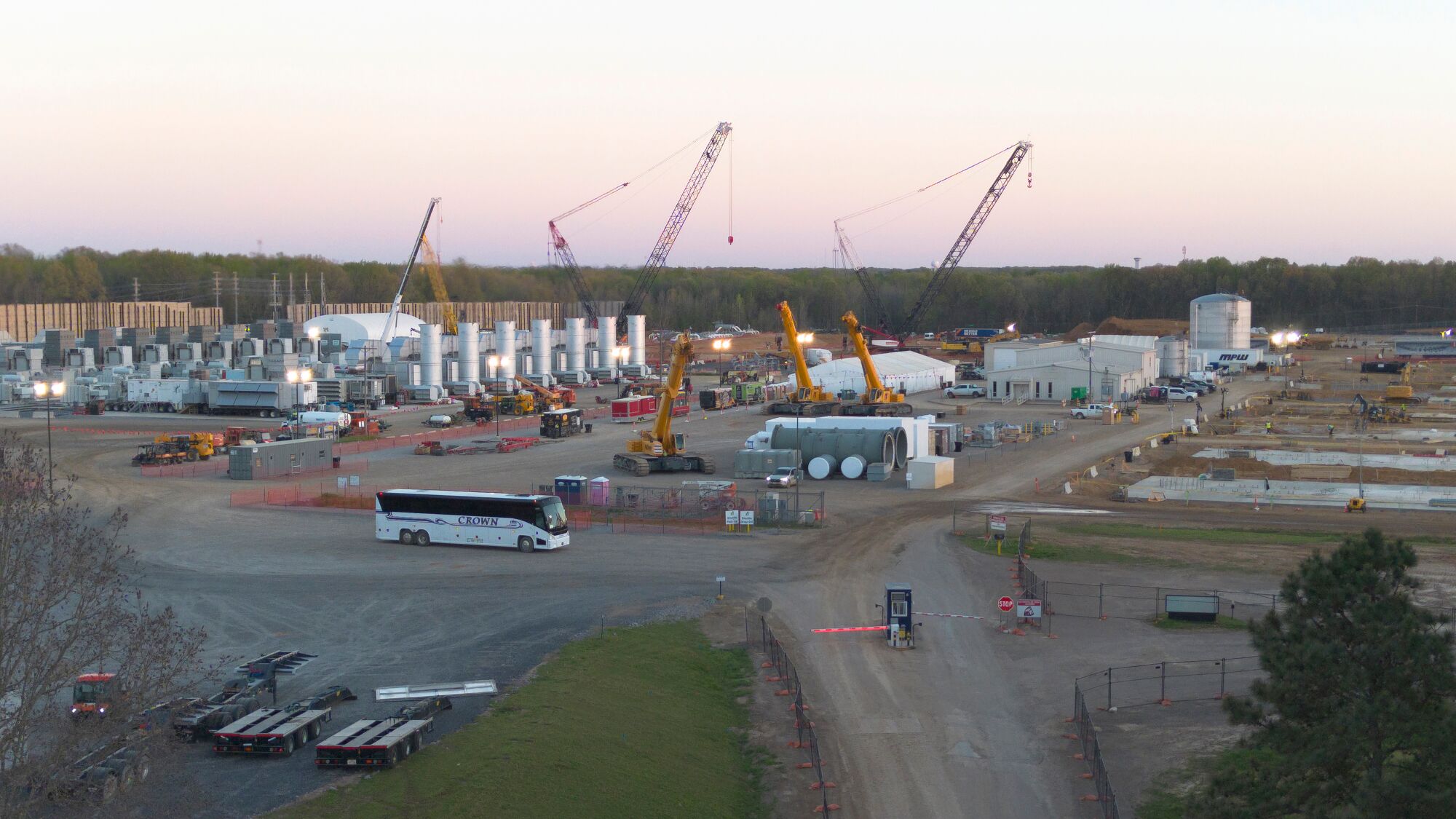
The complaint's description of the site reinforces that reading. It alleges concrete pads under the turbines and at least ten transformers between the rows. It also describes gas and water injection lines, selective catalytic reduction equipment and two switch houses.
The court also declined to defer to MDEQ. Mississippi courts do not defer to state agencies on questions of statutory meaning, the judge noted. The letter's 12-month condition puzzled her. The order asks why the length of time a turbine stays on site would matter for permitting.
How many turbines does the Colossus gas plant have?
The complaint, filed in April 2026, alleged at least 27 gas-fired turbines as of 7 April. The order lists 14 SMT-130 units and one M35. It also counts four Gen 6 TM 2500s, five Gen 7 TM 2500s and three Gen 8 TM 2500s.
Their combined capacity is at least 495 megawatts, according to the allegations. The order records ratings of 13 megawatts for the SMT-130s. The other models range from 22 to 25 megawatts.
The complaint estimates potential annual emissions, putting nitrogen oxides at about 1,700 tons and formaldehyde at 19 tons. It also lists 580 tons of carbon monoxide and 180 tons of fine particulate matter.
Nitrogen oxides matter because they react with other chemicals in sunlight to form ozone and particulate matter. The order notes that NOx is a primary cause of smog.
The plaintiffs also describe effects on people nearby. Their members live, work, worship and study near the plant, the order says. Some have cut time outdoors or invited vulnerable friends and relatives over less often.
The plaintiffs' lawyers publish a larger figure. Earthjustice and SELC say the plant can emit more than 5,000 tons of NOx a year. They also cite more than 400 tons of fine particulates and 47 tons of formaldehyde. A statement from SELC quoted by TechCrunch refers to at least 35 turbines, which helps explain the higher estimate. The order does not address the difference in counts.
The order also records the plaintiffs' claim about controls. At least 13 turbines lack equipment meeting the Clean Air Act's best available control technology standard, the plaintiffs say. They say such controls could cut NOx emissions by about 90 percent or more.
The site covers 114 acres, according to a photo caption published by Earthjustice. The group compares that to nearly 87 football fields.
Why does the mobile-source ruling matter beyond this case?
The case tests a defense that other operators could raise. Turbines mounted on trailers, the argument goes, are mobile equipment rather than a stationary power plant. The court's answer turns on how federal rules define the equipment, not on how it is delivered.
This is one district judge's reading of one state's plan. It does not bind courts in other states, and it does not create a national rule. Its reasoning may still be cited in similar disputes. The definition it used comes from federal regulations that many state plans adopt.
The court did not rely on EPA's recent rulemaking on temporary turbines. The plaintiffs told the court that a January 2026 EPA final rule confirmed such units are not mobile sources. xAI argued that the rule could not retroactively supply fair notice. It also said earlier federal proposals did not interpret Mississippi's plan.
The judge decided the question from the plan's text and the definitions it incorporates. That narrower route may make the ruling harder to dismiss as a dispute about the EPA's policy stance.
The ruling also leaves factual questions open. It does not decide how much the plant actually emits. Nor does it decide whether every unit operated as alleged. It also leaves open whether the plant crosses the thresholds for the permits the plaintiffs say it needed.
The fair-notice defense also remains open. The order notes that the doctrine might matter if MDEQ later tried to enforce a permit requirement. That would be a problem after telling xAI that none was needed. That is not the situation here: a private suit is before the court, and the agency has not changed its position.
The plaintiffs' lawyers frame the stakes as national. Kym Meyer of SELC called the decision "a victory for communities across the nation". She stressed its effect on South Memphis and north Mississippi.
Can citizens sue polluters under the Clean Air Act?
The court also rejected xAI's standing defense. The company argued that the Clean Air Act's phrase "on his own behalf" stops an association from suing for its members' injuries. The court said the NAACP's own objectives include fighting environmental risks to Black and frontline communities. The suit therefore serves the organization too.
The judge noted that Congress defined person to include associations. The parties cited no case holding that the phrase blocks association suits. She was not aware of one.
The constitutional defense went further. xAI argued that the citizen suit provision gives private parties the president's executive power. The company said that violates Article II and the private nondelegation doctrine.
The court rejected that argument. It held that citizen plaintiffs sue in their own name, for their own injuries. Civil penalties can redress those injuries by stopping the conduct and deterring repeats, the court said.
The ruling leans on precedent. It cites Friends of the Earth v. Laidlaw, a 2000 Clean Water Act case. That decision held that civil penalties can redress citizen plaintiffs' injuries. It also cites Medina v. Planned Parenthood South Atlantic, a 2025 decision. That case said Congress may let private parties enforce federal law through civil litigation.
The judge distinguished Trump v. United States, which concerned criminal investigation and prosecution. A private civil suit over pollution is not a criminal prosecution, the order says.
The decision adds to a run of district court rulings upholding citizen suits. The order notes that other courts have reached the same conclusion. It does not settle the question for the Fifth Circuit or the Supreme Court.
The practical stakes are large: if the defense had succeeded, it would have ended this case. It would also have weakened a route that communities use when regulators decline to act. The court said the provision lets citizens sue when agencies choose not to enforce. It does not let them challenge an agency's enforcement discretion.
Why did the Justice Department try to end the case?
The case has a second front. On 15 June 2026, the United States moved to intervene as a plaintiff and to dismiss the suit. An amended motion said it acted on behalf of EPA's administrator.
Judge Brown ruled on that motion on 19 October. She allowed the government to intervene but refused dismissal. The Clean Air Act lets the administrator intervene, she wrote. It does not let the administrator unilaterally end a citizen suit.
The order put the limit plainly: "What the United States can and cannot do after intervention, however, is another matter."
The government also invoked the canon of constitutional avoidance. It argued that doubts about the law's constitutionality should push the court toward its reading. The court said no "fairly possible" interpretation gave the United States a unilateral right to end the suit.
The court did allow intervention, so the government can take part as the case continues. Earthjustice described the ruling as a rejection of what it called a claim to "unilateral and unreviewable veto power" over citizen suits.
The government's filings referred to national security concerns. The court said it would not consider the government's reasons for dismissal. The question turned on whether the statute allowed dismissal at all.
The government had already appealed an earlier procedural ruling. It asked the Fifth Circuit to stay the case. The appeals court declined, noting that the district court had not fully decided the issue.
The intervention fight is separate from the merits. It concerns who controls the litigation, not whether the plant needed permits. The government argued that EPA is the primary enforcer of the Clean Air Act. It said citizen suits should not be able to commandeer federal enforcement. The court agreed that EPA and the states are primary enforcers. It found no dismissal right in the text.
What happens next for xAI and the Colossus plant?
The plant is still running, and the court has not ruled on the NAACP's motion for a preliminary injunction. Filed in June, it asks the court to stop operation until permits and pollution controls are in place. xAI opposed that motion.
A ruling on the injunction would be an early test. The court would have to weigh the plant's emissions against the cost of halting operations. It would not decide the merits, but it could change how the site is run.
If the plaintiffs win on the merits, they seek several remedies. They want a declaration that xAI violated the law. They want an injunction requiring best available control technology. They also seek civil penalties of up to $124,426 per day per violation.
xAI can still argue fair notice and reliance on the state letter. It can also dispute facts about the turbines and their emissions. The order repeatedly notes that it accepts the complaint's allegations at this stage. Discovery will test the state letter, the turbine records and the emissions estimates.
The Justice Department's appeal could produce an appellate ruling on intervention. Denials of motions to dismiss are generally not final judgments. The case is therefore expected to stay in the district court for now.
The broader fight is political as well as legal. TechCrunch notes that New York recently passed a moratorium on new data centers. It says the backlash could be a factor in the midterm elections.
For now, the NAACP's case has survived its first big test. The next one is whether a judge will order the turbines to stop or add controls. That decision would come while the case continues.