What did Nvidia announce at AI Day Seoul 2026?
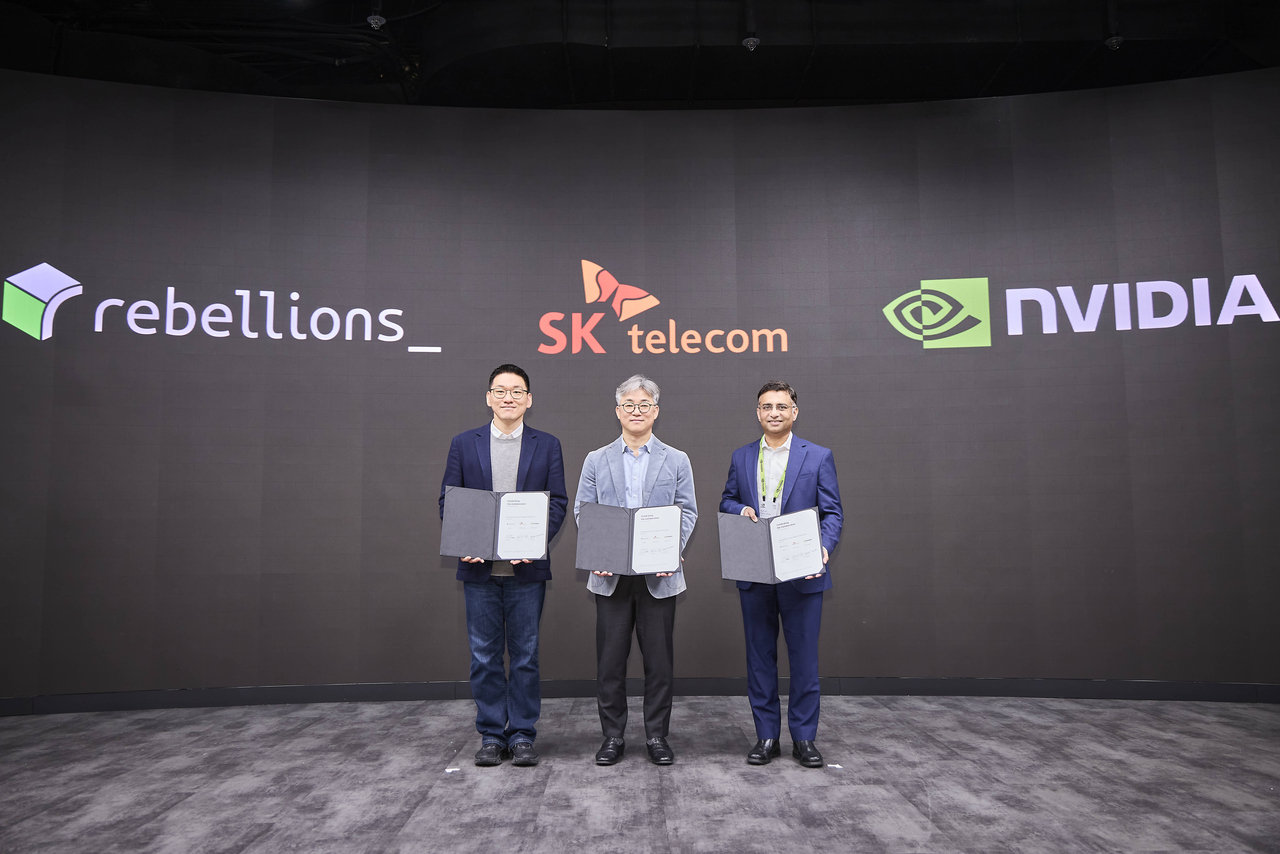
Nvidia, SK Telecom and Rebellions signed a memorandum of understanding on Monday 9 November at the AI Day Seoul event. The agreement connects Rebellions' Korean-designed R200 neural processing units to Nvidia's rack-scale computing systems. Korea's Ministry of Science and ICT supported the deal, which the three companies announced at COEX in Seoul.
The arrangement uses Nvidia's NVLink Fusion technology. Rebellions will adopt the interconnect to link R200 chips with Nvidia's platform and will use Nvidia's MGX rack architecture. SK Telecom plans to deploy the resulting systems in its AI data centre. It intends to connect them to its own foundation models and public services, including those under the government's AI for All project.
Nvidia described the work as infrastructure for sovereign AI. The term refers to AI capacity built around a country's own language, data and priorities rather than rented from abroad. "Sovereign AI gives nations the power to turn their language, culture and expertise into intelligence," said Nvidia chief executive Jensen Huang.
The event itself is large. Nvidia says more than 2,000 developers, startups, enterprises and researchers are taking part in the two-day programme at COEX. Reuters reported that about 2,000 participants were expected. Sessions cover physical AI, agentic AI and national AI infrastructure, according to Nvidia.
The Korea Herald published a photograph of the signing. It showed Rebellions chief executive Park Sung-hyun, SK Telecom technology chief Chung Suk-geun and Nvidia's NVLink Fusion vice president Ashish Karandikar.
The deal is a framework, not a purchase. Nvidia's release says Rebellions' R200 systems are expected to be ready for deployment in 2028. None of the companies disclosed order volumes, prices or performance results for the Korean processor.
What is NVLink Fusion, and why does Rebellions need it?
NVLink Fusion lets other companies' processors plug into Nvidia's rack-scale systems. NVLink is Nvidia's high-bandwidth, low-latency scale-up interconnect, and Fusion extends it to custom processors. That is why a Korean NPU can sit in the same rack as Nvidia GPUs.
Chips connect through NVLink networking and use Nvidia's MGX rack design. The Korea Herald describes it as a way for third-party chipmakers to integrate their processors into Nvidia's data-centre architecture.
Rack-scale matters because modern AI systems are sold as complete units. Nvidia's MGX design sets the rack footprint, power delivery and cooling that partners build around. That standardisation is what makes a mixed rack of GPUs and NPUs practical to design and operate.
For Rebellions, the value is distribution. A Korean NPU startup can test its silicon inside Nvidia's design and pitch it to customers already running Nvidia kit. The Ministry of Science and ICT said platform access could help Korean chipmakers move beyond standalone products, the Korea Herald reported.
Rebellions is a known quantity in Korean AI hardware, not an unknown startup. Nvidia's release lists Aramco, Arm, Kindred Ventures, KT, Mirae Asset Group, Samsung, SK Hynix and SK Telecom among its backers. The company is based in South Korea and operates in the United States. It sells inference accelerators to enterprises and governments, with supply-chain resilience as part of the pitch.
The technical plan is disaggregated inference. Nvidia says the partners will assign different stages of response generation to the processor that suits each best. GPUs would handle prefill, the stage that processes the user's prompt. Rebellions NPUs would handle decode, the token-by-token generation stage.
The two stages stress hardware differently: prefill is compute-heavy and parallel, while decode is memory-bound and sequential. That is why inference specialists argue general-purpose GPUs are not always the cheapest option. Nvidia argues this split can improve throughput and power efficiency, but it has published no comparative figures.
Nvidia calls the R200 an inference chip for frontier models, including mixture-of-experts systems with trillions of parameters. It says the chip is tuned for low latency and energy efficiency. Those claims are hard to check because the R200 has not shipped. Rebellions' current flagship is the Rebel100, which uses a chiplet design and an open-source software stack.
The arrangement also serves Nvidia's interests. Custom accelerators that enter through NVLink Fusion run inside Nvidia's rack design. Its networking, power and cooling reference architectures set the terms. That keeps Nvidia at the centre of systems built around rival silicon.
Why is South Korea pursuing sovereign AI?
The Korean government wants models and chips it controls. MSIT is backing the Nvidia collaboration and runs a separate programme to select foundation-model builders. That programme was launched to cut Korea's reliance on foreign AI models, Aju Press reported.
Nvidia says it will work with three selected consortia and four Korean model builders under AI for All. It will use its Dynamo software to optimise and scale inference.
That competition is narrowing. Aju Press reports that SK Telecom, LG AI Research and Upstage are the remaining teams in the MSIT sovereign-model project. They advanced after an evaluation on 18 August 2026. Two winners are due in early 2027, which means the country's flagship model effort is still unresolved.
AI for All is also a delivery channel. SK Telecom plans to connect the new infrastructure to public-facing services built under the initiative, according to Nvidia. That gives the chip deal a government-backed pipeline rather than a purely commercial one.
Naver's cloud unit was dropped from the project in January, according to Aju Press. Naver later became the first Korean member of Nvidia's Nemotron Coalition, joining in June. Nvidia launched that coalition in March to pool data and evaluations from labs including Mistral AI and Perplexity.
Nvidia supplies open models and data to these teams. Nemotron is a family of open-weight models released with training datasets, recipes and software. LG AI Research has opened API access to K-EXAONE-2.5, which Nvidia says was trained using Nemotron datasets. One of them, Nemotron-Personas-Korea, is a synthetic dataset of 7 million Korean personas grounded in official national statistics.
Nvidia is also making speed claims. Jonathan Cohen, its vice president of applied research, described Nemotron 3.5 Super VL. The 120-billion-parameter model was released on 15 October.
He said it is about as capable as the 550-billion-parameter Nemotron 3 Ultra but runs roughly five times faster. He told the Seoul audience that Nvidia plans to "invest in the Nemotron family forever", Aju Press reported.
What else did Nvidia announce in Seoul?
The chip deal was one item in a broader set of Korean partnerships. Nvidia used the event to promote software, robots, factory simulation and startup investments. Some announcements were demonstrations, some were plans, and several came with vendor performance numbers.
The breadth is deliberate. Nvidia is positioning Korea as a reference customer for its full stack, from training chips to robot simulation. Most of these projects are pilots or explorations, and few include committed volumes.
- •Inference recipes: Dynamo-optimised deployment recipes for four Korean open models. The models are A.X K2, K-EXAONE 2.0, Solar Open 2 and Motif-3. The companies behind them are SK Telecom, LG AI Research, Upstage and Motif Technologies. Nvidia says they are tuned for B200 GPUs and deliver up to twice the performance out of the box.
- •Agent security: Hyundai Motor Group is exploring Nvidia's NemoClaw blueprints and OpenShell runtime. Korean security firm AIM Intelligence is integrating its Starfort platform with OpenShell to police agent behaviour.
- •Chip design: Samsung is using Nvidia's PhysicsNeMo for thermal and mechanical analysis. Nvidia says one homogenisation case fell from about 18 hours on a 32-core CPU to 41 seconds. That used a coarser grid and GPU acceleration, roughly a 1,600-fold speedup.
- •Robotics and driving: LG Electronics demonstrated its CLOiD robot performing manufacturing tasks using Isaac GR00T and Cosmos. Kakao Mobility plans a Level 4 autonomous driving system using Nvidia's Hyperion platform and DRIVE AGX Thor. It starts with Kia purpose-built vehicles and has no announced launch date.
- •Startups: Nvidia announced an investment in interconnect company Point2 and said it plans further investments in Motif Technologies, RLWRLD and Upstage. It met more than 20 Korean startups at a forum with MSIT. Nvidia also says it has over 1,000 Korea-based members in its Inception programme.
Did the Jensen Huang investigation affect the event?
Yes, at the margins. Nvidia's board said on Sunday 8 November that it had opened an independent investigation. The inquiry concerns reports that chief executive Jensen Huang was the target of a foreign intelligence effort.
The board said it had no reason to believe Nvidia secrets or US national security had been compromised. Huang said he would cooperate fully, Reuters reported.
Huang's daughter, Madison Huang, is an Nvidia senior director. She cancelled her visit to South Korea.
Rebellions said a planned visit to its headquarters and a partner dinner were cancelled. It cited "unavoidable internal circumstances at Nvidia", according to Reuters. Kakao Mobility also scrapped a photo session and question-and-answer event with her.
Kakao Mobility said its business agreement with Nvidia would still proceed. Senior director Gaurav Agarwal attended in her place, Reuters reported. Nvidia AI Day Seoul itself went ahead as planned. Sessions ran at COEX, and executives including Deepu Talla and Jonathan Cohen attended.
The Korean government played down the risk to supply. Vice Minister of Science and ICT Ryu Jemyung spoke to a parliamentary budget committee. He said 10,000 GPUs funded by a 2025 supplementary budget had arrived and were in use.
He said 2026 volumes were under contract. "We expect production and the delivery schedule for contracted volumes to proceed without disruption," he said.
The timing is awkward regardless. The same week brought Nvidia's widest Korean partnerships. It also brought a cancelled visit by the chief executive's daughter and a board examining a spy plot.
Deals can still close while reputational risk rises. Partners now have to weigh Nvidia's technology against Nvidia's headlines.
What are the limits of these announcements?
Most of what was announced is intent rather than delivery. The NVLink Fusion arrangement is a memorandum of understanding, which is typically non-binding. R200 systems are targeted for 2028. No pricing, volume commitments or independent benchmark results were released.
Several figures are vendor claims. Nvidia says its Dynamo recipes can double performance, without publishing the baseline. It says Samsung's simulation ran roughly 1,600 times faster, on a specific coarse-grid case. Those numbers may be accurate and still not generalise to other workloads.
Software is the harder test. An accelerator is only useful if developers can run their models on it, and Nvidia's CUDA tooling remains the industry default. Rebellions says its stack is built on open-source technologies and standards, which helps. Porting frontier models to a new chip still takes engineering work that no memorandum removes.
Korea's model project is also incomplete. Two winners will not be chosen until early 2027, and the finalists are training with Nvidia datasets. That is convenient for Nvidia. It does not show that Korean models can compete globally, or that Korean chips are the best place to run them.
There is a sequencing problem too. Korean model builders need compute now, and they are buying it from Nvidia. The Korean NPUs meant to reduce that dependence will not be deployable until 2028. Sovereignty, in this plan, arrives after several more years of reliance.
MSIT's role here is supportive rather than financial, based on the companies' statements. The ministry wants to extend the partnership model to other Korean NPU makers. It is also pursuing similar links with AMD, the Korea Herald reported. That keeps Korea's options open, but it also shows how early the work is.
The practical result is a hedge rather than independence. Korea gets a credible path to domestic accelerators without giving up Nvidia hardware in the meantime. Whether that counts as sovereignty depends on how much of the stack Korean companies end up controlling.
What should you watch next?
The Seoul event continues through 10 November, so more announcements may follow. The immediate test is whether any of them include firm orders rather than frameworks.
Nvidia's board investigation is the largest variable. If the inquiry widens, Korean partners may face questions from their own boards, lenders and the government. Supply commitments look stable for now, according to the science ministry.
On technology, watch for R200 sampling and third-party benchmarks before 2028. Watch, too, for whether SK Telecom discloses how many systems it deploys. The split between NPU and GPU workloads will matter.
On policy, the MSIT model competition reaches a decision in early 2027. The results will show what sovereign AI means in practice. It could be Korean models on Korean chips, or Korean models on Nvidia hardware.
On competition, AMD is the company to track. Korea's science ministry has already signalled interest in giving local chip designers access to more than one global platform.
For now, the Seoul announcements give both sides what they need. Nvidia gets a showcase for its open platform in a key semiconductor nation. Korea gets a plan for domestic accelerators and a partner that can supply GPUs in the meantime.
Whether that plan survives its 2028 timetable is the real test.