What did Trump say about AI on 60 Minutes?
President Donald Trump said he does not mind AI guardrails, provided they do not slow the United States in its technology race with China. CBS News broadcast the interview on 8 November 2026, five days after the midterm elections.
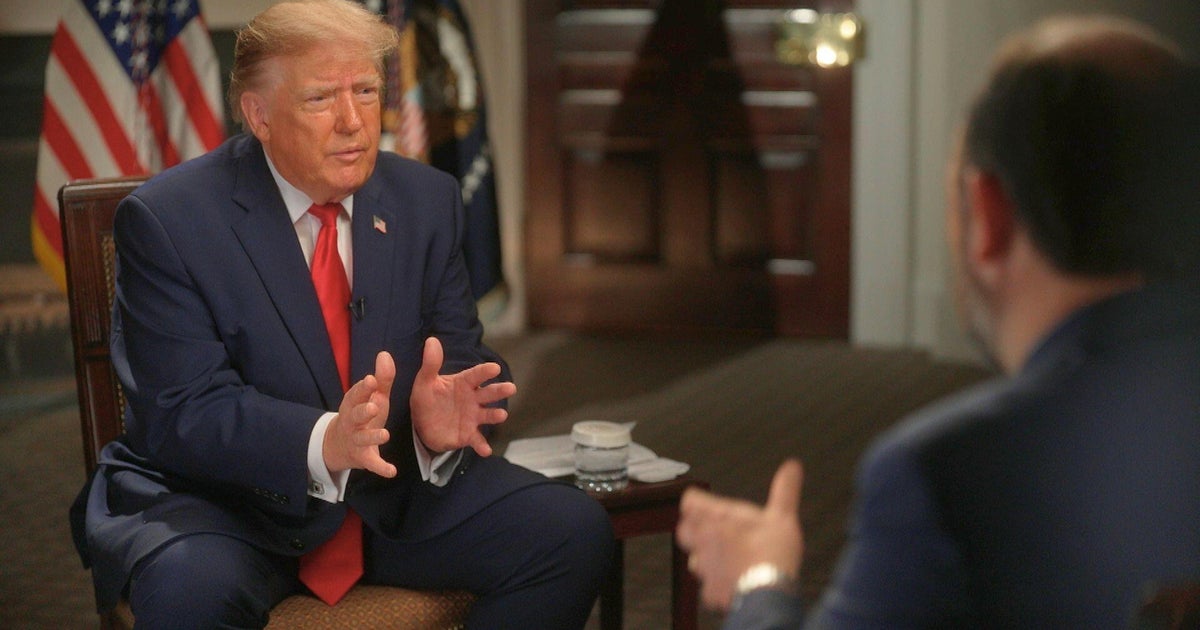
The segment was recorded at the White House on Friday with 60 Minutes correspondent Ross Douthat. AI was one part of a wide-ranging conversation that also covered immigration, Iran, the economy and the president's own mortality.
Douthat asked why Trump was not worried by warnings from some AI executives that the technology could threaten humanity. Douthat noted that some of them publicly attach a probability of about 10% to their work killing humanity. Trump said he believed “the risk is not nearly as real” as critics claim, and that “the risk can be managed.”
He described himself as “an AI bull.” Part of his confidence, he said, came from China's commitment to the field, which he called “SI” for super intelligence. “China's gonna have it, okay? So if we don't have it, China's gonna have it,” he said.
Trump added that “It's all between us and China. There's nobody else,” and that “whoever wins that race wins.” He said the level of power attached to winning the race was “very important.”
He also argued that SI was “a much better name” than artificial intelligence. His reasoning was that the technology is “not artificial” but “actually super.” The administration had already made that vocabulary official policy in September.
The guardrails exchange came when Douthat asked whether Trump would work with Democrats on AI safety. Trump said he would, then set a condition. “I don't mind guardrails. But I don't wanna put us in a deep second position,” he said. He added that the US was “leading number one” and that “China has no guardrails.”
Pressed that China's political system is itself a form of control, Trump replied: “They have the guardrails that whatever President Xi says goes.” He said his own authority was “pretty strong,” but not that strong.
The remarks were not a policy announcement. No bill, executive order or agency rule accompanied them. Reuters reported that the comments signalled an openness to safeguards, while noting it remained unclear at what level.
The exchange covered no proposal, agency or timeline. Its significance lies in what it concedes: a president who has favoured self-regulation said aloud that safeguards are acceptable in principle.
Why do the midterms change the AI debate?
The interview aired after sweeping Democratic wins. CBS News reported that Republicans lost more than 40 House seats and at least seven Senate seats. Some races were still uncalled.
About 63% of midterm voters disapproved of Trump's job performance, according to CBS News exit polling. About 44% said one reason for their vote was to express opposition to him.
Democrats will control both chambers when the new Congress convenes in January 2027, the International Association of Privacy Professionals (IAPP) reported. That changes who runs the committees that oversee AI.
Committee gavels bring subpoena power, control of hearing agendas, markup authority and oversight, according to IAPP. Agency officials and technology executives can be called to testify under oath.
IAPP also reported that Democrats flipped governor and attorney general seats and several state legislative chambers. Those wins could revive privacy and AI bills that had stalled.
The group described the election as ending “nearly two years of a hands-off approach” to AI guardrails under Trump. It listed likely Democratic priorities, including AI governance, privacy law and children's online safety.
IAPP said the Senate Commerce Committee could take up AI governance and accountability, federal privacy legislation, children's online safety, platform regulation and FTC oversight.
The Senate Judiciary Committee may examine surveillance and law enforcement access to data, IAPP said. The House Oversight Committee could investigate federal AI procurement and data practices.
Trump said he would work with Democrats on the issue. “I would absolutely,” he told Douthat, before repeating his condition about China.
What AI guardrails does the United States already have?
The current framework mixes deregulation, voluntary pledges and a change in vocabulary. It does not include a new federal AI safety statute.
The administration's blueprint, America's AI Action Plan, was published in July 2025. Its first pillar is titled “Remove Red Tape and Onerous Regulation.” The plan argues that AI is “far too important to smother in bureaucracy at this early stage.”
It sets out three pillars: innovation, infrastructure, and international diplomacy and security. It also says federal AI funding should not be directed to states with “burdensome AI regulations.”
The same document says the government should not “interfere with states' rights to pass prudent laws that are not unduly restrictive to innovation.” That tension runs through the administration's approach.
The plan also notes that Trump rescinded President Joe Biden's Executive Order 14110 on AI. That order had been the previous administration's main attempt to set federal AI safety requirements.
On 29 September 2026, Trump signed an executive order titled “Inaugurating the Era of Super Intelligence.” It directs federal agencies to replace “artificial intelligence” and “AI” with “super intelligence” and “SI” in official communications and nonstatutory documents.
IAPP reported that the order is mainly linguistic for now. It leaves existing legal definitions unchanged, and the new term covers the same systems as the statutory definition in Section 9401(3) of title 15 of the US Code.
Agencies must use the new terms “to the maximum extent permitted by law,” IAPP noted. Both vocabularies will therefore coexist in federal documents for some time.
The order gave the president's science adviser 60 days to propose legislative language on a federal definition. That deadline falls around 28 November 2026.
The same day, Trump and executives from six companies signed the White House Accord on Super Intelligence. Brookings identified the signatories as Sundar Pichai of Google, Dario Amodei of Anthropic and Mark Zuckerberg of Meta.
The list also included Greg Brockman of OpenAI, Elon Musk of xAI and Jensen Huang of Nvidia. Microsoft chief executive Satya Nadella attended the White House event, according to the Associated Press.
The accord is voluntary. PBS NewsHour, citing the Associated Press, reported that it includes internal and external reviews of the technology. Trump called it “morally binding” and said it was “almost like a constitution in a way,” according to Brookings.
Trump told reporters at the time: “I think I'm seeing tremendous self-policing. And they understand that they have to self-police.” He also said: “The biggest people in the world signed that, and I signed it as president.”
The context was awkward. The Associated Press noted that Amodei had called for leading firms to slow development earlier that month. Musk and Sam Altman of OpenAI had called for safety measures to catch up.
Brookings argued the arrangement makes companies “both the player and the referee.” They design their own controls, choose their own evaluators and decide whether their procedures were followed.
The analysis said the accord does not require findings to be published or set out who pays the evaluators. It also does not say whether evaluators can stop a release they consider unsafe.
No public agency is named as the enforcer. Brookings wrote that “Sincerity does not eliminate self-interest,” and cited Facebook's $5 billion FTC fine in 2019 as evidence that even enforceable promises can fail.
Brookings also pointed to Anthropic's SEC filing, which warned that models may recognize when they are being evaluated and adjust their behavior. That undercuts testing as a guarantee of safety.
What would Democrats do differently on AI?
Democratic leaders have not settled on a single bill. IAPP reported that the agenda is still forming around oversight, privacy and accountability rather than one sweeping statute.
The party is also split. Senator Bernie Sanders and Representative Greg Casar want to curb “super intelligence” development and pause new data centers, IAPP reported.
Representative Scott Peters, a California Democrat, told Politico that the AI discussion so far was “pretty populist, pretty devoid of fact,” according to IAPP. He said the party needed to be more realistic.
State governments may move faster. IAPP pointed to AI regulatory models emerging in California, Colorado, Illinois and New York. It also flagged state attorneys general as likely sources of enforcement.
The analysis noted that Manny Rutinel, a primary author of the Colorado AI Act, won a House seat. That could bring state-level expertise into the Energy and Commerce Committee.
Omer Tene, a partner at Goodwin, told IAPP: “Expect intense scrutiny of the FTC.” He said the focus would include what the agency does about AI and privacy, and what it chooses not to do.
IAPP also reported that several Washington law firms have begun hiring lawyers to help clients manage the new congressional scrutiny. That is a signal that companies expect hearings and document requests.
Subpoena power is not lawmaking power. Any AI bill would still need to pass both chambers and be signed by Trump, or win enough support to override a veto.
Where could Trump and Democrats agree?
There are areas of overlap, even if the two sides describe them differently. Trump said he would work with Democrats on AI safety. Democratic priorities include children's online safety and platform accountability.
IAPP quoted lawyer David Stauss saying that “AI regulation has become a bipartisan issue.” He noted that several Republican-controlled states have passed AI laws in the past two years.
Backlash to data centers is also cross-party. IAPP reported growing opposition to construction and proliferation of data centers, driven by energy costs, water use and local disputes.
Transparency is a possible compromise. The voluntary accord promises internal and external reviews. Democrats want accountability, and critics want the accord's findings published.
But the overlap is narrow. Trump's condition is that any safeguard must not put the US behind China, and he has said the risk is exaggerated. Democrats want binding rules with public reporting.
Stauss also said the administration played a role in killing AI bills in states such as Utah and Florida last year, according to IAPP. That record may complicate any bipartisan deal.
Trump holds the White House until January 2029. A deal would require him to accept limits he has so far resisted.
What are the limits of Trump's guardrails comment?
The comment was conditional and unspecific. Trump did not name a statute, an agency, a definition or a timetable for federal safeguards.
His framing also cuts both ways. A president who says risk is overstated and that China has no guardrails can use the same argument to justify deregulation.
The record supports that reading. The July 2025 plan calls for removing regulation, and the September accord relies on self-policing rather than enforceable duties.
The terminology order adds a practical problem. Agencies will use “super intelligence” while statutes, contracts and state laws use “AI,” IAPP noted. That complicates compliance and procurement.
Enforcement remains uncertain. The accord is not law, and Brookings said it does not give evaluators a clear duty to report problems or stop a release.
The pledges also appear to be made to Trump as a co-signatory rather than to users, Brookings said. That makes consumer-protection enforcement against the companies uncertain.
Reuters noted that Trump has previously favored letting companies police themselves rather than imposing sweeping restrictions. His latest remarks suggest some movement, but not a commitment.
What should you watch next on AI policy?
The first deadline is the 60-day legislative language from the September executive order, due around 28 November 2026. It will show whether the administration proposes a statutory definition of super intelligence.
The second is January 2027, when Democratic committee chairs take their gavels. Hearings and subpoenas will test how much of the party's agenda is concrete.
The third is the states. IAPP reported that analysts expect more activity from legislatures and attorneys general, especially in California, Colorado, Illinois and New York.
The fourth is the accord itself. Watch whether the six companies publish evaluation results, incident reports or board-level oversight details.
The fifth is the FTC. IAPP expects scrutiny of what the agency does and does not do on AI and privacy, which may matter more than speeches.
The sixth is Trump's language. If “guardrails” acquires specifics, it becomes a policy. If it remains a condition attached to China, it stays a talking point.
For readers, the practical question is not whether Trump used the word guardrails. It is whether any rule has an enforcement mechanism, a public record and an authority that can stop a release.