What did the committee find?
Britain is dangerously dependent on China for minerals needed to rearm, build AI infrastructure and reach net zero. That is the conclusion of a UK parliamentary report published on 5 November 2026.
The report comes from the Business, Innovation, Science and Trade Sub-Committee on Economic Security, Arms and Export Controls. It is the ninth report of the 2026-27 session and follows a separate inquiry into the government's China policy.
The committee gathered 60 written submissions and held two oral evidence sessions. It also visited Ottawa and Montreal to meet Canada's mining and metals sector. Its central finding is that ministers cannot demonstrate a sufficiently robust plan.
Liam Byrne, the committee chair, said critical minerals are "the alpha of the new economy". He argued that Britain cannot rearm, build AI or deliver net zero without securing the minerals those technologies depend on. He added that Britain remains "dangerously exposed" sixteen years after China first used rare-earth leverage.
The report describes government progress as opaque. Parliament has no visibility of the capabilities ministers are trying to protect, the vulnerabilities they have identified, or the projects they are funding. The committee says it cannot be confident the government passes any of its ten tests.
The report frames the problem as economic coercion, not only market risk. It says China's 2025 export controls showed how quickly a dependency can become leverage. It also notes that allied governments have responded with subsidies and local content rules, adding to competition for scarce supply.
Ministers reject the charge of inaction. A government spokesperson cited £400 million to expand domestic production and recycling, alongside international partnerships. The government's stated 2035 goals include 10% of demand from domestic production and 20% from recycling.
What are the committee's ten tests?
The ten tests are designed to give Parliament a way to measure progress over the rest of this Parliament. They cover strategy, domestic delivery, international partnerships and finance.
The tests start with a basic question the committee says ministers have not answered. Which sovereign capabilities, from defence to AI infrastructure, must be protected, and which minerals do they require?
Tests one to four ask whether the government has named the sovereign capabilities it wants to protect. They also cover the volume and value of minerals needed, allied demand, and the chokepoints that create vulnerability.
Tests five to seven cover domestic delivery. They ask how much demand can be met through UK mining, refining and recycling, whether energy and planning costs are competitive, and whether the workforce exists.
Tests eight to ten cover external supply and money. They ask for a credible allied sourcing plan, access to a full financing stack, and evidence that businesses are actually diversifying.
The committee says it cannot be confident that the government passes any single test today. It wants annual reporting against mineral-by-mineral targets, rather than project-by-project funding announcements.
That demand forecasting gap matters. The committee says minerals are often hidden inside broad trade statistics, making it hard to know what Britain imports and in what quantity. Better data would let ministers prioritise the dependencies that matter most.
Why does AI infrastructure depend on critical minerals?
Critical minerals include copper, lithium, cobalt, nickel, graphite and rare earth elements. They are inputs for batteries, semiconductors, wind turbines, data centres and defence platforms. The report argues that AI infrastructure cannot be separated from these physical supply chains.
Rare earth magnets are used in data centre equipment, quantum computers and modern weapons. The committee notes that global drone manufacturing was the fastest-growing demand segment for these materials in 2025.
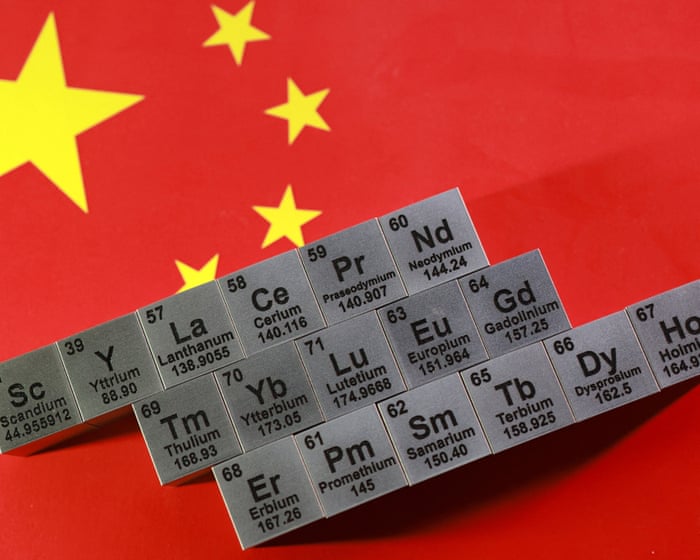
China's advantage is concentrated in processing. The International Energy Agency estimates that China is the leading refiner for 19 of 20 strategic minerals, with an average market share of 70%.
The IEA puts China's share of rare earth separation at 91% and magnet production at 94% in 2024. Its share of battery precursor and lithium iron phosphate cathode production exceeds 95%. These are the stages that convert mined rock into usable components.
China's cost advantage reinforces that position. The report says Chinese refined rare earth components remain five to six times cheaper than Western equivalents. Glencore's Toby Spittle told the committee that China treats refining as part of an integrated supply chain, aimed at getting materials into Chinese-made products at the lowest cost.
UK demand is projected to rise sharply by 2030. Government projections cited by the committee show lithium demand growing 45 times from 2024, from 2,525 tonnes to 113,400 tonnes.
Rare earth demand is projected to rise 16 times, to 18,020 tonnes. Graphite demand rises 15 times, cobalt 13 times and nickel eight times. The lithium figure covers the eight growth-driving sectors in the government's industrial strategy.
Dr Gavin Mudd of the UK Critical Minerals Intelligence Centre told the committee that processing is "where the bottlenecks are". Mining is concentrated, but deposits are more widely distributed. Refining capacity is not.
How exposed is the UK supply chain?
The UK is almost completely dependent on imports for critical minerals and mineral products. It has no domestic mining or refining capacity for rare earth elements, according to the report.
The vulnerability became visible in April 2025. China imposed export controls on a group of rare earths after US tariffs, and the impact spread beyond military applications. Ford temporarily closed several US plants, and European manufacturers reported similar disruption.
The controls were not country-specific, but they hit manufacturers well beyond their intended target. The report says the episode showed that export controls can cascade through supply chains even when a company is not the named target.
The committee cites an estimate that full implementation of the export regime could put around $6.5 trillion a year of downstream production at risk. A US-China deal in November 2025 suspended parts of the regime. The Guardian reports that the reprieve now runs to January 2027.
Legacy chips have also been caught in the dispute. The Guardian notes that restrictions linked to the Nexperia row left the European car industry "days away" from stoppages. That episode showed how quickly a single component can halt assembly lines.
Recycling is the UK's clearest domestic opportunity, but the report finds it underused. About 80% of metal products classified as waste are exported rather than processed at home.
The Advanced Propulsion Centre estimates that 28,000 tonnes of reusable battery waste could be recycled by 2030. The government's Circular Economy Growth Plan was meant to set out how recycling capacity would grow. It was due in autumn 2025 and had not appeared by September 2026.
Trade codes are part of the problem. The report says they are too broad to show which types of scrap are leaving the country. Export restrictions elsewhere also limit the feedstock available to UK recyclers.
Energy and planning costs compound the gap. UK industrial electricity prices were the highest in the G7 in 2025, and power can account for 35% of a mining operation's costs. One UK nickel refinery paid nearly 60% more for electricity than its French counterpart.
Permitting is another bottleneck. Cornwall Resources told the committee that permitting brings long delays, high costs and unpredictable outcomes. Northern Lithium said a project can wait seven to eight months just for its application to reach the top of the pile.
What would the Critical Minerals Finance Facility do?
The committee's headline recommendation is a Critical Minerals Finance Facility. It would pool Britain's public finance institutions and deploy grants, equity, debt, guarantees and long-term offtake agreements.
The facility is meant to fill a gap at the early stage. The National Wealth Fund's minimum equity investment is £25 million, while many projects need £5 million to £20 million to reach bankability. Without support at that stage, viable projects can stall before commercial production.
The committee also wants British International Investment to take equity stakes in overseas mining projects. It says UK Export Finance's mandate should be widened to cover economic security.
A single US rare earth magnet facility required $1.25 billion of investment, the report notes. That scale explains why UK demand alone is often insufficient to attract private capital.
The buyers' club idea is already being tested abroad. The EU has allocated about €3 billion to alternative supply projects and is creating a platform to aggregate demand. France has committed €500 million to a dedicated critical minerals fund.
The G7 has also launched a buyers' club under Canada's presidency. It is designed to connect strategic projects with finance and potential buyers across member countries.
Long-term offtake agreements and price floors are meant to protect projects from volatile prices. Canada has signed a seven-year offtake deal with Nouveau Monde Graphite, and the report says the UK should consider similar fixed-price contracts.
The committee also recommends a stockpile covering about 60 days of minerals for defence capabilities. Procurement for the stockpile should be structured to support domestic mining and refining projects.
The committee's plan can be summarised in five parts:
- •Prioritise sovereign capabilities where dependence on China poses unacceptable risk.
- •Forecast demand by combining government and industry intelligence on minerals hidden in trade statistics.
- •Maximise domestic mining, processing and recycling by modernising geological surveys and cutting energy costs.
- •Create allied buyers' clubs to share the cost of new mines and smelters.
- •Establish the finance facility to deploy equity, loans, offtake agreements and price floors.
How realistic is "precision de-risking"?
The committee calls its approach precision de-risking. It is explicit that the task will take ten to fifteen years and that complete decoupling is neither realistic nor desirable.
Scale is the core constraint. IPPR analysis cited in the report suggests Chinese processing capacity will still exceed 50% of global capacity for most battery metals in 2030. The UK cannot replace that capacity alone.
Competition for scarce projects makes the task harder. Allied governments are offering subsidies and local content requirements. The report says UK support is smaller than in many competitor nations, which makes it harder to attract projects.
Domestic barriers are practical. New projects face multi-year permitting, high energy costs and a skills shortage. The UK Mining Education Forum says the sector needs more than 60 new mining and minerals processing engineers each year.
Public opinion and recruitment add friction. The Critical Minerals Association told the committee that mining is a "dirty word" in the UK. That perception makes it harder to build the workforce the strategy assumes.
The government's Vision 2035 strategy, published in November 2025, sets three headline goals. At least 10% of annual demand should come from domestic production by 2035, and 20% from recycling. No more than 60% should come from any single country.
Those targets are modest, and the report does not claim they would end dependence. Its complaint is that the government cannot show how it will meet them. It says Parliament has no visibility of the vulnerabilities being protected or the projects being backed.
The report is scrutiny, not legislation. Its recommendations are not binding, and the government's public comment so far has focused on existing funding and targets. The £400 million cited by ministers is money the government says it is already delivering.
There is also a measurement caveat. The 45-times lithium projection covers the eight growth-driving sectors and runs to 2030. It is a planning assumption, not an observed trend.
What should readers watch next?
The first signal is the government's formal response to the report. The committee says it will use its ten tests to track progress through the rest of this Parliament.
A Chatham House symposium on 5 November will bring defence, AI, renewable energy and mining representatives together. It will test whether the report's language translates into commitments from buyers as well as suppliers.
Two deadlines matter. The Circular Economy Growth Plan is overdue and will determine whether the 20% recycling target has a delivery mechanism. The US-China reprieve on rare earth export controls expires in January 2027.
Businesses face their own test. The committee's tenth test asks whether companies are reducing dependence on vulnerable supply chains and reporting measurable diversification. For large AI and defence buyers, that means mapping suppliers further upstream than the immediate vendor.
Individual projects show where financing currently fails. Weardale Lithium in County Durham has completed a pilot but cannot fund a demonstration plant. Northern Lithium says permitting delays prevent it from raising commercial funding.
For AI companies, the report reframes data centre risk. Power and chips dominate planning, but magnets, copper and battery materials sit further up the same supply chain. Diversifying those inputs will take longer than building the facilities that need them.
The committee's conclusion is blunt. Britain cannot afford to drift, it says, because dependencies that look manageable today can become strategic liabilities. The government's response will show whether that warning changes policy or only adds to the file.