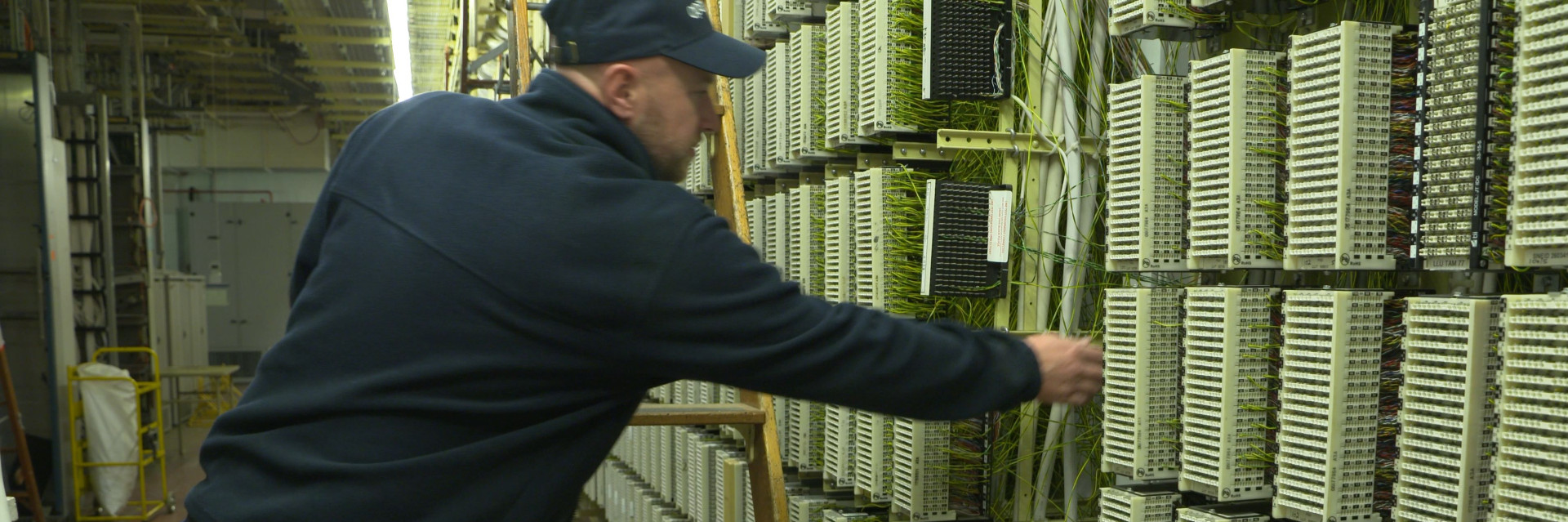
What is the UK landline switch-off?
Openreach will retire the UK's public switched telephone network, known as the PSTN, on 31 January 2027. Openreach is BT Group's network arm. It runs the access lines that BT, Sky, TalkTalk, Vodafone and many smaller providers use to reach homes and businesses.
From that date, traditional phone lines stop working as they do today. Calls move onto digital services, which usually means plugging a handset into a broadband router instead of a wall socket. The copper pair that has carried a dial tone for decades is withdrawn from service.
Openreach says the date is fixed. According to The Register, it warned communications providers in a letter during the week ending 1 November. Any customers still on PSTN connections face disruption when the network is retired, the letter said.
The migration is led by the telecoms industry rather than by ministers. GOV.UK guidance states plainly that the upgrade "is not a government programme and does not result from a government decision or policy". Ministers publish advice and expect providers to protect vulnerable customers, but they are not running the project.
The stated reason for retirement is wear. Analogue equipment is decades old and spare parts are increasingly hard to source. Government guidance cites Ofcom's finding that 2023 brought 20% more service incidents on the PSTN than 2022. Customers also lost 60% more hours to faults.
For an ordinary household, the change can be small. If broadband is already installed, the migration may be as simple as plugging the phone into the router. The exact process depends on the provider and its equipment, according to government guidance.
Digital voice also adds features. Government guidance cites anonymous caller rejection and three-way calling as examples. Internet-based cabling is also less prone to storm damage than copper, it says.
- •The PSTN is the copper phone network that predates broadband.
- •Openreach sets the 31 January 2027 retirement date for its network.
- •Digital voice runs over broadband, so it needs mains power at the premises.
How many lines are still on the old network?
Openreach's most detailed public count came on 31 July 2026. It estimated that around 1.5 million lines were still running on the old copper network, including about 350,000 business premises. The company said many of those sites depend on the line for payment terminals, lift alarms and security systems.
By mid-October the backlog had shrunk. A BBC consumer explainer published on 15 October put the figure at more than 1.2 million connections still needing to be switched. The BBC piece was built around questions from viewers to consumer journalist Harry Kind.
The two numbers are not directly comparable. Openreach counts lines, the BBC counts connections, and about eleven weeks separate the two statements. Both are estimates from parties with an interest in the migration finishing on time.
Openreach is also using price to push stragglers along. Rental prices for its Wholesale Line Rental product rose 40% in July 2026, with a further 40% rise due in October. Together those steps roughly double the rental cost, according to Openreach.
Network reach is not the main obstacle for most premises. Openreach says Full Fibre is available to more than 23 million homes and businesses. The difficult cases are properties with equipment wired into the line, or where fibre installation needs landlord permission.
Being mobile-only does not settle the question either. A household can live without a landline handset and still have a home alarm or payment terminal on the copper pair. The Register notes that Openreach has planned this retirement for the best part of a decade. It also reported that public awareness of the deadline seems low.
Openreach argues the price signal now cuts both ways. It says migrating to fibre can often be cheaper than staying on legacy products. Wholesale rentals have risen, and fibre offers have been introduced alongside them.
- •Around 1.5 million lines remained in July 2026, including 350,000 business sites.
- •More than 1.2 million connections still needed switching by 15 October 2026.
- •Legacy wholesale line rental roughly doubled in price during 2026.
Who is most at risk from the switch-off?
Care alarms are the sharpest risk. The BBC reported in May 2024 that nearly two million people in the UK use personal alarms that rely on landlines. Those devices often dial a monitoring centre automatically when the user presses a button or a sensor triggers.
Government guidance published on 8 October 2026 adds detail for housing. The Department of Health and Social Care estimates around half a million people use grouped living scheme or warden call alarms. That is roughly a quarter of all UK telecare users. A single faulty upgrade in that setting can affect many residents at once.
That guidance also shows uneven progress. The finding draws on research with alarm receiving centres in winter 2025-26 and again in mid-2026. It says around three-quarters of grouped living scheme alarms were still analogue. For personal alarms, about one-third were still analogue.
Lifts carry a similar hazard. On 31 October 2026, the Lift and Escalator Industry Association urged building owners and facilities managers to check emergency communication lines. It set out four steps. First, ask the communications provider what is changing. Then consult the lift maintainer and choose a 4G device with battery backup. Test it before migration.
"Lift emergency communications are an essential safety feature," said Micky Grover-White, LEIA's head of technical. The association also warned that 2G and 3G mobile networks are being retired. A like-for-like mobile replacement may therefore have a short working life.
Other equipment sits on the same copper. Payment terminals, security alarms, CCTV links, fax machines and health devices can all depend on the line. Openreach's July warning named payment terminals, lift alarms and security systems among the critical services at risk.
Procurement is part of the explanation. The October guidance says telecare manufacturers have stopped selling analogue devices and have developed digital replacements. Most telecare service providers are councils, which have also been working with communications providers to share data on telecare users.
- •Nearly two million people use landline-dependent personal alarms, per the BBC.
- •About 500,000 people use grouped housing alarms, a quarter of telecare users.
- •LEIA recommends 4G replacements with battery backup for lift emergency lines.
What happens if you miss the 31 January 2027 deadline?
Openreach's consumer guidance describes a fallback called Emergency Voice and Access Continuity, or EVAc. It is a temporary, voice-only service that may keep basic calls working for a limited period after the old network closes.
It is not a like-for-like replacement. Openreach warns that EVAc may not support the calling features a customer uses today. Its guidance tells anyone who relies on a landline or uses telecare to contact their provider well before the deadline.
The fallback has changed over time. Openreach previously told The Register that customers without fibre would likely move to SOTAP for Analogue. That product uses equipment in the local exchange to keep an old-style line working. The current consumer page describes EVAc instead, and the two services differ in scope.
Power is the deeper problem. Analogue lines carried a low voltage from the exchange, enough for a corded handset to work during a local outage. Digital lines need mains power at the premises, so they fail in a blackout unless a battery backup or generator is fitted.
BT said in 2024 that it would supply free battery back-up units and hybrid phones, the BBC reported at the time. The phones can use broadband or mobile networks. The offer depends on the provider and on whether the customer was identified as vulnerable.
There is also a scope caveat. GOV.UK guidance says not all analogue phone services will be switched off by 2027, and that requirements vary by communications provider. Customers who are unsure whether they are affected are told to ask their provider for their own date.
Rural coverage adds another variable. The BBC noted in 2024 that an outage could leave a digital landline unable to make calls. Copper lines kept working during local power cuts. Battery units help, but only where a provider has actually supplied one.
- •EVAc is temporary and voice-only, not a full replacement service.
- •Digital lines fail in a power cut without battery backup.
- •Provider requirements and dates can differ from Openreach's network date.
Why has the deadline already moved once?
The original target was the end of 2025. BT paused forced migrations at the end of 2023 after incidents in which telecare devices stopped working. In May 2024 it abandoned the 2025 date and set January 2027 as the new aim.
Safeguards followed the pause. Communications providers signed a charter in December 2023 covering telecare users and other vulnerable customers. A Telecare Action Board of around 30 organisations formed in January 2024, and network operators signed a second charter in March 2024.
In February 2025, the health and science departments published a Telecare National Action Plan. The October 2026 housing guidance builds on that plan. It says many housing providers still have significant work to do, despite knowing about the switch since 2017.
Not everyone thought the delay was enough. "We feel the deadline of January 2027 is very premature," Silver Voices director Dennis Reed told the BBC in 2024. The campaign group wanted clearer safeguards before any forced migration resumed.
Openreach has since closed the door on a second extension. James Lilley, Openreach's director of All-IP, ruled out another extension in July 2026. "The PSTN switch-off is now just six months away and there is no extension to the deadline," he said. The November letter repeated that message to providers.
- •The deadline moved from the end of 2025 to 31 January 2027.
- •The pause followed incidents where telecare devices stopped working.
- •Charters, a telecare board and a national action plan followed the pause.
What should households and businesses do now?
For households, the first step is to respond to the provider. GOV.UK says providers will contact customers before migration and that nobody needs to act until then. Openreach warns that any customer still on PSTN at the deadline faces disruption.
Anyone with a care alarm, a health device, a lift in the building or poor mobile coverage should say so explicitly. Providers are expected to identify at-risk customers and offer a resilient option, including battery backup where the line is essential.
Businesses have a longer checklist. Openreach says delaying makes it harder to book engineering support, because the remaining migrations are the complicated ones. A site visit for fibre, a lift integration and a payment terminal swap all take coordination.
"The straightforward migrations have largely been completed," Lilley said in November, describing what remains as connections "that underpin critical operations". His advice was to audit remaining analogue services and agree a migration plan with the communications provider.
Testing matters as much as ordering. LEIA's guidance is to test alarms with their backup power before the line is migrated, not afterwards. A device that powers up but cannot dial out is worse than one that is obviously offline.
Communication remains the weak point. Paolo Pescatore, an analyst at PP Foresight, wanted a coordinated campaign. "Openreach and all providers need to coordinate a much more cohesive campaign that reaches customers directly," he told The Register. He called for targeted letters, calls and door-to-door support for older people.
Age UK's charity director, Caroline Abrahams, made a similar point in the same article. "Providers must not give up on people who have not responded," she said. Some customers may be unwell, living with dementia or worried about scams.
Landlords and councils carry a separate duty. Government guidance asks local authorities and telecare providers to share data on which lines carry alarms. That lets providers flag addresses needing extra support. Registered housing providers must also ensure landlord-supplied equipment, including alarms, is inspected or tested as safe to keep using.
- •Answer provider letters and confirm whether equipment is attached to the line.
- •Ask about battery backup if the line supports a care alarm or health device.
- •Test replacement alarms on backup power before the migration date.
What to watch next
The next deadline is already visible behind this one. The copper phone network is not the only old system being retired. Many replacement devices depend on mobile networks that are also changing.
Ofcom says 3G networks are now switched off and that operators have committed to retiring 2G by 2033 at the latest. EE will begin in May 2029 and O2 in summer 2029. VodafoneThree will switch off the Vodafone 2G network during 2030, according to regulator figures reported by Building Services Today.
That matters because care alarms, security devices and payment terminals may use 2G. A replacement that only supports 2G buys a few years of life, not a decade. LEIA recommends 4G equipment with battery backup for that reason.
Watch the housing sector most closely. The October guidance says many housing providers have significant work left. Grouped schemes can take out alarms for many residents at once. Councils and telecare providers are also being asked to share data on which lines carry alarms.
Building managers have their own paper trail to check. LEIA points owners to a Department for Science, Innovation and Technology letter circulated to building managers. It also cites earlier industry warnings about lift alarm calls.
Watch the final weeks for engineering capacity. Openreach said in July that late migrations risk missing installation slots, and it began issuing formal notifications to providers with outstanding lines. The November letter was the latest nudge in that sequence.
And watch for a revised count. The 1.5 million figure dates from July 2026 and the 1.2 million figure from October. A final pre-deadline number will show whether the last stretch of migration is closing quickly or stalling with the hardest sites left.
- •2G retirement runs to 2033, with operator start dates from 2029.
- •Housing providers still have significant telecare work outstanding.
- •A final line count before January 2027 will show the real backlog.