What did Zipline announce on November 5, 2026?
Zipline said on November 5 that it raised $1.5 billion at a $21.5 billion post-money valuation. The South San Francisco company plans to spend the money on US manufacturing and hiring. The goal is a national drone delivery network.
The round was led by Paradigm, WCM Investment Management and Layer Global. Valor Equity Partners, Fidelity, Uber, Tiger Global, J.P. Morgan, ARK Invest and Salesforce Ventures also participated, according to Zipline.
The same announcement included a new multi-year agreement with Walmart. The retailer will add 300 Zipline drone delivery sites across the United States, with room to add more later.
Zipline was founded in 2014 and made its first commercial delivery in 2016. It describes itself as the world's largest drone delivery service by miles flown. Its aircraft operate in Africa, the United States and Japan.
The company also says ground delivery is constrained by traffic, aging infrastructure and rising costs. That is its case for moving small, urgent orders into the air. The pitch is aimed at retailers, restaurants and health systems that need speed more than volume.
Zipline did not disclose revenue, profit or the number of new hires. Walmart did not name the new locations or a completion date. Those gaps matter when judging how quickly the network can grow.
How big is the Walmart drone delivery expansion?
Walmart and Zipline have worked together since 2021. TechCrunch reported that the pair currently run 21 active drone delivery sites. The 300 added sites are roughly fourteen times that count.
Walmart says its drone program has completed more than 2 million deliveries. The program uses more than one operator. Wing, owned by Alphabet, also flies Walmart orders and announced its own expansion in January.
That January plan added 150 Walmart stores in 2026. It targeted 270 US drone locations by the end of 2027, according to CBS News. Wing estimated the expansion would reach more than 40 million Americans, with Los Angeles, St. Louis, Cincinnati and Miami among the markets.
Walmart has not explained how the 300 Zipline sites fit with that 270-location target. The figures may count different things, because stores, delivery sites and service areas are not the same unit.
The store base explains Walmart's interest. Walmart operates more than 4,600 US stores, and about 90% of Americans live within 10 miles of one, the company says. A drone that carries a small order a few miles can use that density.
Customers see drone delivery in the Walmart app or website only when their address is in range. Walmart says eligible orders can arrive in as fast as 30 minutes. Tens of thousands of items are available where the service operates.
Walmart places drone delivery alongside four other same-day options. Those include 30-minute-or-less delivery, Express within an hour, On-Demand within three hours and scheduled windows. Drone delivery is positioned for a handful of items, not a full weekly shop.
The retailer's scale is the reason partners want access. Walmart says about 280 million customers and members visit its stores and sites each week. It reported $713 billion in revenue for fiscal 2026.
Why did Zipline's valuation nearly triple in ten months?
In January 2026, Zipline raised more than $600 million at a $7.6 billion valuation, Reuters and Bloomberg reported. The new $21.5 billion mark is about 2.8 times that figure in less than a year.
Bloomberg reported in September that Zipline was in talks for a large round. The final size and valuation were confirmed in the November 5 announcement.
The Uber partnership is part of the story. In August, Zipline and Uber said they would offer drone delivery through Uber Eats, starting in Dallas and Houston. The companies aim for one million deliveries a day by 2029, and Uber made a strategic investment.
Zipline also points to operating data. It says it made more than one million deliveries in the Dallas-Fort Worth metroplex this year. In October, it says the median order arrived 19 minutes after checkout, against more than 30 minutes for traditional delivery.
Zipline says a group of its longest-tenured restaurants raised its share of their delivery revenue from 10.8% to 34.9%. The change happened between March and October. It also says those orders added revenue rather than reducing demand on other platforms.
Matt Huang of Paradigm said Zipline is now "one of the largest autonomous robotics companies in the world." He pointed to its scale, safety record and consumer experience as reasons merchants are signing up.
Those figures come from Zipline and cover a selected group of partners. They are useful signals, not audited results. Private valuations reflect what investors will pay, not a proven long-run margin.
The jump from $7.6 billion to $21.5 billion is a mark set by investors, not a market price. Zipline's shares do not trade publicly, so the figure will not be tested until a sale, an IPO or a down round.
How does Zipline's drone delivery work, and where does it break down?
Zipline's home delivery aircraft is designed around small, urgent orders. TechCrunch reports that its Platform 2 drones carry up to 8 pounds within a 10-mile radius. The larger Platform 1 aircraft handles longer routes for businesses, governments and medical clients. It can cover 120 miles round trip.
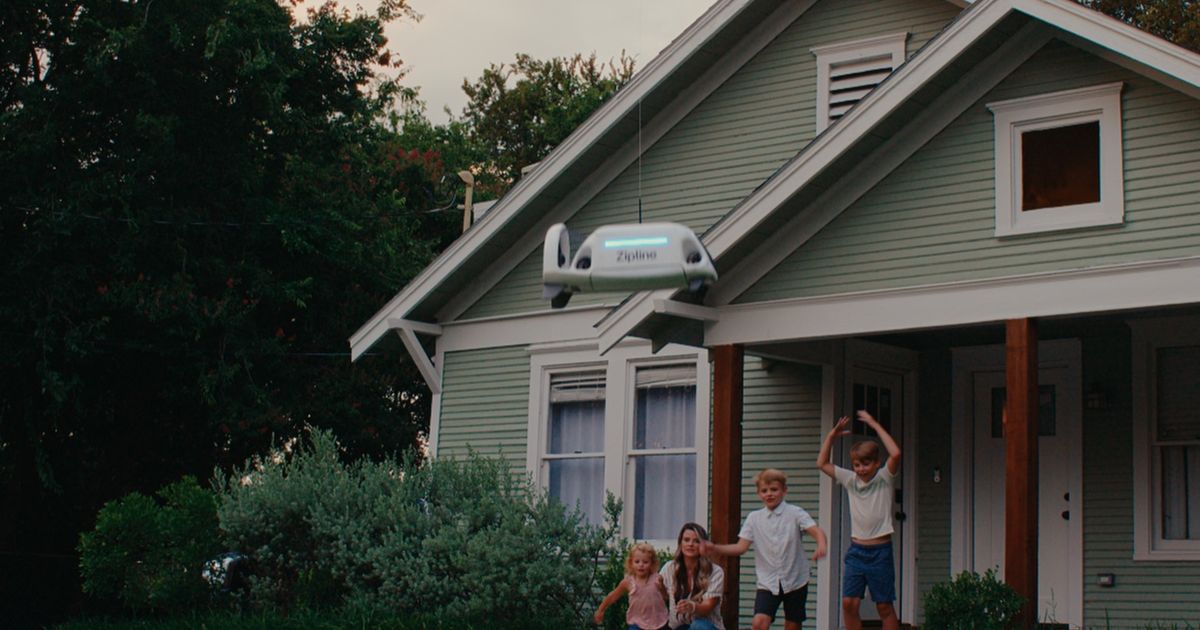
The delivery method is unusual. The drone stays about 330 feet above the ground while a pod containing the order descends on a tether, according to Walmart. That keeps the aircraft away from people and obstacles near the ground.
The aircraft does not land to hand over the order. It hovers while the tether lowers the pod to a front yard, backyard or driveway. Customers can track the flight in the Walmart app.
Zipline says the aircraft runs more than 500 safety checks per second and carries a parachute. It also says each flight reserves a route in an FAA-approved traffic management system and uses detect-and-avoid equipment. The drones use a fixed wing and can shut down all but one motor at cruise. Zipline says that design helps with noise and range.
Noise has been a weak point for delivery drones. Zipline says a software upgrade called sound-optimized dynamic flying cut sound exposure per flight by 68%. It says peak volume fell 24% versus its 2025 fleet, flights are 53 seconds shorter and each flight uses 21% less energy.
Those are internal modeling results, not independent measurements. The physical limits are clearer. An 8-pound payload covers a snack, a pharmacy item or a missing ingredient, not a weekly grocery run.
The 10-mile radius is a hard boundary. A home outside it cannot order, even if it sits close to a Walmart store. Apartment buildings may also lack a safe drop zone, because Walmart describes landings in yards and driveways.
Zipline says only 5% of US restaurant orders are for delivery, and most are limited to customers within a couple of miles. That is the gap it wants to fill. Weather, trees, building layout and local rules still shape which addresses qualify.
Speed depends on the merchant as well as the aircraft. Zipline says the median bakery order arrived 10 minutes after checkout in October. A restaurant that is slow to prepare the food cannot match that pace.
Zipline is also developing a next-generation aircraft. It says the design will fly higher and quieter while carrying heavier orders over longer distances. The company has not published a payload or range for that aircraft.
What are the safety and regulatory limits?
The safety record is good but not spotless. On September 4, 2026, a Zipline food delivery drone came down on Highway 6 in northwest Harris County, Texas. A photo showed the aircraft in the southbound lanes with its parachute deployed.
No one was hurt and no property was damaged, according to KPRC 2. Zipline said the drone encountered a midflight issue on its way to pick up an order. The cause was not determined, and the company said weather was not believed to be a factor.
Zipline describes such parachute landings as rare but part of its backup system. It says its aircraft have flown 150 million commercial autonomous miles without a major safety incident. The company's wording matters, because a parachute landing may not meet its definition of a major incident.
The company says each aircraft runs 500 pre-flight checks and has redundant propellers, communications equipment and a parachute. It says trained staff monitor flights from a remote operations center and retrieve any aircraft that lands by parachute.
Independent verification of the 150 million-mile figure is not public. The number comes from Zipline, and the company defines what counts as a major incident. That does not make the claim false, but it means readers should treat it as a company metric.
Regulation is the bigger constraint on scale. Zipline holds a Part 135 air carrier certificate, which it received in 2022, and operates under FAA approvals. Routine beyond-visual-line-of-sight flights still depend on certificates and waivers.
The FAA proposed a new Part 108 framework in August 2025. It would create performance-based rules for low-altitude beyond-visual-line-of-sight operations, including package delivery. The proposal covers lighting, Remote ID and third-party traffic management services, and it gives the TSA a role in security measures.
The comment period closed and reopened, but no final rule had been published as of early November 2026. Until then, each expansion depends on approvals that are not guaranteed.
The FAA approved commercial package deliveries by drone in 2019, which opened the market Walmart and others now use. Zipline says it received the FAA's first approval of an airspace traffic management system for drone delivery. Those approvals give it a head start over new entrants.
Walmart has not said how it will handle zoning or community objections at the 300 new sites. Noise complaints and local limits could slow a rollout that looks simple on a map.
Who else is racing to deliver by air?
Walmart is not betting on one supplier. Wing, owned by Alphabet, flies Walmart orders and also partners with DoorDash. Amazon runs its own Prime Air drone service. CBS News reported that home drone deliveries gained momentum after the FAA approved commercial package deliveries in 2019.
Wing called its Walmart expansion "the world's largest drone delivery expansion." The plan stretches from Los Angeles to Miami and covers more than 40 million Americans, according to CBS News.
Zipline's advantage is experience and range. It started in Rwanda in 2016 delivering blood, then expanded to Ghana and Nigeria. It now flies in five African countries, several US cities and Japan, according to TechCrunch.
The medical business still matters. Zipline says it serves more than 5,000 hospitals and health facilities. In Côte d'Ivoire, it is building a network expected to reach more than 2,200 health facilities and 12 million people.
Zipline says it makes a delivery somewhere in the world every 15 seconds. It also says it has delivered more than 20 million items. Those figures cover medical, retail and food deliveries across its global network.
The US consumer market is different. Wing and Zipline are both chasing Walmart, and DoorDash and Uber are both testing aerial delivery. The winner may be the operator that can add sites quickly without raising noise complaints or safety incidents.
Walmart benefits from the competition. It can shift volume between partners, compare costs and push for coverage in more cities. Zipline's new valuation assumes it wins a large share of that business.
The barriers to entry are regulatory as well as technical. A rival needs aircraft, a traffic management system and FAA approvals before it can fly long routes at scale. Zipline has been building those pieces for a decade.
What should customers and investors watch next?
First, watch the rollout. Walmart has 300 sites to add and has not said where they will go or when. The pace will show whether this is a multi-year build or a near-term expansion.
Second, watch the Uber target. One million Zipline deliveries a day by 2029 is far above current volumes. Hitting even a fraction of it would require many more aircraft, sites and approvals.
Third, watch the FAA. A final Part 108 rule would set the rules for routine beyond-visual-line-of-sight flights. Delays would keep the business dependent on case-by-case approvals.
Fourth, watch safety reporting. The September parachute landing caused no injuries, but it happened on a busy road. More incidents, or a serious one, could change public and regulatory tolerance.
Fifth, watch the manufacturing plan. Zipline says it will expand US facilities and hire workers, but it has not given a capacity target. A larger fleet also means more maintenance and more flight monitors.
For shoppers, the practical test is simple. Drone delivery appears in the Walmart app only when an address is in range. Walmart has not published fees for the new sites, so cost will be another variable.
For investors, the key question is whether drone delivery can move from novelty to routine without losing money on each order. The new round buys time to prove that. It does not prove it.
The $21.5 billion valuation assumes years of growth. The next 12 months will show whether the site count, safety record and regulation move in the same direction.