What happened to AI stocks on 5 November 2026?
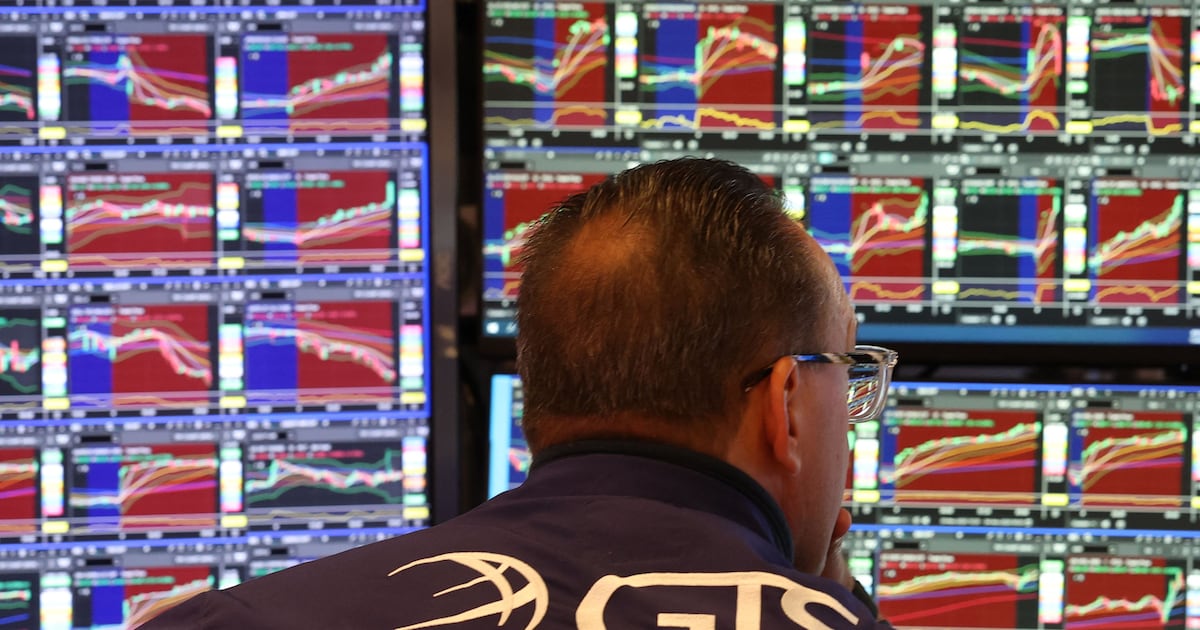
US technology stocks fell sharply on Thursday 5 November 2026, two days after the midterm elections. The session reversed a brief rally that had greeted the result on Wednesday.
The Nasdaq Composite closed 5.4% lower and finished 10% below its 6 October record close, according to The National. That put the index in a technical correction. The Nasdaq 100 fell 6.4%, the Financial Times reported.
The selling spread beyond technology. The S&P 500 lost 4.4%, and the Dow Jones Industrial Average fell more than 1,833 points, or 3.44%. All three main indices had their worst session since April 2025, The National reported.
In dollar terms, the Financial Times put the fall in the broad S&P 1500 Composite at about $3.2 trillion in market value. It described the drop as one of the largest one-day wipeouts since the turn of the millennium.
Chipmakers led the decline. Nvidia, the most visible beneficiary of the AI buildout, fell 9.3% and lost more than $400 billion in market value. Micron dropped 17%, Broadcom 10% and Qualcomm about 9.5%, according to the Financial Times.
Data center and cloud companies were hit harder. CoreWeave fell 9.83%, Nebius 14.94%, IREN nearly 17% and Oracle 6.96%, The National reported. The largest platforms also slipped: Amazon 2.19%, Apple 1.53%, Meta 3.96% and Microsoft 3.58%.
Elon Musk's companies fell too. Tesla dropped 10.8% and SpaceX 9.1%, the Financial Times reported, extending losses from the previous session.
Published figures differ because outlets measure different indices at different times. NPR described the Nasdaq as down more than 5%, with more than $2 trillion erased. The Financial Times measured a $3.2 trillion fall across the S&P 1500. Both point to the same broad, technology-led selloff.
The Nasdaq had closed at a record on 6 October, and the Financial Times tied this year's rally to the AI spending boom. The correction therefore marked a reversal of gains built on expectations of continued data center construction.
Why did the midterm results trigger a selloff?
Democrats won control of both chambers of Congress in Tuesday's elections, according to the Financial Times, The National and CNBC. Two days later, investors began to price in what that might mean for the AI buildout.
The immediate fear was not a specific law. It was a shift in the odds of several outcomes. Traders started to weigh tougher oversight of data center construction, more scrutiny of electricity costs and a slower permitting pipeline.
The Financial Times reported that investors fear newly elected politicians who campaigned against data centers will hit the brakes on AI infrastructure development. That would upset expectations for spending on chips, servers and facilities.
Charles-Henry Monchau, chief investment officer at SYZ Group, described the concern directly. "With the blue wave, investors fear that peak [AI capital spending] is behind us," he told the Financial Times.
Vijay Valecha of Century Financial said the market was watching regulation rather than earnings. "The theme we are watching most closely is AI scrutiny," he wrote in a note quoted by The National. He expected more congressional hearings on who pays for the power-hungry buildout.
David Busch, chief investment officer at Trajan Wealth, told NPR that investors were worried about "AI regulation." He also cited "a pushback on the buildout of data centers across the country."
Some incoming lawmakers want more than oversight. Abdul El-Sayed, the Democratic senator-elect from Michigan, has called for a "full-on pause" in frontier AI development. Annie Andrews, the incoming senator from South Carolina, proposed a two-year ban on new data center construction.
Andrews said communities were being "steamrollered" by "incredibly wealthy, powerful companies," the Financial Times reported. Those are individual proposals, not party policy.
NPR also reported that Musk spent hundreds of millions of dollars in an unsuccessful attempt to elect Republicans. Investors fear that he and his companies could face scrutiny when the new Congress is seated.
State races may matter sooner. In Texas, Democrat Gina Hinojosa made data center regulation central to her campaign. So did Amy Acton in Ohio and Keisha Lance Bottoms in Georgia, Scientific American reported. Goldman Sachs analysts estimate that Texas alone accounts for about 25% of planned US data center capacity, according to The National.
Did voters actually reject data centers?
The ballot evidence is unusually clear. Voters faced 41 local data center measures in 10 states on Tuesday, according to Ballotpedia data cited by CNBC and Scientific American.
They sided against data centers in every contest except one. The exception was Harwood, North Dakota, where voters rejected extra review of industrial projects by about three to one. A $3 billion data center called Polaris Forge 2 is already under construction nearby, Scientific American reported.
The questions covered moratoriums, attempted rezonings and advisory votes, Scientific American reported. Ohio alone had 21 measures, more than half the national total. CNBC noted that Ohio was named America's Top State for Business in 2026.
The issue reached the top of the ticket. Democrat Sherrod Brown defeated Republican Senator Jon Husted in Ohio after casting him as "the face of data centers," CNBC reported. Democrat Amy Acton won the governor's race there and supports a "conditional moratorium," full coverage of utility costs and union labor.
Margins were often lopsided. In Wells, Maine, more than 80% of voters approved a retroactive 180-day moratorium on data center development. Six more measures were decided earlier in the year, and three are still to come, Scientific American reported.
Not every vote is binding. Advisory measures and zoning changes still give state and local officials a political mandate to slow projects.
The stakes are large because the projects are large. In Ohio, OpenAI has secured 8 gigawatts of computing capacity at the PORTS-Pike Technology Campus. CNBC described it as the largest planned AI data center campus in the world.
SoftBank and SB Energy are developing the site with the US Department of Energy. Nvidia is backstopping the project, and CNBC reported that it could cost more than $500 billion in total. The first phase was due to begin construction this year, with capacity arriving in stages from 2028.
Why did Qualcomm's forecast matter?
Qualcomm reported results the day before the selloff, and they showed how quickly AI-era demand can collide with ordinary hardware economics. Fiscal fourth-quarter revenue was $10.32 billion, down 8% from a year earlier. Non-GAAP earnings per share fell 28% to $2.17.
Handset chip revenue dropped 26% to $5.14 billion. Automotive revenue rose 89% to $1.99 billion, the first $2 billion quarter for that business. IoT revenue rose 4% to $1.89 billion, and licensing revenue fell 7% to $1.3 billion.
For the full fiscal year, revenue was $43.12 billion, down 3% on a GAAP basis. The results included a $5.7 billion income tax benefit, which lifted GAAP earnings per share to $12.70.
The guidance disappointed. Qualcomm forecast first-quarter revenue of $10.4 billion to $11.2 billion. It guided adjusted earnings per share to $2.15 to $2.35, while analysts expected $2.27, according to CNBC.
The company blamed input costs rather than weak interest in its products. It cited "a broad-based increase in input costs across wafer fabrication, assembly, test, advanced packaging, memory and other materials." Qualcomm has raised prices and expects the full benefit in chip margins in the second half of fiscal 2027.
Memory is the squeeze point. CNBC reported that rising memory costs are forcing handset makers to raise prices, which is hurting demand. Qualcomm expects the handset market to be flat in 2027.
Its data center business is still small. Qualcomm recorded $650 million of data center revenue in the quarter and reiterated a $5 billion target for fiscal 2027. CEO Cristiano Amon said the constraint was supply: "We don't have a demand issue; it's a supply issue."
Qualcomm also renewed long-term licensing agreements with Apple, Huawei and Transsion. It announced a multi-generational product collaboration with Amazon for AI data centers.
That mix explains why Qualcomm fell about 9.5% despite beating estimates on revenue and earnings. Investors were not only selling AI optimism. They were also selling a handset supplier with rising costs and pressured customers.
How much of the selloff was politics, and how much was spending?
The midterms were a trigger, not the whole story. The AI trade had already been weakening. The Nasdaq fell about 5.3% in October, The National reported, as investors questioned spending and valuations.
CNBC reported that chipmakers, neoclouds and other data center companies sold off in October on concerns about rising interest rates and overspending. Those concerns did not disappear on election night.
Vincent Mortier, investment chief at Amundi, said the tech repricing was "harsh and quick." He said the fundamental question marks had resurfaced "under the microscope of the new political US picture." He named the data center backlash and new regulation as the specific worries.
He also noted that the "honeymoon" gains for US stocks after the Democratic win were "very shortlived." Adam Crisafulli of Vital Knowledge described the mood more bluntly. "[Investors] are throwing in the towel and indiscriminately liquidating," he told the Financial Times.
Wednesday had brought relief that the election produced a clear result, NPR reported. Thursday brought a reckoning with what that result might do.
The economic stakes reach beyond Wall Street. AI has become a major driver of US growth, which reached 3.4% in the July-to-September quarter, NPR reported. Many households own AI shares through retirement accounts such as 401(k)s.
The Institute for International Finance reported emerging-market portfolio outflows of $33.8 billion in October. Only the 2020 Covid shock and the March 2026 Iran war shock produced larger outflows, The National reported.
Yet one session is weak evidence about policy. The new Congress is not seated until January 2027. The selloff reflects what investors think lawmakers might do, not what they have done.
The numbers also carry uncertainty. Index moves differ by provider, losses depend on which index is measured, and closing prices can shift after late trading. A 10% decline from a record is a correction by convention, not a verdict on the industry.
Some of Thursday's damage had little to do with politics. Qualcomm's guidance was a hardware story about memory costs and handset demand. Nvidia's fall reflected its size and its centrality to the AI trade. The two narratives reinforced each other, which is why the move was so violent.
What should investors and AI buyers watch next?
The first test is what Democrats actually do. The new Congress is seated in January, NPR noted. Hearings on data center power costs, permitting and utility bills would be the earliest signal of legislation.
The second is state policy. Texas, Ohio and Georgia will have governors who campaigned on data center rules. Local moratoria, zoning changes and utility cost allocation could slow projects long before Congress acts.
The three remaining ballot measures will show whether the pattern holds.
The third is corporate guidance. Hyperscalers' capital spending plans will show whether the buildout is slowing. Qualcomm's first-quarter results will test whether memory costs and handset demand are stabilizing. Nvidia's data center sales remain the clearest read on AI infrastructure demand.
Qualcomm expects the benefit of its price increases to reach chip margins only in the second half of fiscal 2027. Relief on costs may therefore be slow.
Micron's 17% fall is a reminder that memory pricing now connects AI demand, handset costs and data center construction.
The fourth is financing. The National noted growing scrutiny of how the infrastructure will be paid for. Neoclouds and developers rely on financing and long-term contracts, so higher rates or tighter credit would hurt them faster than any hearing. Watch for delays, cancelled contracts or renegotiated power deals.
For AI users, the practical question is capacity. If construction slows in Texas or Ohio, new computing capacity may arrive later or cost more. That would affect cloud pricing and the availability of training capacity, though the effect would take quarters to appear.
For investors, the question is whether Thursday was a one-day repricing or the start of a longer de-rating. NPR noted that it is unclear whether the rout will continue or spread beyond tech stocks.
OpenAI's chief global affairs officer, Chris Lehane, predicted that AI will be the defining issue of the 2028 presidential election. Scientific American reported the remark. That suggests the political risk will not fade quickly.
The safest conclusion is narrow. A political shock met an expensive, crowded trade, and the result was one of the fastest one-day declines in years. What happens next depends on whether the policy fear turns into policy.