What did Blue Origin announce for New Glenn?
Blue Origin used an invite-only space conference at the Kennedy Space Center on 5 November 2026. There it announced two changes to its New Glenn rocket. The company unveiled a new third stage, called GS3, and a new first-stage engine, called Northstar. Both are aimed at cutting manufacturing costs and expanding the missions the heavy-lift rocket can fly.
Chief executive Dave Limp presented the hardware at UP.Summit, held at the Shuttle Landing Facility at Kennedy Space Center in Florida. Blue Origin published a blog post on each product the same day. The announcements came as the company tries to turn New Glenn from a rarely flown vehicle into a routine one.
New Glenn is currently a two-stage rocket. Seven BE-4 engines power its reusable first stage, and two BE-3U engines power its upper stage. Space.com reports that the vehicle stands 98 meters tall. It can carry about 13 metric tons to geostationary transfer orbit, or 45 metric tons to low Earth orbit.
The rocket has flown three times: in January 2025, November 2025 and on 19 April 2026. On that third flight, New Glenn left AST SpaceMobileâs BlueBird 7 satellite in the wrong orbit, and the spacecraft was lost. On 28 May 2026, the rocket exploded during a hot-fire test on its Florida launchpad.
Those failures matter because launch customers buy schedule certainty as much as lift capacity. Blue Origin has said it wants to fly far more often. Ars Technica reports that the company aims eventually to position New Glenn for more than 1,000 launches a year. That figure is far beyond any rocket flying today.
The two announcements are linked by cost. A third stage adds performance, but it also adds hardware and integration work. A cheaper engine offsets some of that cost. Blue Origin is effectively trying to raise payload capacity without raising prices. Customers now compare every launch against SpaceX’s Falcon 9.
Limp argued that demand is not the constraint. "There has never been higher demand for launch, ever," he said at the event, according to Ars Technica. The upgrades are an attempt to meet that demand with cheaper hardware and more capable upper stages.
How much payload can the GS3 third stage carry?
GS3 stands for Glenn Stage 3. It is a hydrogen-fueled stage that sits on top of the existing second stage and uses a single BE-7 engine. Blue Origin developed the BE-7 for its Blue Moon lunar landers. NASA selected a Blue Moon variant as one of its Artemis crew landers.
The stage is designed for missions that need direct insertion into geostationary orbit or an escape trajectory toward the Moon. Blue Origin published figures for the stage. A GS3-equipped New Glenn in its 7x2 configuration can carry 8 metric tons directly to geostationary orbit. The same version can send 10 metric tons to translunar injection. The larger 9x4 version raises those figures to 14 metric tons and 20 metric tons.
The comparison helps explain why the stage matters. The current two-stage 9x4 design is rated at 14 metric tons to geostationary transfer orbit. The same design can carry 70 metric tons to low Earth orbit. A transfer orbit is a staging point, not the final destination. Direct geostationary insertion costs more energy. It also lets a satellite reach its operating slot without spending years of its own propellant.
Direct insertion changes the economics for satellite operators. A satellite that reaches geostationary orbit under its own power must carry extra propellant. That propellant adds mass at launch and can shorten the satellite operating life. A stage that does the job saves that mass. The trade-off is that GS3 must be light and reliable. Every kilogram of stage hardware is a kilogram not available for the payload.
Blue Origin says GS3 fits inside an interstage and uses the same payload adapters and fairing as the two-stage rocket. That means customers keep the full fairing volume. Engineers do not have to redesign a satellite just to use the extra stage.
The hardest part is the tank. GS3 is built mostly from composites, including a 5.5-metre liquid hydrogen tank. Hydrogen is the smallest molecule and leaks easily, while repeated thermal cycling can crack composite structures. Blue Origin recently completed a tanking test at its Launch Site One in Texas. The tank held 100 percent of its maximum expected operating pressure for 2.5 hours, then 150 percent for 10 minutes.
"The GS3 tank is expected to be the first composite LH2 tank ever flown in space," Blue Origin said. Spaceflight Now reported the claim. That is a prediction about a future flight, not a record the company has already set. The ground test is a step toward qualification, not proof that the design will survive launch loads and repeated missions.
The 9x4 variant is the larger of the two New Glenn configurations. Space.com reports that it will stand nearly 122 meters tall and carry 14 metric tons to geostationary transfer orbit. It has not flown yet. GS3 would give that variant a way to reach geostationary orbit directly. The current two-stage version cannot do that without help from the satellite.
Blue Origin already has a customer for the stage. Limp said one government buyer has signed up for a cislunar mission in 2028. "We have one customer signed up for cislunar space in 2028. We are open for business," he said, according to Ars Technica. The company has not named the agency or described the payload.
What is the Northstar engine and will it replace the BE-4?
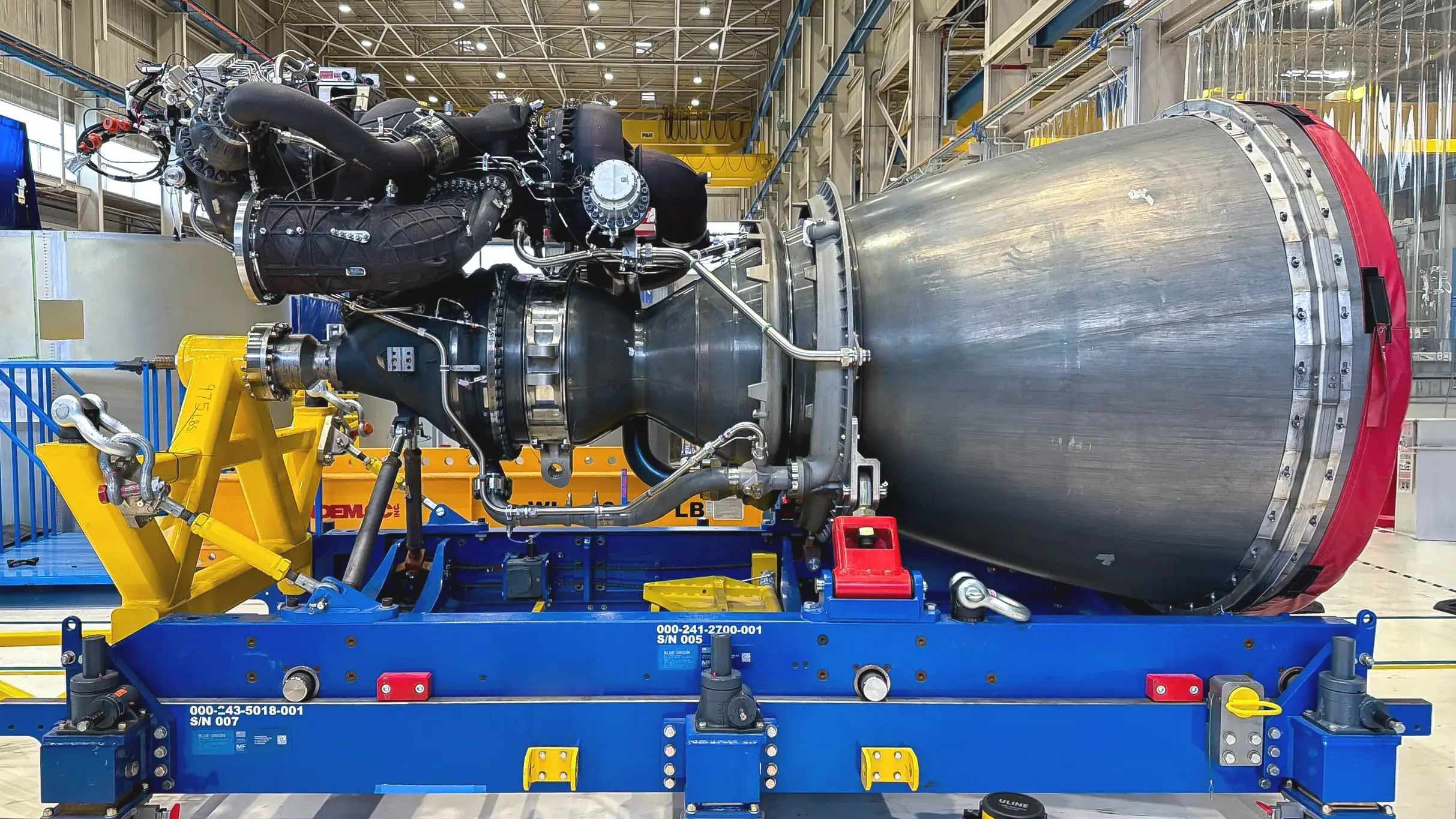
Northstar is a simplified, more powerful version of the BE-4 engine that powers New Glennâs first stage today. It burns liquefied natural gas and liquid oxygen, the same propellant pair as the BE-4. It also keeps the oxygen-rich staged combustion cycle and single-shaft turbopump architecture that Blue Origin has used before.
The headline number is thrust. Blue Origin says Northstar will produce 715,000 pounds-force at startup, compared with 640,000 pounds-force for the BE-4. That is an increase of about 12 percent. The engine also has half as many parts and 30 percent less mass, according to the company.
Blue Origin says about 65 percent of the engine can be 3D-printed. Those changes are meant to make production faster and cheaper. Ars Technica reports that the company believes it can build Northstar for about 25 percent of the cost of a BE-4. It also wants to reach a point where each engine is assembled in less than a day.
Manufacturing speed is already part of the pitch. Ars Technica reported that Blue Origin is building a Northstar engine roughly every 10 days. The company says the program moved from approval to development testing in 11 months. A test-firing campaign is already under way.
Simpler plumbing is the core of the design. The BE-4 uses a single-shaft turbopump and an oxygen-rich staged combustion cycle, an architecture that is efficient but demanding to build. Northstar keeps that approach while cutting parts and mass. Fewer parts mean fewer suppliers, fewer inspection points and less touch labor per engine.
The long-term plan is for Northstar to replace the BE-4 on New Glennâs first stage. That does not mean the BE-4 disappears. Blue Origin will keep building BE-4 engines for United Launch Alliance, whose Vulcan rocket uses two of them on each flight. A person familiar with the program told Spaceflight Now that Northstar will be compatible with the larger 9x4 version of New Glenn.
Two caveats matter here. The 25 percent cost figure is a company estimate, not an audited price. It also depends on production volume that Blue Origin has not disclosed. Northstar has no announced first flight date. Engine tests on the ground do not settle how the engine behaves on a full rocket.
Why is New Glennâs return to flight delayed to January 2027?
The upgrades arrived alongside a schedule setback. Limp told employees in a memo on Wednesday 4 November that New Glennâs return to flight had slipped to January 2027. The Financial Times first reported the memo, and CNBC said it had viewed the document.
Blue Origin had previously targeted a launch before the end of 2026. CNBC, citing a person familiar with the matter, said the January date is about 10 days later than the earlier target. The delay, according to the memo, comes from work to reconstruct the Cape Canaveral launchpad, including bad weather over the summer.
Limp framed the slip as modest. "This small adjustment doesn't diminish what we've accomplished or the importance of the work still ahead," he wrote. He also said returning New Glenn to flight "remains our top priority" and called the recovery work remarkable.
The cause of the delay is the 28 May explosion. The rocket blew up during a hot-fire test and badly damaged the pad. CNBC reports that New Glenn had been due to deploy 48 satellites for Amazon’s Leo internet constellation just a few days later.
Bezos had sounded more optimistic in October. He told Fox News that New Glenn would still fly in December, according to CNBC. The January target means the rocket will return roughly eight months after the explosion and about nine months after its last flight.
A ten-day slip is small in calendar terms. It is more significant as a signal. Blue Origin is rebuilding a complex pad while trying to certify a new stage and a new engine. Each of those tasks has its own schedule, and they now share the same deadline.
Why does the delay matter for Amazon, NASA and SpaceX?
Amazon is the most directly exposed customer. Amazon Leo, the companyâs satellite internet service, depends on Blue Origin for part of its launches. CNBC reports that Amazon has turned to United Launch Alliance and Arianespace while New Glenn is grounded. Every month of delay makes the constellation deployment plan harder to hit.
NASA is the second. The agency has awarded Blue Origin several Artemis contracts, including a lunar lander. Blue Originâs Blue Moon landers use the BE-7 engine that also powers GS3. A reliable New Glenn is therefore tied to the lander program, not just to commercial satellite launches.
SpaceX remains the benchmark. Its Falcon 9 flies far more often than New Glenn, and SpaceX is testing Starship for larger payloads. Blue Origin does not need to match that cadence immediately. It does need to show customers that it can launch on the date it advertises.
Blue Origin’s own targets are ambitious. CNBC reports that new Florida launch facilities are meant to support multiple flights per week by the end of the decade. Ars Technica’s figure of more than 1,000 launches a year is a longer-term ambition. Both goals depend on pad capacity, engine supply and a steady customer manifest.
The engine business adds a second layer. Blue Origin sells BE-4 engines to ULA, so it cannot simply stop making them when Northstar arrives. Northstarâs cost target matters for New Glenn economics. It could also change how Blue Origin prices engines for outside customers, though the company has not announced commercial terms.
Schedule risk has a commercial cost. Satellite operators book launch slots years in advance and coordinate insurance, ground stations and spectrum. A moved date can force a customer to re-plan a whole mission. Blue Originâs challenge is not only to fly in January but to show that later dates will hold.
What could still go wrong, and what should you watch next?
The composite hydrogen tank is the largest technical unknown. A pressure test at ambient conditions is not the same as flight qualification. Launch vibration, repeated filling and draining, and thermal cycling can all affect a composite vessel. Blue Origin needs to show that the tank can hold hydrogen through a full mission profile.
Northstar is the second unknown. Blue Origin has tested the engine, but it has not flown it. The 25 percent cost target depends on 3D printing, part count and assembly time all holding up at scale. Qualifying a new engine for flight adds another layer of scrutiny.
GS3 adds a third. The stage has not flown, and neither has the 9x4 New Glenn variant that can carry its largest payloads. Blue Origin is aiming for a 2028 debut with a government customer. That gives the company roughly two years to qualify the stage, the tank and the mission integration.
The schedule is the fourth. January 2027 is a target, not a guarantee. The pad has to be rebuilt, the rocket has to pass its own tests, and the range has to be ready. Any one of those can move.
What to watch next is concrete. Look for a New Glenn static fire on the rebuilt pad and a firm launch date from Blue Origin. Also watch for the first flight of a Northstar-powered booster. Watch whether Amazon Leo shifts more launches to other providers. Watch the GS3 tank qualification and the 2028 cislunar mission. Those milestones will show whether the upgrades are real capacity or a promise for the next decade.