What is Nvidia RTX Spark?
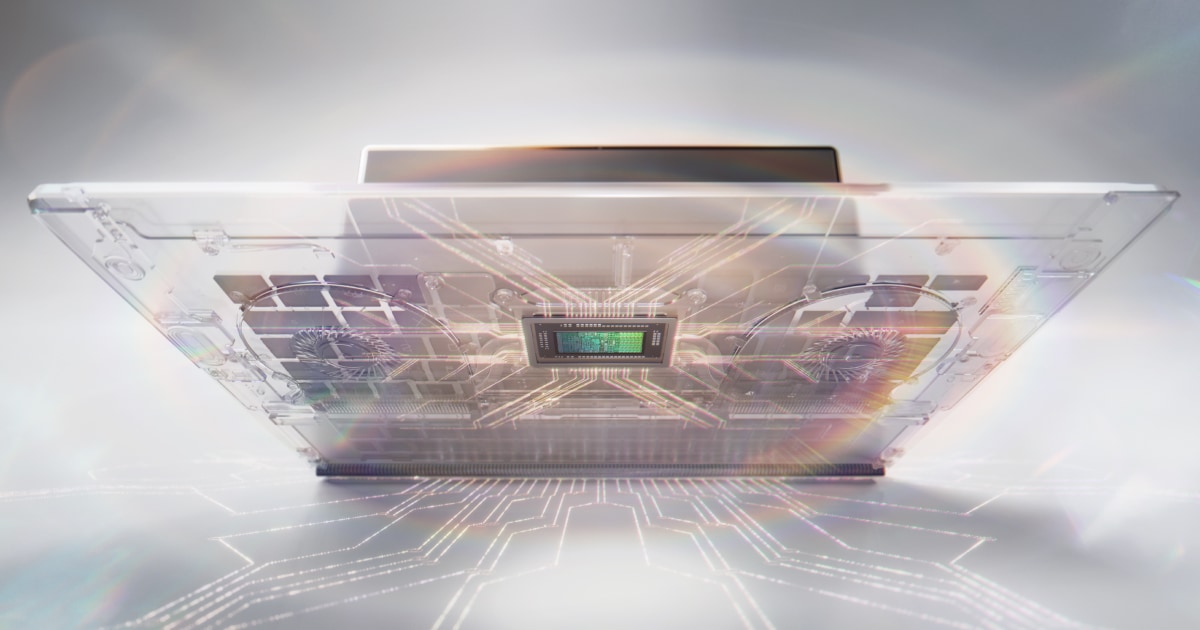
Nvidia spent decades selling graphics cards and data-center accelerators. RTX Spark puts a version of that hardware inside a Windows laptop. It pairs an Nvidia Grace CPU with a Blackwell RTX GPU on a single package, plus one pool of LPDDR5X memory shared by both.
The top chip, the RTX Spark N1X, has 20 Arm CPU cores and a 6,144-core GPU. Nvidia lists up to 128GB of unified memory and a 45-80W power range. A smaller N1 variant has 18 CPU cores, a 5,120-core GPU and up to 64GB.
Nvidia rates the platform at up to one petaflop of FP4 AI performance. It says CUDA runs natively and that the hardware can handle models up to 120 billion parameters with a million-token context. Those are vendor claims, not independent measurements.
The memory design is the real difference. Most gaming laptops pair system memory with a discrete GPU that has its own VRAM, usually 8GB to 24GB. RTX Spark lets the GPU address most of the system memory instead. PCWorld put roughly 96GB of a 128GB ProArt P16 at the GPU's disposal.
The rest of the spec sheet reads like a high-end Nvidia laptop. The GPU has fourth-generation ray-tracing cores and fifth-generation Tensor cores. The software stack includes CUDA, TensorRT and NVFP4, the same tools developers use on data-center GPUs. RTX Spark machines ship with Windows 11 only.
Six PC makers now sell RTX Spark laptops: ASUS, Dell, HP, Lenovo, Microsoft and MSI, according to Nvidia. The superchip is not sold to DIY builders, so buyers cannot assemble an equivalent machine from parts.
Nvidia describes the target uses as AI development, creation and gaming in one machine, and it is running global launch events for the platform. That is marketing, but it shows where the company wants the category to sit.
Which RTX Spark laptops can you buy, and what do they cost?
Microsoft's Surface Laptop Ultra is the flagship machine and the best-documented so far. It starts at $2,599.99. That base model pairs the 18-core N1 with 24GB of memory and a 512GB SSD, according to TechRadar.
The top configuration costs $5,899.99. It brings the 20-core N1X, 128GB of unified memory and 1TB of storage. TechRadar reported lead times stretching into late December for that build.
The Surface has a 15-inch 3:2 touchscreen at 3,270 x 2,180 pixels and a 120Hz refresh rate. It weighs 2kg and measures 19.16mm thick, IT Pro found. Ports include two USB-C connectors, HDMI 2.1b, USB-A, an SD card reader and a magnetic charging port.
Other machines push the price higher. PCWorld tested a $7,000 ASUS ProArt P16 with 128GB of memory. The first wave also includes HP's OmniBook Ultra 16, plus models from Dell, Lenovo and MSI.
Microsoft sells the Surface in Platinum and Nightfall finishes, with storage up to 2TB. It is also running a trade-in offer through 23 November that adds up to $1,000 in cash back on top of a qualifying MacBook Pro's value, TechRadar reported. Returns are accepted until 31 January 2027, which gives early buyers a long test window.
Nvidia's own list of launch machines is short and easy to check before buying:
IT Pro also praised the magnetic charging connector. It snaps on easily and can reverse-charge a phone when connected to the power brick.
- •Microsoft Surface Laptop Ultra: from $2,599.99, 15-inch Mini-LED, up to 128GB.
- •ASUS ProArt P16: tested at $7,000 with 128GB and a 4K tandem OLED panel.
- •HP OmniBook Ultra 16: tested for gaming and general use by PCWorld.
- •Dell XPS 16, Lenovo Pro 9n and MSI Prestige N16 Flip AI+: listed by Nvidia, with prices set by retailers.
How fast is RTX Spark for local AI?
The strongest evidence comes from PCWorld's head-to-head test. A 128GB ProArt P16 ran OpenAI's 120-billion-parameter gpt-oss model alongside a desktop with a GeForce RTX 5090 and 128GB of system memory.
The laptop processed 472,084 tokens in 33 minutes and 13 seconds. The desktop needed 52 minutes and 51 seconds for the same workload. The laptop won because the model needed more GPU-accessible memory than the 5090's 32GB of VRAM could hold.
Raw speed is a different question. PCWorld's Brad Chacos wrote that the RTX Spark GPU is roughly RTX 5070-class. When a workload fits inside 32GB, the desktop card runs far ahead.
CPU performance is uneven. IT Pro recorded 1,859 in Geekbench 7 single-core and 18,771 in multi-core for the Surface. An M5 MacBook Pro scored 4,284 in single-core on the same test.
PCWorld's Mark Hachman found the 20 Arm cores delivered excellent multicore results but called single-core performance "considerably less impressive". Everyday responsiveness still leans on one or a few threads, so the core count does not fix every slowdown.
The value case is therefore narrow. PCWorld argued that $7,000 buys an awful lot of cloud inference. A laptop like this makes sense when models exceed normal GPU memory, or when data cannot leave the machine.
Privacy is part of the pitch. A local model keeps prompts and documents on the device, which matters for regulated work. The cost argument cuts both ways. A $7,000 laptop is hard to justify against metered cloud tokens unless the machine stays busy every day.
One caveat matters. PCWorld's result comes from a single research workload. It shows what memory capacity enables, not how the platform performs across every model or framework.
Is RTX Spark battery life good enough?
Nvidia promised all-day battery life at Computex in June, TechRadar reported. Microsoft's own rating for the Surface is up to 15 hours of local video and 12 hours of web browsing.
Independent tests land below those figures. IT Pro's looped video test ran 12 hours 41 minutes, and less than 10 hours with HDR enabled.
Linus Tech Tips measured about nine hours of 1080p playback at 200 nits and 60Hz, Notebookcheck reported. A 14-inch MacBook Pro with an M5 Pro lasted about the same, despite a battery 27% smaller.
IT Pro's own comparison pointed the other way, with an M5 Pro MacBook lasting more than 20 hours in its looped-video test. The two outlets used different brightness and playback settings, so the figures are not directly comparable. Both agree that the Surface does not beat Apple's efficiency.
The ProArt P16 managed around 12 hours in that test with a 99.9Wh battery, 38% larger than the MacBook's. An Arm-based Asus Zenbook A16 with a 70Wh pack ran 12 hours 40 minutes.
Under load the gap widens. The Surface lasted 53 minutes in a 1440p GravityMark stress test, and the ProArt 1 hour 9 minutes. The MacBook Pro 14 reached about 1.5 hours and the Zenbook more than two hours.
PCWorld saw roughly 10 hours of office work from the Surface. During one 33-minute AI run, the ProArt consumed 46% of a charge. The platform can cover a working day of light tasks, but not the workloads it was built for.
How does RTX Spark compare with Snapdragon and Apple silicon?
RTX Spark is not the only Arm chip in Windows laptops. Qualcomm's Snapdragon X series arrived first, and it set expectations for battery life on Arm. Notebookcheck's battery round-up included an Asus Zenbook A16 with a Snapdragon X2 Elite Extreme.
That machine ran 12 hours 40 minutes in the 1080p playback test with a 70Wh battery. Under the GravityMark stress test it lasted more than two hours, roughly double the Surface's 53 minutes. It also has a much smaller GPU, so the comparison flatters Qualcomm on endurance.
Apple remains the benchmark for efficiency. An M5 MacBook Pro matched the Surface's nine-hour playback result with a battery 27% smaller. It also scored 4,284 in Geekbench 7 single-core against the Surface's 1,859.
The picture changes for large local models. TechRadar reported that outlets testing local AI put the Surface ahead of Apple's M5 Max and AMD's Ryzen AI Max+. TechRadar did not publish the tested configurations, so treat that result as directional rather than definitive.
The comparison therefore depends on the workload. For office work, video and battery life, Snapdragon and Apple machines are competitive or better. For a 120-billion-parameter model that needs tens of gigabytes of GPU-accessible memory, RTX Spark has few rivals in a laptop.
Why does the Surface Laptop Ultra display divide reviewers?
Microsoft fitted a 15-inch Mini-LED panel with a 3:2 shape and 120Hz refresh. Notebookcheck reports 1,000 nits in SDR and a 2,000-nit HDR peak, and calls the brightness excellent.
Notebookcheck also found visible ghosting, caused by slow IPS response times. It could not find a way to enable local dimming, so blacks looked gray and contrast suffered.
Microsoft disputed the dimming finding. The company told Windows Central that dimming is active by default, with 5,400 Mini LEDs split across 1,344 zones. TechRadar reported that it depends on the "Change brightness based on content" setting and works best with HDR off.
Not everyone will notice the ghosting. TechRadar, citing Notebookcheck measurements, reported a 4,650Hz PWM backlight that should suit most flicker-sensitive users. The effect is most visible in motion, such as games and fast video.
Brightness and color are strong. IT Pro measured 969.95 nits in HDR and 94.7% color coverage. Adobe RGB coverage was only 65.6%, which limits serious color work.
A firmware update, version 200.0.7.0, fixed flicker and long restarts on 22 October. Ghosting remains because it comes from the panel hardware, not the software.
The update itself is worth understanding. Microsoft listed it in Windows Update under System Hardware Update, and TechRadar noted that the rollout is staggered. Firmware cannot be uninstalled once applied, and owners check for it in the Surface app under Help & support.
Does Windows on Arm still hold RTX Spark back?
RTX Spark runs Windows on Arm. Microsoft's Prism layer translates most x86 software, and native Arm builds keep growing. PCWorld described the experience as much better than a year or two ago.
There is no official Linux option. Nvidia lists Windows 11 as the only supported operating system, so buyers who need Linux have no vendor-supported path on this hardware.
Gaps remain. Its reviewer needed a beta build of Adobe Premiere because the shipping version did not properly support the RTX Spark GPU.
Microsoft told Windows Central that Copilot+ PC features are not ready for the platform. They should arrive in the coming months, according to TechRadar's account.
A default setting can also hurt performance. The Surface ships in "Best Power Efficiency" mode, which Windows Central found could cut performance by a quarter or even half until the user picks another preset.
Nvidia is addressing one new problem: agents and apps competing for the same GPU. Its NVIDIA App now lets users split GPU resources between a foreground application and a background agent. The feature sits under System, then Advanced, and requires hardware-accelerated GPU scheduling to be enabled in Windows Settings.
Software support is long. Microsoft promises driver and firmware updates until 16 October 2032, which matters for a first-generation platform.
Who should buy an RTX Spark laptop, and what comes next?
PCWorld's verdict is unusually clear. Heavy AI developers and researchers should pay attention, especially if their models overflow normal GPU memory. Gamers should buy a conventional GeForce laptop instead.
Nvidia is presenting RTX Spark as a new category rather than a faster notebook. Its launch page pairs the hardware with a conversation between Jensen Huang and Satya Nadella about the future of the PC. That framing explains the pricing: the target buyer is a developer or researcher, not a student.
TechRadar's review roundup reached a similar test: "Grab it if local models above 24GB are your daily work." Other outlets that ran local models put the Surface ahead of Apple's M5 Max and AMD's Ryzen AI Max+.
Everyone else can wait. The first machines are expensive and the platform is new. Buyers should confirm that their critical software runs properly before spending several thousand dollars.
Nvidia's roadmap adds tools rather than hardware. Recent updates brought the Nemotron 3.5 Transcribe speech model, Liquid AI's LFM3 model family and the GPU-sharing controls. Minecraft path tracing and Phantom Blade Zero with DLSS 4.5 are part of the pitch.
Several things are worth watching. Reviews of the Dell, Lenovo, MSI and HP models will show whether the Surface's weaknesses are platform-wide. The Copilot+ rollout will test Microsoft's software promises. Firmware updates may fix some irritations, but not the panel's slow response.
The practical test is simple. Run your own largest model, on your own framework, before the return window closes. A spec sheet cannot tell you whether a 120-billion-parameter model will fit or how long a batch will take.
The RTX Spark story is not that Nvidia built a faster laptop. It is that unified memory lets a portable machine run models that once needed a workstation. That is a narrow win, but a real one.