What did Sandisk report for its fiscal first quarter of 2027?
Sandisk reported revenue of $11.03 billion for the quarter ended 2 October 2026. That is the first quarter of its fiscal 2027 year. Revenue rose 23% from the prior quarter and 378% from $2.31 billion a year earlier, according to the earnings release filed with the SEC.
Profitability moved just as sharply. GAAP gross margin reached 85.0%, against 29.8% a year earlier. Operating income was $8.78 billion and net income $8.10 billion. GAAP diluted earnings per share were $52.60.
The quarter beat expectations on both lines. Investing.com reported that analysts had expected $10.7 billion of revenue and $47.15 of non-GAAP earnings per share. Sandisk delivered $49.51 on a non-GAAP basis.
Guidance was also above consensus. Sandisk forecast revenue of $12.2 billion to $12.6 billion and non-GAAP earnings of $55 to $57 a share, before its stock split. Analysts had expected $12.29 billion and $54.69.
The company announced an eight-for-one forward stock split alongside the results. Stockholders of record on 9 November 2026 receive seven additional shares for each one held. The new shares are issued after the close on 19 November, and post-split trading is expected to start on 20 November.
Sandisk returned $5.0 billion to shareholders in the quarter by repurchasing about 3.2 million shares. Adjusted free cash flow was $5.70 billion, Investing.com reported. Across two quarters it bought back 6.0 million shares, roughly 4% of those outstanding.
The balance sheet strengthened with the results. Cash and equivalents rose to $5.14 billion from $4.76 billion a quarter earlier, while inventories edged up to $3.02 billion from $2.70 billion.
The shares still slipped after the release, despite the beat, according to Investing.com. Strong results did not change the fact that the company's stock had already run hard over the past year.
- •Revenue: $11.03 billion, up 23% from the prior quarter and 378% from a year earlier
- •Data center revenue: $4.80 billion, up 61% sequentially
- •Edge revenue: $5.83 billion, up 7% sequentially and 320% year over year
- •Consumer revenue: $397 million, down 29% sequentially and 39% year over year
- •Second-quarter guidance: $12.2 billion to $12.6 billion of revenue, 84.5% to 85.5% non-GAAP gross margin
Why is Sandisk's revenue up 378% year over year?
The short answer is price. Sandisk sells NAND flash, the memory used in solid-state drives, memory cards and phones. That market is severely undersupplied, because capacity is being pulled toward data centers.
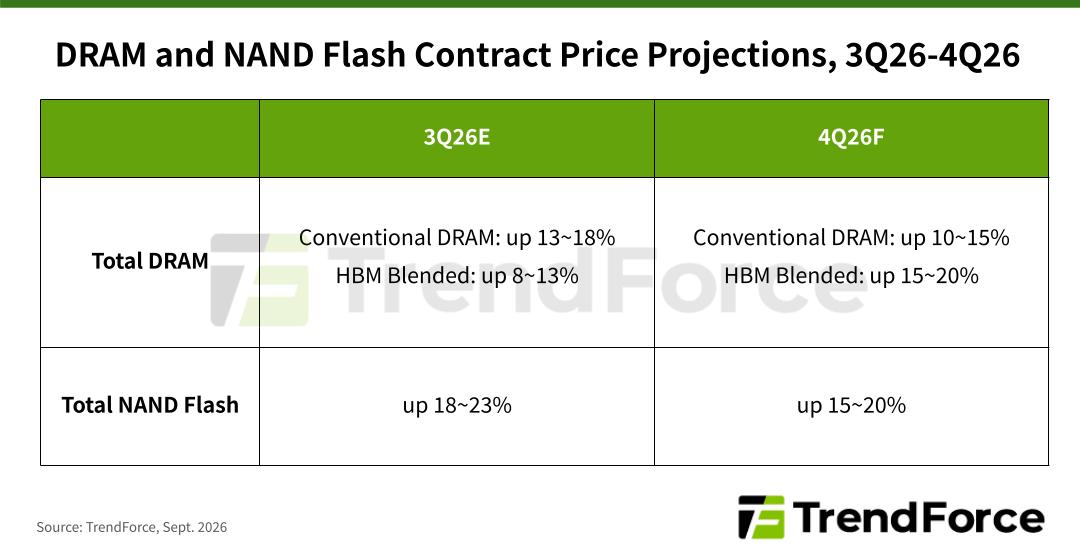
TrendForce tracks memory contract prices. In late September it projected that NAND flash contract prices would rise 15% to 20% in the fourth quarter of 2026. That follows an 18% to 23% increase in the third quarter. Conventional DRAM was forecast to rise 10% to 15%, after 13% to 18%.
Those quarterly increases sit on a much larger run-up. IDC estimates memory costs have climbed approximately 350% since last year. Its analysts used that figure to explain the record decline in smartphone shipments.
Demand comes from artificial intelligence infrastructure. TrendForce expects bit demand for enterprise solid-state drives to grow more than 80% year over year in 2026. Cloud providers are expanding inference systems and caching more data. Servers now account for more than 40% of total NAND bit demand. Agentic AI workloads add to the load by generating large volumes of data for real-time retrieval and caching.
Sandisk's segments show the shift. Data center revenue rose 61% from the prior quarter to $4.80 billion. The edge business, which covers client drives and other devices, reached $5.83 billion, up 7% sequentially and 320% from a year earlier.
Unit volumes played a smaller role than prices. Edge revenue rose 320% year over year, while IDC estimates that PC shipments fell 20.1% in the third quarter. A gap that wide points to pricing rather than more devices sold.
Chief executive David Goeckeler credited "robust and growing demand for our products" and faster growth in the data center business.
A gross margin near 85% is the clearest evidence that pricing drove the quarter. Sandisk's cost of revenue was only about 15% of sales. That is unusual for a hardware manufacturer and typical of a market where sellers set terms.
Why are laptop prices rising in 2026?
Laptop makers buy memory on the same tight market. The effect now shows up in shipment data, price lists and product specifications.
IDC reported that worldwide PC shipments fell 20.1% year over year in the third quarter of 2026, to 62.7 million units. That was the second consecutive decline. It was also steeper than the 3.8% drop in the second quarter. Shipments fell 9.1% from the second quarter, breaking the usual pattern in which the third quarter is the stronger one.
The largest vendors lost the most. Lenovo shipped 14.9 million units, down 22.6%. HP fell 30.9% to 10.3 million units, and Dell fell 25% to 7.6 million.
IDC blamed supply constraints, high prices and inventory pulled forward earlier in the year. Vendors and retailers stocked up ahead of expected increases. The numbers are preliminary and subject to revision, the firm notes.
Discounts may appear as channels work through that stock. "Prices will remain elevated," said Jitesh Ubrani, IDC's research director for consumer devices. He added that vendors and channels "loaded up on inventory early in the year to get ahead of price hikes" and now worry about carrying too much stock into a market where high prices suppress demand.
TrendForce expects notebook shipments to fall around 10% in 2026. It sees a slight contraction again in 2027, because component costs stay high.
The firm also notes that PC brands are cutting solid-state drive capacity in mainstream models to lower bill-of-materials costs. A buyer may pay more for a machine with less storage than the model it replaces.
PC makers are already signalling further increases. Acer chief executive Jason Chen said in September that PC prices could rise another 5% to 20% before the end of 2026, with a peak in the first half of 2027, as Mashable reported.
Smaller devices face the same squeeze. IDC said smartphone shipments fell 22% to 255.3 million units in the third quarter, the sharpest annual decline on record. "The pressure is now moving from vendors to consumers," said Francisco Jeronimo, IDC's vice president for worldwide devices.
Not every vendor is affected equally. Apple lost 11.3% of shipments and ASUS lost 8.6%, both better than the market. Lenovo, HP and Dell together ceded 4.2 points of share.
What does Sandisk's shrinking consumer business reveal?
Sandisk's consumer segment covers retail memory cards, USB drives and similar products. It generated $397 million in the quarter. That was 29% below the previous quarter and 39% below the year-earlier quarter.
The mix has changed sharply. Consumer products supplied $652 million a year ago, or 28% of Sandisk's $2.31 billion in revenue. They now supply about 4% of a much larger total. Data center and edge together produced more than 96% of revenue in the latest quarter.
Some of that is arithmetic. When data center revenue grows 61% in one quarter, every other segment shrinks as a share of the whole. The absolute decline still matters.
Retail memory is the part of the market most exposed to buyers who can postpone a purchase. Suppliers also have an incentive to steer limited output toward longer, higher-value contracts.
That helps explain why a shortage has not produced cheap consumer memory. TrendForce expects consumer DRAM prices to keep rising, though more slowly, because major suppliers remain committed to production cuts. Those cuts leave the market heavily reliant on Taiwanese suppliers. It expects client solid-state drive prices to rise more gently, because PC makers built inventory in the first half of 2026 and are buying less.
For anyone shopping for a memory card, an external drive or a laptop upgrade, the result is thinner discounting. IDC still expects some promotions in the coming months as channels clear inventory. It does not expect a return to last year's prices.
How long will the memory shortage last?
Forecasts disagree, and the gap between them is unusually wide. That matters for anyone deciding whether to buy now or wait.
TrendForce expects the NAND flash market to run a 4% to 5% supply deficit in 2026. It expects the balance to turn positive in the second half of 2027, as suppliers migrate to newer process nodes and Chinese producers add capacity. Chinese suppliers should reach nearly 19% of global NAND bit output.
Acer's Jason Chen is more optimistic than most of the industry. Mashable, citing DigiTimes and TechSpot, reported that he believes supply of most RAM and solid-state drive types has caught up with demand. He has said PC prices could begin to fall by late 2027.
Memory makers describe a longer squeeze. Mashable reported that Micron chief executive Sanjay Mehrotra has said tight supply will persist beyond 2027. SK Hynix chief executive Kwak Noh-Jung expects shortages to peak in 2027 and stay tight through 2030, according to the same report.
IDC sits between those views. It has pushed any meaningful smartphone recovery to 2028 at the earliest. Ubrani told Mashable that memory supply will stay tight through 2027, with some alleviation in 2028, and that device prices will not fall significantly even then.
The rest of the market is moving in the opposite direction to notebooks. TrendForce expects server shipments to grow 17% in 2026, as new server platforms ramp, while smartphone production falls 15% to 20%. Consumer demand is the weak part of the market, not the strong one.
The timing of new capacity decides which forecast proves right. TrendForce expects Chinese producers to reach nearly 19% of NAND bit output as new manufacturing equipment comes online.
Sandisk's guidance implies high prices through the December quarter at least. Its forecast gross margin of 84.5% to 85.5% is essentially flat with the quarter just reported. The company sees little near-term change in the balance between supply and demand.
What should laptop buyers watch next?
Several near-term signals will show whether the market is turning. Each of them is public.
The first is holiday pricing. IDC expects promotions as retailers and vendors work through inventory built earlier in the year. It expects those discounts to leave prices well above last year's level. A discount on a higher list price is not a cheaper laptop. For phones, IDC says the holiday quarter should offer the most attractive discounts of the period, though it also warns that prices will not return to last year's levels.
The second is Sandisk's own reporting. The company reports its fiscal second quarter in late January 2027. Its guidance of $12.2 billion to $12.6 billion in revenue and an 84.5% to 85.5% gross margin sets a clear bar. A margin miss would suggest pricing is weakening faster than forecasters expect.
The third is quarterly contract price data from TrendForce. Its September projections already showed the pace of increases narrowing for the fourth quarter compared with the third. That is slower growth, not a decline.
The fourth is product configuration. TrendForce says PC brands are already trimming storage in mainstream models to protect margins. Buyers should compare memory and storage capacity, not just the headline price.
- •Holiday promotions: expected, but unlikely to return prices to 2025 levels
- •Sandisk's second-quarter results: due in late January 2027, guided to $12.2 billion to $12.6 billion in revenue
- •Stock split mechanics: shares distribute after the close on 19 November 2026, with post-split trading from 20 November
- •Contract prices: TrendForce expects NAND up 15% to 20% and conventional DRAM up 10% to 15% in the fourth quarter
- •Model specifications: watch for reduced memory and storage at unchanged prices
What are the limits of this quarter's story?
One quarter of extraordinary pricing is not proof that the shortage lasts for years. Memory markets have swung between shortage and glut many times. These results are a snapshot of one cycle at its tightest point.
Sandisk does not disclose bit shipments or average selling prices in its release. The 378% revenue increase cannot be split cleanly into volume and price. The gross margin shows that pricing did most of the work: a 55-point expansion in a year is not a volume story.
Some customers are less exposed to spot pricing than the headline numbers suggest. TrendForce notes that price increases for some server DRAM buyers lag the market average because of long-term agreements. Reported contract prices and actual bills can diverge.
Demand is the wild card. Ubrani warned that worsening macro conditions could push demand lower and darken the outlook for the rest of 2026 and into 2027. A shortage of components does not guarantee that every unit produced will find a buyer at the new prices.
Inventory is a second gauge. Sandisk held $3.02 billion of stock at quarter end, against quarterly revenue of $11.03 billion. That is a lean ratio, and it leaves the company with little cushion if demand turns.
Sandisk's filing also lists the risks that apply to any memory maker. They include pricing volatility, reliance on its manufacturing partnership with Kioxia, trade policy, and the possibility that customers delay deployments. None of those risks disappeared because one quarter was strong.