
The Act of Writing and the Rupture of the Ancient Equation
The act of writing has long been humanity's most intimate intellectual technology. When an author sits down to draft a sentence, they do not merely assemble prefabricated semantic bricks; they participate in an internal trial of clarity, vulnerability, and intent. Writing forces an individual to confront the haze of their own subconscious intuitions, subject them to the demanding laws of syntax, and chisel them into communicative form. Through this arduous friction, thinking itself happens. The finished text is not simply a decorative wrapper around an idea; it is the physical artifact of human struggle, perspective, and personal accountability.

The rapid ascendancy and mass deployment of generative artificial intelligence have ruptured this ancient equation. Large language models (LLMs) can now emit grammatically flawless essays, persuasive opinion columns, evocative poetry, and dense analytical white papers in a matter of seconds. What previously required weeks of synthesis, iterative revision, and emotional investment can be manifested almost instantaneously through a single statistical prompt. Yet this technological leap has thrown digital discourse into a severe ethical crisis. When prose can be generated at near-zero marginal cost, the fundamental contract between author and audience is placed under unprecedented strain.
Where, precisely, is the ethical line? At what point does a digital writing assistant cease to be an empowering creative bicycle and become an instrument of intellectual fraud? The boundary cannot be located through knee-jerk Luddite resistance, nor can it be settled by naive techno-utopian evangelism. Instead, it demands a rigorous, nuanced examination of agency, truth, voice, labor, and systemic consequence.
This treatise examines the six core frontiers of the debate: the spectrum from assistance to substitution, the epistemological hazard of statistical hallucinations, the commercial acceleration toward model collapse, the existential defense of the human voice, the practical codes of disclosure, and the enduring philosophical dignity of un-automated thought.
Section 1: The Spectrum of Agency: Tools vs. Surrogates
To construct a defensible ethical architecture for contemporary writing, we must dismantle the false dichotomy that generative artificial intelligence is either entirely harmless or wholly illegitimate. The intersection of computation and composition exists along a wide spectrum of authorial agency. At one end lies ergonomic enablement; at the other lies intellectual abdication.
Figure 2 (Governance Matrix): The tripartite categorization of algorithmic writing involvement, separating benign mechanics from intellectual abdication.
At the benign baseline sits technical remediation. Spellcheckers, typographic linters, and algorithmic thesauruses have inhabited digital word processors for decades without threatening the moral integrity of writers. When an author accepts a grammar correction or replaces a repetitive adjective with a suggested synonym, the digital tool acts merely as a sharpening stone. The writer brings their own blade, directs the angle of the stroke, and determines the cutting path. The underlying cognitive labor, rhetorical stance, factual premises, and argumentative trajectory remain completely intact.
The boundary grows nuanced within the intermediate realm of exploratory collaboration. Here, a writer utilizes an LLM as a conversational sounding board, a Socratic challenger, or a brainstorming accelerator. An essayist might feed their completed thesis to an algorithm and demand five counter-arguments commonly raised by skeptics; a researcher might request a concise breakdown of a dense sixty-page statutory filing to identify relevant sections. In these contexts, the model functions analogously to a sharp, tireless research intern. The author does not surrender their judgment; they direct the investigation, verify every claim against primary documentation, discard algorithmic filler, and compose the resulting prose by their own hand. Agency is preserved because the human writer remains the ultimate filter and composer.
The clear ethical line is breached when collaboration shifts into total generative substitution. In this paradigm, a user inputs a terse prompt — such as "write a 1,500-word analysis on the economic fallout of supply-chain shocks in post-pandemic maritime logistics" — and receives a fully rendered article which they proceed to publish under their own byline with only superficial formatting adjustments. Here, the so-called author has performed no research, synthesized no competing evidence, experienced no cognitive friction, and made no genuine communicative decisions. They have merely acted as an unlicensed sales agent for an automated stochastic blender. Presenting this synthetic compilation as the product of one's own intellect is a straightforward breach of trust.
"When an individual claims authorship over words they did not conceive, evaluate, and sculpt, they commit an act of communicative deceit that devalues the currency of human discourse."
Authorship is fundamentally a claim of responsibility. When readers encounter a byline, they enter into an implicit social compact: they invest their scarce time and mental energy under the presumption that another conscious human being spent their own life energy to distill an insight worth sharing. Deceiving the reader regarding the origin of that labor dissolves the bedrock of trust upon which public discourse depends.
Three-tier ethical matrix: Assistive, Collaborative, Substitutive.
Section 2: Epistemic Hazard: Hallucination and Moral Liability
Beyond the crisis of personal creative integrity lies a profound societal menace: the degradation of our collective factual reality. Large language models do not possess an internal model of objective truth; they are probabilistic sequence predictors. Their objective function is not veracity, but verisimilitude — the generation of tokens that sound statistically plausible within the lexical context of the prompt.
Figure 3 (Cinematic Contrast): Algorithmic probability networks vs. human subjectivity — comparing statistical aggregation to deliberate moral reasoning.
When automated systems hallucinate non-existent academic papers, invent fabricated court rulings, or calculate erroneous drug interactions, they do so with the exact same linguistic confidence and authoritative cadences that accompany empirical truths. A human being reading uncurated synthetic text is frequently disarmed by this veneer of computational authority. The moral hazard arises when hurried writers rely on generative engines as primary research engines without rigorous third-party cross-referencing. If an author publishes an article containing a fabricated statistic generated by an LLM, who bears moral and legal responsibility? The answer must be absolute: the individual whose byline crowns the text. Attempting to deflect culpability onto the software — protesting that "the machine hallucinated" — is a confession of professional negligence.
Figure 4 (Performance Vector): Multidimensional comparison illustrating the acute trade-off between algorithmic velocity and human epistemic rigor.
The ethical line requires that a writer must never commit a statement of fact to public print that they have not personally verified through credible, primary, non-generative evidence. If an author does not know whether a claim is true, they have no ethical right to publish it. Speed and volume cannot excuse the abandonment of due diligence. When authors flood the media landscape with unchecked assertions, they poison the informational wells from which democratic deliberation draws its sustenance.
Section 3: Industrialization and the Specter of Model Collapse
The contemporary web has spent decades incentivizing click-through volume, search-engine optimization, and ad-revenue impression farming. Generative artificial intelligence represents the ultimate weapon in this race to the bottom. Across digital publishing, automated content syndicates now operate continuous programmatic pipelines that scrape trending queries, generate thousands of formulaic articles per day, and flood search indexers with synthetic prose.
Figure 5 (Empirical Dynamics): The mathematical decay of linguistic diversity and rise in systemic error when generative models train on recursively generated synthetic prose.
This relentless industrialization threatens not only human creators, whose livelihoods are squeezed by zero-marginal-cost mimicry, but also the long-term viability of AI itself. In foundational research published in Nature, computer scientists demonstrated the mathematical reality of "model collapse." When generative models are trained on datasets polluted by the synthetic output of earlier generations, their probabilistic tails degenerate. Idiosyncratic linguistic expressions, uncommon facts, and nuanced stylistic variations vanish, collapsing the system into a self-referential monoculture of bland mediocrity.
To write ethically in the age of generative models is to actively resist this flood of informational sludge. It means asserting the primacy of craft over volume, depth over speed, and personal witness over generic statistical summarization. Writers who surrender their cadence to machine templating are not merely degrading their own talents; they are contributing to the cultural desertification of the internet.
Section 4: Reader Perception, Trust, and the Economics of Authenticity
What do readers actually want when they engage with a piece of long-form writing? Comprehensive market research and audience psychology reveal an overwhelming preference for verifiable human intentionality. While audiences welcome algorithmic grammar correction and assistive search tools, their trust plummets precipitously the moment the conceptual core of an article is outsourced to generative algorithms.
Figure 6 (Empirical Survey): Reader trust and perceived authenticity indices across varying gradations of algorithmic contribution.
As depicted in Figure 6, audience acceptance remains above 90% for standard technical proofing and lexical refinement. However, as soon as algorithmic involvement crosses into synthetic drafting (even with human revision), perceived authenticity drops to 54%, collapsing further to 14% when an author merely prompts and polishes, and dropping to a negligible 4% for unedited AI generation.
This dynamic highlights an inescapable economic reality: as synthetic prose becomes ubiquitous and free, authentic human voice becomes exceptionally scarce and valuable. When anyone can generate a clean, five-hundred-word corporate memo in four seconds, clean corporate memos lose all communicative currency. What readers increasingly crave is the irreducible presence of a distinct consciousness — the author's unique cadence, their personal eccentricities, their capacity for moral indignation, and their willingness to stake their reputation on an original thesis.
Clip 1: The Mechanical Clatter — Duration: 0:08 • Focus: Tactile Craft. High-speed macro capture of a mechanical typewriter ribbon impacting textured cotton paper, highlighting the irreversible deliberate choice of manual prose.
Clip 2: The Neural Cascade — Duration: 0:06 • Focus: Token Probability. 3D visualization of dense transformer attention heads activating in sequence across high-dimensional latent space to compute next-word probability distributions.
Clip 3: Model Collapse Decay — Duration: 0:09 • Focus: Information Entropy. Animated time-series chart showing the geometric decay of lexical vocabulary across 10 generations of recursive algorithmic re-ingestion on digital archives.
Section 5: The Writer's Moral Charter: A Four-Point Protocol
To navigate these turbulent currents, writers, editors, newsrooms, and independent creators require more than vague ethical sentiments; they need an operational protocol. The following four-point moral charter defines where the line must be drawn in daily practice:
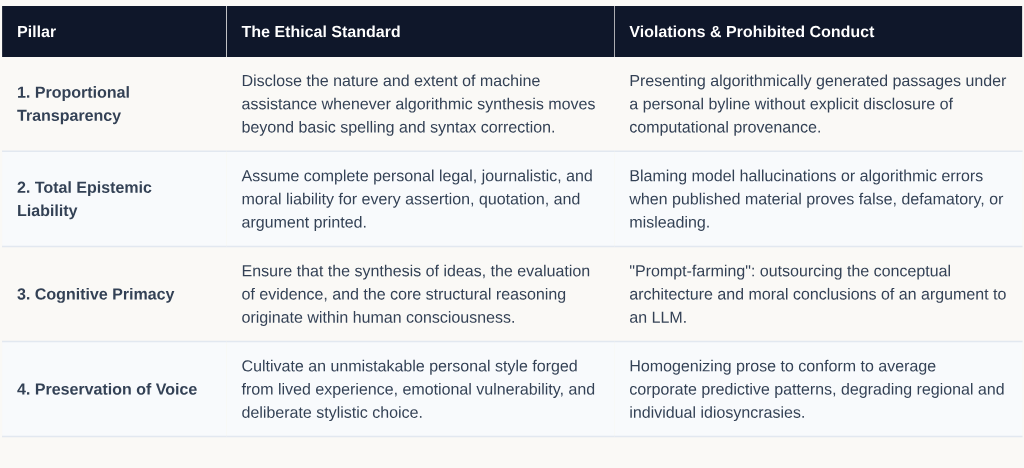
The application of this charter does not require writers to retreat into reactionary isolation from modern technology. It allows for the thoughtful, strategic deployment of computational tools to eliminate administrative drudgery and expand exploratory breadth. But it establishes an unyielding boundary: the intellectual soul of the writing must belong unequivocally to the author.
Section 6: Conclusion: The Unconquerable Sanctuary of Human Intent
In the final analysis, writing is not an optimization problem. It was never intended to be an industrial manufacturing pipeline designed to flood communication channels with frictionless prose. Writing is a confession. It is an act of witness. It is an enduring testament to what it feels like to live, struggle, love, doubt, and endure within the fragile confines of a mortal human life.
A large language model can simulate the syntax of grief, but it has never mourned. It can generate the vocabulary of courage, but it has never faced fear. It can output the cadence of moral conviction, but it has no stake in the consequences of its claims. When we read truly great writing, we are not merely decoding symbols; we are communing with another human mind across the boundaries of time, geography, and mortality.
The ethical line is therefore not merely a technical guideline for journalistic integrity; it is an existential defense of our own humanity. Use the tools to sharpen your clarity, organize your research, and vanquish tedious administrative friction. But keep the conception of your arguments, the cadence of your language, and the courage of your convictions unmistakably, unapologetically, and authentically your own.