
The first rung is where the pressure shows


When people ask which jobs artificial intelligence is changing first, the instinctive answer is a list of professions: translators, coders, paralegals, customer-service agents. The data collected over the past year points somewhere more specific. The earliest and clearest signal is not a profession at all. It is a stage of a career. Beginners are feeling it before anyone else.
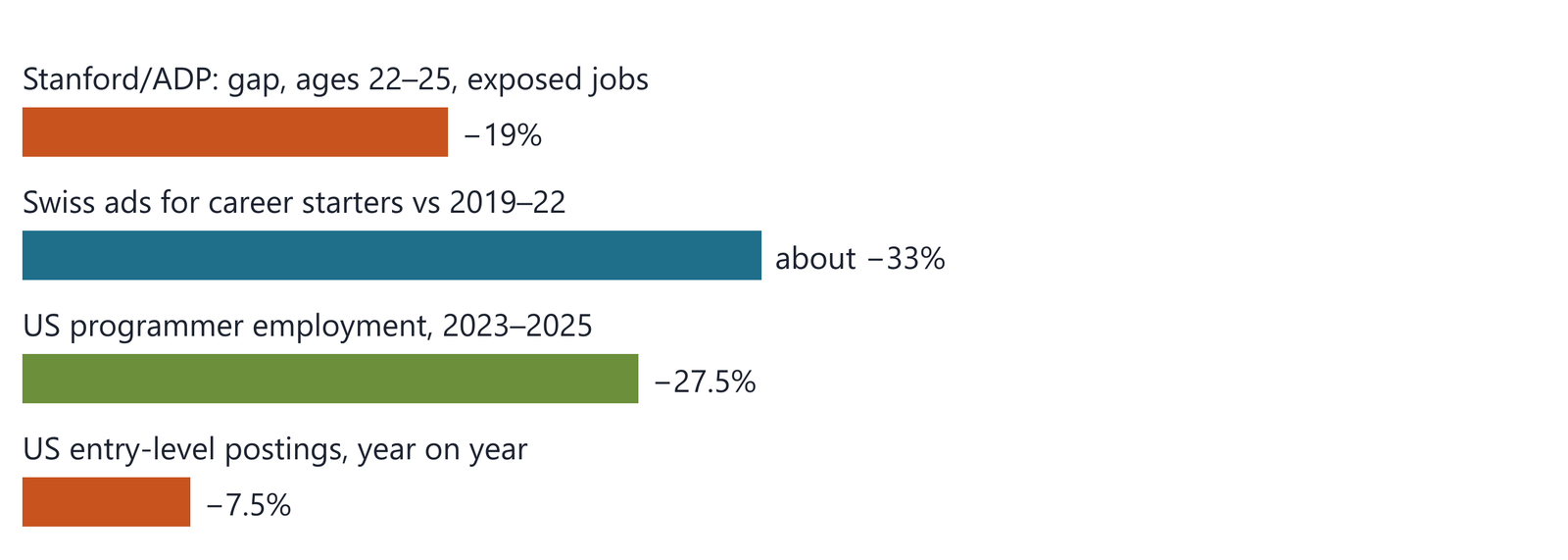
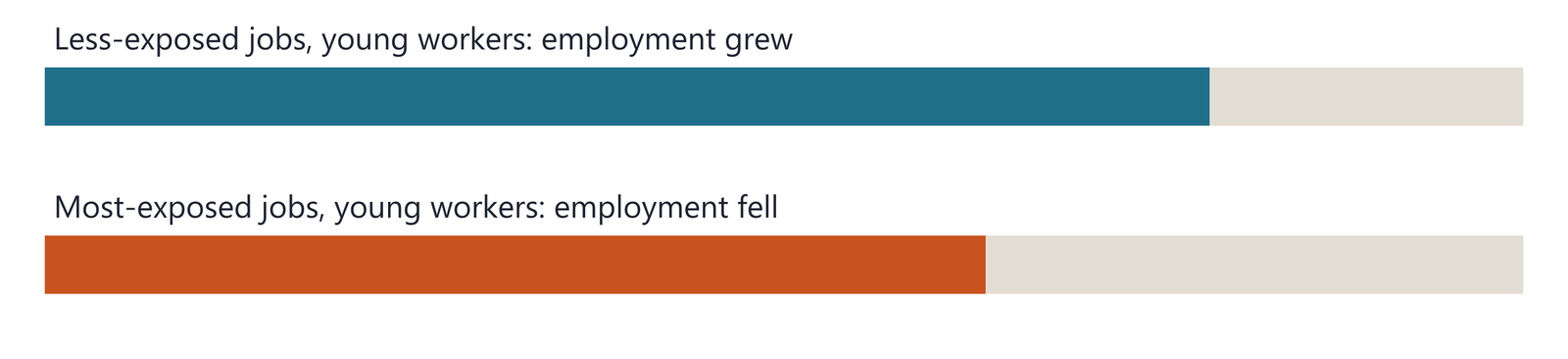
The strongest evidence comes from the Stanford Digital Economy Lab, whose researchers use anonymised payroll records from ADP to follow employment by age and occupation. In the August 2026 update of their “Canaries in the Coal Mine” project, employment among workers aged 22 to 25 in the most AI-exposed occupations sat roughly 19 percent below where it would be had it tracked young workers in the least exposed jobs. In absolute terms, the most exposed groups shrank between November 2022 and June 2026, while the least exposed groups grew. An earlier release put the decline for young workers in exposed roles at about 13 percent, so the gap has widened as more data arrived.
Two details in that research matter as much as the headline. First, across the whole workforce the researchers saw little difference between exposed and unexposed occupations. The divergence is concentrated among the young. Second, the mechanism looks like weaker hiring rather than layoffs. Companies are not marching experienced staff out the door; they are simply opening fewer doors at the bottom. Effects also showed up more in headcount than in pay, which is typical of the early stage of a shift.
Other datasets, built differently, lean the same way. A Swiss report drawing on 7.3 million job advertisements found that the share of ads aimed at career starters in 2025 was just under a third below its 2019–2022 average, with digital, office-based and knowledge-heavy roles affected most. An analysis compiled in September 2026 noted that entry-level postings in the United States were running about 7.5 percent lower year on year as of May. None of these numbers is identical, because they measure different things, but they point in a shared direction.
Tasks change first, job titles change last
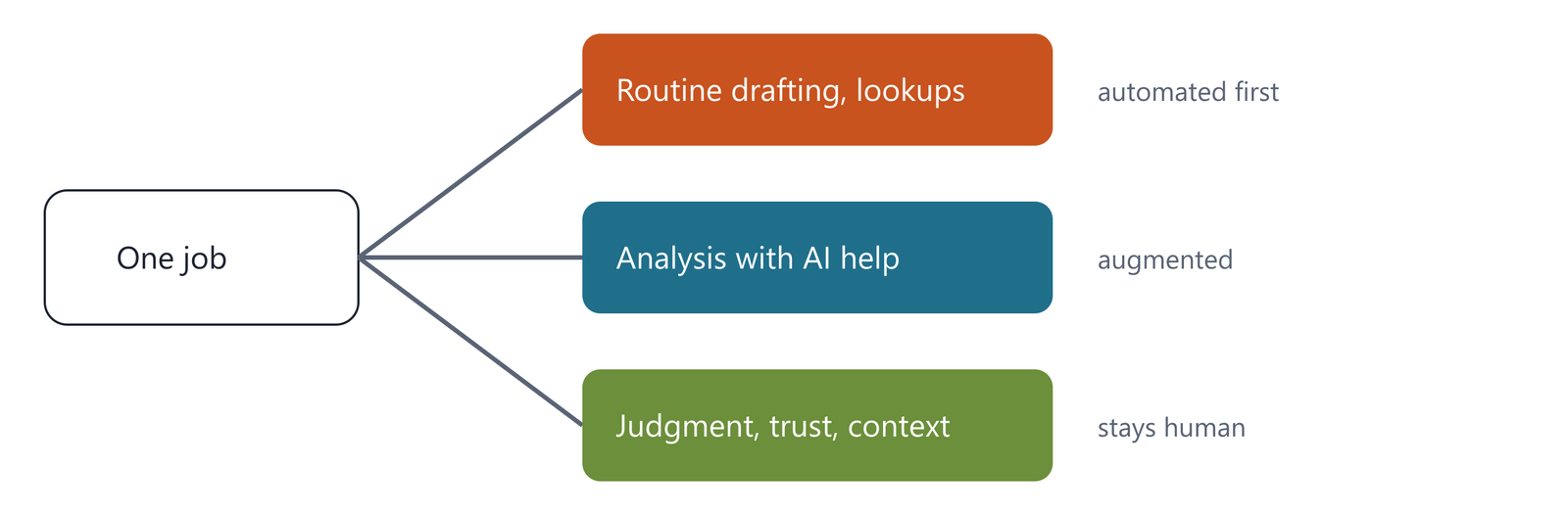
Why would beginners be hit hardest? The most convincing explanation is about what a first job actually consists of. A junior analyst, associate lawyer, support agent or entry-level developer spends much of the early career on well-defined, codified work: summarising documents, drafting first versions, writing routine code, answering standard queries. That work is exactly what current AI systems do competently. The Stanford team found that occupations where AI is used to automate tasks, rather than to assist a person, had the weakest results for entry-level employment.
The same study draws a useful line between codified knowledge, which can be written down, and tacit knowledge, which comes from mentoring and repeated exposure to messy real situations. Occupations that lean on codified knowledge showed slower entry-level growth, while jobs that depend on tacit knowledge showed stronger growth for mid-career and senior people. Experience, in other words, is currently the thing machines cannot copy, which is why experienced workers have been shielded while newcomers have not.
A survey reported in June 2026 supports the task-level picture. Respondents estimated that AI already performs about a third of entry-level tasks worldwide, and a larger share in India. Yet the same people were not gloomy: roughly 94 percent expected AI to create entry-level roles that do not exist yet, and 85 percent still saw beginner jobs as essential for building future leaders. Those are opinions rather than measurements, but they show the employer view: the task bundle is being rewritten, not abolished.
That rewriting appears in postings. PwC’s 2026 Global AI Jobs Barometer, which analysed more than a billion job ads across 27 countries, describes the “seniorization” of first jobs: roles that once asked for little now request skills traditionally associated with seniority, such as judgment and leadership. According to one summary of the report, redrawn entry-level roles have grown about 35 percent since 2019 while traditional entry-level openings shrank about 10 percent. The ladder still exists, but its first rung has been moved higher.

Which occupations sit at the front of the line
Pulling the evidence together, the roles changing first share three traits: they are digital, they are text- or code-heavy, and they have a well-trodden junior pathway built on routine output. Software development is the clearest case. One compilation of statistics reported US programmer employment down about 27.5 percent between 2023 and 2025, though programming is also where AI tools are most mature, and the category covers a narrower slice of work than software engineering overall. Customer support, clerical and administrative work, junior content and marketing production, and parts of finance and legal support sit in the same neighbourhood.
It helps to be careful here. “Exposed” is a measure of how much of an occupation’s tasks overlap with what AI can do, not a forecast that the job vanishes. Several datasets complicate any simple story. A study of 2.6 million US entry-level job ads published by Coresignal found that the share of ads for AI-exposed work rose slightly, from about 11 percent to 12.5 percent between early 2025 and early 2026, while the share for in-person, manual roles fell from 43.1 to 37.1 percent. That study measures the mix of advertised roles rather than headcount, so it does not contradict Stanford; it shows that the composition of beginner work is shifting even as its volume is debated.
The broader economy adds noise. US nonfarm payrolls fell by 23,000 in July 2026, with unemployment at 4.1 percent, according to the Bureau of Labor Statistics as summarised in coverage of the Stanford update. Cautious hiring after several turbulent years can depress opportunities for graduates regardless of AI. Analysts who reviewed the full range of hiring data in September concluded that AI is one of several plausible, only partly separated contributors to weaker entry-level hiring, which is the honest summary of where the evidence stands.
A two-track market, and what the wage data rewards
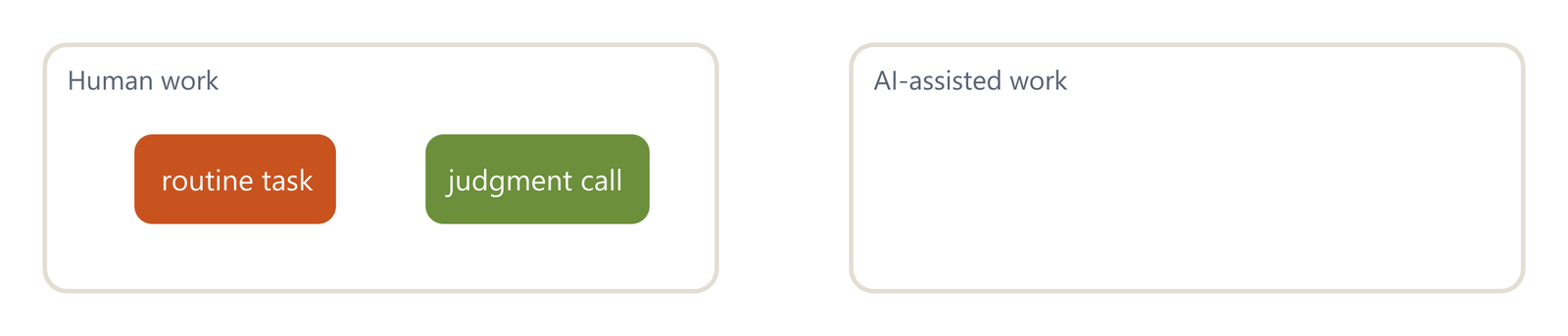
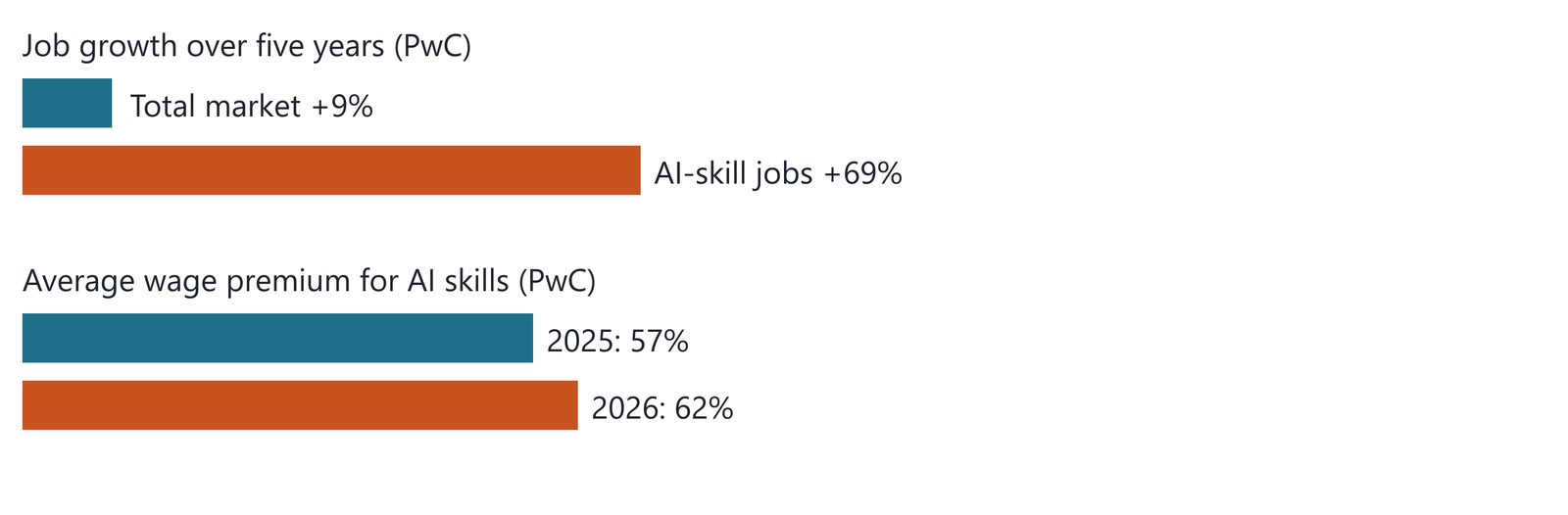
If beginner roles are tightening, where is demand growing? PwC’s barometer offers the most detailed answer. It reports that jobs requiring specific AI skills have grown 69 percent over five years, against 9 percent for the job market as a whole, and that the average wage premium for AI skills rose to 62 percent from 57 percent a year earlier. The report also splits occupations into two tracks. “Professionalised” roles, where AI takes over routine work and leaves humans the expert part, saw about twice the job growth and 42 percent faster wage growth than “democratised” roles, where AI makes the work easier for non-experts to perform.
The reading is subtle. In professionalised jobs such as radiology or recruiting, AI handles the lower-level tasks and raises the value of the expert on top. In democratised jobs, the tool narrows the gap between novice and expert, which weakens bargaining power and pay. Whether a technology helps or squeezes you depends on which of those two effects dominates in your line of work.
One caution applies. PwC sells advisory services, and independent commentators have pointed out that it has a commercial interest in findings that frame AI as an opportunity. The scale of the dataset, over a billion ads, is a strength, but job ads measure what employers ask for, not necessarily what they pay or end up hiring. Treat the premium as a strong signal rather than a guaranteed paycheck bump, and note that sector figures vary widely: the Dutch analysis found a negative premium in financial services, while the UAE analysis found a very large one.
The skills that still matter
Strip away the debate and the data suggests a consistent answer about skills, though it comes with an important framing: these are things employers are asking for and paying more for today, not predictions about decades from now.
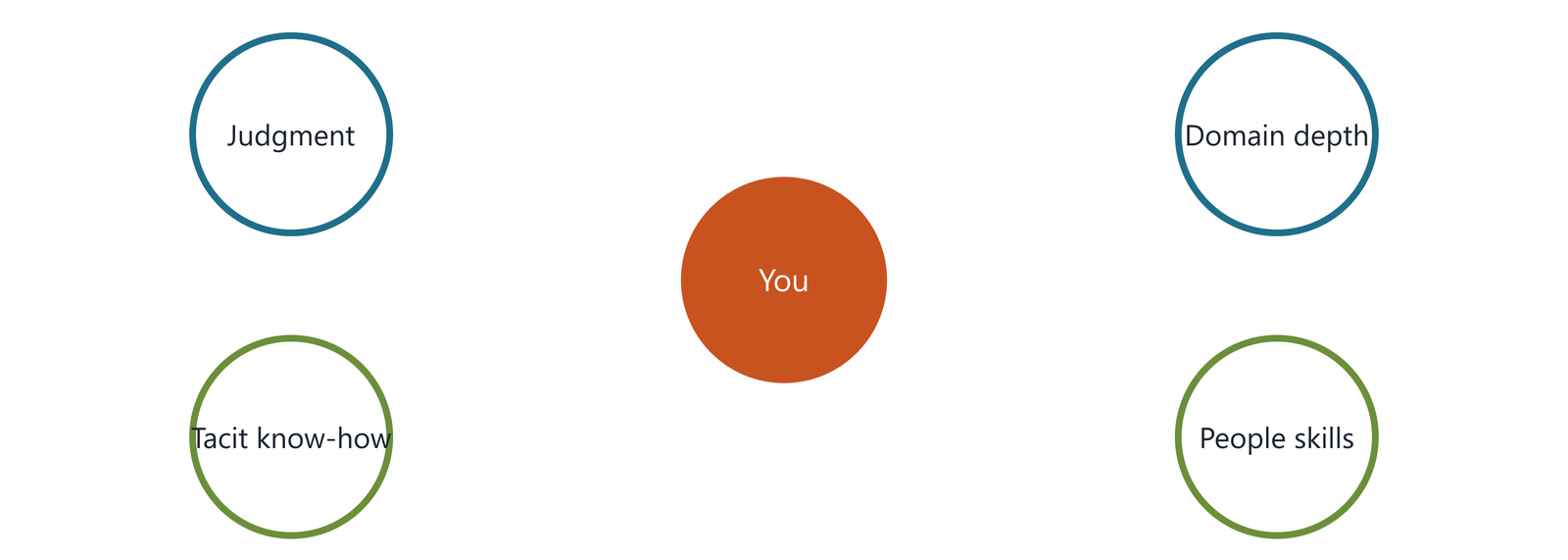
Judgment and critical thinking. The most repeated item in coverage of the barometer is knowing when an AI output is wrong. As generation becomes cheap, verification becomes the scarce activity. A junior who can check a draft, spot a flawed assumption or notice that a number does not add up is more useful than one who simply produces output faster.
Domain depth paired with tool fluency. Analysts of the premium note that it accrues most strongly to people who combine AI fluency with real expertise in a field, not to those who master tools alone. A tool anyone can learn confers a limited edge; knowing a sector’s rules, customers and failure modes is harder to copy.
Tacit knowledge and relationships. Stanford’s finding that tacit-knowledge occupations held up better points to the value of things learned by doing: reading a client, knowing which rule bends, sensing when a plan will fail. This is also why apprenticeship-style work matters, and why companies that cut junior hiring may erode their own future pipeline of experienced people.
Communication, leadership and creativity in ambiguous situations. These appear throughout employer language about the redrawn entry-level role. Someone has to decide what to ask the system, whom to trust and how to explain a decision to a person affected by it.
Adaptability. Surveys of employers repeatedly place willingness to learn and to rework one’s own workflow near the top. Education also appears to offer some protection in the Stanford data, although it is not a guarantee.

What a sensible response looks like
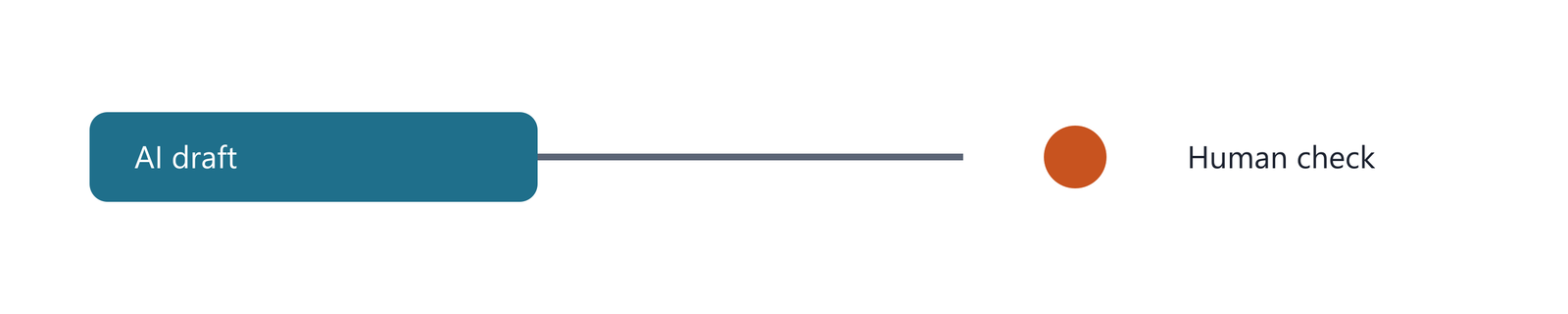
For a student or early-career worker, the data argues for choosing work that builds tacit knowledge, such as client contact, supervised practice and exposure to real mistakes, and for treating AI tools as part of the craft rather than a rival. Showing that you can direct a tool, check its output and take responsibility for the result is a stronger pitch than showing you can do the routine task by hand. For employers, the lesson is less comfortable: if junior roles shrink while senior skills are demanded on day one, the pipeline of future experts thins. Several analysts have urged companies and universities to redesign early-career training rather than simply cut it.
For mid-career workers, the evidence is more reassuring but not complacent. Stanford’s data show experienced workers in exposed fields holding steady, and tacit-knowledge jobs growing. The premium goes to those who add tool fluency to existing expertise. The risk lies in doing a routine task that others can now do with a prompt.
What the data cannot tell us
Several limits deserve plain statement. Exposure scores are estimates of task overlap, and different researchers rank occupations differently. Payroll data capture formal employment in one country; job-ad data capture employer intent. Studies using different methods reach different magnitudes, from single digits to nearly a third. The Coresignal analysis even warns readers that its measure of job-ad mix differs from headcount studies. Macroeconomic conditions, interest rates and post-pandemic over-hiring are all plausible competing explanations for part of the entry-level slump, and researchers say these are only partially separated from AI.
The fair conclusion is therefore modest but useful. The first thing AI is changing is the beginning of careers: fewer routine entry tasks, higher expectations for newcomers, and more value placed on judgment, domain depth and human skills. How far that goes will be settled by data not yet collected, so it is worth rechecking the sources below as new releases arrive.
All prose, illustrations and animations on this page are original. Figures are paraphrased from the sources above and may be revised as those organisations publish updates.