
Section 1: The Apprentice in the Infinite Library — Rethinking What an AI Actually Is
Most people picture a computer program as a strict, unyielding clerk. For the first seventy years of computing history, that picture was completely accurate. Traditional software operates on explicit instructions written by human programmers: If the customer clicks this button, check the database; if the account balance is greater than twenty dollars, approve the purchase; otherwise, display an error message. Every single contingency had to be anticipated by a human mind and translated into rigid, step-by-step code. If something unexpected happened—say, a user uploaded a blurry photograph of a handwritten receipt instead of typing numbers into a neat box—the clerk simply froze. Traditional code cannot improvise because it does not understand patterns; it only obeys rules.
Modern artificial intelligence models, particularly the large language models (LLMs) that power today's conversational assistants, work on an entirely different principle. They are not built out of millions of hand-coded “if-then” rules. Instead, they are grown through observation. To understand how an AI model actually operates under the hood without getting lost in linear algebra, imagine a vast, impossible building: The Infinite Library.
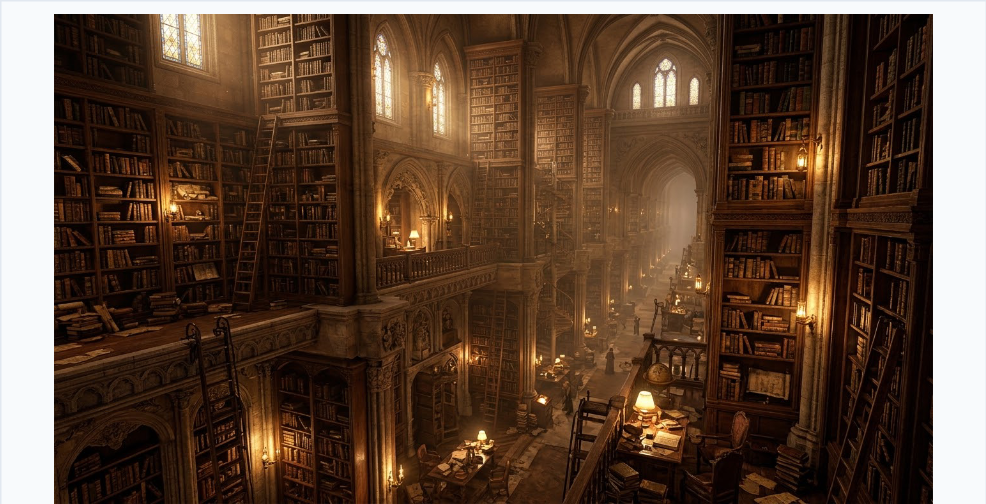
Inside this library sits every digitized book, scientific paper, recipe blog, movie script, software manual, and forum argument ever written by humanity. Now, imagine hiring an Apprentice Librarian to work inside this building. When the Apprentice first arrives on day one, they face a massive problem: they do not speak a single word of any human language. They do not know what a “cat” is, they do not know that water is wet, and they do not know how to write a sonnet or debug Python code. They have no dictionary, no encyclopedia of facts, and no conscious awareness of the outside world. All they have is an extraordinary, superhuman capacity to notice statistical patterns, and billions of pages of text waiting on the shelves.
Before the Apprentice can begin examining those pages, the library's intake system performs a crucial preparation step called tokenization. Human readers see sentences made of whole words, spaces, and punctuation marks. The Apprentice, however, breaks text down into smaller, standardized building blocks called tokens. Common, short words like apple or run stay whole as a single token. Longer or rarer words get snapped apart into recognizable roots, prefixes, and suffixes—so a word like unbelievable might be split into three separate puzzle pieces: un, believ, and able. Each unique token in the library's catalog (usually between 50,000 and 200,000 pieces in modern models) is stamped with a permanent identification number. From that moment on, the Apprentice never actually sees letters; they see long streams of numbered puzzle pieces flowing across their desk.
How does an Apprentice who only sees numbered puzzle pieces learn to write coherent essays, summarize legal contracts, or explain quantum physics? They do it by playing a single, relentless game billions of times in a row: Cover the Next Piece.
Section 2: Cartography of Meaning — How Embeddings Turn Words into Coordinates
Before the Apprentice can master the game of predicting which puzzle piece comes next, they need a way to organize the library. In an ordinary municipal library, books and words are organized alphabetically or by the Dewey Decimal System. In an alphabetical dictionary, the word apricot sits right next to apron, even though a fuzzy orange fruit and a kitchen garment have almost nothing to do with one another in the real world. Meanwhile, apricot and peach—which are practically cousins—are separated by hundreds of pages.
An alphabetical system is useless if your goal is to understand relationships and context. So, as the Apprentice reads through billions of sentences, they throw out the alphabet entirely and build a Spatial Map of Meaning. In artificial intelligence, this map is called an embedding space, and the coordinates of each word or token on that map are called vectors (Mikolov et al., 2013).
To picture how the Apprentice constructs this map, imagine they start with a giant, flat gymnasium floor. Every time they encounter a token in the library's texts, they place a physical tile for that token somewhere on the floor based on the company it keeps. The guiding rule of the library—known in linguistics as the distributional hypothesis—is simple: You shall know a word by the company it keeps.
Suppose the Apprentice reads ten thousand sentences containing the word coffee and ten thousand sentences containing the word tea. Even though the Apprentice has never tasted a hot beverage, they notice that both tokens constantly appear alongside the exact same neighboring tokens: cup, morning, brew, hot, caffeine, kettle, and pour. Because coffee and tea share almost identical neighborhoods in text, the Apprentice places their tiles right next to each other on the gymnasium floor. Conversely, the word carburetor appears near engine, fuel, piston, and mechanic, so its tile gets pushed to the far opposite corner of the room.
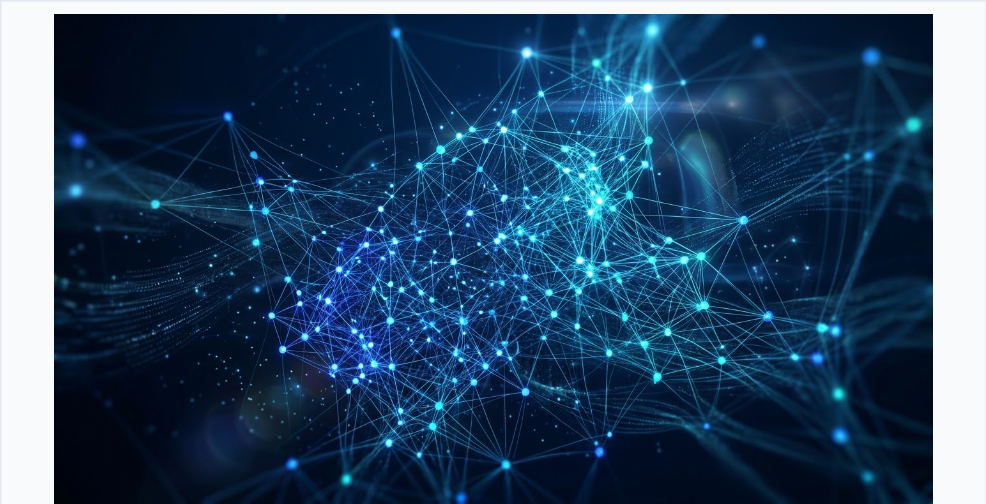
Now, here is where the library becomes truly mind-bending. A flat gymnasium floor only has two dimensions: North-South and East-West. Two dimensions are nowhere near enough to capture the messy richness of human language. Consider the word bank. It relates to river, mud, and current (a river bank), but it also relates to loan, vault, and mortgage (a financial bank). Consider the word mercury, which needs to sit near venus and mars (planets), near lead and zinc (liquid metals), and near zeus and apollo (mythology).
If the Apprentice only had a flat two-dimensional floor, pulling mercury closer to the planets would accidentally drag it away from the metals. To solve this, the Apprentice builds a library room with thousands of dimensions. While human brains cannot visualize a room with 4,096 perpendicular directions, to a computer, a dimension is just an extra number on a coordinate list.
On a flat map on earth, you can locate any coffee shop using just two numbers: Latitude and Longitude, like (40.71, -74.00). In the Apprentice's high-dimensional library, every single token is assigned a list of thousands of numbers—say, (-0.042, 0.891, -0.312, 0.115, ...) continuing for several thousand entries. Each number represents a subtle, nameless spectrum of meaning that the Apprentice discovered on their own:
One direction in the room might roughly correspond to formality (moving from hey to greetings to heretofore). Another direction might track size (moving from pebble to boulder to mountain). Another direction might capture tense (moving from walked to walking to will walk). Another direction might capture royalty or gender.
Because these coordinates are pure numbers, the Apprentice can actually perform geometry and arithmetic on meaning itself. In a famous demonstration of how vector embeddings work (Mikolov et al., 2013), researchers showed that if you take the coordinate numbers for the word King, subtract the coordinate numbers for Man, and add the coordinate numbers for Woman, the resulting coordinates land you right on top of the tile for Queen. Similarly, if you take the vector for Paris, subtract France, and add Japan, the map points directly to Tokyo.
The Apprentice still does not “know” what France is in the way a tourist eating a croissant under the Eiffel Tower knows France. Yet by measuring the exact geometric angles and distances between billions of words across thousands of dimensions, the Apprentice has constructed a remarkably accurate mathematical mirror of human concepts.
Video Visual 1: Visualizing High-Dimensional Word Embeddings (8-Second Clip Concept). Visual Scene: A 3D camera glides through a dark, starry void filled with glowing text nodes (King, Queen, Monarch, Prince, Palace). Neon coordinate gridlines flash briefly between King and Man, then shift in parallel to connect Queen and Woman, showing identical geometric distance and angle before zooming out to reveal millions of clustered word galaxies. Source Reference: TensorFlow Embedding Projector Interactive Visualization (TensorFlow / Google Research).
Section 3: The Great Training Regimen — Billions of Dials and the Pain of Being Wrong
Having a map of words is a massive leap forward, but a map alone cannot write a sentence. To turn static word coordinates into fluent thoughts, the Apprentice relies on a massive machine sitting in the center of the library: The Neural Network.
In popular culture, a neural network is often described as an “electronic brain,” which conjures up spooky images of synthetic gray matter bubbling in a vat. In reality, a neural network is much closer to a colossal mixing console in a recording studio—imagine a soundboard the size of a city block, covered in billions (or even trillions) of tiny rotary dials. In machine learning, these dials are called parameters or weights.
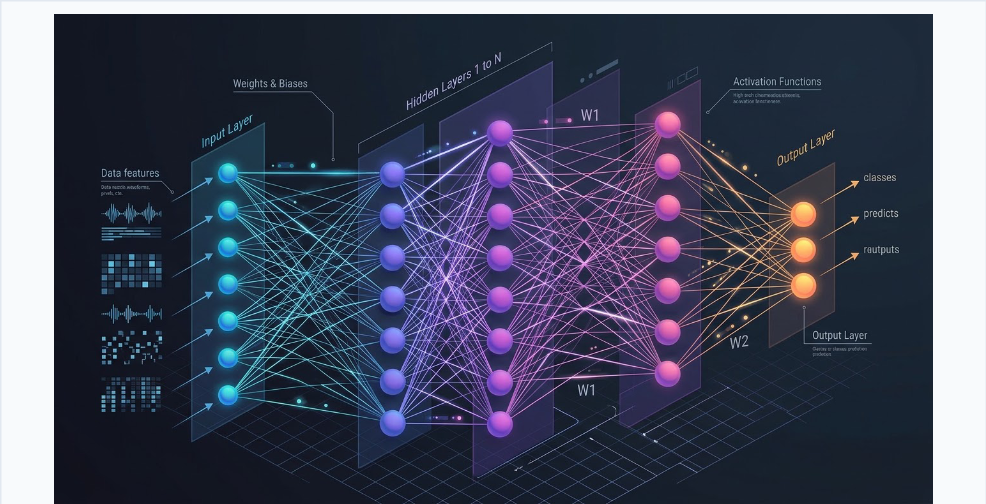
As shown in the architectural diagram above, the machine is organized into sequential layers—an input layer where the word coordinates enter, dozens of deep hidden layers where information is mixed and transformed, and an output layer that produces a final prediction. Every single connection line between the glowing nodes in one layer and the nodes in the next layer has its own adjustable dial attached to it. If a dial is turned high (a positive weight), it amplifies the signal passing through that wire; if it is turned to zero, it blocks the signal; if it is turned negative, it inhibits the signal.
When the neural network is first built inside the data center, before training begins, every single one of those billions of dials is set completely at random. At this stage, the Apprentice is clueless. Now begins Pre-Training—the most expensive and computationally intensive phase of creating an AI model. The Apprentice sits down at the billion-dial mixing console, pulls a real sentence from the library shelves, and covers up the last word:
“The barista poured steamed milk into the...”
The coordinates for those seven words enter the input layer on the left. They travel through the first hidden layer, get multiplied by whatever random numbers the dials are currently set to, pass through the second layer, and eventually emerge at the output layer on the far right. Because all the dials are set randomly, the machine's first guess for the next word is utter garbage. It predicts: “rhinoceros.”
Immediately, an automated supervisor standing behind the Apprentice reveals the true word from the original book: “cup.” Here, three critical mechanisms work together to teach the machine (Sanderson, 2017–2024):
1. The Loss Function (The Penalty Score): A mathematical grading formula measures just how catastrophically far away the guess (“rhinoceros”) was from the actual answer (“cup”), along with all the other plausible words the machine failed to rank highly. This error score is called the loss. Early in training, the loss is sky-high.
2. Backpropagation (Tracing the Blame): Once the penalty score is calculated, the system works backward through the mixing console from right to left. Using calculus, it traces the mistake back through every single layer, asking: Which specific dials were responsible for boosting “rhinoceros” and suppressing “cup”?
3. Gradient Descent (Nudging the Dials): Once the culpable dials are identified, an optimization algorithm steps in and twists millions of those tiny dials by a microscopic fraction of a millimeter. Dials that contributed to the wrong answer get turned down slightly; dials that would have pointed toward “cup” get turned up slightly.
Why only turn the dials by a tiny fraction instead of cranking them all the way over so the machine always says “cup”? Because the very next sentence in the training pile might be: “The chef poured steamed milk into the saucepan.” If the Apprentice cranked the dials too aggressively after a single sentence, the machine would erase everything else and only ever guess “cup”. By nudging the dials in tiny increments across trillions of examples—a process called stochastic gradient descent—the dials gradually settle into a delicate, harmonious equilibrium that captures the statistical reality of all human writing at once.
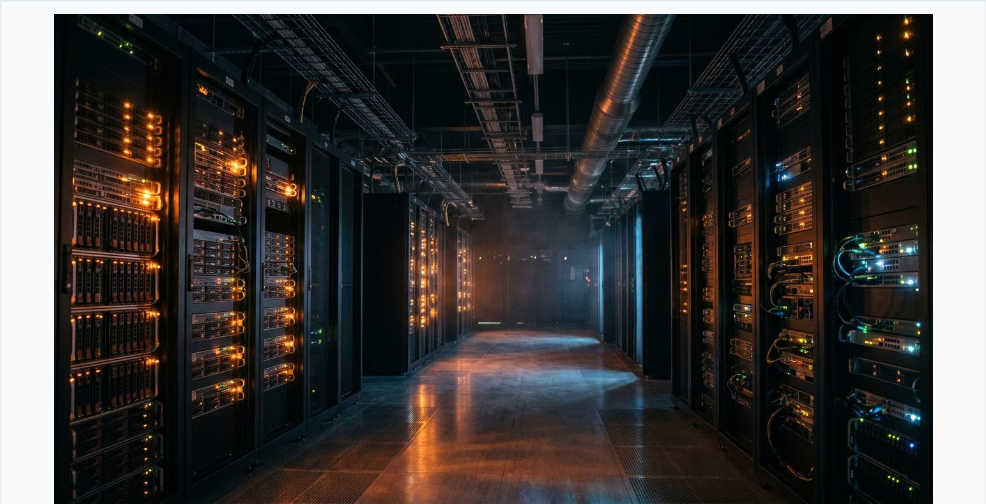
This training loop—guess the next token, measure the error, trace the blame backward, nudge billions of dials—is repeated across trillions of words over weeks or months inside massive data centers packed with thousands of specialized graphics processing units (GPUs), like the glowing server racks pictured above.
Something remarkable happens as the Apprentice plays this guessing game at scale. At first, during the earliest hours of training, the dials only capture crude surface statistics: the Apprentice learns that a period is usually followed by a capital letter, and that the word the is rarely followed by another the. After a few billion more examples, deeper hidden layers begin dedicating their dials to grammar and syntax, learning that plural nouns require plural verbs even when separated by a long clause.
Push the training further, however, and emergent world modeling appears. Suppose the Apprentice has to predict the final word of this passage:
“Sarah placed her keys inside the blue porcelain bowl in the kitchen, walked into the living room to read a chapter of her book, and when her brother arrived and moved the blue bowl to the garage, Sarah went to look for her keys in the...”
To predict the next word accurately (“kitchen”, where Sarah believes the keys are, rather than “garage”, where they actually are), surface-level word associations are no longer enough. The dials in the middle layers of the network are forced by the relentless pressure of the error score to wire themselves into circuits that track objects, locations, cause-and-effect, and even the mental states of fictional characters. Simply learning to predict the next word with extreme accuracy forces the neural network to build a compressed, working model of how the world operates.
Video Visual 2: Gradient Descent and Backpropagation in Action (7-Second Clip Concept). Visual Scene: Split-screen animation. On the left, a glowing marble rolls down a rugged, neon-lit 3D mountain range (the “Loss Landscape”), bouncing past high peaks of high error until it settles smoothly into a deep blue valley floor (“Minimum Loss”). Simultaneously on the right, a cross-section of neural network pathways flashes gold backward from output to input as connection lines thicken and thin in real time. Source Reference: 3Blue1Brown, Neural Networks Chapter 2 & 3: Gradient Descent and Backpropagation (Sanderson, 2017–2024).
Section 4: The Spotlight of Attention — How the Transformer Architecture Changed Everything
For many years, neural networks had a debilitating flaw: they had terrible short-term memory. Earlier designs (known as Recurrent Neural Networks) read sentences strictly one word at a time from left to right, passing a single summary note from word to word like a game of telephone. By the time the model reached the end of a long paragraph, the details from the beginning of the paragraph had blurred into an unreadable smudge.
Then, in 2017, a team of researchers at Google published a landmark paper titled “Attention Is All You Need” (Vaswani et al., 2017), introducing a brand-new architecture called the Transformer. Almost every major modern AI model—from GPT and Claude to Gemini and Llama—is built on the Transformer blueprint. The secret weapon inside the Transformer is a mechanism called Self-Attention.
To understand how Self-Attention works inside our Infinite Library, imagine that instead of reading a page through a tiny keyhole one word at a time, the Apprentice mounts dozens of movable, color-coded searchlights across the ceiling of the reading room. When a sentence lands on the desk, the Apprentice looks at the entire page all at once and shines those searchlights between every single pair of words to see how they modify one another.
Consider these two classic test sentences:
1. “The dog didn't cross the street because it was too tired.”
2. “The dog didn't cross the street because it was too wide.”
To a human reader, the distinction is effortless: in the first sentence, “it” refers to the dog; in the second sentence, “it” refers to the street. Yet notice that the two sentences are completely identical except for the final word! If you just look up the word “it” on our static embedding map from Section 2, its coordinate tile sits in a generic, vague spot for pronouns. On its own, “it” has no fixed identity.
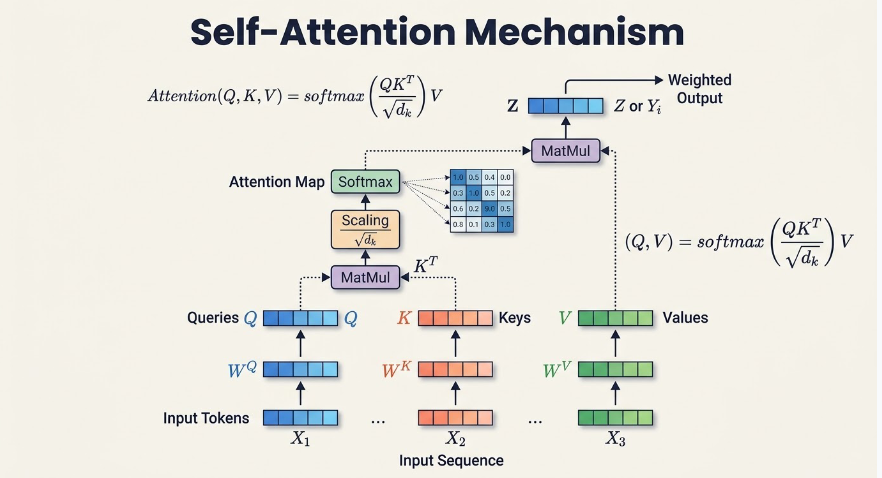
The Self-Attention mechanism resolves this ambiguity dynamically using a three-part filing system shown in the diagram above: Query, Key, and Value (Vaswani et al., 2017; Alammar, 2018–2023).
Whenever the Apprentice encounters a word in a sentence—say, the pronoun “it”—the network generates three distinct mathematical slips of paper for every token on the desk:
The Query (What I am looking for): The token “it” sends out a broadcast signal asking: “I am a singular inanimate or animal pronoun looking for the noun I belong to, taking into account the descriptive adjective at the end of this clause.”
The Key (What I have to offer): Every other word in the sentence holds up a descriptive label advertising its grammatical role and attributes. “Dog” holds up a Key saying: “I am a living, animate noun capable of fatigue.” “Street” holds up a Key saying: “I am a physical, spatial noun with geometric dimensions.” “Tired” holds up a Key saying: “I am a biological state of exhaustion.”
The Attention Score (The Match): The machine multiplies the Query of “it” against the Keys of every other word in the sentence (the MatMul and Softmax steps in the diagram). In sentence 1, because “tired” is present, the Query for “it” clicks strongly with the Key for “dog”. A bright searchlight beam locks onto the connection between “it” and “dog”, while the beam pointing to “street” dims to almost zero.
The Value (The Information Transfer): Once the searchlight locks onto “dog”, the network pulls the Value—the actual rich semantic content of “dog”—and blends it directly into the coordinate representation of “it”.
By the time the tokens pass through one layer of Self-Attention, the tile for “it” is no longer a generic pronoun tile; it has been physically dragged across the high-dimensional room so that it now carries the essence of “tired dog”.
Even better, modern Transformers use Multi-Head Attention, meaning the Apprentice doesn't just operate one searchlight at a time—they operate dozens of independent searchlights in parallel across every layer:
Searchlight Head #1 might track pronoun references (who did what to whom). Searchlight Head #2 might track temporal sequence (what happened first vs. what happened later). Searchlight Head #3 might track tone and sarcasm (noticing that the word “great” at the end of a complaint about a delayed flight actually means the opposite of great). Searchlight Head #4 might look three thousand words back to the beginning of a conversation to remember that the user asked for the explanation to be written for a ten-year-old.
Because all of these searchlights shine across the entire text simultaneously rather than waiting in a slow single-file line, Transformers can be trained on vastly larger datasets at blistering speeds, keeping track of intricate threads of context across entire books or codebases.
Video Visual 3: Transformer Self-Attention Searchlights in Motion (6-Second Clip Concept). Visual Scene: The sentence “The animal didn't cross the street because it was too tired” floats horizontally across a dark screen. As the cursor highlights the word “it”, translucent cyan light beams shoot upward from “it” to every word in the sentence. The beam connecting “it” to “animal” and “tired” pulses thick and bright opaque blue, while the beams to “the” and “street” fade into thin, dotted wisps. Source Reference: BertViz / Transformer Attention Visualization Tool (Jesse Vig, Open-Source Attention Head Visualizer & Google Research Blog, github.com/jessevig/bertviz).
Section 5: Finishing School, Temperature, and Why the Librarian Sometimes Hallucinates
Suppose our Apprentice has just finished months of Pre-Training on trillions of words using the Transformer architecture. Their billions of dials are finely tuned, and their attention searchlights are razor-sharp. What happens if you walk up to the library counter right now and ask this freshly pre-trained model a simple question:
User: “How do I bake chocolate chip cookies?”
You might expect a polite recipe. Instead, a raw pre-trained base model might respond with: “How do I bake oatmeal raisin cookies? How do I bake brownies from scratch? Click here to subscribe to our weekly baking newsletter!”
Why did it respond with more questions instead of an answer? Because during Pre-Training, the Apprentice's only job was to continue the document. If the Apprentice saw a list of questions on an internet forum or a quiz website during training, the most statistically probable continuation of a question is often another question. A raw pre-trained model is a world-class document completion engine, not a helpful assistant.
To transform this raw document completer into a conversational partner, engineers send the Apprentice to Finishing School, which consists of two crucial post-training stages (Ouyang et al., 2022):
1. Supervised Fine-Tuning (SFT): Human writers create tens of thousands of gold-standard transcripts showing how an ideal, polite, accurate assistant responds to user requests. Instead of reading random corners of the web, the Apprentice practices predicting the next token exclusively on these high-quality question-and-answer dialogues. Quickly, the Apprentice realizes: Aha! When a prompt starts with a user question, the genre we are writing is “helpful, structured assistant response.”
2. Reinforcement Learning from Human Feedback (RLHF): Next, the Apprentice writes three or four different answers to the same prompt. Human reviewers read the drafts side-by-side and rank them based on helpfulness, clarity, honesty, and safety. That human preference data is used to train a separate “Reward Model”—essentially an automated etiquette coach—which nudges the Apprentice's dials further toward clear, helpful explanations and away from toxic, evasive, or rambling habits.
Finally, the model is ready for you to use. When you type a prompt into a chat window and watch the answer stream onto your screen word by word, what is actually happening in that final split second? At the very end of the neural network, after your prompt has traveled through all the embedding maps and all the layers of attention searchlights, the Apprentice does not output a single word. Instead, the Apprentice outputs a Probability Menu across every single token in its entire vocabulary. If the sentence so far is “The sky on a clear afternoon is…”, the Apprentice's final calculation sheet looks like the table below.
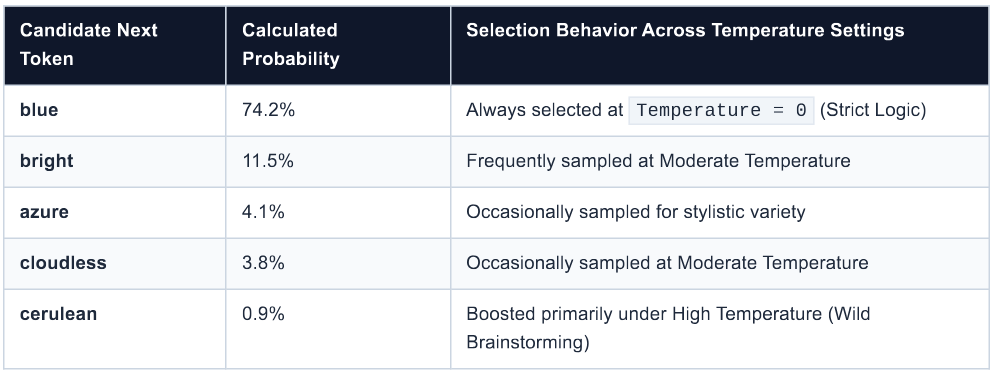
To pick the actual word that appears on your screen, the system rolls a weighted die based on a setting called Temperature:
Temperature = 0 (Strict Logic): The Apprentice never rolls the die; they always pick the #1 highest-probability word (“blue”) every single time. This makes the model predictable, consistent, and great for coding or data extraction, though its prose can feel slightly dry and repetitive.
Moderate Temperature (Balanced Conversation): The Apprentice rolls a weighted die among the top plausible candidates. Usually it picks “blue”, but occasionally it picks “bright” or “cloudless”. Because that single choice becomes part of the sentence that feeds into predicting the next token, picking “azure” instead of “blue” sends the rest of the paragraph down a slightly more poetic trajectory.
High Temperature (Wild Brainstorming): The probabilities are flattened out, giving rare words a much bigger fighting chance. Turn the temperature too high, and the Apprentice starts picking bizarre, improbable tokens that derail into grammatical nonsense.
Video Visual 4: Next-Token Probability Sampling & Temperature Slider (9-Second Clip Concept). Visual Scene: A sentence types across the screen and pauses at a blinking cursor. To the right of the cursor, a dynamic horizontal bar chart pops up showing the top five candidate tokens (“blue”, “bright”, “clear”, “cobalt”, “vast”) with percentage bars. A UI slider labeled “Temperature” moves from 0.0 to 1.2, causing the tall top bar to shrink and the smaller lower bars to grow taller before a glowing selector highlights “cobalt” and inserts it into the sentence, immediately triggering the next bar chart. Source Reference: Jay Alammar, The Illustrated GPT-2 / How LLMs Generate Text & OpenAI Tokenizer/Logprobs Interactive Playground (Alammar, 2018–2023).
Understanding this final step also solves the biggest mystery surrounding modern AI: Why do AI models sometimes “hallucinate” (confidently invent fake facts, nonexistent court cases, or imaginary book citations)?
Think back to the Apprentice's job description. At no point during training was the Apprentice given a live truth-detector or a permanent, verbatim hard drive of verified facts. Every piece of knowledge the Apprentice possesses has been compressed—squished down like a blurry JPEG photograph—into the relative settings of billions of statistical dials.
When you ask about something famous that appeared millions of times in the training library—such as “What is the capital of France?”—the statistical groove carved into those dials is so deep and unmistakable that “Paris” wins the probability menu with 99.99% certainty.
However, when you ask about an obscure, niche topic that barely appeared in the training data—or a fake historical event you just made up in your prompt—the Apprentice cannot simply look inside an empty file folder and see that nothing is there. The neural network must still pass your prompt through its layers, and it must still output a probability menu of next tokens. Because the Apprentice is an absolute master of how authoritative text sounds, its dials will smoothly construct a sentence that has the exact cadence, formatting, legal citation style, and confident tone of a real encyclopedia entry—picking the most statistically plausible-sounding names, dates, and page numbers token by token, even when the underlying historical fact isn't firmly anchored in its weights.
To an AI model, truth and plausible-sounding fiction are generated by the exact same mechanical process: looking at the map of meaning, shining the searchlights of context across the page, checking the settings on billions of dials, and placing one probable puzzle piece after another until the thought is complete.