The center of gravity moved beneath the surface
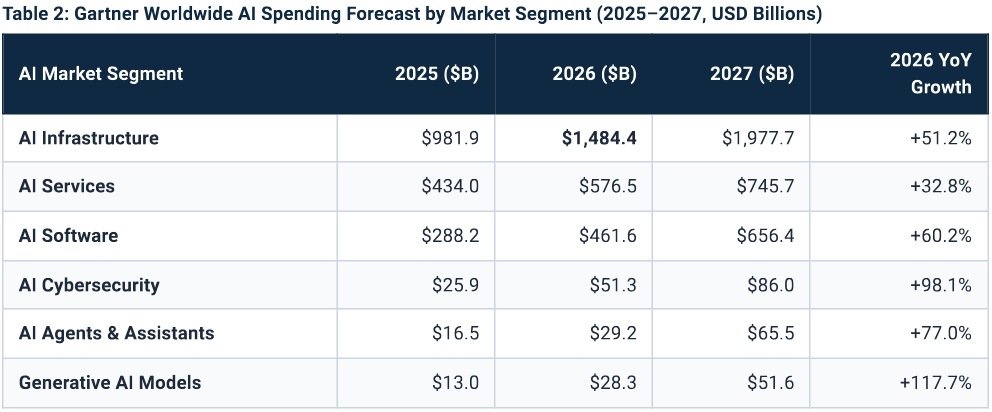
For the first three years of the generative artificial intelligence wave, the loudest headlines belonged to the models themselves—who had the highest benchmark score, the largest parameter count, or the slickest conversational interface. In 2026, the center of gravity has shifted decisively beneath the surface. According to Gartner's August 2026 forecast, worldwide spending on AI-optimized Infrastructure-as-a-Service (IaaS) is projected to jump 96.4% this year to reach $42.3 billion, on its way to $66 billion in 2027. Zooming out to the entire physical and cloud compute stack, Gartner's September 2026 market update places total global AI infrastructure spending at $1.484 trillion in 2026—more than half of the $2.67 trillion expected to be spent across all AI categories worldwide.
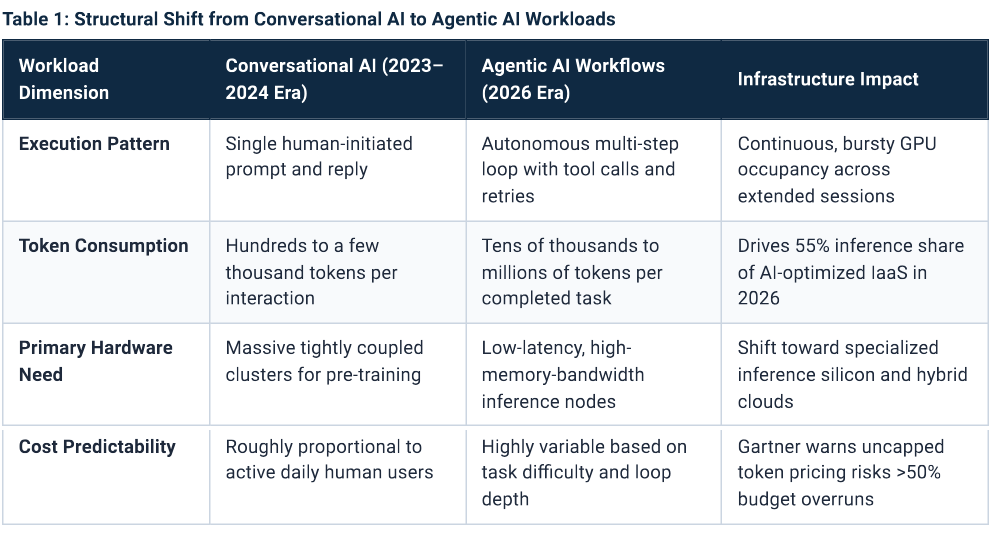
What makes this surge qualitatively different from the initial 2023–2024 training gold rush is why the hardware is being bought. The primary catalyst in 2026 is no longer just training frontier foundation models from scratch. Instead, it is agentic inference: goal-driven software agents that plan, call external tools, write and test code, query databases, and verify their own outputs across continuous multi-step loops. When an enterprise deploys an autonomous agent rather than a passive chatbot, compute demand does not scale linearly with headcount—it multiplies exponentially with every background reasoning cycle.
To understand where this historic wave of capital is landing—and whether the physical and financial foundations underneath it can hold—we have to follow the money from silicon wafers and cloud leases all the way to regional electrical substations and enterprise profit-and-loss statements.
Watch: the infrastructure boom in two clips
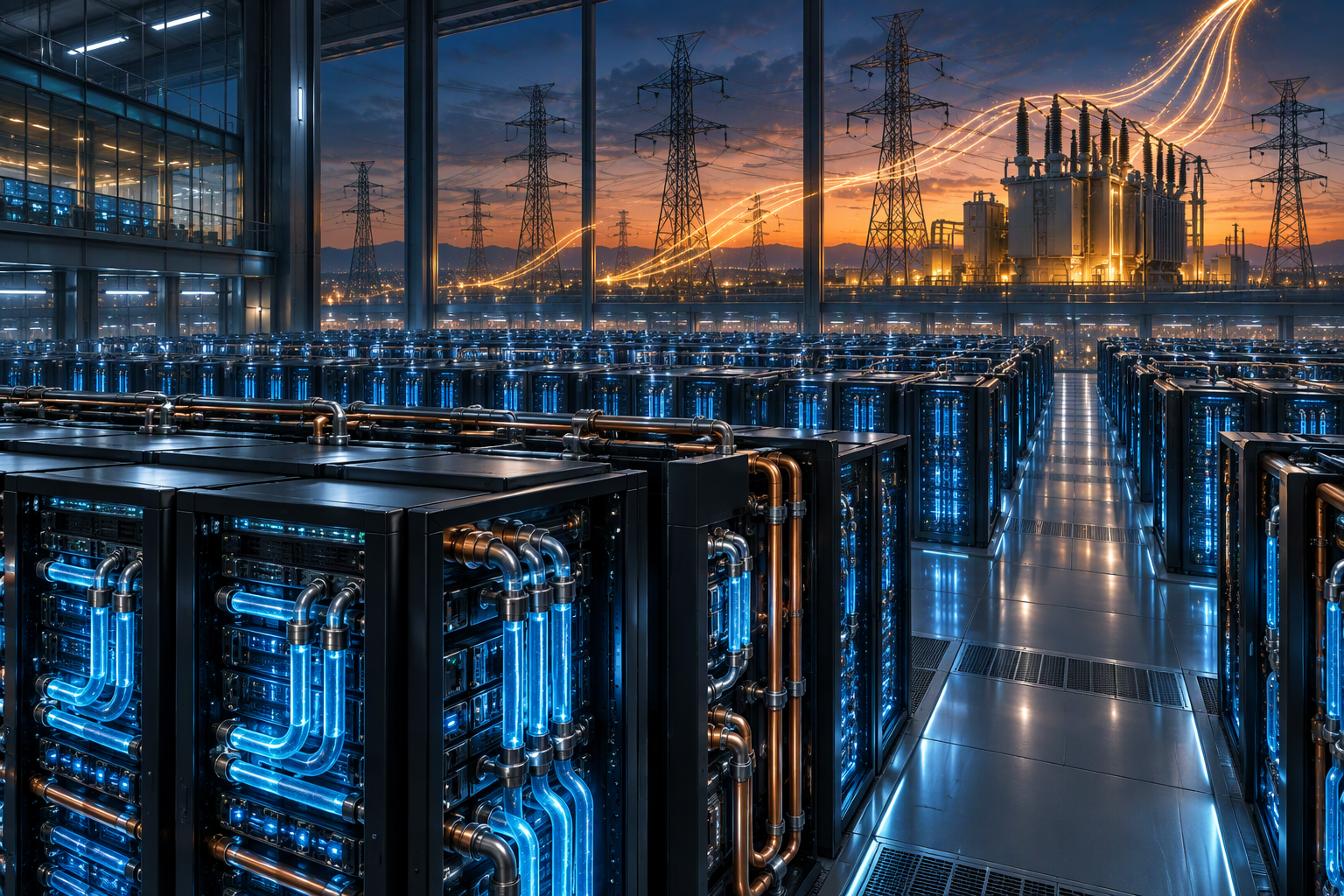
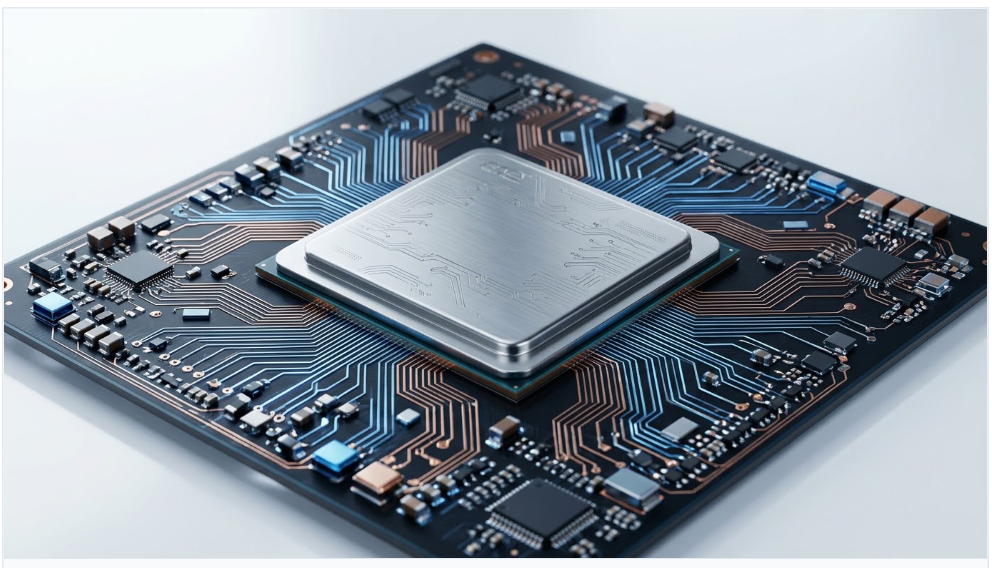
Two short motion clips produced for this article open the story visually: a high-voltage substation at dusk, the new bottleneck for AI campuses, and a liquid-cooled accelerator board with the coolant plumbing that keeps dense racks inside thermal limits.
1. From Chatbots to Autonomous Loops: Why Agents Changed the Compute Equation
The architectural shift from conversational assistants to autonomous AI agents has fundamentally altered the economics of data center utilization. A traditional chatbot interaction follows a predictable, bounded pattern: a human types a prompt, a model generates a response, and the transaction ends. An AI agent operates more like a junior employee working through a complex ticket. Given a high-level objective—such as triaging a production outage, reconciling vendor invoices, or refactoring a software repository—an agent breaks the goal into subtasks, retrieves context, executes actions, inspects errors, and iterates until a termination condition is met.
“Unlike traditional AI interactions, agentic systems perform complex multistep tasks that require substantially more tokens, creating new cost management challenges for I&O teams.” — Gartner Infrastructure & IT Operations Trend Analysis (October 2026).
This structural difference explains why inference—not training—now dictates infrastructure roadmaps. Gartner (August 2026) estimates that 55% of all AI-optimized IaaS spending in 2026 is dedicated to supporting inference workloads, a share projected to climb to 59% in 2027. While Epoch AI research shows that the per-token price for a fixed level of model intelligence has fallen dramatically—by 9× to 900× annually depending on the benchmark—cheaper unit intelligence has triggered a classic Jevons paradox. Rather than shrinking compute bills, lower per-token costs have encouraged software architects to wrap models in deeper reasoning loops, multi-agent orchestration frameworks, and continuous background monitoring.
Because enterprises rarely possess the capital or lead-time patience to build custom supercomputing clusters on-premises, they are renting capacity at breakneck speed—fueling the 96.4% surge in AI-optimized IaaS. At the same time, data sovereignty, latency, and privacy rules are pushing companies away from single-cloud reliance. Gartner (October 2026) projects that by 2029, 80% of large enterprises will run production AI workloads across at least three distinct infrastructure environments, blending hyperscale public clouds, specialized GPU “neoclouds,” on-premises hardware, and edge locations.
Video Reference (01:48–01:58): For a concrete breakdown of how per-token price drops collide with multi-step agent loops in production budgets, see KodeKloud's analysis of continuous execution loops multiplying model calls at youtube.com/watch?v=I97FwirBidA.
2. Following the $1.48 Trillion: Where the Infrastructure Money Actually Goes
When headlines cite trillion-dollar AI figures, it is easy to imagine the entire sum flowing directly into the bank accounts of a single GPU designer. In reality, the 2026 infrastructure boom is distributed across four distinct layers of capital expenditure, each governed by different supply chains and bottlenecks.
To keep the numbers clear, analysts distinguish between hardware shipments, rented cloud capacity, and full-stack procurement:
Inside a modern AI data center, every dollar of capital expenditure splits across four core engineering buckets:
Video Reference (00:15–00:22): Watch Joaquin Fagundo's executive briefing on how hyperscaler capex and power budgets are reshaping 2026 IT planning, highlighting the $730B hyperscaler breakdown across Amazon, Alphabet, Microsoft, and Meta at youtube.com/watch?v=GwoBusIudMg.
- •Full-Stack AI Infrastructure ($1.484 Trillion — Gartner, Sept 2026): encompasses enterprise and hyperscale spending across AI-optimized servers, storage, networking equipment, semiconductors, and cloud infrastructure services. Remarkably, for every $1 spent directly on generative AI models in 2026 ($28.3 billion), more than $52 is spent on the infrastructure required to run them.
- •Physical Hardware Shipments ($487B–$521B — IDC, 2026): tracks pure physical server, storage, and networking hardware sales, which grew 53% year-over-year in Q2 2026 alone ($121.4 billion in a single quarter).
- •Hyperscaler Capital Expenditure ($700B+ — IEA & Corporate Guidance, 2026): combined 2026 capital outlays from Amazon (~$200B+), Alphabet, Microsoft, and Meta exceed $700 billion, overwhelmingly directed toward data center campuses and technical infrastructure.
- •AI-Optimized IaaS ($42.3B — Gartner, Aug 2026): the fastest-growing slice (+96.4% YoY), representing rented cloud compute tailored specifically for AI training and agentic inference.
- •Accelerators and High-Bandwidth Memory (HBM): GPUs and custom ASICs still command the largest share of server bill-of-materials, but agentic inference with long context windows is heavily memory-bandwidth bound, making HBM stacks and next-generation packaging major beneficiaries—and persistent supply bottlenecks.
- •High-Speed Networking and Optical Interconnects: moving massive key-value (KV) caches and tensor states between thousands of chips requires ultra-low-latency fabrics such as InfiniBand and 800G/1.6T Ethernet. As copper wiring hits thermal and distance limits inside dense racks, capital is pouring into optical transceivers and co-packaged optics that transmit data via light with far lower resistive heat loss.
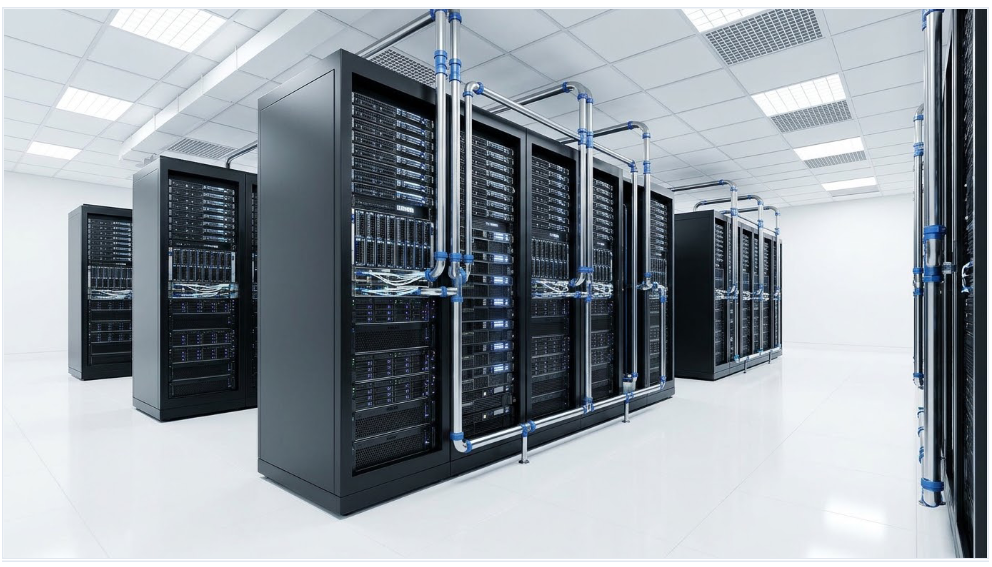
- •Thermal Management and Liquid Cooling: traditional air cooling fails once rack power densities cross 40 to 50 kilowatts, whereas next-generation AI racks routinely exceed 100 to 130 kilowatts. Billions of dollars are flowing into direct-to-chip cold plates, coolant distribution units (CDUs), rear-door heat exchangers, and closed-loop chiller plants.
- •Shell, Core, and Power Distribution Gear: data center construction benchmarks compiled by JLL and industry analysts put facility shell-and-core build costs at roughly $11.3 million per megawatt before a single server is installed. Medium-voltage transformers, switchgear, uninterruptible power supplies (UPS), and backup battery or gas generation systems have moved from background commodities to critical-path items with multi-year lead times.
3. Physical Ceilings: Power Grids, Transformers, and Water Stress
The most pressing threat to the sustainability of the AI infrastructure boom in 2026 is no longer software engineering—it is civil and electrical engineering. Capital can be allocated in a boardroom in hours, but high-voltage transmission lines, substations, and permitting approvals move on multi-year industrial timelines.
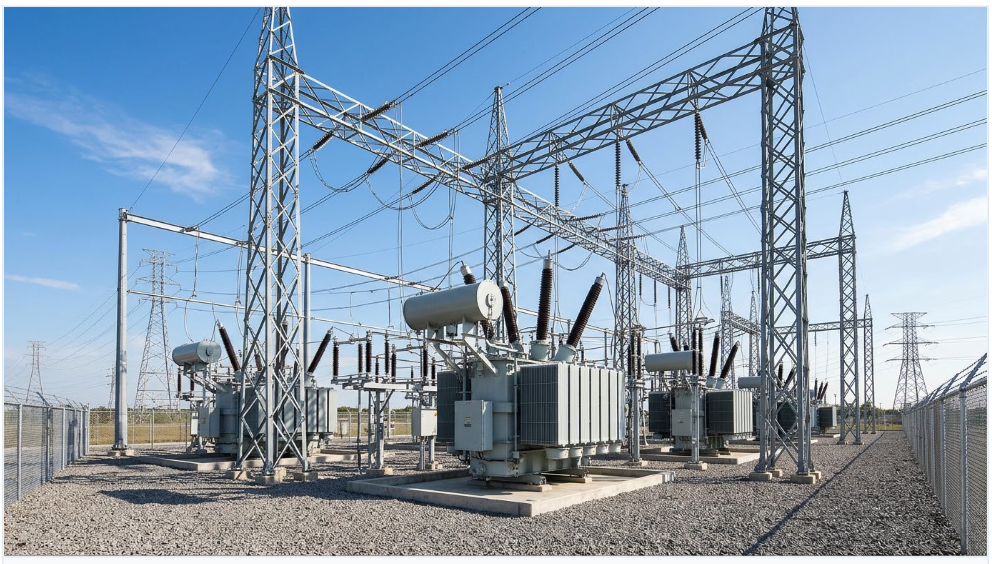
According to the International Energy Agency's (IEA) Powering Artificial Intelligence report (October 2026), global data center electricity demand is on track to nearly double from 485 terawatt-hours (TWh) in 2025 to roughly 945–950 TWh by 2030—an incremental load roughly equivalent to adding the entire annual electricity consumption of Japan to the global grid. More immediately, the IEA warns that roughly one in five planned data center projects faces grid connection delays. In major North American and European hubs—from Northern Virginia and Dublin to Amsterdam, which instituted strict moratoriums citing grid and land limits—utilities are struggling to balance hyperscale interconnection queues against residential electrification and industrial manufacturing.
These physical constraints are creating three structural pressures across global energy and water systems.
Video References (02:42–03:15 & 01:16–01:36): TED-Ed's explainer with Sajan Saini illustrates why dense GPU clusters generate extreme heat and how liquid cooling and photonics curb electricity demand (youtube.com/watch?v=z3Y-gsBKChc). For an on-the-ground look at municipal water stress in London's Docklands and how closed-loop cooling eliminates evaporative water draw, see Al Jazeera English's report (youtube.com/watch?v=DpU0qXkQrAs).
- •Grid Congestion and Cost Allocation Battles: across 34 major jurisdictions surveyed by the IEA (October 2026), covering 90% of global data center capacity, regulators introduced or updated 134 data center policies—nearly 40% of them within the past 12 months alone. A central regulatory battleground in 2026, including FERC proceedings in the United States, is tariff design: ensuring that multi-billion-dollar transmission upgrades built for 100-megawatt AI campuses are paid for by tech tenants rather than passed onto local households through higher utility bills.
- •Water Scarcity and Cooling Trade-Offs: legacy evaporative cooling towers dissipate heat cheaply by evaporating millions of liters of potable water—a model facing fierce community pushback in drought-prone regions from the American Southwest to parts of Europe and Latin America. While modern facilities are transitioning to closed-loop liquid cooling and waterless dry coolers, eliminating water consumption typically increases parasitic electrical load, forcing operators into a delicate energy-versus-water trade-off.
- •Geographic Redistribution of Compute: because traditional hubs are power-constrained, infrastructure capital is migrating toward regions with stranded energy or faster permitting. PwC's Global Data Centre Outlook 2026–50 highlights rapid compound growth in the Middle East—where sovereign capital, energy, and land are coordinated under unified approvals—as well as renewable-rich markets like Kenya (roughly 95% renewable grid) and Nordic hydro-powered corridors. Meanwhile, hyperscalers are signing long-term power purchase agreements (PPAs)—45 TWh contracted in the first half of 2026 alone—and co-locating campuses alongside nuclear, geothermal, and behind-the-meter natural gas generation.
4. Financial Sustainability: The $1.48 Trillion ROI Question and the Bubble Debate
Even if utilities solve every transformer shortage and water bottleneck, a harder financial question hangs over Wall Street and enterprise CIOs: Does the revenue generated by AI software and agents justify $1.48 trillion in annual infrastructure spending?
The current market exhibits a striking macro-level asymmetry. On the supply side, hyperscalers, sovereign funds, and neocloud operators are investing at an unprecedented pace—PwC's central scenario models $31.6 trillion in cumulative global data center capex between 2026 and 2050, rising toward $50 trillion under accelerated adoption. On the demand side, end-user software and model revenues remain an order of magnitude smaller than the hardware supporting them. Gartner's September 2026 figures show $29.2 billion in direct spending on AI agents and assistants and $28.3 billion on generative AI models, alongside $461.6 billion in broader AI-embedded software.
Three financial vulnerabilities make 2026 a decisive proving ground for sustainability.
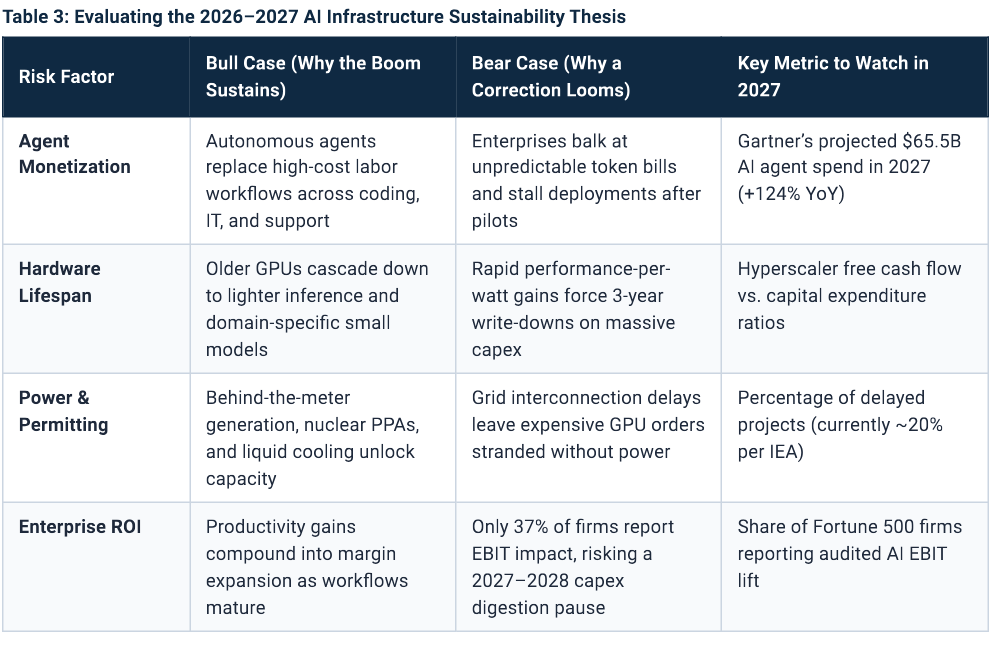
- •The Enterprise Earnings Gap: while McKinsey's 2026 research shows that 89% of organizations use AI in at least one function and 44% have scaled deployments enterprise-wide, only 37% report a measurable positive impact on earnings before interest and taxes (EBIT)—a figure that has remained stubbornly flat. Individual employee productivity gains have yet to translate cleanly into bottom-line corporate profit expansion.
- •Accelerated Hardware Depreciation: unlike fiber-optic cables laid during the late-1990s telecom boom—which remained usable for decades after overbuilding—AI accelerators face rapid architectural obsolescence. As chipmakers release major architectural leaps every 12 to 18 months with dramatically better performance-per-watt, a data center packed with older-generation GPUs can become economically uncompetitive for frontier inference long before its 5- or 6-year accounting depreciation schedule expires. If hyperscalers must replace silicon every three years to stay competitive, true free-cash-flow margins are far tighter than GAAP earnings suggest.
- •Runaway Agentic Unit Economics: inside enterprise IT departments, shifting from fixed-seat SaaS licenses to usage-based agentic workflows introduces severe budget volatility. Gartner (October 2026) warns that through 2027, organizations deploying IT operations agents under uncapped variable token pricing risk exceeding initial budget projections by more than 50%, prompting Gartner to advocate a strict “no telemetry, no deployment” governance rule. Furthermore, Flexera estimates that roughly 29% of cloud spend goes wasted—with idle or over-provisioned GPU instances representing the fastest-growing source of cloud waste.
5. How Enterprises and Builders Can Navigate the Infrastructure Squeeze
Whether the current cycle matures into a durable utility-scale expansion or hits a temporary “capex digestion” pause in 2027–2028, the winners will be organizations that treat compute and power as disciplined engineering constraints rather than blank checks.
For enterprise technology leaders, four practical disciplines separate sustainable AI scaling from runaway burn:
The 96% surge in AI-optimized infrastructure spending marks the moment artificial intelligence stopped being purely a software story and became heavy industry. Autonomous agents have given enterprises a compelling reason to consume unprecedented volumes of inference compute, yet physics and accounting remain undefeated. Over the next 24 months, the durability of this boom will depend less on how fast chipmakers can print transistors—and far more on how efficiently utilities can deliver megawatts and how rigorously businesses turn token loops into real economic profit.
- •Right-Size Models to the Task: not every step in an agentic workflow requires a massive frontier reasoning model. Routing routine classification, extraction, and formatting steps to Domain-Specific Language Models (DSLMs) or compact open-weight models—while reserving frontier models strictly for complex planning and synthesis—can cut inference compute costs by 70% to 90% without degrading end-to-end task accuracy.
- •Enforce FinOps Telemetry and Loop Guardrails: before promoting any autonomous agent to production, engineering teams should enforce hard token budgets, step-count caps, and semantic caching. Without loop termination guardrails, a single misconfigured coding or research agent stuck in a retry cycle can burn thousands of dollars in inference credits overnight.
- •Adopt Hybrid and Sovereign Workload Placement: relying exclusively on premium on-demand hyperscale GPU instances erodes margins. Blending reserved inference capacity for steady baseline traffic, specialized neoclouds for burst training or batch evaluation, and on-premises or regional sovereign nodes for sensitive regulated data optimizes both unit cost and latency.
- •Underwrite Power Before Silicon: for infrastructure developers and colocation buyers, megawatts—not square footage—are now the primary unit of planning. Securing binding utility interconnection milestones, closed-loop thermal designs, and phased energization schedules before committing capital to short-lived accelerators prevents stranded balance-sheet exposure.