
1. The Great Asymmetry: Billions Flowing Toward a Skeptical Audience
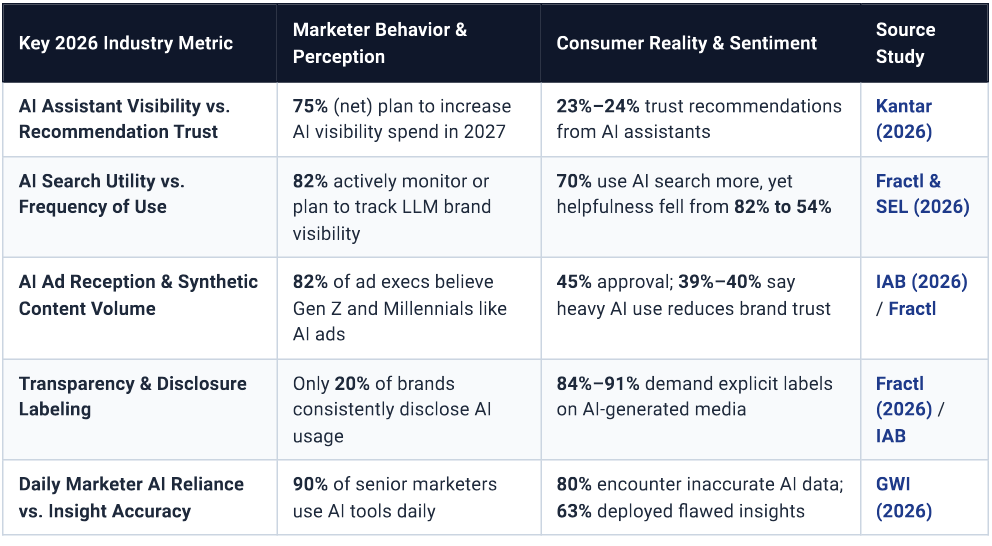
The defining tension of modern digital marketing is no longer whether artificial intelligence will reshape customer discovery—it is the widening chasm between corporate capital allocation and human belief. According to Kantar's Media Reactions 2026 study, which surveyed 23,000 consumers and 800 senior marketers across 33 global markets, a net 75% of marketers plan to increase their investment in AI assistant visibility, including paid placements and Generative Engine Optimization (GEO), for 2027. Yet within that exact same dataset, only 23% to 24% of consumers say they trust the recommendations generated by AI assistants.
This capital surge is driven by an understandable fear of invisibility. Kantar's data reveals that 73% of global consumers now interact with AI assistants, and 33% actively use them to research brands and products. Traditional search engine referral traffic is contracting simultaneously: a Q2 2026 study by Fractl and Search Engine Land (2026) found that 50% of marketers have experienced declining organic search traffic since the widespread rollout of AI Overviews, with 61% attributing those losses directly to AI discovery interfaces. Faced with disappearing blue links, Chief Marketing Officers are racing to ensure their brands are indexed, cited, and surfaced inside conversational engines like ChatGPT, Gemini, and Perplexity.
However, behavioral adoption is masking a sharp deterioration in consumer sentiment. The Fractl and Search Engine Land research demonstrates that while 70% of consumers use AI tools for search more frequently than they did a year prior, the percentage of people who actually find AI search more helpful than traditional search plunged by 28 percentage points in twelve months—falling from 82% in 2025 to 54% in 2026. Meanwhile, the camp of active skeptics—consumers who rate AI search as strictly less helpful than conventional web search—nearly sextupled from 3% to 17%.
2. Anatomy of Consumer Distrust: Synthetic Slop, Opacity, and Gen Z Pushback
To understand why consumer confidence is eroding even as usage climbs, marketers must separate functional convenience from relational trust. Consumers use AI assistants because summarizing ten product reviews takes three seconds instead of twenty minutes. Convenience, however, is not credibility. When people suspect a brand is using automation to cut corners, manipulate search outputs, or replace genuine human craftsmanship, trust evaporates.
Empirical research from 2026 points to three primary drivers behind this widening trust deficit:
1. The "AI Slop" Brand Penalty: In 2025, only 20% of consumers reported that heavy reliance on generative AI would diminish their trust in a favorite brand. By mid-2026, that figure nearly doubled to 39%–40%, with 14% stating their trust would drop significantly (Fractl & Search Engine Land, 2026). Furthermore, controlled experiments examining consumer reception demonstrate that when audiences are shown identical advertisements and informed that one was AI-generated, they rate the AI version as substantially less credible, less emotionally engaging, and less worthy of a click—especially in tactile, high-trust categories like food, apparel, and home goods (Marketing Management Journal, 2026).
2. The Disclosure Deficit: Consumers overwhelmingly want to know when they are interacting with synthetic media. Across formats, 91% demand labels on AI-generated video, 90% on images, 87% on audio, and 84% on written copy. Yet industry compliance remains abysmal: only 20% of organizations consistently disclose AI involvement, while 33% never disclose it at all. Despite the Interactive Advertising Bureau (IAB, 2026) releasing its inaugural AI disclosure framework in January 2026, most brands operate in a gray zone that audiences interpret as deceptive. When 63% of shoppers say their trust drops immediately if a brand's AI use feels misleading, silence becomes a severe reputational liability.
3. Generational Disillusionment: A pervasive myth in boardrooms is that digital-native consumers automatically embrace synthetic marketing. IAB data uncovered a 37-point perception gap: while 82% of advertising executives assume Gen Z and Millennial consumers view AI-generated ads favorably, only 45% actually do. Even more striking, Fractl's 2026 findings show that Baby Boomers now find AI search more helpful than Gen Z (63% versus 47%), and 54% of Gen Z consumers say heavy brand AI use reduces their trust. The generation with the highest exposure to algorithmic feeds is also the fastest to spot—and penalize—homogenized, machine-spun brand messaging.
"Consumers expect AI search to win, even when they don't fully trust it. Sixty-four percent agree AI will replace traditional search engines within five years—essentially unchanged from 2025. They expect the future; they just aren't enjoying what it currently delivers." — Fractl & Search Engine Land 2026 AI Search Study
3. Inside the Marketing Machine: Quality Erosion and Hallucinated Strategy
The trust gap is not merely an external public relations issue; it is also an internal operational crisis. Marketing teams are deploying generative tools far faster than they are building governance, quality assurance, or measurement frameworks around them.
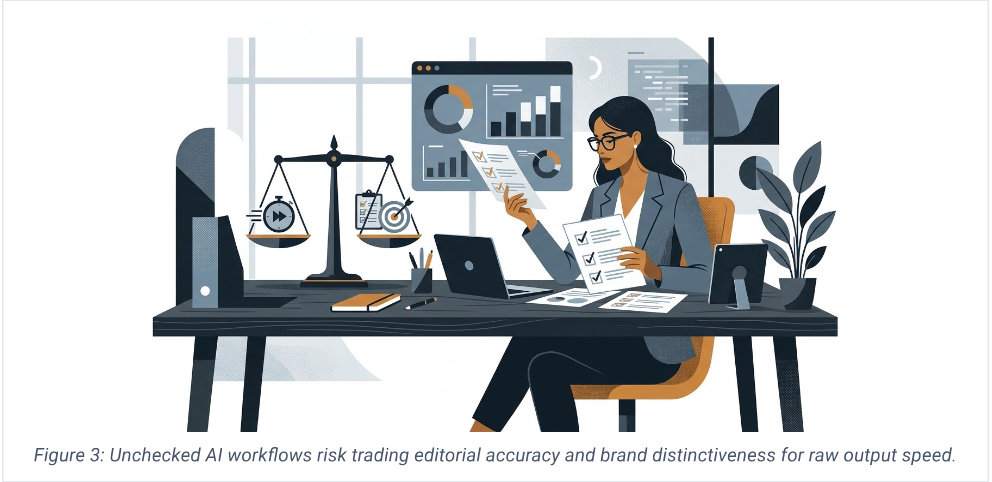
By mid-2026, artificial intelligence touched 53% of all marketing workflows, up from 38% a year earlier—effectively shifting the equivalent of one full workday per week into AI-assisted production. Yet speed has come at the expense of differentiation. Only 26% of marketers report that AI made their output both faster and better, whereas nearly half (47%) admit their work became faster but noticeably more generic, and 7% report an outright decline in quality (Fractl & Search Engine Land, 2026).
This flattening of brand voice is compounded by widespread lapses in editorial oversight across corporate marketing departments:
- •46% of marketing teams skip human fact-checking on AI-assisted content prior to publication.
- •58% omit legal, compliance, or plagiarism reviews on machine-generated copy and creative assets.
- •73% fail to conduct bias evaluations, leaving automated outputs vulnerable to subtle exclusions or tone-deaf framing.
Hallucinated strategy: marketers are falling for their own blind spots
Worse still, marketers are increasingly falling victim to their own synthetic blind spots when planning strategy. A November 2026 study by audience research firm GWI and Marketing Dive (2026) revealed that while nearly 90% of senior marketing professionals use AI daily, 80% frequently encounter inaccurate or misleading AI findings. Because 81% feel overly confident using AI to generate audience profiles and segmentation, 63% admitted to accidentally deploying outdated or hallucinated insights in live campaigns—and 27% reported direct financial losses stemming from flawed AI outputs. Meanwhile, Kantar notes that four in ten marketers now doubt they are getting the fundamentals of their media mix right, with overall confidence in media selection falling from 64% in 2025 to 57% in 2026.
4. Closing the Gap: How Brands Win Both Algorithms and Human Trust
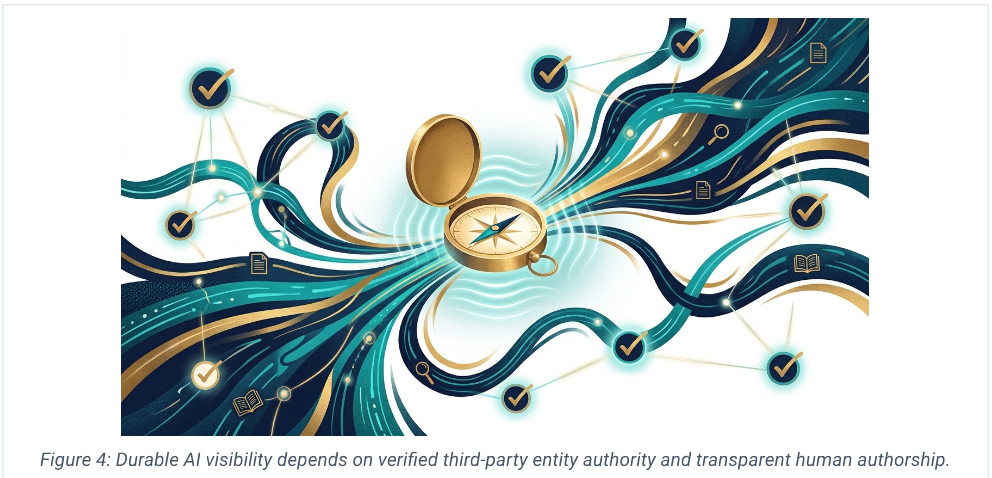
If three-quarters of brands are pouring money into AI visibility while consumers actively distrust AI recommendations, pouring more budget into automated content farms will only accelerate diminishing returns. Closing the AI trust gap requires a dual-track strategy: engineering structured, verifiable entity authority so Large Language Models (LLMs) cite your brand accurately, while doubling down on unmistakable human proof for the consumer on the other side of the screen.
Shift from Keyword Volume to Off-Site Entity Authority
Large Language Models do not rank web pages the way legacy search engines did; they synthesize consensus across trusted third-party sources. Industry correlation studies across tens of thousands of domains demonstrate that branded web mentions correlate with AI assistant visibility at 0.664 to 0.709, outperforming traditional backlinks (which sit below 0.30) by nearly three to one. Instead of publishing hundreds of unverified AI blog posts, marketing budgets should prioritize original proprietary research, digital public relations, verified customer reviews, and expert commentary in respected industry publications that LLMs rely on as grounding data.
Treat AI Transparency as a Competitive Moat
When 84% to 91% of consumers demand disclosure and only 20% of brands provide it, radical honesty becomes an immediate differentiator. Adopting clear labeling standards—such as the IAB (2026) disclosure guidelines—signals respect for the audience's intelligence. Brands should explicitly demarcate where AI assists (such as data aggregation, translation, or dynamic sizing) versus where human experts, artisans, and creators remain firmly in control.
Empower Creators Instead of Scripting Them
Kantar (2026) highlights that as synthetic content floods feeds, human creators are surging in strategic value—not merely for reach, but for relational credibility. Sixty-two percent of marketers now recognize that brands must guide rather than micromanage creators, with nearly half treating them as genuine storytelling partners. Twenty percent of consumers report that independent creators are their primary source for discovering new products, providing the human verification layer that AI assistants lack.
Close the Attribution and Governance Loop
Currently, 76% of marketers execute Generative Engine Optimization without proven attribution, and only 12% report high confidence in measurable GEO results. Before scaling spend in 2027, marketing leaders must institute mandatory human-in-the-loop verification gates—requiring factual, legal, and brand-voice sign-off on all AI-assisted assets—while regularly auditing how major LLMs describe their brand to catch hallucinations before customers encounter them.
Watch: the trust gap in two clips
Two short motion clips accompany this analysis: a brass trust compass linking an audience to an algorithmic interface, and a close inspection of the neural network behind synthetic brand content.
5. Featured Video Briefings: Industry Perspectives
For deeper context on how search specialists, brand strategists, and trust platforms are navigating the visibility-versus-credibility divide, consult the following industry briefings:
- •Trustpilot — How the Trust Maturity Index Reveals Your AI Search Gaps (0:54): Examines how verified customer review ecosystems and third-party trust signals directly influence whether AI search models recommend a brand.
- •Digital Domination Marketing — Google Just Revealed What Its AI Actually Trusts About Your Business (0:36): A concise breakdown of the entity validation and off-site credibility signals Google's AI systems prioritize when generating brand summaries.
- •SCION SOCIAL — Can AI Build Trust? Why Human Connection Still Wins in Marketing (3:00): Explores why automated efficiency cannot substitute for authentic human storytelling and relational brand equity.
- •Measure Marketing Results Inc. — The AI Search Optimization Framework (1:39): Outlines practical steps for structuring brand data so conversational assistants accurately surface and cite your offerings.
- •The Millennium Alliance — The Visibility Gap: How Consumers Search in the Age of AI (32:08): An executive panel discussion analyzing shifting consumer discovery habits and how CMOs are recalibrating media mixes for 2027.
6. Primary Research & Data Sources
The five primary studies behind the figures above, as listed in the report:
- •Kantar (October 2026). Media Reactions 2026: From More Signals to Clearer Media Decisions. Global survey of 23,000 consumers and 800 senior marketers across 33 markets analyzing AI assistant adoption (73%), brand research usage (33%), net marketer investment intent (75%), and consumer trust in AI recommendations (23%–24%).
- •Fractl & Search Engine Land (June 2026). 2026 AI Search Consumer Trust & Brand Visibility Study. Survey of 1,008 U.S. consumers and marketing practitioners tracking year-over-year drops in AI search helpfulness (82% to 54%), rising brand distrust from heavy AI usage (20% to 39%–40%), format-specific labeling demands (84%–91%), and internal editorial QA gaps.
- •GWI & Marketing Dive (November 2026). AI-Derived Audience Insights Research. Survey of senior marketing professionals detailing daily AI adoption (nearly 90%), exposure to inaccurate or misleading AI insights (80%), accidental campaign deployment of flawed data (63%), and resulting financial losses (27%).
- •Interactive Advertising Bureau (IAB) (January 2026). AI Content Disclosure Framework & Consumer Perception Gap Report. Industry benchmark highlighting the 37-point perception gap between ad executives (82%) and Gen Z/Millennial consumers (45%) regarding AI-generated advertising.
- •Marketing Management Journal (October 2026). The AI Trust Gap: Consumer Perceptions of AI-Powered Digital Marketing. Vol. 36, Issue 1, pp. 1–22. Peer-reviewed analysis examining Commitment-Trust Theory and automation transparency in algorithmic brand recommendations.