Where the deal stands
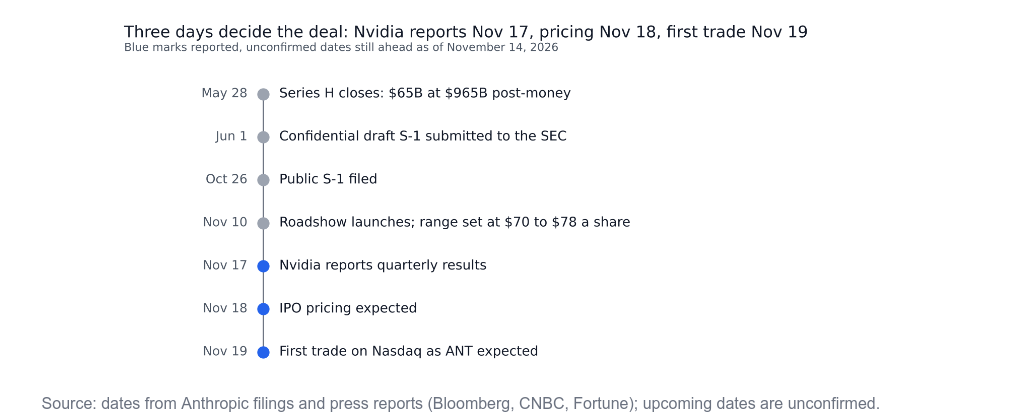
For most of the generative-AI boom, the economics of the companies building frontier models were something outsiders could only guess at. Private funding rounds leaked valuations, leaked slide decks hinted at revenue, and the true cost of training and serving models stayed behind closed doors. That is about to change. Anthropic, the maker of Claude, has made its registration statement public, set a price range, and, according to reports from Bloomberg, CNBC and others, is lined up to price its shares on Wednesday, November 18 and start trading on Nasdaq the following day under the ticker ANT. That puts the debut inside the week of November 16, as earlier reporting suggested.
The sequence, as reported, is straightforward. Anthropic submitted a confidential draft to the SEC at the start of June, made its S-1 public on October 26, and, once the mandatory 15-day waiting period had passed, launched its roadshow on November 10. The marketed terms are 825 million Class A shares at $70 to $78 each, which would raise roughly $64.4 billion before costs at the top of the range. Alongside the public offering sits a $26 billion private placement, reported to include Google, Nvidia, AMD, Broadcom, Micron, Microsoft and TSMC, all of which already do business with the company. Counting that placement and shares sold by the co-founders, Bloomberg reported that as much as $90.4 billion could change hands, which would exceed SpaceX's record-setting June listing. Goldman Sachs and Morgan Stanley are leading, with twenty other banks in the syndicate.
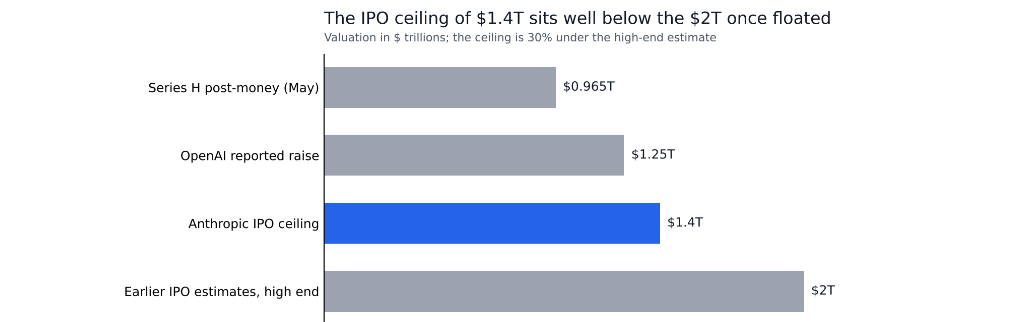
The implied valuation is up to about $1.4 trillion on a fully diluted basis. That is a notable step down from where the company once aimed. Earlier in the year, estimates ran as high as $2 trillion, and a private round in May had valued Anthropic at $965 billion after the money went in. The retreat tracks a rough patch for AI shares. One market report put the Nasdaq's one-week loss during the recent selloff at roughly $2.5 trillion, a figure worth treating as indicative rather than precise.
Demand, so far, has not wavered. Bloomberg reported that the order book was about six times the number of shares on offer after only a few days, driven by large anchor-style orders, and that banks told some prospective buyers that existing shareholders would be prioritized, so newcomers might receive less than they asked for. Underwriters were reportedly weighing a price above the stated range, and the Financial Times reported that bankers were preparing for a valuation nearer $1.5 trillion.
A caution is in order. Anthropic has not announced a final price or trading date. The registration statement still has to be declared effective, and ranges, sizes and timing can all move until the shares are actually priced. If the plan holds, Anthropic would become the first major AI lab to reach public markets, ahead of OpenAI, and, per CNBC, only the third company to list at a valuation above $1 trillion, after Saudi Aramco and SpaceX.
A first look at the finances
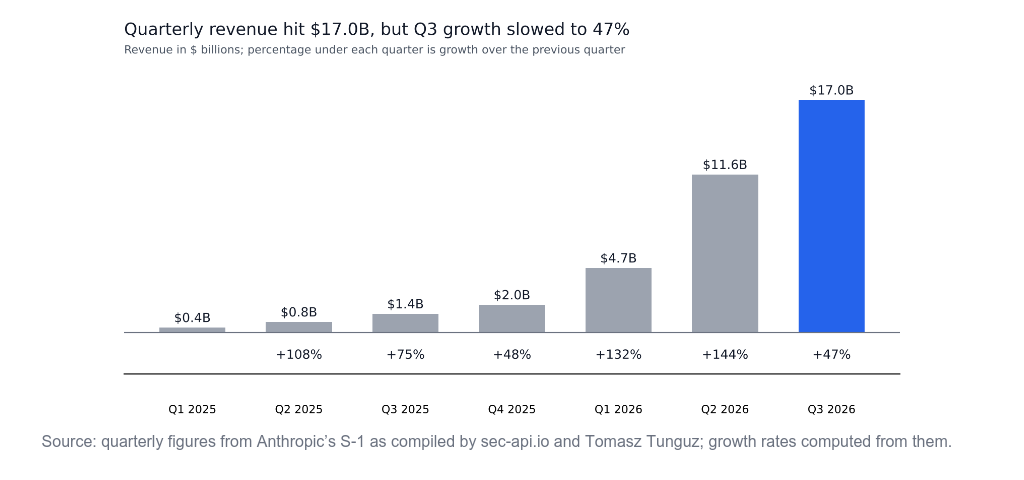
Growth that is hard to compare with anything else. The S-1 shows revenue of about $4.6 billion in 2025, an eleven-fold jump on the year before. The first half of 2026 brought in $16.3 billion, against $1.2 billion in the same period of 2025. Quarterly revenue reached $11.6 billion in the second quarter, up from $4.7 billion in the first, and about $17.0 billion in the third, which brings nine-month revenue to roughly $33.2 billion. By my own arithmetic, the third quarter was about 47 percent above the second, a very fast pace by almost any standard but a visible slowdown from the 144 percent sequential jump the quarter before. Several analysts have flagged that deceleration, because it matters for how the valuation is judged. Annualizing the third quarter gives a run rate near $68 billion, so a $1.4 trillion valuation equals roughly twenty times that figure.
A customer base that looks less fragile than critics assumed. About 80 percent of revenue is usage-based and about 20 percent comes from subscriptions. The company reports more than 11,900 customers spending over $100,000 a year, and no single customer accounted for more than 10 percent of revenue over the first nine months, with the top five near a quarter. It also cites net revenue retention of roughly 900 percent, a figure defined by the company and therefore worth reading with care. Nearly half of revenue now flows through cloud marketplaces. Usage-based revenue is a double-edged feature: it expands fast when customers find new uses, but it carries no lock-in, and customers can scale back as easily as they scaled up.
Margins that improved dramatically, with an asterisk. Anthropic does not present gross margin on its income statement, having switched to reporting expenses by nature rather than function. A footnote still discloses cost of revenue, though, and analysts working from it estimate a gross margin near 85 percent in the first half of 2026, up from roughly 40 percent in 2025 and deeply negative in 2024. Those are third-party calculations, not company-reported figures. They also reflect the cost of serving customers; the cost of training models sits in research and development. Count all compute and infrastructure, and the picture is thinner: about $8.9 billion in the first half, around 55 percent of revenue, according to one breakdown. The filing also describes efficiency gains passed to customers, including price cuts of about 25 percent on typical workloads with one recent model release and about 40 percent per task with another.
Losses that look scarier than they are, and operating results that are close to breakeven. The headline numbers are enormous: a net loss of $80.7 billion in the first half and about $104 billion across nine months. But the bulk is non-cash. Roughly $72 billion of the first-half loss, and about $94 billion of the nine-month figure, came from changes in the fair value of convertible notes and related instruments, an accounting charge that grows as the company's own valuation rises. Operating results tell a more useful story. Anthropic reported a GAAP operating profit of about $974 million in the second quarter and an operating loss of about $567 million in the third, after an operating loss of roughly $8.1 billion in 2025 that included a $1.5 billion copyright settlement. Adjusted figures, which strip out stock-based compensation and some other items, look better still. The S-1 is also blunt in its risk factors: it says the company has a history of net losses, that growth may slow, and that costs are expected to rise.
The infrastructure bill
If the revenue line explains the enthusiasm, the commitments line explains the anxiety. Coverage of the amended filing puts Anthropic's aggregate commitments to compute and infrastructure at about $900 billion, with roughly $70.7 billion falling due within twelve months, about $451.6 billion before 2031, and almost all the remainder by 2045.
Totals differ across sources, and the reason is instructive. An analysis published after the original S-1 summed seven named agreements to $637 billion: Broadcom at about $161 billion, SpaceXAI at up to about $120 billion, Google at least $114 billion, Amazon at least $110 billion, Microsoft at least $45 billion, Nscale up to about $45 billion and Lambda around $41 billion. The author noted that the filing itself did not state an aggregate and that the figure was his own sum. Later filings added more commitments, and the amended document is the source of the larger number. The sensible reading is that the bill is somewhere between several hundred billion and nearly a trillion dollars, depending on version and counting method, and that it has been growing.
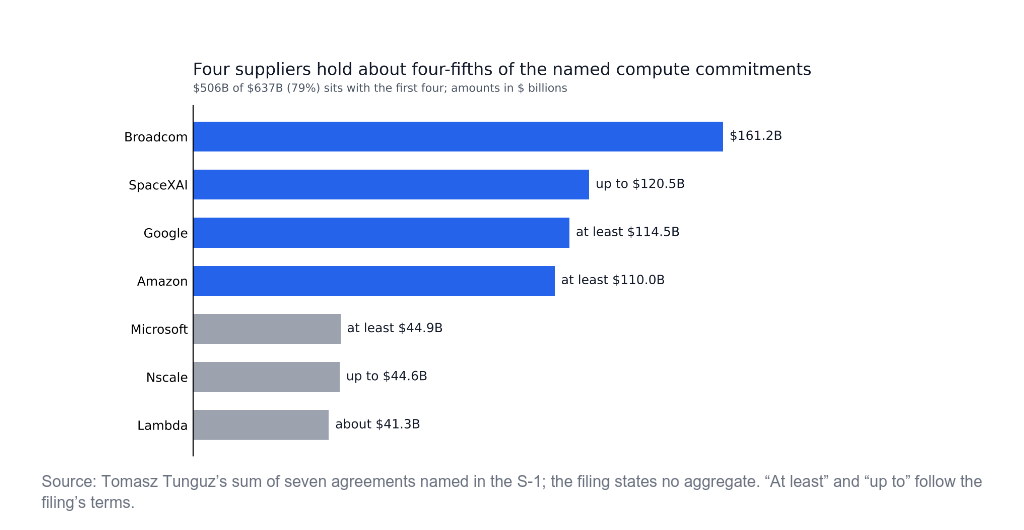
The terms matter as much as the totals. About two-thirds of the named commitments are described as non-cancelable, with true-up clauses. The SpaceXAI arrangement can be ended by either side on 90 days' notice after initial periods expire in early 2027, and Nscale and Lambda accrue fees only as capacity is actually delivered. Anthropic carries almost no drawn debt: its $15 billion revolving credit line is undrawn and the only notes outstanding are about $6.2 billion of non-interest-bearing Amazon convertibles. The leverage lives in the contracts instead of on the balance sheet. A back-of-envelope comparison puts the roughly $900 billion at about thirteen times the annualized third-quarter revenue, but since the obligations stretch over two decades, that ratio is a rough gauge of scale, not a measure of solvency.
There is also a web of entanglement. Amazon, Google, Microsoft and Nvidia are simultaneously suppliers, investors and in some cases customers or distribution channels. CNBC reported that up to $77 billion in notes could be issued to Amazon, Broadcom and Google in connection with the offering, while Microsoft and Nvidia agreed to invest $15 billion. One analyst called the arrangement a keiretsu, in which each partner is tangled in the others' equity, debt and sales. The structure can be a strength, because suppliers have every reason to keep the customer thriving, and a weakness, because stress at one node travels quickly.
What it could mean for the AI industry
A public price for a frontier lab. Until now, the value of leading AI labs was set in private rounds negotiated among a small circle of investors and strategic partners. A listed Anthropic produces a continuous, observable price. Every earnings report, model launch and price cut will be translated into a share-price move that rivals, customers and investors can see. That matters most for OpenAI, which is reportedly raising $15 billion at a $1.25 trillion valuation after hoping for $1.5 trillion, and which is expected to consider an IPO as early as next year. A strong Anthropic debut would make that path easier. A weak one could push OpenAI's timeline out and force a rethink of private valuations across the sector. As one growth-equity investor told CNBC, a poor showing would turn Anthropic into the bellwether, with the effect trickling down to the excess capital pouring into venture-backed AI.
A new center of gravity for the AI trade. For the past three years, Nvidia has been the cleanest public stock for betting on AI. Anthropic offers a more direct claim on the product side: the models, the enterprise contracts, the coding tools. Nvidia reports earnings on November 17, the day before Anthropic is due to price, and some commentators have framed the week as a test of whether investors will keep paying for infrastructure on faith or want proof of end-demand. Anthropic's numbers, with usage growing fast and serving margins healthy, supply a piece of that proof, while its commitments show how much infrastructure suppliers are counting on it to keep growing.
A disclosure standard for everyone else. Once a leading lab reports gross margin footnotes, retention, customer concentration and multi-year purchase commitments, rivals and their investors will be measured against the same yardsticks. OpenAI's reported quarterly revenue of more than $10 billion with an operating loss of about $10.9 billion, for instance, now invites a direct comparison with Anthropic's near-breakeven operating results, though OpenAI's figures are press-reported and unaudited by outsiders. Public status also brings quarterly scrutiny of safety claims, legal exposure and governance. The S-1 devotes considerable space to risks, including a warning that advanced AI could pose catastrophic or even existential risks if not developed responsibly. Anthropic, a public benefit corporation, will have to balance that mission language against the short-term pressures every listed company faces.
Pressure on pricing and on startups. The filing suggests Anthropic has been cutting the cost of tasks for customers even as demand climbs, a pattern analysts compare to the Jevons paradox, where cheaper units drive more total consumption. As a public company it will be expected to show that this can continue without eroding margins. Startups are described as a significant share of buyers, which means changes in pricing, rate limits or model deprecation schedules matter well beyond the company's own results. If the IPO works, it may also loosen capital for the wider AI ecosystem; if it does not, venture investors are already advising founders to raise while they can and hold cash.
Competition for the same pool of capital. SpaceX's June listing, Anthropic's November offering and a possible OpenAI deal next year are drawing on the same crossover funds and institutions. A very large raise in a choppy market tests how much capital is available for mega-listings, and a smooth execution would encourage other late-stage AI and infrastructure companies to follow.
Risks, and what to watch
The bull case is simple: extraordinary growth, improving unit economics, a diversified customer base and an operating profit just within reach. The bear case is just as clear. A valuation near twenty times run-rate revenue is being applied to a business whose sequential growth is slowing, whose revenue is consumption-based, and whose largest obligations are fixed and long-dated. The S-1 itself cautions that the margin gains may not last, and that rising compute purchases could raise operating expenses and cash needs substantially.
Several concrete signposts will show how the market is weighing those arguments.
- •Where the deal prices relative to the $70 to $78 range. Pricing above it would signal conviction; pricing inside it, or a resized deal, would suggest the order book was less firm than headlines implied.
- •The first-day and first-month trading pattern. A large pop can reflect scarcity as much as value, since allocations are tight, while a break below the issue price would be a stark signal for the sector.
- •Nvidia's results on November 17. They will set the tone for AI stocks just before Anthropic prices.
- •The first public quarterly report. Whether growth re-accelerates, how gross margin is presented, and any update on commitments will carry more weight than the debut itself.
- •Changes in compute contracts. Any renegotiation of the cancelable arrangements, or new multi-year deals, would reveal how management balances capacity against demand.
Bottom line
The most important thing about Anthropic's listing may not be the price at which it opens. It is that a frontier AI lab will now have to show its work every quarter, in public, with legal liability attached. The early evidence is mixed in an interesting way: revenue is rising at a pace with few precedents, operating results are near breakeven, and serving margins look strong, yet the company has promised hundreds of billions of dollars to suppliers for capacity that has to be filled for years. Whether that adds up to a durable business or a very expensive bet will be argued over, in real time, by the market.
For the industry, the implications run in two directions. A successful debut would validate the model of raising enormous sums to buy compute ahead of demand, ease the way for OpenAI and others, and reward the suppliers entangled in the deal. A stumble would not end the AI buildout, but it would raise the cost of capital for everyone who relies on it. Either way, the era in which the economics of the leading labs could be inferred only from leaks is ending, and that alone changes how the whole sector will be valued, funded and held accountable.