The 25-year bargain starts to crack
For a quarter of a century, the architecture of the open internet rested on an unwritten, remarkably durable social contract. Search engines crawled the web for free, indexed the world's journalism, research, tutorials, and product reviews, and in exchange, delivered a steady river of referral clicks back to the publishers who created that work. Publishers monetized those visits through display advertising and subscriptions; search engines monetized user intent through sponsored links alongside the results. Nobody drafted a formal treaty to govern this arrangement, because the mutual economic incentives kept both sides invested in the same ecosystem.
In late 2026, that 25-year bargain is visibly fracturing. At a press event in New York on November 2, 2026, OpenAI consumer product lead Adam Fry dropped a headline-grabbing metric: ChatGPT's volume of search-like queries has grown to roughly one-fifth, or 20%, of Google's search volume. Within hours, the figure rippled across technology newsrooms, boardrooms, and marketing agencies as proof that conversational artificial intelligence is no longer a novelty sidecar to traditional search, but a direct, scaled challenger to Google's core business.
Yet behind that triumphant 20% benchmark lies a far more complicated and deeply contentious reality. While AI platforms are absorbing an unprecedented share of human curiosity, independent analytics firms, academic field experiments, and federal court dockets tell a sobering story about what happens after a user hits enter. Unlike traditional search engines that act as signposts pointing readers toward original reporting, generative answer engines synthesize information directly inside the chat window. For publishers, media executives, and independent creators, the central question of 2026 is no longer merely whether AI search is replacing Google, but whether the rise of zero-click AI answers is starving the very journalism and expertise those models depend on to stay accurate.
Decoding OpenAI's 'One-Fifth of Google' claim: query volume vs. actual traffic
To understand whether AI search is genuinely displacing Google, it is essential to separate raw conversational activity from live web discovery, and to distinguish between queries asked and clicks delivered. When OpenAI executive Adam Fry stated that ChatGPT processes roughly one-fifth as many search-like queries as Google, he clarified how OpenAI defines a search: every individual prompt inside a conversation that triggers ChatGPT to look up live information on the web counts as a single search. If a user asks a follow-up question that requires another web lookup, that counts as a second search.
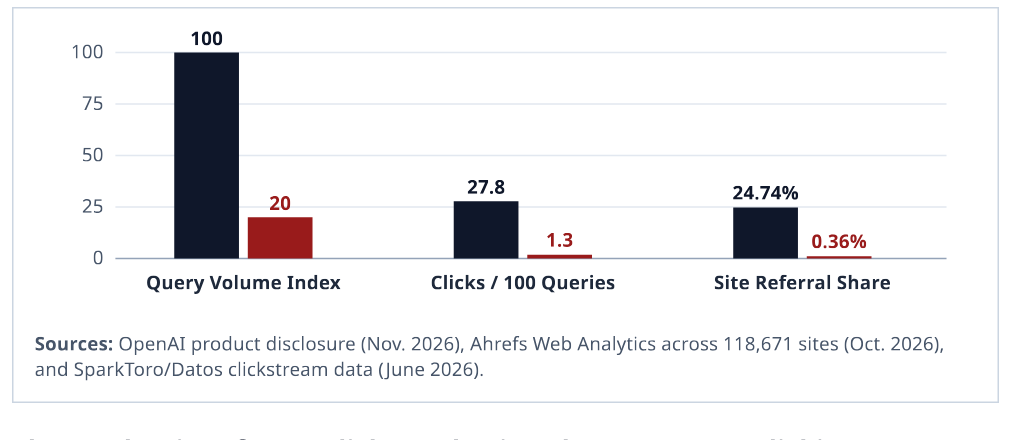
Even with that clear internal definition, independent search intelligence firms note that OpenAI did not disclose which baseline figure it used for Google's daily or annual search volume. When researchers triangulate public disclosures from both companies alongside massive clickstream panels, a nuanced spectrum of adoption emerges. According to Ahrefs' 2026 search benchmark analysis, Google processes roughly 13.7 billion searches per day, extrapolated from Google's disclosure of more than 5 trillion annual searches, while ChatGPT processes approximately 2.5 billion total prompts per day. At first glance, raw prompt volume sits at roughly 18% of Google's daily search volume. However, a 200-million-user clickstream panel analyzed by Semrush in 2026 found that only 34.5% of ChatGPT prompts actually triggered a live web search, equating to roughly 862 million web-touching queries per day, or 6.3% of Google's daily volume.
In an October 2026 study incorporating OpenAI's Signals v3.0 behavioral dataset and National Bureau of Economic Research usage classifications, seoClarity estimated that ChatGPT generates approximately 1.24 billion search-equivalent messages per day, spanning information-seeking queries and practical guidance, against a modeled 16.44 billion daily Google searches. That places ChatGPT's search-equivalent activity at roughly 7.5% of Google's scale. Crucially, Google has not stood still while conversational rivals scaled: by mid-2026, Google announced that its own conversational AI Mode had surpassed one billion monthly active users worldwide, and Alphabet CEO Sundar Pichai reported in earnings remarks that AI features were actively accelerating Google's year-over-year query growth to its highest rate in five years.
Where the divergence between OpenAI's query milestone and the health of the broader web becomes unmistakable is in referral traffic. Ahrefs' Web Analytics tracker, monitoring traffic across 118,671 websites in October 2026, found that Google accounted for 24.74% of all tracked website visitors, whereas ChatGPT accounted for just 0.36%. Put differently, Google still sends nearly 69 times more tracked referral share, and across broader industry datasets up to 190 times more total web visits, than ChatGPT.
- •Daily query volume: Google processes roughly 13.7 billion searches per day; ChatGPT processes approximately 2.5 billion total prompts per day.
- •Live web-search activation: 100% of Google searches trigger index or live retrieval, but only about 34.5% of ChatGPT prompts trigger a web search, so most ChatGPT interactions still rely on the model's parametric weights.
- •Tracked website referral share, October 2026: Google delivered 24.74% of site traffic across 118,671 tracked sites; ChatGPT delivered 0.36%.
- •Open-web clicks per 1,000 queries: Google sends roughly 278 clicks per 1,000 searches, while AI answers satisfy intent in-chat, cutting outbound clicks by more than 20 times.
- •Citation overlap with Google's top 10: only about 6.8% to 10% of ChatGPT fan-out citations overlap with Google's top organic rankings; over 90% pull from outside Google's top 10.
2026 benchmarks: Google Search vs. ChatGPT Search
The table below compresses the 2026 measurement landscape into a single view: how the two platforms compare on raw query volume, how often each query actually touches the live web, how much referral traffic each sends, and how differently their citations overlap.
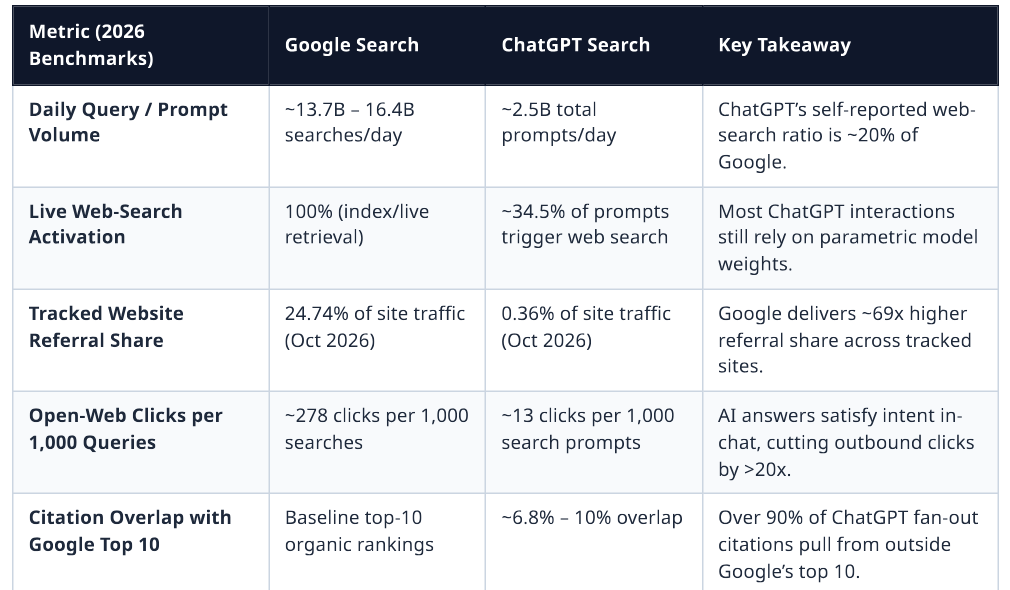
Read together, the rows explain the paradox at the heart of this report. ChatGPT's self-reported ratio of search-triggering prompts is about one-fifth of Google's volume, yet the platform delivers only 13 outbound clicks per 1,000 search prompts against Google's roughly 278, because AI answers satisfy intent inside the chat window rather than handing users a list of destinations.
The mechanics of zero-click synthesis: why users stop clicking
Why does a platform handling one-fifth of Google's search-triggering queries send back less than one-seventieth of the referral traffic? The answer lies in the fundamental difference between index retrieval and query fan-out synthesis.
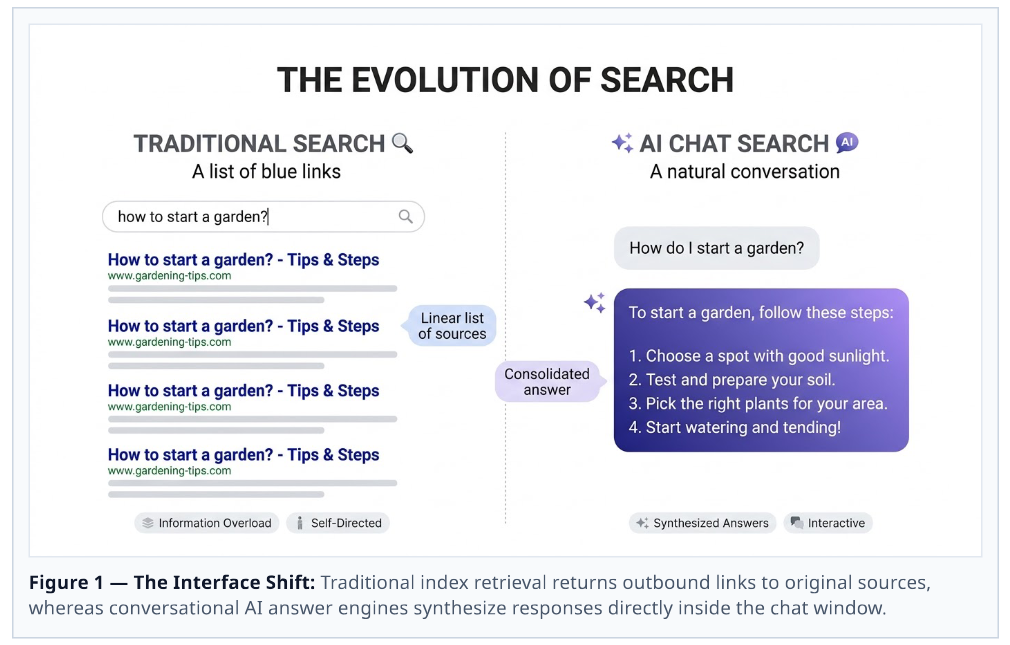
When you type a query into a classic search engine, the software acts like a digital librarian: it hands you ten blue links and leaves the reading, comparing, and synthesizing to you. By contrast, modern AI search engines, whether ChatGPT Search, Perplexity, or Google's own AI Overviews and AI Mode, perform query fan-out behind the scenes. A single user question such as which mid-range mirrorless camera has the best autofocus for wildlife photography under $1,500 is automatically decomposed by the AI into half a dozen sub-queries. The system crawls camera review publications, forum threads, and spec sheets simultaneously, extracts the consensus benchmarks, weighs pros and cons, and writes a cohesive three-paragraph recommendation directly inside the interface.
By the time the answer finishes streaming onto the user's screen, the cognitive work is done. Even when the AI attaches small inline superscript citations or a sidebar of source cards, a satisfied user has little practical incentive to click through to the underlying review site. Empirical research published in 2026 confirms just how dramatically this interface shift compresses outbound web traffic.
- •The 39.8% organic click drop: in a revised June 2026 field experiment on SSRN, researchers Agarwal and Sen measured the real-world behavioral impact of AI-generated summaries on search behavior, documenting a 39.8% relative drop in organic clicks when AI summaries appear, while sponsored ad clicks remained statistically unchanged.
- •Collapsing open-web click-through rates: SparkToro and Datos' June 2026 update revealed that the share of US Google searches resulting in any open-web click declined by 22.9% compared to mid-2024, leaving roughly 278 open-web clicks per 1,000 Google searches. Meanwhile, Ahrefs estimates ChatGPT's outbound click-through rate across all cited links in a search-classified prompt at just 1.3%, or 13 clicks per 1,000 search prompts. Mathematically, it takes roughly 31 ChatGPT citations to generate the same raw click volume as a single number-one organic Google ranking.
- •B2B validation rather than discovery: even in high-value business-to-business purchasing, 2026 buyer research analyzed by 6sense and marketing analysts shows that buyers rarely use ChatGPT to discover unknown brands from scratch. Instead, they use AI chatbots to summarize feature matrices and validate shortlists of vendors they already know, meaning smaller, independent publishers and niche blogs lose their historical role as top-of-funnel discovery engines.
The publisher backlash: uncompensated substitution and the 2026 courtroom battles
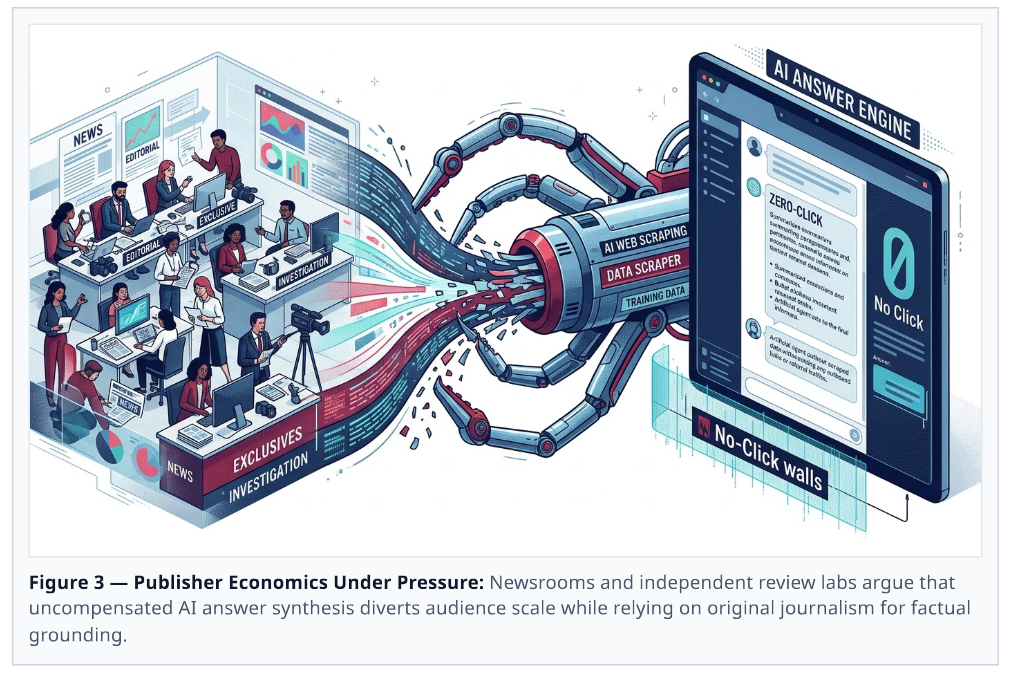
As traffic to newsrooms, educational platforms, and product-review sites eroded through 2025 and 2026, the friction between media companies and AI developers escalated into full-scale legal and regulatory warfare. Publishers argue that generative answer engines are no longer indexing content to send readers to the source; instead, they are ingesting copyrighted reporting and proprietary analysis to build a direct market substitute that competes against the original publisher without paying for the raw material.
In Washington, D.C., U.S. District Judge Amit Mehta, who previously presided over the landmark federal antitrust case against Google Search, issued a pivotal 41-page opinion on September 30, 2026, dismissing antitrust lawsuits brought by online education company Chegg and media conglomerate Penske Media against Google over AI Overviews. Crucially, Judge Mehta did not deny that AI Overviews harm publisher traffic; rather, he ruled that existing antitrust statutes cannot compel a search engine to redesign its product to preserve third-party referral clicks, explicitly handing the structural problem over to Congress.
Meanwhile, consolidated copyright infringement lawsuits brought by The New York Times, Ziff Davis, and dozens of regional and national news organizations against OpenAI and Microsoft wrapped up intensive discovery phases in autumn 2026. Writing in a widely cited September 2026 op-ed, Ziff Davis CEO Vivek Shah argued that licensing fees for authoritative journalism would represent a mere rounding error for multi-billion-dollar AI labs, warning that without fair compensation, publishers will lock their journalism behind rigid paywalls and bot blockers, degrading the open web into an impoverished pool of unverified synthetic text. In November 2026, The New York Times also escalated enforcement against smaller AI search challengers, suing Brave Software over alleged unauthorized scraping of its reporting for AI search indexing.
Policy analysts examining the 2026 compensation debate highlight a critical blind spot in proposed legislation. While governments in Canada, via the Online News Act, which extracts C$100 million annually from Google, and European copyright advocates in Germany and Brussels have focused on protecting traditional daily newspapers, the steepest traffic collapses in 2026 have hit service journalism, consumer tech reviews, and educational publishers. Outlets like TechRadar, Tom's Guide, published by Future plc, and Chegg suffered acute audience contraction and editorial staff cuts because factual how-to guides, study explanations, and product comparisons are the easiest formats for an LLM to summarize completely in a single response. A statutory fund calibrated for political newsrooms does little to compensate a testing lab that spent thousands of dollars reviewing laptops only to have an AI agent recite its verdict to shoppers.
The licensing experiments: who pays for the answers?
In response to mounting legal pressure and aggressive robots.txt blocking across major media domains, AI search companies have begun experimenting with structured revenue-sharing and licensing frameworks. The approaches differ sharply in scale and philosophy, and none yet covers the long tail of independent publishers.
OpenAI has signed multi-year licensing agreements with select publishers, including News Corp, Axel Springer, the Financial Times, and Conde Nast, to surface attributed summaries and train models on archival reporting, though smaller independent outlets remain largely excluded from bespoke bilateral deals. On November 12 and 13, 2026, Yahoo announced that its AI answer engine, Yahoo Scout, would begin compensating publishers through the Independent Licensing Collective whenever their journalism is retrieved to ground AI-generated answers, an effort to move beyond one-off lump-sum settlements toward scalable, per-citation compensation.
Facing regulatory scrutiny in both the U.S. and the European Union over Gemini and AI Overviews, Google rolled out five link-visibility upgrades in late 2026, including prominent inline links and a Preferred Sources feature inside news carousels, which Google reports roughly doubles click-through rates for user-selected outlets.
Video briefings: industry perspectives on the AI search shift
To explore how creators, technologists, and media analysts are reacting to ChatGPT's query milestone and the publisher copyright standoff, these four industry video breakdowns cover the 2026 search landscape from different angles.
Watch: four briefings on the 2026 search landscape
A breakdown of OpenAI's November 2026 disclosure and what reaching 20% of Google's search-like query volume means for search competition.
An analysis of user behavior shifts between traditional blue-link search and conversational AI answer engines.
How AI summaries are reshaping website referral economics and forcing publishers to rethink SEO.
A look at the November 2026 legal clash over unauthorized scraping and publisher rights in AI search.
Is AI search replacing Google, or redefining what search means?
Looking at the totality of late-2026 evidence, the claim that AI search has already replaced Google collapses under scrutiny, even as the claim that nothing has changed is equally untenable. Google remains the undisputed heavyweight of commercial navigation, local discovery, shopping intent, and outbound web traffic, delivering roughly 70 times the referral share of ChatGPT and growing its own query base through AI Mode. People still turn to Google when they want to visit a specific website, compare real-time flight prices, check local restaurant hours, or browse visual product listings.
What is being replaced, rapidly and perhaps irreversibly, is the informational middle layer of the open web. For synthesis tasks, summarizing complex policy debates, debugging code, comparing software features, or explaining medical and scientific concepts, hundreds of millions of users now prefer a direct, conversational synthesis over sifting through ad-cluttered web pages. OpenAI's milestone of reaching one-fifth of Google's search-triggering query volume proves that conversational synthesis has achieved permanent mainstream habit formation.
Yet this triumph carries a structural paradox that neither OpenAI nor Google can afford to ignore. Large language models and retrieval-augmented search engines do not conduct primary investigative reporting, run laboratory hardware benchmarks, or witness breaking news on the ground; they synthesize the work of human institutions that do. If AI search engines capture 20% or more of search intent while returning less than 1% of the referral traffic, and without establishing transparent, market-rate licensing mechanisms for the publishers whose work grounds their answers, they risk exhausting the very information ecosystem that makes AI answers trustworthy. The next phase of the search wars will not be won merely by the model with the smartest synthesis, but by the platform that figures out how to keep the open web financially alive enough to quote.