
1. Introduction: The Epistemological Blindspots of Modern Tech Culture
In technology communities, an interesting psychological phenomenon occurs whenever a paradigm shift arrives: non-specialists embrace magical thinking, while technical practitioners often embrace a subtle, sophisticated form of overconfidence. Working closely with code, compilers, deployment pipelines, and cloud clusters provides an intuitive mental model for deterministic software. When engineers and technical decision-makers confront modern generative systems, transformer architectures, and deep neural nets, they frequently project those deterministic mental models onto systems governed entirely by statistical mechanics and high-dimensional vector spaces.
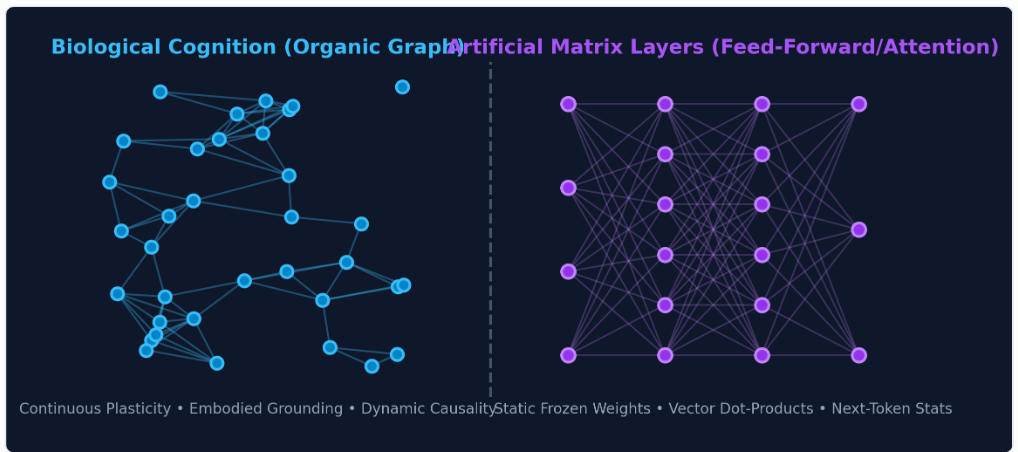
The modern software landscape is inundated with slogans: "scale is all you need," "code will write itself," "clean models eliminate human prejudice," and "deep networks are completely untraceable black boxes." These beliefs are not held merely by lay observers or casual internet users. They are repeated by engineering managers, software architects, startup CTOs, and devops specialists.
Believing these myths carries tangible costs: misallocated venture capital, fragile software architectures prone to cascading failures in production, security blind spots, algorithmic bias in hiring and lending pipelines, and flawed hiring strategies that prioritize ephemeral prompt shortcuts over foundational engineering rigor. To build resilient, secure, and genuinely valuable machine learning systems, we must strip away the marketing mythology and inspect the mathematical realities of modern artificial intelligence. Below is an exhaustive, research-backed deconstruction of five persistent AI myths that continue to circulate across engineering rooms and tech leadership forums.
2. Myth 1: Large Language Models "Understand" Logic and Possess True World Models
When an engineer asks an LLM to generate an optimized Dijkstra algorithm or refactor a convoluted React hook, the generated output often compiles cleanly on the first attempt. Because software engineers spend years developing the abstract logical discipline required to produce that same code, the immediate psychological reaction is to infer that the model "understands" graph theory, memory ownership, or component lifecycles.
This inference represents a fundamental category error. Modern language architectures—predominantly decoder-only transformers—are non-recurrent probabilistic next-token predictors. They compute the conditional probability distribution P(wt | w1, w2, ..., wt-1) over high-dimensional token representations across billions of parameters, optimizing for statistical likelihood over training corpora rather than verifying factual consistency against a grounded physical or logical reality.
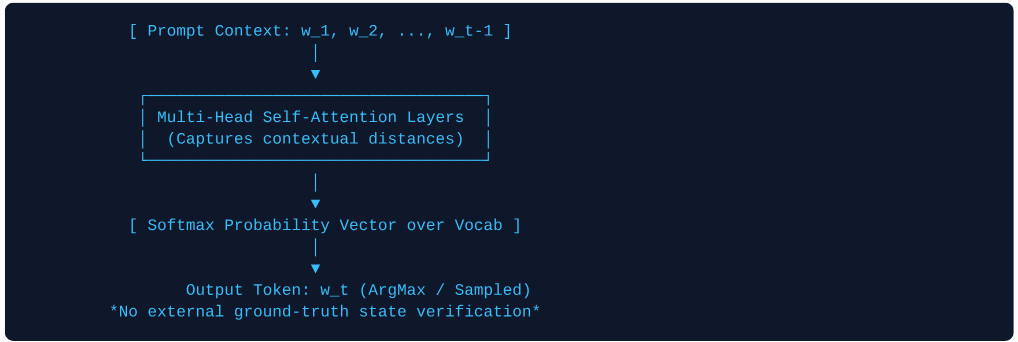
Groundbreaking empirical research by Dziri et al. (Faith and Fate: Limits of Transformers on Compositional Problems, Stanford/McGill/Mila) demonstrated that transformer models fail sharply when problems require multi-step compositional reasoning that extends beyond the statistical distributions observed in their training corpora. While a modern LLM can reliably multiply two 3-digit integers, its accuracy decays dramatically as digit lengths increase or when standard multiplication steps are permuted into non-standard computational topologies.
Similarly, evaluations using the ARC-AGI (Abstraction and Reasoning Corpus) benchmark, created by François Chollet, show that while modern LLMs can memorize and regurgitate millions of variations of standard programming algorithms, their ability to infer novel, basic inductive rules from few-shot visual or abstract grid puzzles remains fragile. The model relies on approximate retrieval across dense vector representations, mimicking the stylistic artifacts of reasoning without maintaining an internal symbolic world engine.
Key Architectural Insight: Visualizes real-time multi-head attention weight distributions across vocabulary vector spaces during inference, illustrating how fluent text generation originates strictly from statistical token co-occurrence rather than an internal symbolic fact engine.
3. Myth 2: AI Is Objective and Inherent Data Scale Sanitizes Bias
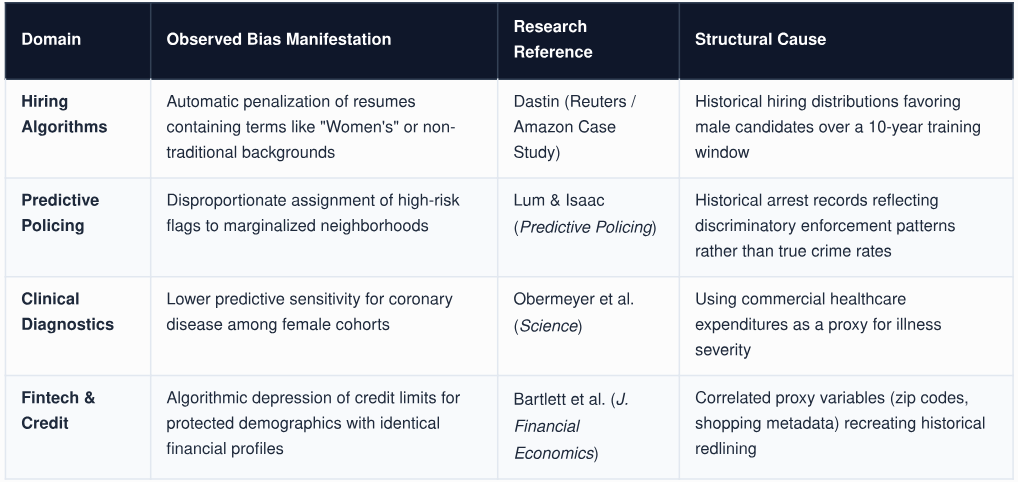
A surprising number of back-end developers and data architects hold the belief that math cannot be biased. The line of thought runs: "Code is just logic, data is just recorded events, and neural nets are just matrix multiplications. Therefore, if we train an algorithm on a large enough dataset, human subjective bias gets averaged out into objective truth." This is one of the most hazardous fallacies in modern enterprise computing. An algorithm trained on historical data does not eliminate historical discrimination; it codifies, accelerates, and optimizes it.
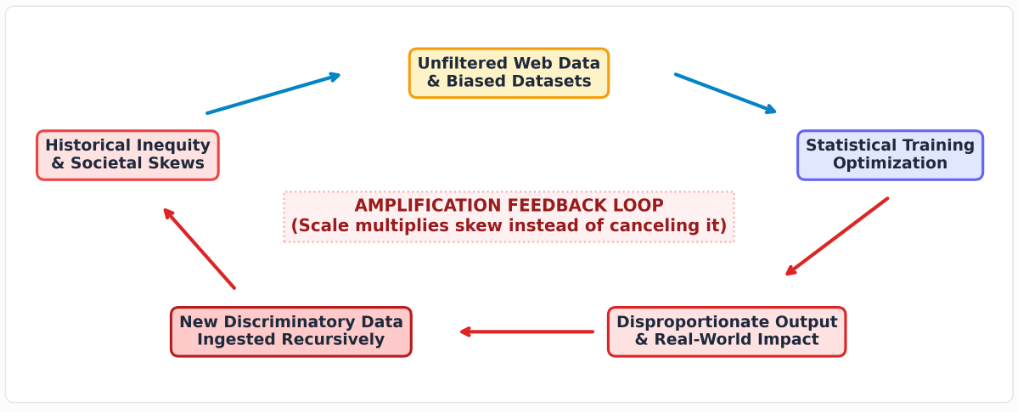
Data is not an immaculate reflection of objective natural laws; data is a digital exhaust produced by flawed human systems, historical inequalities, and sampling imbalances. When machine learning systems are exposed to vast corpora, they do not merely absorb statistical tendencies linearly—they frequently amplify majority-class representations while penalizing minority long-tail phenomena.
Consider facial recognition benchmarks: Joy Buolamwini and Timnit Gebru's foundational Gender Shades study evaluated commercial computer vision classifiers and revealed error rates of less than 1% for lighter-skinned males, but error rates exceeding 34% for darker-skinned females. The models did not malfunction; they functioned with mathematical precision on training data that severely under-indexed non-white demographics.
Scaling data volume does not solve representation disparities; in many cases, crawling larger swathes of uncurated web data introduces toxic feedback loops, internet hate speech, and fringe conspiracy patterns into model weights. True algorithmic fairness requires active curation, adversarial testing, demographic parity metrics, and rigorous post-processing constraints—none of which occur spontaneously through compute scaling alone.
4. Myth 3: Deep Neural Networks Are Completely Impenetrable "Black Boxes"
In software engineering, technical teams frequently excuse model opacity by shrugging and declaring: "The model has 400 billion weights; it's an incomprehensible black box, so explaining why it denied this loan or flagged this pull request is fundamentally impossible." While it is true that deep neural networks cannot be audited line-by-line in the manner of an imperative Python script, treating modern deep learning architectures as entirely unknowable magical oracles is an outdated defense. Over the past half-decade, the discipline of Mechanistic Interpretability and Explainable AI (XAI) has evolved from theoretical curiosity into an exacting empirical science.
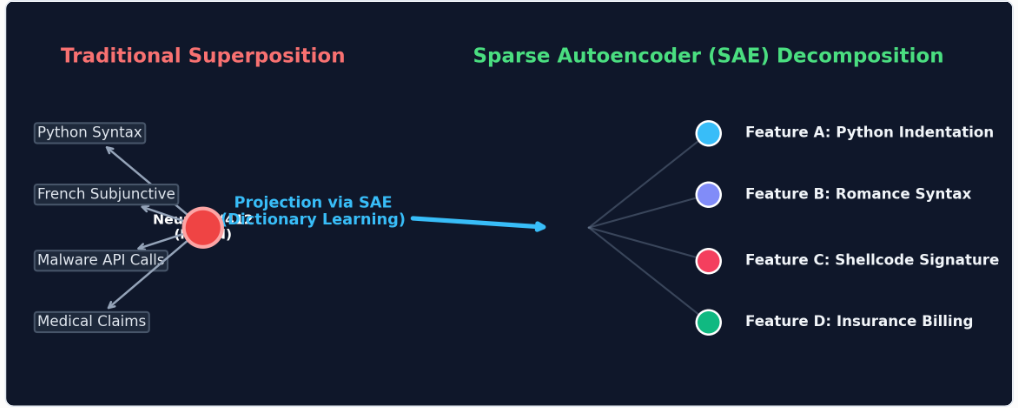
Researchers at institutions like Anthropic, Stanford, and MIT have made significant strides in peering inside neural representations:
1. Feature Attribution via Saliency & Attribution: Techniques such as Integrated Gradients, SHAP (Shapley Additive exPlanations), and LIME (Local Interpretable Model-agnostic Explanations) allow engineers to trace exactly which input features, words, or pixels contributed numerically to a classification output.
2. Sparse Autoencoders (SAEs): In transformer networks, individual neurons are notorious for "polysemanticity"—a single neuron might fire for academic citations, French syntax, and JavaScript objects. By utilizing Sparse Autoencoders on residual streams, researchers can disentangle polysemantic layers into interpretable, monosemantic conceptual features (such as identifying the specific internal circuit that activates when discussing deceptive behavior, programming bugs, or historical figures).
3. Induction Heads and Circuit Analysis: Elhage et al. (A Mathematical Framework for Transformer Circuits) proved that specific sub-circuits across attention heads perform explicit algorithms, such as copy-pasting patterns, tracking syntactic agreement, or carrying forward hierarchical dependencies.
Video clip 2 — Visualizing Saliency and Activation Attribution Maps (0:00–0:08). Key Architectural Insight: High-speed visualization of gradient-weighted class activation mapping (Grad-CAM) illuminating the exact feature regions used in model inference, debunking the myth of total opacity.
5. Myth 4: Scaling Compute and Parameters Will Automatically Yield AGI
Rich Sutton's seminal essay, The Bitter Lesson, argued that general methods leveraging search and learning powered by raw compute consistently beat hand-crafted human heuristics in the long run. While Sutton's historical observation holds merit, many technical leaders over-extrapolated this into a rigid dogma: that simply increasing floating-point operations (FLOPs), stacking deeper transformer blocks, and vacuuming up more text tokens will inevitably give rise to Artificial General Intelligence (AGI) and autonomous agency. By 2025 and 2026, leading frontier labs began experiencing the sobering reality of diminishing marginal returns on pre-training scale.
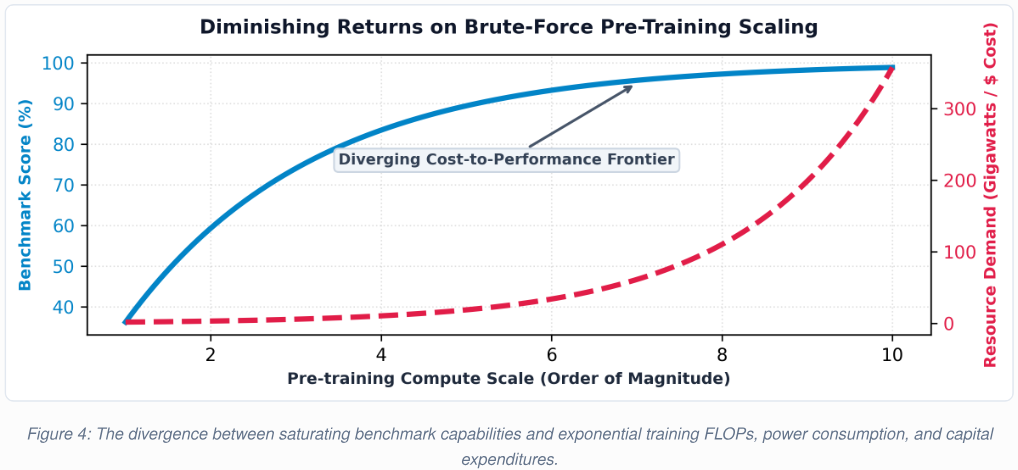
The assumption that pre-training scale guarantees linear capability growth collides with fundamental theoretical and physical constraints:
The Web-Scale Data Exhaustion Problem: High-quality human-written text on the public internet is fundamentally finite. Research from Epoch AI projects that the world's supply of high-grade linguistic data will be exhausted before the end of the decade. Training frontier models on self-generated synthetic data without rigorous external grounding frequently leads to Model Collapse (a mathematical degradation where tail probabilities vanish and outputs devolve into degenerative gibberish).
Power, Thermodynamic, and Infrastructure Envelopes: Training a next-generation model now demands bespoke gigawatt-scale data center facilities, specialized power substations, and hundreds of thousands of interconnected GPUs. The financial and physical capital required to train a single cluster run is scaling super-linearly relative to the incremental benchmark gains achieved.
System 1 vs. System 2 Reasoning Gaps: Traditional LLMs operate entirely within feed-forward, fixed-time-step computation. As cognitive scientist Daniel Kahneman framed human thought, token generation is predominantly "System 1"—rapid, associative, and instinctive. True intellectual leaps require "System 2"—deliberate, recursive, test-driven validation, hypothesis generation, and backtracking. Scaling pre-training weights enhances System 1 fluency, but does not autonomously construct a self-verifying System 2 architecture without test-time compute scaling, reinforcement learning environments, and formal external verifiers.
Video clip 3 — The Data Wall and Synthetic Model Collapse (0:00–0:06). Key Architectural Insight: 3D semantic entropy distribution illustrating the collapse of output variance when language models are iteratively re-trained on unverified synthetic corpora.
6. Myth 5: AI Coding Assistants Will Fully Replace Human Software Engineers
Perhaps no demographic has indulged more in catastrophizing than the developer community itself. Following the release of automated coding copilots and autonomous software agents, claims proliferated that human programmers would be obsolete within two to three years, and that software engineering as a career path was dead. This narrative confuses code syntax generation with software engineering.
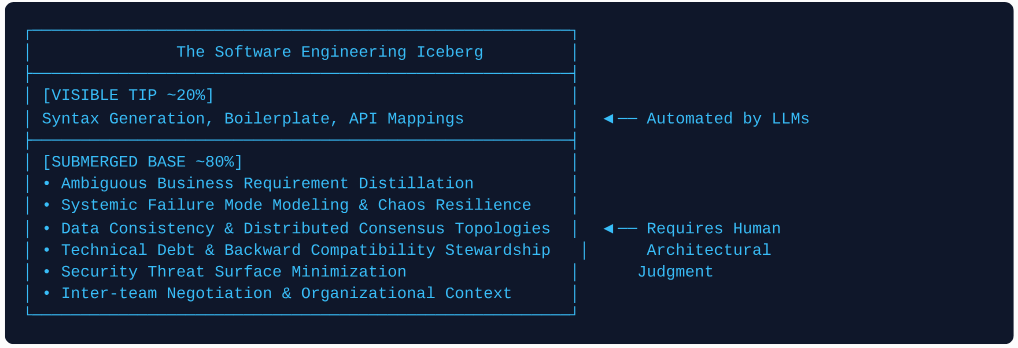
Writing isolated functions or boilerplate classes is the easiest, most mechanical fraction of building software. The overwhelming majority of enterprise software development involves activities where LLMs struggle:
1. Navigating Ambiguity and Organizational Intent: Clients and business stakeholders rarely know what they need with mathematical precision. Software engineering is primarily the discipline of translating conflicting, ambiguous, and constantly evolving human business desires into rigorous, deterministic constraints.
2. Distributed Systems Complexity and Edge-Case Management: Writing a CRUD endpoint takes seconds. Designing an idempotent, partition-tolerant transaction pipeline across multi-region databases under network latency and Byzantine hardware failures requires systemic contextual judgment that no text-synthesis engine can verify without real-world telemetry.
3. The Verification Dilemma: Generating 500 lines of plausible-looking TypeScript is trivial; debugging subtle memory leaks, subtle security vulnerabilities, or silent concurrency race conditions buried within an unfamiliar 2-million-line monolithic repository is exponentially more difficult. Because generative systems hallucinate edge cases with high grammatical confidence, junior engineers using code assistants without foundational auditing skills frequently commit fragile code into production environments.
Video clip 4 — Agentic Code Drift in Multi-File Refactoring (0:00–0:08). Key Architectural Insight: Demonstrates autonomous code agents passing localized unit tests while introducing silent asynchronous deadlocks across cross-module event loops, underscoring the vital role of human architectural stewardship.
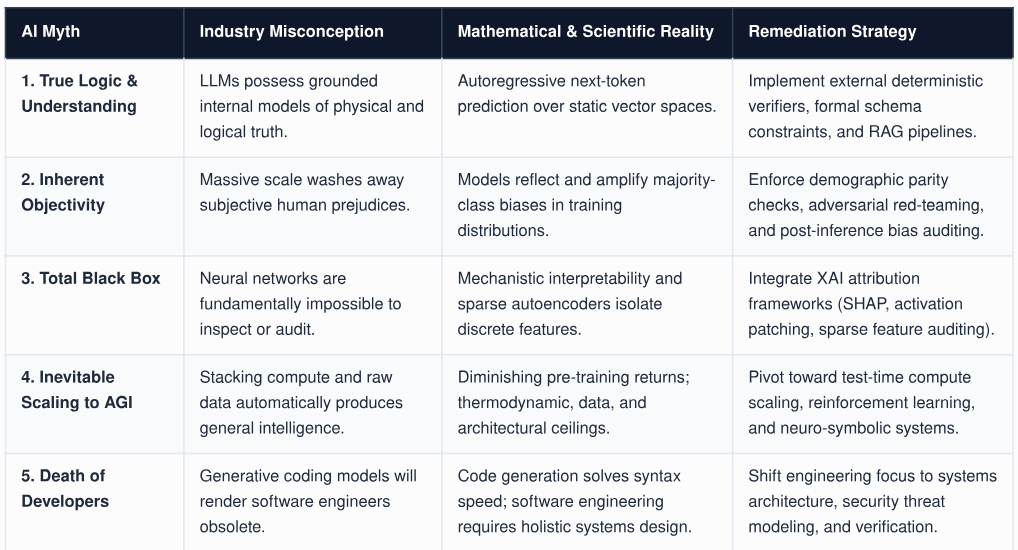
7. Comparative Technical Matrix: Perception vs. Reality
The matrix below condenses all five myths into their industry misconception, the mathematical and scientific reality, and the remediation strategy the report recommends.
8. Strategic Realism: How Technical Teams Must Adapt
Dispelling these five myths is not an exercise in technological cynicism; it is the fundamental prerequisite for technical excellence. When organizations treat artificial intelligence as a mythical, infallible oracle, they build brittle systems, waste millions of dollars on compute runs that deliver diminishing returns, and expose themselves to severe security and ethical liabilities.
When engineering teams strip away the hype, they can see AI for what it truly is: one of the most powerful, flexible statistical optimization tools ever engineered by humanity.
Moving forward, the engineering organizations that win will not be those that hand over their architectural steering wheels to statistical token generators. They will be the teams that implement rigorous defensive engineering:
- •Pairing probabilistic models with deterministic, formal software guardrails.
- •Treating training data as a critical, auditable software asset with full provenance tracking.
- •Investing in interpretability toolchains to audit high-stakes neural decisions.
- •Elevating software engineers from manual coders into rigorous system architects and code evaluators.
Closing: moving past the silicon mirages
By moving past the silicon mirages, tech professionals can stop chasing impossible narratives and start building resilient, grounded, and genuinely transformative systems.
Academic References & Industry Sources
The academic references and industry sources behind the five myths:
- •Dziri, N., Lu, X., Sclar, M., et al. (2023). Faith and Fate: Limits of Transformers on Compositional Problems. Proceedings of the Thirty-seventh Conference on Neural Information Processing Systems (NeurIPS).
- •Buolamwini, J., & Gebru, T. (2018). Gender Shades: Intersectional Accuracy Disparities in Commercial Gender Classification. Proceedings of Machine Learning Research (PMLR), 81:1–15.
- •Elhage, N., Nanda, N., Olsson, C., et al. (2021). A Mathematical Framework for Transformer Circuits. Anthropic Research Publications.
- •Chollet, F. (2019). On the Measure of Intelligence. arXiv preprint arXiv:1911.01547 (Abstraction and Reasoning Corpus - ARC).
- •Sutton, R. (2019). The Bitter Lesson. Incomplete Ideas (Essays in Computation and AI).
- •Shumailov, I., Shumaylov, Z., Zhao, Y., et al. (2024). AI Models Collapse When Trained on Recursively Generated Data. Nature, 631, 755–759.
- •Dell'Acqua, F., McFowland, E., Mollick, E., et al. (2023). Navigating the Jagged Technological Frontier: Field Experimental Evidence of the Effects of AI on Knowledge Worker Productivity and Quality. Harvard Business School Working Paper, No. 24-013.
- •Obermeyer, Z., Powers, B., Vogeli, C., & Mullainathan, S. (2019). Dissecting Racial Bias in an Algorithm Used to Manage the Health of Populations. Science, 366(6464), 447–453.