Executive summary
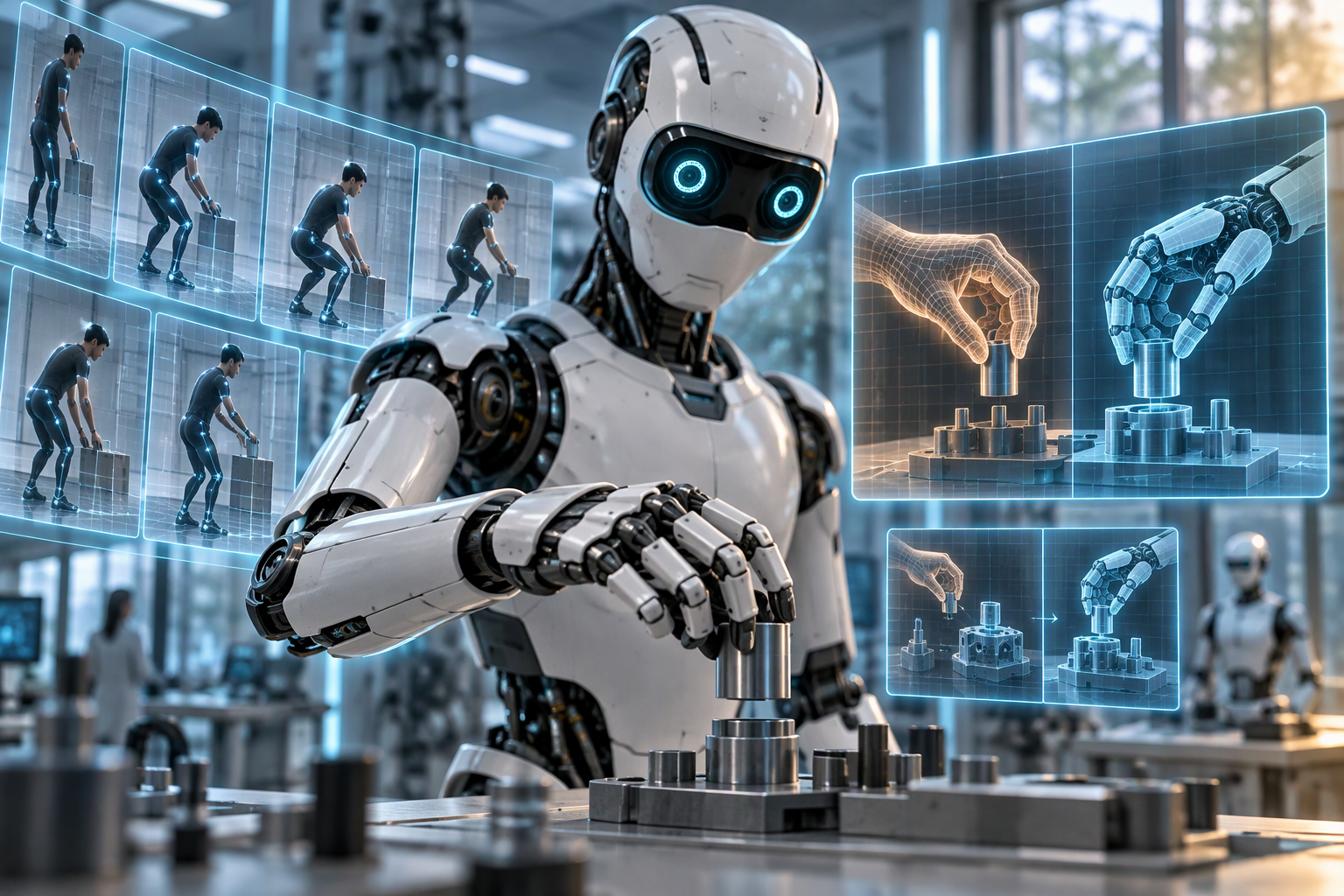
NVIDIA's introduction of GR00T 2 at the Conference on Robot Learning (CoRL) marks a major milestone in embodiment AI, shifting from direct motor-to-vision mapping toward world-action models. This comprehensive analysis evaluates the underlying architectures, examines how human egocentric video is translated into physical robot policies, and separates controlled lab success benchmarks from independent verification realities.
1. Introduction: The Teleoperation Bottleneck and the Promise of Video Learning
For decades, the field of robotic manipulation has faced an unyielding bottleneck: data collection. Unlike large language models that can ingest billions of tokens scraped from the public internet, or computer vision models trained on limitless photographs, industrial and general-purpose robots require high-frequency, multi-modal trajectories paired with precise kinematic states. Traditionally, acquiring this data demanded tedious, painstaking teleoperation—human operators physically guiding robotic arms through hundreds of thousands of repetitions to teach basic pick-and-place maneuvers, cable insertions, or assembly tasks (NVIDIA GEAR, 2026).
This paradigm is economically untenable for scaling robots into unstructured human environments like homes, hospitals, and dynamic warehouses. Humans, by contrast, acquire extraordinarily complex manual skills through observation. A child learns to tie shoelaces, cook, or assemble flat-pack furniture by watching parents or instructional videos, seamlessly mapping visual observations onto their own musculoskeletal anatomy. Consequently, roboticists have long pursued the holy grail of internet-scale video learning: teaching robots to extract physical intuition and task strategies directly from casual human video recordings (Garg, 2026).
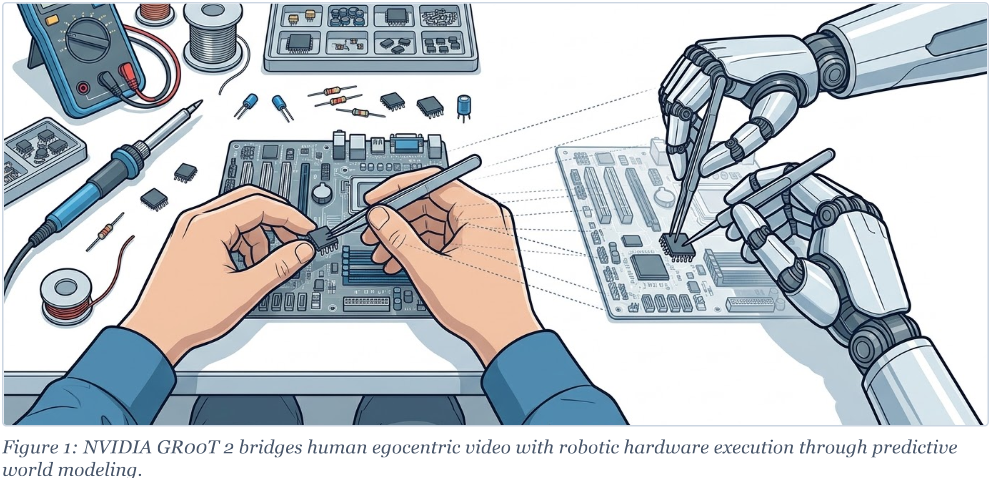
NVIDIA's unveiling of GR00T 2 at CoRL thrust this ambition back into the spotlight. Built upon NVIDIA's Cosmos foundation platform, GR00T 2 claims to bridge human egocentric video datasets—such as large open first-person corpora—with direct robotic hardware execution. Yet, while marketing headlines trumpet staggering success rates and multi-task mastery, rigorous engineering scrutiny requires separating brilliant architectural achievements from inflated claims. How much of this learning is a true zero-shot capability, and how much relies on curated simulation environments and specialized teleoperation anchors?
2. Deconstructing the World-Action Model (WAM) Architecture
To understand what separates GR00T 2 from previous Vision-Language-Action (VLA) models like RT-1 or RT-2, one must examine its core paradigm shift: the transition to a World-Action Model (WAM). Older architectures typically attempted an end-to-end mapping from visual observations and text commands directly to low-level actuator torques or joint velocity commands. This often resulted in brittle policies that struggled with unseen object geometries or lighting shifts because the model lacked an internal physics engine modeling cause and effect (MLQ.ai, 2026).
GR00T 2 alters this equation by introducing predictive world modeling prior to physical action execution. Utilizing advanced diffusion transformers, the model co-trains on two simultaneous objectives: predicting future video frames (anticipating how lighting, object deformation, friction, and spatial orientation will evolve over the next several seconds) and predicting the corresponding low-level robot action chunks required to achieve those visual states (Kingy, 2026).
Key Architectural Feature: By predicting future visual outcomes before moving actuators, GR00T 2 builds an internal physical intuition of contact physics. This allows the model to reason about sliding, grasping, and collision forces independently of the specific mechanical body executing the task.
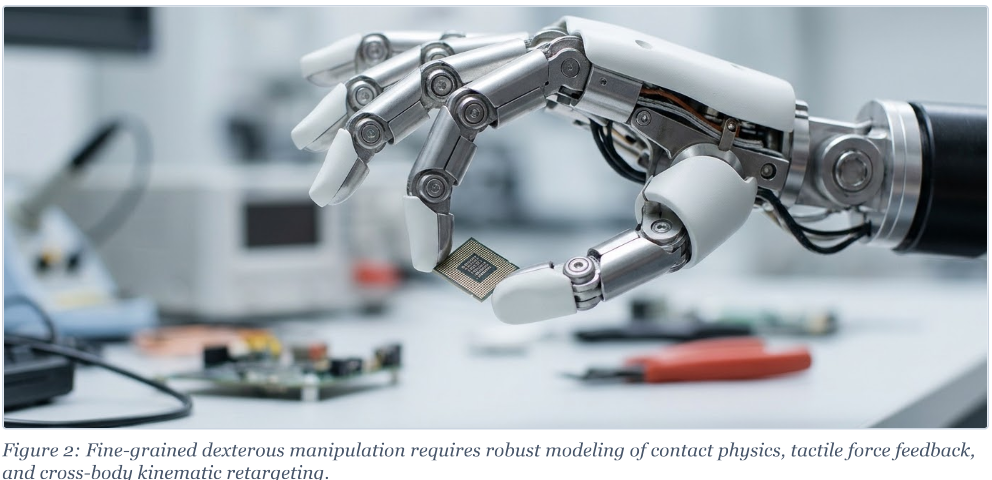
A critical innovation within this pipeline is cross-body transfer. Human hands and humanoid robot effectors possess vastly different degrees of freedom (DoF), joint limits, and kinematic structures. To bridge this gap, NVIDIA integrated specialized human demonstration hardware, such as MANUS metagloves and Universal Manipulation Interfaces (UMI), which capture precise finger articulation alongside synchronized wrist tracking and multi-view video (MANUS, 2026). The human video provides the semantic strategy and contact geometry, while sparse robot demonstration data grounds those strategies into the specific hardware kinematics of platforms like the TIANJI Marvin Pro or custom humanoid testbeds (Gizmodo, 2026).
3. Separating Marketing Metrics from Independent Realities
Evaluating foundational AI releases requires careful scrutiny of evaluation protocols. NVIDIA's technical disclosures surrounding GR00T 2 present striking performance figures across standardized industrial benchmarks:
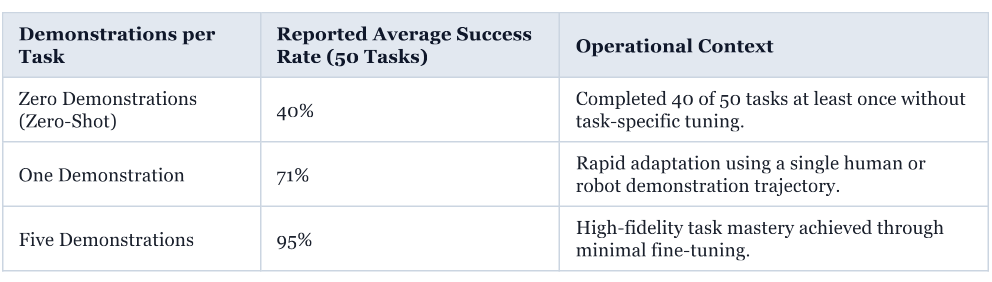
While these figures appear revolutionary, independent robotics researchers have noted important caveats. The evaluated 50 tasks were preselected among those the foundational architecture could already learn effectively, meaning the baseline success rate on arbitrary real-world chaos is substantially lower. Furthermore, while a 40% zero-shot success rate demonstrates remarkable qualitative understanding of novel tools and environments, it simultaneously implies that the robot fails more than half the time when operating purely on uncalibrated human video observations—rendering it insufficient for unsupervised industrial deployment without fine-tuning (Garg, 2026).
Another major consideration involves ecosystem access and reproducibility. While NVIDIA frames GR00T 2 as an open world-action model, initial releases lacked immediate public model cards, explicit licensing documentation, or direct repository weights, leaving external academic labs temporarily dependent on replication studies and secondary testing frameworks (MLQ.ai, 2026).
4. Simulation Scaling: Isaac Lab 3.0 and the Physics of Training
Foundation models alone cannot bridge the reality gap without immense simulation infrastructure. Alongside GR00T 2, NVIDIA introduced Isaac Lab 3.0, an open-source robot-learning framework designed for massively parallelized reinforcement learning and policy validation (NVIDIA GEAR, 2026). Isaac Lab integrates advanced physics solvers, including the Newton engine and PhysX, capable of accurately modeling complex contact dynamics such as soft tissue deformation, granular media behavior, and fluid-solid interactions (NVIDIA GEAR, 2026).
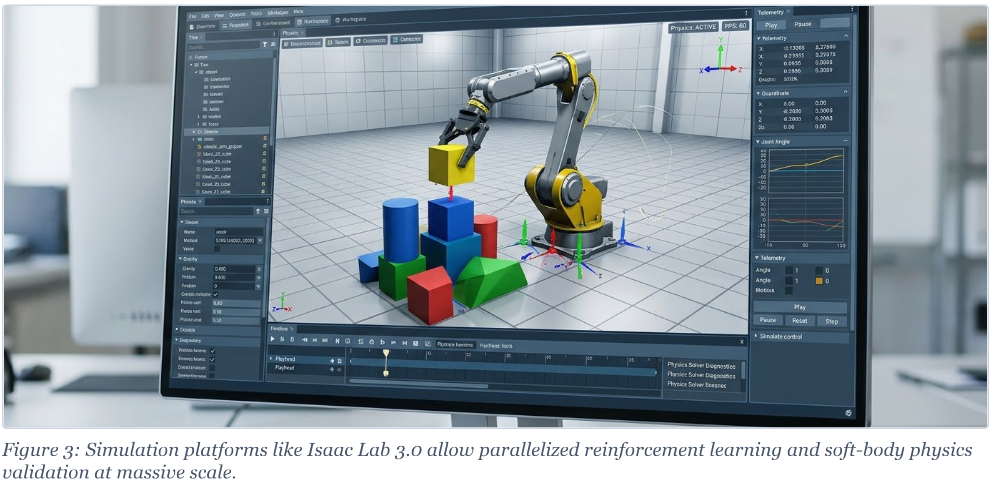
In benchmark evaluations like AlphaNIST—which tasks a single robot policy with mastering all 20 assembly operations of the NIST Assembly Task Board—Isaac Lab 3.0 achieved over 98% training success compared to 81% for traditional per-task specialized policies, while consuming approximately 39 times less GPU compute time (Garg, 2026). This leap in throughput is essential for generating the millions of simulated rollout trajectories needed to refine policies before physical deployment on expensive hardware platforms.
5. Industrial Adoption and the Road Ahead
Despite the challenges of zero-shot generalization and hardware integration, major hardware manufacturers and automation integrators are actively stress-testing world-action frameworks. Companies in electronics manufacturing and automotive assembly are exploring GR00T 2 for complex cable routing, server maintenance, and flexible part sorting. By reducing the required teleoperation data to just a handful of demonstrations fine-tuned in under 30 minutes on local workstations (such as systems powered by RTX 5090 GPUs or Jetson Thor edge computers), the economic barrier to deploying bespoke robotic skills drops dramatically (MLQ.ai, 2026).
Ultimately, robots cannot yet reliably learn complex physical tasks merely by passively watching uncurated YouTube videos. However, architectures like GR00T 2 represent a profound step forward, establishing that human video serves as an exceptionally powerful initialization point for spatial intelligence.
Watch: GR00T 2 in two clips
Two short motion clips accompany this analysis: a simulated multi-arm assembly cell running with live telemetry overlays, and a humanoid learner at a workbench while human hands assemble a board on screen.
References & Cited Literature
The report's cited literature, reproduced in full:
- •NVIDIA GEAR Research (2026). Practice Makes Precise: At CoRL, NVIDIA and Partners Reveal How Robots Rehearse Delicate Work in Simulation. NVIDIA Official Blog & Whitepaper.
- •Garg, N. (2026). NVIDIA GR00T 2 and Isaac Lab 3.0 at CoRL 2026. CellCog Research Analysis.
- •MLQ.ai (2026). Nvidia Launches GR00T 2, a Robot Model That Learns New Skills from Human Video, and Isaac Lab 3 at CoRL. Machine Learning Quarterly.
- •Kingy AI (2026). Meet GR00T 2: NVIDIA's New Robot Intelligence and World-Action Models. Artificial Intelligence Research Bulletin.
- •MANUS Meta (2026). NVIDIA GR00T 2: Enabling Robots to Acquire Skills from Human Experience via Metagloves and Motion Retargeting. MANUS Technical Blog.
- •Gizmodo (2026). At CoRL, GENTO Unveils a 21-DoF Hand as NVIDIA Introduces GR00T 2 With TIANJI Marvin Pro. Technology & Robotics Desk.